
Subscribe!
Ask Chef Walter: The Glorious Imposter on Your Plate – Master Chef Walter Potenza
by Master Chef Walter Potenza
Italian American cuisine is not a corruption of something purer. It is its own magnificent invention — born of hunger, memory, and the audacity of abundance.
Friends:
Let us settle this, once and for all, over a plate of something that nobody in Naples has ever served. What Americans celebrate as Italian food is, at most, a loving reimagining. By the strictest, it is a myth so thoroughly repeated that it now functions as memory. But myths, when shared across generations and seasoned with enough garlic, have a way of becoming something real.
Walk into any red-sauce restaurant from Providence, Boston’s North End, to San Francisco’s North Beach, and you will find menus that claim Italy as their spiritual homeland. The names are right. The cadence is right — the soft vowels, the invocations of Nonna. What is not right, or at least not straightforwardly right, is the food itself.
“In Italy, food is an act of restraint. In America, it became an act of celebration. Both impulses are deeply human. Only one of them invented the meatball sub.”
The Dishes That Never Existed
Order Fettuccine Alfredo in Rome, and the waiter will regard you with the particular brand of pity reserved for the hopelessly lost. The dish exists in Rome, technically — created in the early twentieth century by Alfredo di Lelio as an enriched pasta for his ailing wife — but it never spread through Italian cooking culture. It was American tourists, particularly the silent film stars Mary Pickford and Douglas Fairbanks, who fell in love with it on their 1927 honeymoon and carried the recipe home, where it was smothered in heavy cream and declared “Italian.”
Chicken Parmesan presents an even more brazen case. The dish’s Italian cousin, Melanzane alla Parmigiana, uses eggplant — not chicken — and comes from the southern regions of Campania and Sicily. When immigrants arrived in America with the memory of that dish and suddenly found cheap, plentiful chicken at their doorsteps, an act of inspired substitution occurred. The result tasted something like home. Over time, it became home.
Chicken Parmesan, Fettuccine Alfredo, American invention.
No Italian equivalent exists. Derived from eggplant Parmigiana via immigrant substitution, likely in New York kitchens of the early 1900s. Heavily adapted. The Roman original used only butter and Parmigiano. American versions added heavy cream, creating something richer and entirely different.
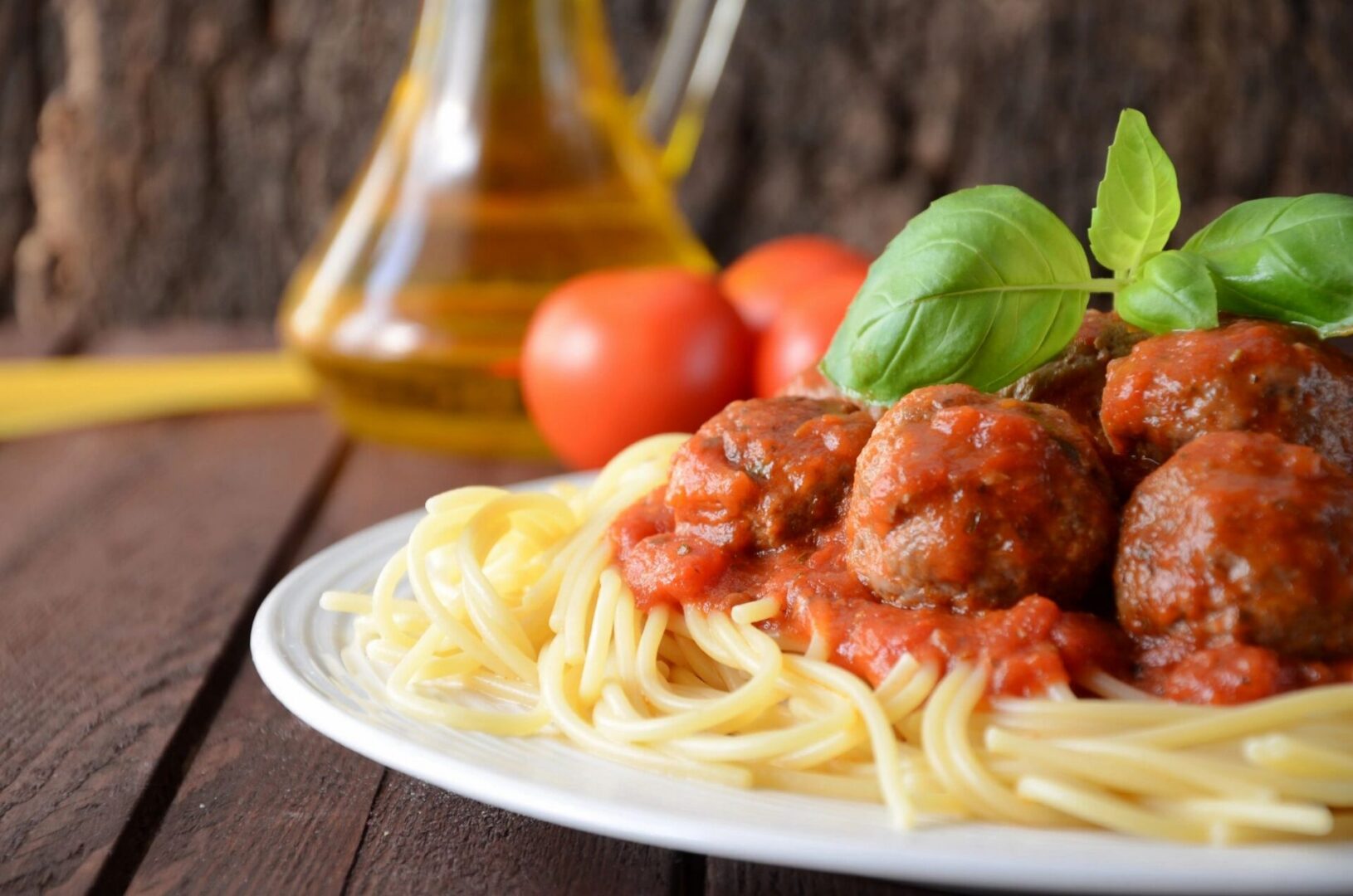
Spaghetti & Meatballs: American Invention
In Italy, pasta is a first course; meat is a second. Combining them on one plate is a distinctly American efficiency born of abundance, appetite, and fewer plates to wash.
Caesar Salad: American invention.
In Italy, pasta is a first course; meat is a second. Combining them on one plate is a distinctly American efficiency born of abundance and appetite. Not even Italian. Invented in 1924 by Italian immigrant Caesar Cardini in Tijuana, Mexico. Has been “Italian” by association ever since. Many restaurants wrongly use mayonnaise.
Sunday Gravy, Garlic Bread, Immigrant evolution.
A genuine cultural artifact — a long-simmered ragù elevated into family ritual. Closest to tradition, and perhaps the most emotionally authentic dish. American invention. Italians brush bread with olive oil and garlic, but the butter-drenched, foil-wrapped loaf is a postwar American creation.
Garlic Bread: American invention
Italians do brush bread with olive oil and garlic, but the butter-drenched, foil-wrapped loaf is a postwar American creation. Italy has bruschetta. America has this.
I Contadini and the Land of Plenty
To understand the food, you must understand the hunger. Between 1880 and 1920, roughly four million Italians emigrated to the United States. Most came from the mezzogiorno — the poor, agricultural south: Sicily, Calabria, Campania, Basilicata. These were the contadini, the peasants, and they arrived not with cookbooks but with memories of scarcity. Meat was a Sunday luxury, if that. The cheese was rationed. Tomatoes were grown in small plots and preserved with religious care.
In America, the arithmetic of abundance was disorienting. The meat was cheap. The cheese was cheap. Canned tomatoes were stacked in towers at the corner store. For the first time in their lives, these families could eat the food they had always dreamed of — rather than the stripped-down version that poverty had allowed. They didn’t simply scale up their recipes. They rebuilt them from the dream outward.
1880 – 1900 The great departureSouthern Italian peasants begin emigrating in waves, settling in New York’s Lower East Side, South Philadelphia, Boston’s North End, and Chicago’s Taylor Street. They bring seeds, recipes held in memory, and a ferocious desire to feed their families.
1900 – 1920 The cuisine takes shapeWith access to cheap beef, canned tomatoes, and dairy, immigrant cooks began to adapt their cuisine upward. Meatballs grow. Sauces thicken. Pasta portions expand to fill American-sized plates. “Little Italy” restaurants open to serve a curious public.
1920 – 1950 Mainstreaming the mythItalian American food enters the broader American diet through restaurants, church festivals, and GI canteens. Hollywood glamorizes it—the checkered tablecloth and candle in a wine bottle become cultural icons.
1950 – 1980 The red-sauce eraChains and supermarkets industrialize the cuisine. Ragu and Chef Boyardee bring Italian American flavors into every kitchen. The food reaches its widest audience and becomes most distant from any Italian source material.
1980s – present A reckoning and a revival
A wave of Italian chefs arrives, bringing regional, minimalist cooking. Food writers begin unpacking the mythology. Meanwhile, a nostalgic revival celebrates the red-sauce joint as an American institution. Both things are true simultaneously.
Two Philosophies of the Same Ingredient
At the root of the divergence lies a fundamental disagreement about what cooking is for. Italian cooking operates on a philosophy of subtraction — the fewer the ingredients, the more clearly each one is heard. A plate of spaghetti aglio e olio contains garlic, olive oil, chili flakes, pasta water, and the pasta itself. Nothing else. Its success depends entirely on the quality of each element and the precision of its execution.
Italian American cooking is, in the most generous sense, a cuisine of abundance and emotion. It does not ask what the minimum required is. It asks: what would make this more? More sauce. More cheese. More garlic — not rubbed on bread and discarded but minced by the handful and sizzled until fragrant. It is cooking designed not for refinement but for welcome. Its message, every time, is you are here, and there is enough.
The two traditions:
Italian American Adaptation: The philosophy of abundance
Sauce — Light, barely coating; pasta is the subject. Italian Tradition: The philosophy of restraint
Sauce – Thick, rich, sweet; the star of the table. Italian American Adaptation: The philosophy of abundance
Garlic — Used sparingly, often removed before serving. Italian Tradition: The philosophy of restraint
Garlic – Generous; a flavor profile in itself. Italian American Adaptation: The philosophy of abundance
Polpette — Golf-ball sized; served alone or in broth. Italian Tradition: The philosophy of restraint
Meatballs — Fist-sized; served atop a mound of spaghetti. Italian American Adaptation: The philosophy of abundance
Courses — Primo and secondo served separately. Italian Tradition: The philosophy of restraint
Courses — Everything arrives together on one plate. Italian American Adaptation: The philosophy of abundance
Cheese — Region-specific; never with seafood. Italian Tradition: The philosophy of restraint
Cheese — Mozzarella, Ricotta, Parmigiano on everything. Italian American Adaptation: The philosophy of abundance
Portion — Modest; pasta is a course, not a meal. Italian Tradition: The philosophy of restraint
Portion — Large; eating heartily is hospitality.Italian American Adaptation: The philosophy of abundance
The Emotional Archaeology of the Sunday Table
Perhaps the cruelest irony of Italian American cuisine is that the immigrants who invented it were not, in any simple sense, distorting their culinary heritage. They were fulfilling it. The dishes they cooked on Sundays in Brooklyn and Baltimore were closer to their aspirations than anything they had ever eaten in Palermo or Salerno. They were cooking the food their grandmothers would have cooked if their grandmothers had ever had enough.
This is why the cuisine carries such tremendous emotional weight, particularly for the descendants of those immigrants. Sunday gravy simmering on a back burner for six hours is not a recipe. It is a form of memory — a family history of scarcity and arrival, ladled out in portions. When someone’s grandmother made meatballs the size of her fist, she was not ignoring Italian tradition. She was living out a dream deferred by poverty and finally made real in America.
“The sauce that simmered all Sunday was not a corruption of Italy. It was Italy dreaming of a better version of itself, finally with enough tomatoes.”
What We Lose When We Call It “Authentic”
The problem is not the food. The food is magnificent. The problem is the word “authentic” — deployed on menus and in marketing as a shield against scrutiny. When a restaurant in Chicago claims to be serving “authentic Italian,” and then delivers a plate of Eggplant Parmesan the size of a hubcap, something important has been lost. Honesty about what this cuisine actually is and where it actually comes from.
The cost of that dishonesty is that it flattens the remarkable story of immigrant adaptation and invention. It suggests that the Italian American table is merely a copy of something more legitimate elsewhere, rather than a genuine cultural achievement in its own right. A cuisine built, dish by dish, by people trying to survive, remember, and celebrate in a new country deserves better than to be sold as a pale imitation of somewhere else.
A Cuisine That Earns Its Own Name
Italian American food is now old enough to have its own nostalgia, its own classics, its own defenders, and its own evolution. There is a reason that certain red-sauce restaurants — Rao’s in Harlem, Bamonte’s in Williamsburg, and many on Federal Hill in Providence — are treated with the reverence of historical monuments. They are historical monuments. They represent a chapter of American culinary history written not by trained chefs but by families feeding families, in cramped kitchens with cheap ingredients and extraordinary intentions.
The next time you order a chicken parm hero for the size of a small paperback novel, know what you’re eating. You’re eating four million people’s first experience of having enough. You’re eating Sunday mornings in apartments that smell of tomato and olive oil. You’re eating a country absorbing another country and making something new from the collision. It is not Italian.
It is not Italian. It is its own beautiful, over sauced, generous thing.
✦ ✦ ✦ Master Chef Walter M.E. Potenza
___
Sign up HERE for RINewsToday daily newsletter – and look for my column this SUNDAY!

Meet Chef Walter!
There is a constant, recognizable thread in the career of Walter Potenza to elevate the level of Italian culinary culture in the United States. Besides his unquestionable culinary talent and winning business perspective, Chef Walter has been a relentless educator with passion and knowledge who defeats stereotypes. His life, career, and values are a model, an example to follow by any chef of Italian gastronomy working outside Italy.
Chef Walter appears regularly on National and International Networks such as Food Network, ABC, CBS, NBC, RAI, FOX, and Publications such as NY. Times, Washington Post, Wall Street Journal, Food & Wine, Saveur, Gourmet, and several Italian media outlets. And now – RINewsToday!