
Subscribe!
The Rhode Island Congressman Who Changed Aging in America – Herb Weiss
By Herb Weiss, contributing writer
Over three weeks ago, the Senior Agenda Coalition of Rhode Island (SACRI) organized a statewide gathering at the historic Rhode Island State House to observe this year’s Older Americans Month (OAM). The event brought together more than 135 attendees, including seniors, aging advocates, legislators, and state officials, filling the room to capacity.
During the 74-minute program, speakers addressed topics such as combating social isolation, increasing federal funding for community-based aging services, alerting attendees to financial scams targeting seniors, and discussing new models for elder care and housing. The event concluded with a reading of a gubernatorial proclamation honoring the Older Americans Act (OAA) and calling on Rhode Island lawmakers to support policies for the growing older adult community.
The event also focused on promoting the Administration for Community Living (ACL), the federal agency that administers the OAA, and this year’s OAM theme: “Champion Your Health.” This theme encourages prevention, wellness, self-advocacy, and personal responsibility as key elements of healthy aging.
At the event, SACRI Executive Director Carol Anne Costa announced that the Rhode Island State House Dome would be illuminated from May 13–16 as a tribute to Older Americans Month.
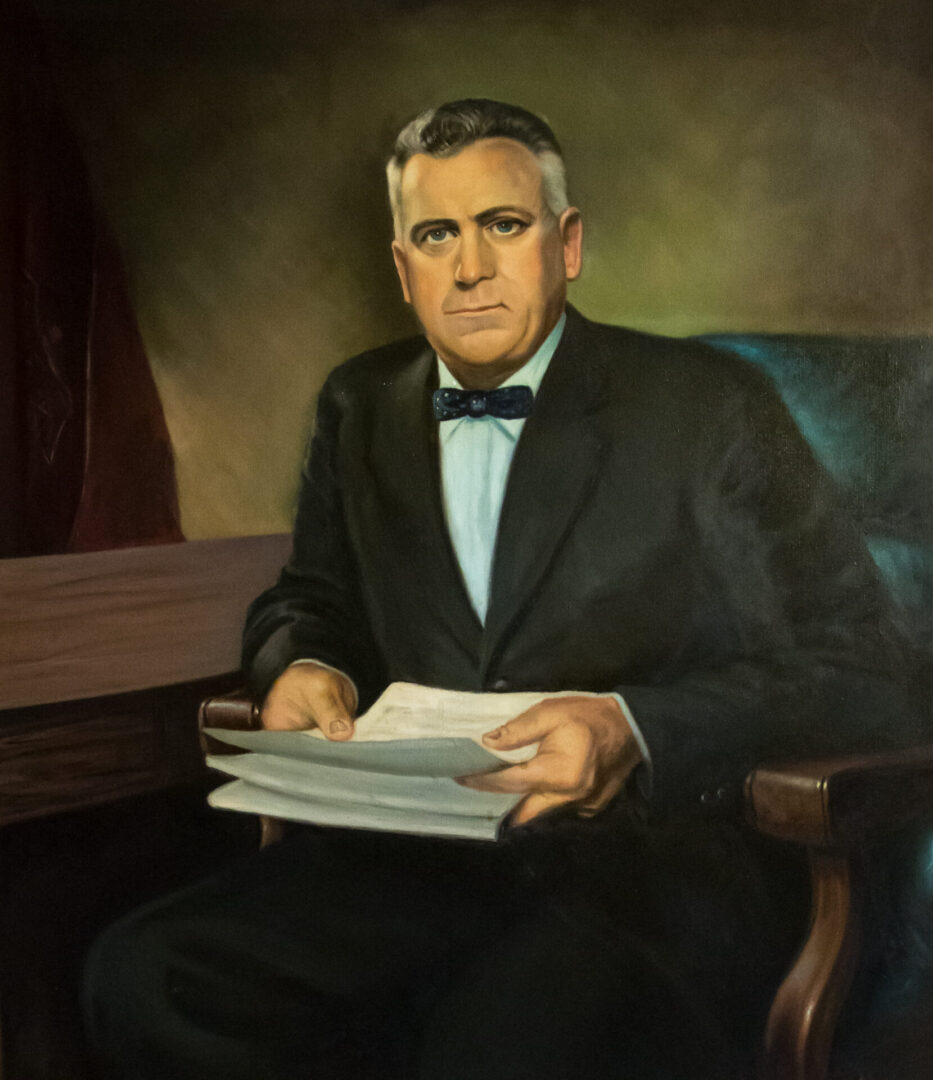
Beyond marking the month, this year’s celebration also centered on the legacy of former Rep. John E. Fogarty (D-RI), the primary sponsor of the legislation (Public Law 89-73) that established the Older Americans Act (OAA). He lived on a small family farm in the village of Harmony (part of Gloucester), Rhode Island.
A Rhode Island Congressman’s Legacy Recognized
Affectionately nicknamed “Mr. Public Health,” Fogarty became one of the most powerful House lawmakers. He served in Congress from 1941 until his death in 1967. A former bricklayer and president of Bricklayers Union No. 1 of Rhode Island, he chaired the powerful House Appropriations Subcommittee on Labor,
Health, Education, and Welfare. He used his legislative skills to expand the National Institutes of Health (NIH) and transform federal healthcare funding. He was also instrumental in establishing the White House Conference on Aging and the OAA.
At SACRI’s May 6 event, Lt. Governor Sabina Matos praised Fogarty for his major impact on federal aging policy. “Older Americans Month gives us the opportunity to reaffirm our commitment to older adult Rhode Islanders. It is a true honor to join SACRI in celebrating the enduring legacy of Congressman John Fogarty, whose vision helped shape aging policy for generations. Today, we build on that legacy by continuing to champion the dignity, well-being, and contributions of every older Rhode Islander,” says the Lt. Governor.
SACRI’s Costa stated, “Congressman Fogarty has left a legacy on which so much progress has flowed. His quiet and powerful work is a reminder that RI is a leader in empowering older adults.”
Former Lt. Gov. Charles Fogarty came to share personal memories of Fogarty, his uncle. He stressed that his uncle’s work on the OAA was driven by a simple philosophy: the government’s role was to help people. His success was built on personal connections with constituents in Rhode Island’s 2nd Congressional District.
“As Rhode Island’s population ages rapidly, my late uncle, Rep. John E. Fogarty, remains a powerful example of how we can protect the dignity and independence of older Rhode Islanders. The Older Americans Act, which he championed, continues to support vital programs for seniors across Rhode Island and the nation, says the former Lt. Gov.
Seven years before the 1965 Older Americans Act (OAA), Fogarty introduced legislation (H.R. 9822) to create the White House Conference on Aging. President Dwight D. Eisenhower signed the bill into law (Public Law 85-908) on September 2, 1958. The law established a national forum held every 10 years to address the challenges facing older Americans. The forum also developed policy recommendations to improve their economic security.
According to the Administration for Community Living (ACL), the 1961 White House Conference on Aging (WHCoA) exposed a broken, patchwork system of elder care. It served as the blueprint for the 1965 Older Americans Act. The conference pushed Congress to move away from old “welfare” models and build a community-focused support network for all older adults. In the end, this paved the way for the creation of the Administration on Aging.
Two Times is the Charm
“According to an online article, “AARP Fights for Older Americans Act in 1965,” published on Sept. 28, 2024, on AARP’s website, the organization played a key role in pushing for the passage of Fogarty’s OAA legislative proposal. Building support for the Congressional passage of the OAA became AARP’s key legislative priority from 1961 to 1965, as noted. In that article, Ernest Gidding, AARP’s legislative representative, said, “The bill meets the major organizational recommendations of the WHCoA and overcomes the present welfare stigma of aging.”
However, Fogarty and Sen. Patrick V. McNamara (D-MI) failed to pass their initial OAA proposal in both chambers on the first try. Lawmakers had begun efforts to pass their legislative proposals (H.R. 7957/S. 2000) in 1963. While this initial attempt stalled and the legislative proposal died in session, it got the whole country talking about how we treat older Americans, planting the seeds for a major comeback.
Two years later, Fogarty would try again. This time, the bill gained unstoppable momentum. During the 89th Congress, logs show the proposal cleared the House Committee on Education and Labor on March 9, 1965, and passed the House on March 31 by an overwhelming 395-to-1 vote. After the Senate passed it on May 27 and the House accepted a minor Senate amendment on July 6, President Lyndon B. Johnson signed Public Law 89-73 on July 14, 1965, in the White House Rose Garden, permanently changing how the nation funds and delivers support to older Americans.
“The OAA is to my mind one of the most significant laws ever passed by Congress,” said William C. “Bill Fitch,” AARP Executive Director from 1959 to 1967, in AARP’s online article.
At the signing, President Johnson stated: “The Older Americans Act clearly affirms our Nation’s sense of responsibility toward the well-being of all of our older citizens. But even more, the results of this act will help us expand our opportunities to enrich the lives of all our citizens in this country, now and in the years to come.”
The President added: “This legislation is really the seed-corn that provides an orderly, intelligent, and constructive program to help us meet the new dimensions of responsibilities which lie ahead in the remaining years of this century.”
Some of Fogarty’s most lasting legislative achievements were the Hill-Fogarty “Health for Peace” initiative, which expanded international medical research and training, and the Library Services Act, which provided federal support to rural libraries. He also helped pass important laws that improved research and services for people with intellectual and developmental disabilities, as well as educational opportunities for blind and deaf Americans. According to records from the National Institutes of Health and Congress, these efforts continued to shape public policy long after Fogarty left office and are still part of his legacy.
Fogarty also spent years introducing the bills that led to the creation of the National Endowment for the Arts (NEA) and the National Endowment for the Humanities (NEH) in 1965, noted Thomas J. McAndrew, Esq., of Thomas J. McAndrew & Associates.
Building on Fogarty’s legislative achievements, McAndrew, serving as treasurer of the John E. Fogarty Foundation for Persons with Intellectual and Developmental Disabilities in Rhode Island, also recalls that his father-in-law was honored with the National Heart of the Year Award on Feb. 3, 1966 – less than a year before he would die of a heart attack on Jan. 10, 1967 in his Washington, D.C. office at the age of 53.
McAndrew calls Fogarty “Everybody’s Congressman” in Rhode Island and points out that he was one of the state’s most important legislators in Congress. He also mentions his skill in influencing colleagues and gaining support for his legislative work.
He recalls that the Congressman rarely issued press releases or promoted himself, instead dedicating his attention to issues that benefited the American people and humanity.
McAndrew asks: “Where have these wonderful public servants gone?”
To watch SARCI’s State House OAA event, go to The Senior Agenda Coalition of RI – Older Americans Month: 5-6-2026
To view votes from SARCI’s Older Americans Month celebration, go to Out and About in RI: SACRI’s Celebration of Older Americans Month (photos)
To see a Drone’s view of the lighted State Capitol, go to State House Senior Coalition Final.mp4 – Google Drive
Photo, top: State of Rhode Island
___
To read more articles by Herb Weiss, go to: https://2×8.ea2.myftpupload.com/herb-weiss/

Herb Weiss, LRI, 12, is a Pawtucket-based writer who has covered aging, healthcare, and medical issues for more than 45 years. To purchase his books, Taking Charge: Collected Stories on Aging Boldly and its two sequels, visit herbweiss.com.
