
Subscribe!

RIPEC Report: State’s Affordable Housing Inefficient, Few Units, High Cost. Legislator: Our Wake Up Call
|
by RINewsToday News Team RIPEC Recommends at least half of 2026 bond be dedicated to middle-income housing – Minority Leader Responds |
| The Rhode Island Public Expenditure Council (RIPEC) released a report highlighting structural inefficiencies in Rhode Island’s affordable housing investments and policies.
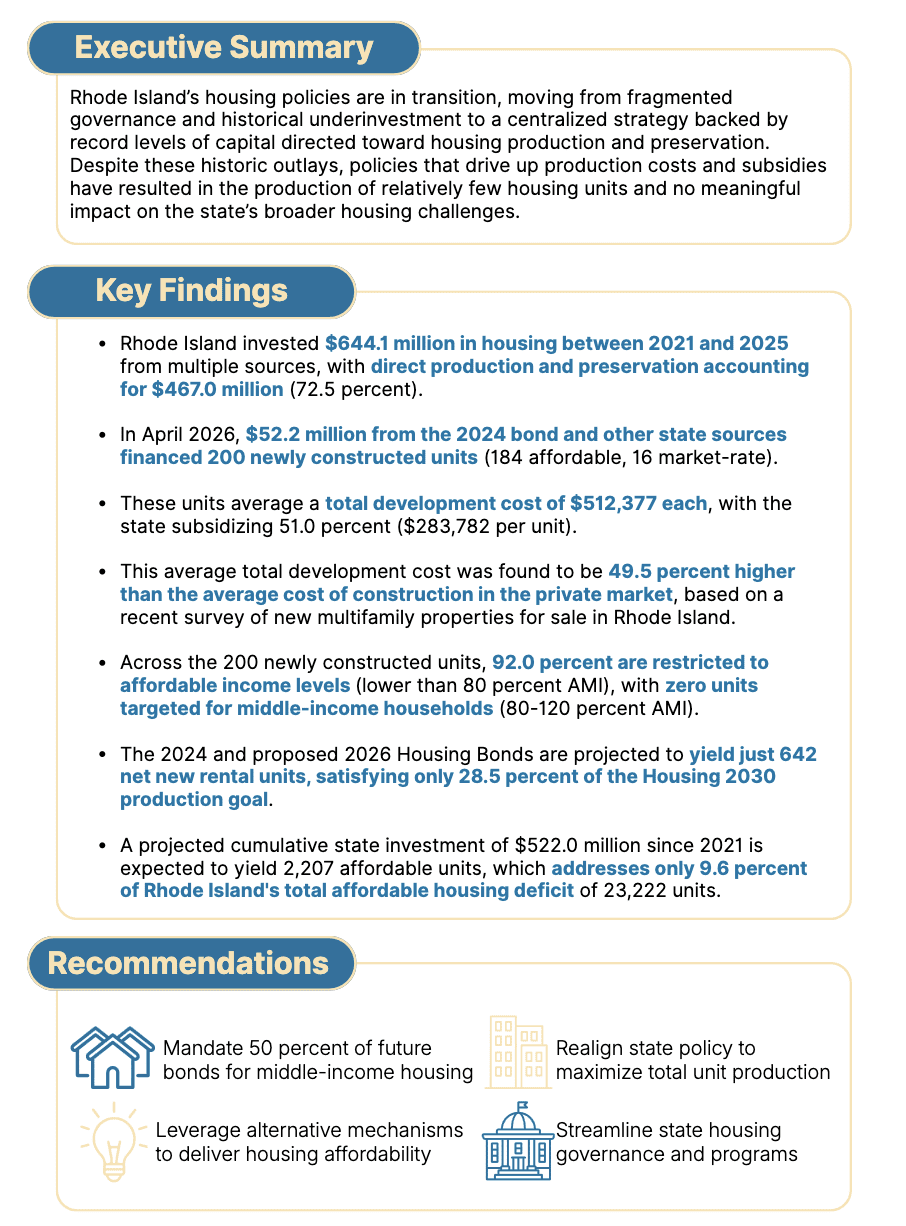
While the state has moved away from decades of underfunding housing development, recent record-level investments have relied on a high-cost, high-subsidy model. RIPEC found that this approach has served relatively few Rhode Islanders and has made no meaningful impact on the state’s overall housing challenges. “Rhode Island authorized over $644 million toward housing since 2021, including substantial new and increased taxes, yet we are struggling to convert this record investment into the production volume needed to meaningfully close our affordable housing gap,” said RIPEC President & CEO Michael DiBiase. “Our research shows that the state relies on an overly complex strategy with policy incentives that fail to maximize housing production.” The report found that it would take nearly $6 billion in state funding to bridge Rhode Island’s housing gap, as development costs top $500,000 per unit, and state subsidies approach $300,000 per unit. “This is an inefficient and unsustainable path that requires a strategic shift to ensure a real return for taxpayers and an increase in housing production,” added DiBiase. More Key Findings Highlighted in the Report
“Given the extraordinary spending to date and the need for more units, RIPEC recommends that the General Assembly dedicate at least half of the proposed 2026 housing bond to middle-income housing,” DiBiase said. “We should not continue to ask taxpayers to fund a model that fails to benefit the vast majority of Rhode Islanders. Instead, we must fundamentally improve production efficiency and build middle-income and market-rate housing to increase supply and provide relief to families across the entire state.” Policy Recommendations RIPEC recommends policymakers:
Find the full report here. Find the executive summary here. |
Following the release of the RIPEC report, RI House Minority Leader Chippendale released this statement:
“Rhode Island House Minority Leader Michael W. Chippendale offers the following statement regarding RIPEC’s Analysis on Rhode Island’s Housing Strategy, which was posted today:
The RIPEC report confirms what many of us have warned for the past five years: Rhode Island is spending historic amounts of taxpayer money on housing, but the results are not matching the investment.
State leaders are quick to rattle off exactly how much money they have “invested” in housing. But the real measure is not dollars spent – it is units produced. On that measure, they are far more vague, relying on phrases like “more building permits” and “shovels in the ground” while Rhode Islanders continue to struggle with housing costs they cannot afford.
Since 2021, the state has committed more than $644 million toward housing. Yet RIPEC found that one recent funding round produced new units costing more than $512,000 each, with taxpayers subsidizing roughly $284,000 per unit. Those subsidized units cost nearly 50 percent more than comparable private-market construction. That is not a sustainable housing strategy. In fact, it is a sign of failed strategy.
For the past five years, the General Assembly has pushed a policy of more spending, more mandates, more centralized control, and less local authority. Municipalities were told the state needed to seize more control to solve the housing crisis. But after all the spending, mandates, and self-congratulation, RIPEC makes clear the results are not there.
Here is the plain truth: when the basic cost of building anything in Rhode Island is too high – land, labor, permitting, delays, fees, taxes, mandates, and the cost of doing business – we will always be chasing affordability instead of achieving it.
Government cannot keep making housing more expensive to build and then congratulate itself for spending taxpayer money to subsidize the costs its own policies helped create. Affordable housing matters. Targeted assistance matters. But Rhode Island needs to shift from measuring success by how much money we spend to measuring success by how many homes we actually produce, at a cost taxpayers can justify. Right now, by that standard, state leaders are failing Rhode Islanders.
This report should be a wake-up call.”
While I agree that the cost of subsidized housing for low-income households is beyond a workable amount for the state to ever approach it’s HOUSING 2030 goals, RIPEC in its analysis is not saying enough about how developers and investors are profiting from government subsidized housing developments.
RIPEC also uses and “apples and oranges” example to compare government subsidized units with private market units. RIPEC states, that the average total development costs are $512,377 per unit…49.5 percent higher than average cost of construction in the private market. (That’s a difference of$170,000 per unit.) Construction costs are a percentage of total development costs. The comparison should be made against total DEVELOPMENT cost of private market housing. It may not be that much different, except for the government benefit.