
Subscribe!
NEW: RI Sect. of State Requests DMV Audit — But Review Predates Licenses for Undocumented Residents
The newly announced lookback covers 2017–2019. Rhode Island did not begin issuing Driver Privilege Cards until July 2023.
Rhode Island Secretary of State Gregg Amore announced Friday afternoon that the Division of Motor Vehicles will conduct an additional audit of noncitizen transactions processed through its voter-registration system.
But the newly announced audit will examine records from 2017 through 2019—records that are now seven to nine years old.
That period predates Rhode Island’s Driver Privilege Card program by four years and predates the recent national surge in immigration that began around 2021.
It also does not directly examine the transactions that placed this issue on Rhode Island’s radar.
What Amore announced
In his Friday statement, Amore said the DMV has conducted regular audits of randomly selected records since 2019. Those audits compare DMV database entries with the corresponding paper records.
According to Amore, more than 5,000 records have been examined, with no errors detected.
The Department of State also visited the DMV Friday morning. DMV employees and the state’s vendor demonstrated the front- and back-end portions of transactions. Amore said that demonstration reassured his office that noncitizens applying for DMV credentials are not offered an opportunity to register to vote.
Amore then announced the additional audit:
“The RI Department of State requested the DMV conduct an audit of records of non-citizen transactions for the period between 2017, when the DMV implemented its current transaction system, to the start of our regular audits of all transactions in 2019.”
The additional review may fill a historical gap between the installation of the current DMV system and the beginning of the state’s randomized audits.
It does not, however, constitute a complete examination of privilege-card transactions beginning in 2023.
- 2017: Current DMV transaction system implemented
- 2019: Randomized audits begin
- 2021: Recent national migration surge begins
- July 2023: Driver Privilege Cards begin
- January 2024: Identification Privilege Cards begin
- July 2026: New audit announced—but it covers 2017–2019
The relevant system changed in 2023
Rhode Island began issuing Driver Privilege Cards on July 1, 2023, to residents who are unable to establish lawful presence in the United States. Identification Privilege Cards became available in January 2024.
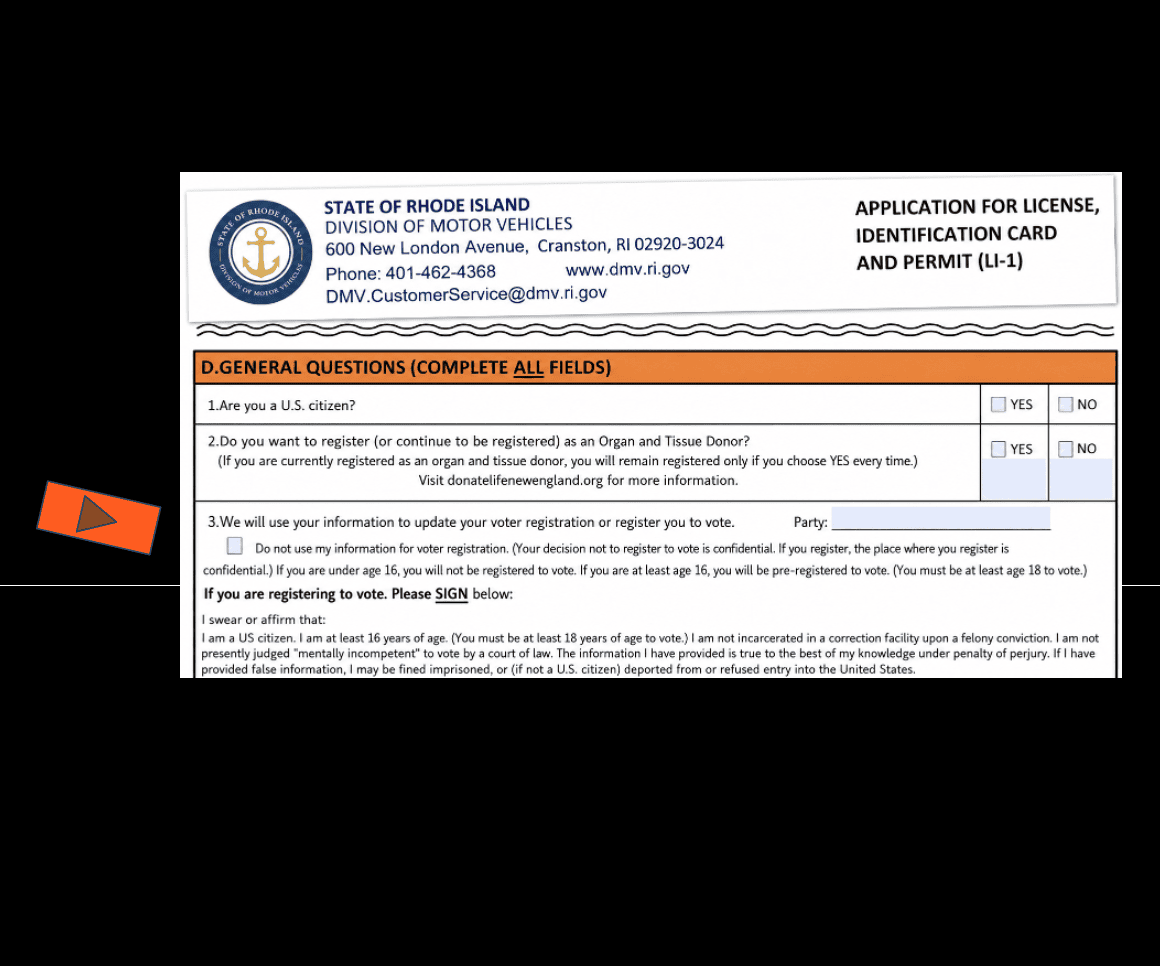
State law requires the front and back of those credentials to be identical in appearance to standard non-REAL-ID licenses and identification cards. They cannot be used for voting, but the applicants use the same Rhode Island DMV application containing the citizenship and voter-registration questions.
The DMV system therefore began processing a new category of transactions involving applicants whom the state knew could not establish lawful presence.
That is the period at the center of the current questions.
New Jersey’s acknowledged failure also occurred during 2023 and 2024. Approximately 6,600 people who answered “No” when asked if they were United States citizens during motor-vehicle transactions were nevertheless registered to vote. Fewer than 400 reportedly cast ballots.
IDEMIA, the vendor involved in the disputed New Jersey system, also provides credentialing and software services to the Rhode Island DMV. The company participated in Friday’s Rhode Island system demonstration but was not identified by name in Amore’s statement.
The presence of the same vendor does not establish that Rhode Island and New Jersey use identical software or experienced the same problem. It makes determining whether they share software, programming or transaction configurations a legitimate question.
What the statement does not answer
Amore’s statement does not say:
- How many of the 5,000 randomly audited records were processed after July 1, 2023.
- How many of those records involved Driver Privilege Cards or Identification Privilege Cards.
- Whether the existing audits only compared paper records with DMV database entries or also verified the voter-registration outcome of each transaction.
- Whether Rhode Island has compared every noncitizen DMV credential transaction since July 2023 against registrations transmitted to the state’s Central Voter Registration System.
- Whether Rhode Island uses any of the same IDEMIA software, code or configuration involved in New Jersey.
- Whether the methodology and results of the newly announced audit will be made public.
A demonstration of how the system functions now provides some reassurance. It is not the same as a forensic reconciliation of what happened in every relevant transaction since the privilege-card program began.
The audit that would answer the question
Rhode Island can directly address the concern by internally comparing every Driver Privilege Card and Identification Privilege Card transaction since those programs began with all voter-registration information transmitted by the DMV.
That review would not require publicly identifying cardholders or releasing their private information to the federal government. The state could conduct the reconciliation internally and publish aggregate findings.
Amore began his statement by connecting present election concerns with misinformation surrounding the 2020 presidential election and warning against rhetoric that undermines trust in democratic institutions.
There remains an important distinction between unsupported claims that an election was stolen and asking a specific question following a documented government-system failure in another state.
The additional 2017–2019 audit is not meaningless. But it examines an earlier system environment, before Rhode Island created privilege cards and before the DMV began processing the transactions now in question.
Rhode Islanders still need to know what happened from July 2023 forward.
The SAVE ACT and REAL ID have the same requirements. You need a US birth certificate, US marriage license or legal change of name document, 2 bills with your name and current address.
Not everyone drives so get a REAL ID identification card from the DMV – same requirements.
If you don’t have a copy and all of these changes were in RI, your City Hall or the RI Dept. of Vital Statistics is your contact.
For those US citizens who were born/ name changed outside of RI, contact that state’s Vital Statistics.
All 50 states fulfill the REAL ID requirements. 26 states require a photo ID to vote. RI is one.
Most of this can be done online. All states require a fee which varies. RI is $22.00.
REAL ID licenses and ID cards have a star in the upper right corner so it’s easily identifiable at the polls for the workers.
REAL IDs are required to board a plane or to enter a Federal building. In RI, both the DMV and AAA issue licenses/IDs.
IMHO, this is a scare tactic to disenfranchise women and minorities. I didn’t have my marriage certificate. I went to City Hall and got a legal copy, took that, my birth certificate and 2 utility bills to AAA. I had my new REAL ID in a few days.
You are an American citizen. Our Constitution gives you the right to vote. Don’t let the government get away with this. Make sure you vote – every vote counts. This is our say in our country.
Every illegal vote cast diminishes the legitimacy and effect of each citizen’s vote. There should be a full audit not just through 2025, not just three years.