
Subscribe!
NEW: Calls for Rhode Island Voter-Roll Audit after New Jersey DMV Failure. Could error happen here?
Rhode Island officials say there is no indication of a similar problem here—but a full system review has now been requested.
Update: Rhode Island Republicans call for voter-roll audit
Rhode Island Republican Party Chairman Allyn Meyers and House Minority Leader Michael Chippendale will hold a press conference today, Friday, July 24, at 12:30 p.m. at the Rhode Island Board of Elections in Cranston, calling for an immediate audit of the state’s voter-registration list following the New Jersey disclosure.
They will ask state officials to identify the vendor and software governing Rhode Island’s DMV-to-voter-registration interface, determine whether it shares technology with New Jersey’s system, and publicly reconcile registrations originating through the DMV since Rhode Island began issuing Driver Privilege Cards in July 2023. Chippendale also plans to pursue oversight hearings and legislation requiring annual certification that ineligible Driver Privilege Card holders are not on the voter rolls.
___
New Jersey disclosed this week that approximately 6,600 people who identified themselves as non-U.S. citizens while obtaining driver’s licenses or identification cards were nevertheless added to the state’s voter rolls.
The registrations occurred between June 2023 and June 2024. New Jersey Gov. Mikie Sherrill blamed a serious software error in the Motor Vehicle Commission system and said fewer than 400 of the people subsequently voted. She ordered the registrations removed, an investigation begun and the vendor replaced.
That vendor is IDEMIA—the same international identity-technology company that has worked with the Rhode Island Division of Motor Vehicles and its predecessor systems since 2002.
IDEMIA disputes New Jersey’s description of what happened. The company says the applicants’ answers were recorded correctly and that voter-registration approvals were the responsibility of New Jersey officials. State officials say records identifying applicants as noncitizens should never have been transmitted for registration. That disagreement is now part of the investigation.
What IDEMIA does in Rhode Island
In an interview with Gene Valicenti on WPRO, Rhode Island DMV Administrator Walter “Bud” Craddock said IDEMIA provides the security features used on Rhode Island driver’s licenses and transmits voter-registration information collected by the DMV to the Secretary of State’s office.
The company’s Rhode Island work has also been described as including credentialing software, production of physical licenses and identification cards—including REAL ID—and facial-recognition technology used in the credentialing process.
IDEMIA provides DMV products in more than 30 states. Rhode Island is seeking proposals for a replacement credentialing system, and Craddock said IDEMIA is expected to respond to the RFP.
Who is IDEMIA?
IDEMIA is a French multinational identity, biometrics and security-technology company formed in 2017 through the combination of Oberthur Technologies and Safran Identity & Security, formerly known as Morpho. Its U.S. government business operates as IDEMIA Identity & Security USA, part of IDEMIA Public Security.
Rhode Island has used IDEMIA or its predecessor companies for credentialing and software services since 2002. The current arrangement has been extended through June 2027. State payment records show that IDEMIA received nearly $5.2 million between August 2021 and June 2025.
The company provides DMV-related products in more than 30 states and operates IdentoGO enrollment centers used for fingerprinting and federal programs including TSA PreCheck.
IDEMIA says it serves more than 1,000 U.S. federal, state and local agencies, supplies physical drivers licenses to over 30 states, runs hundreds of enrollment sites and sells facial-, fingerprint- and iris-recognition systems. That makes Rhode Island’s contract part of a very large—and highly concentrated—government identity network.
IDEMIA Public Security is currently controlled by private-equity funds managed by Advent International. In April 2026, travel-technology company Amadeus announced an agreement to purchase the business for 1.2 billion euros. The transaction is expected to close in 2027; until then, Advent remains the controlling owner.
The Rhode Island application
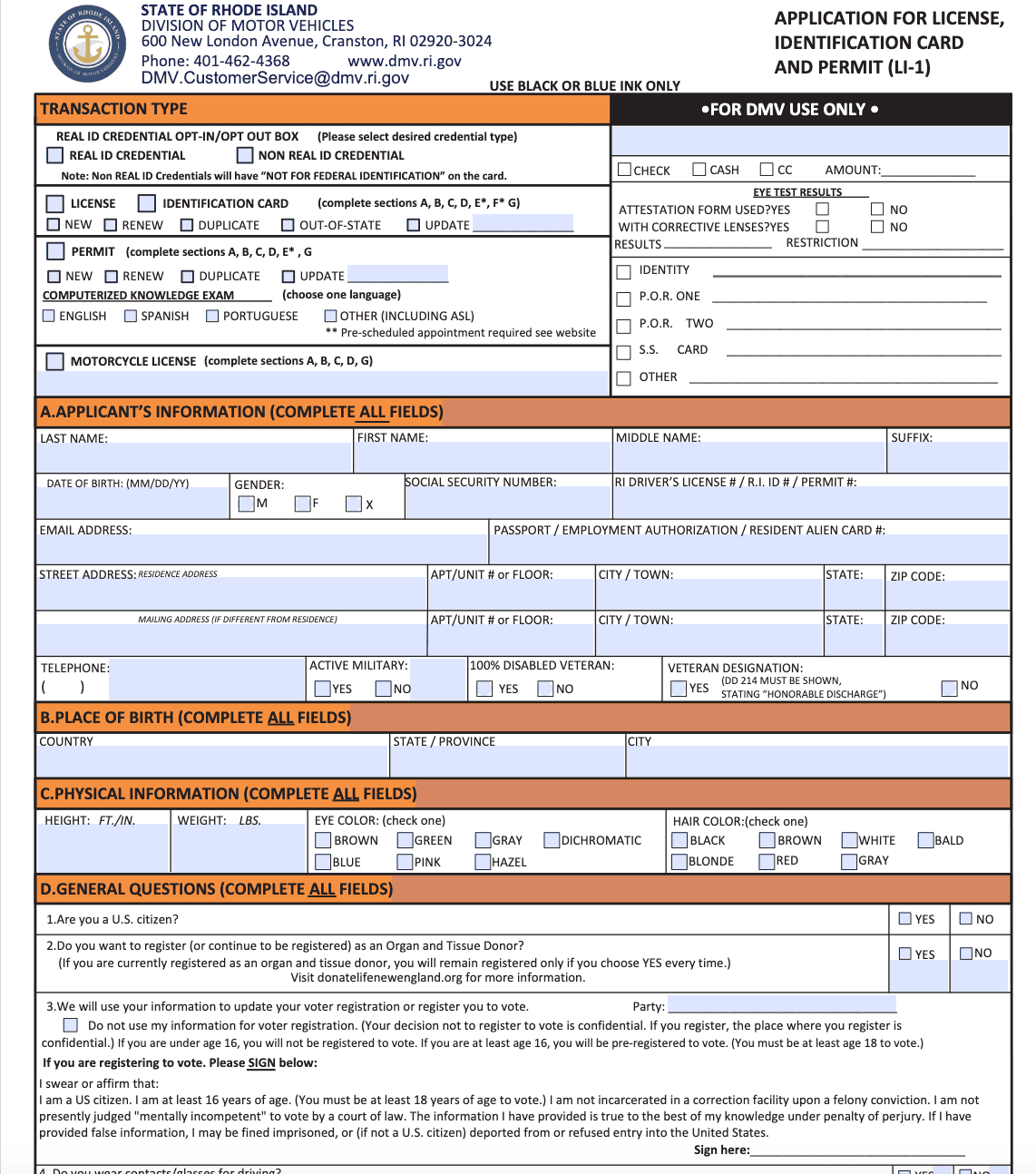
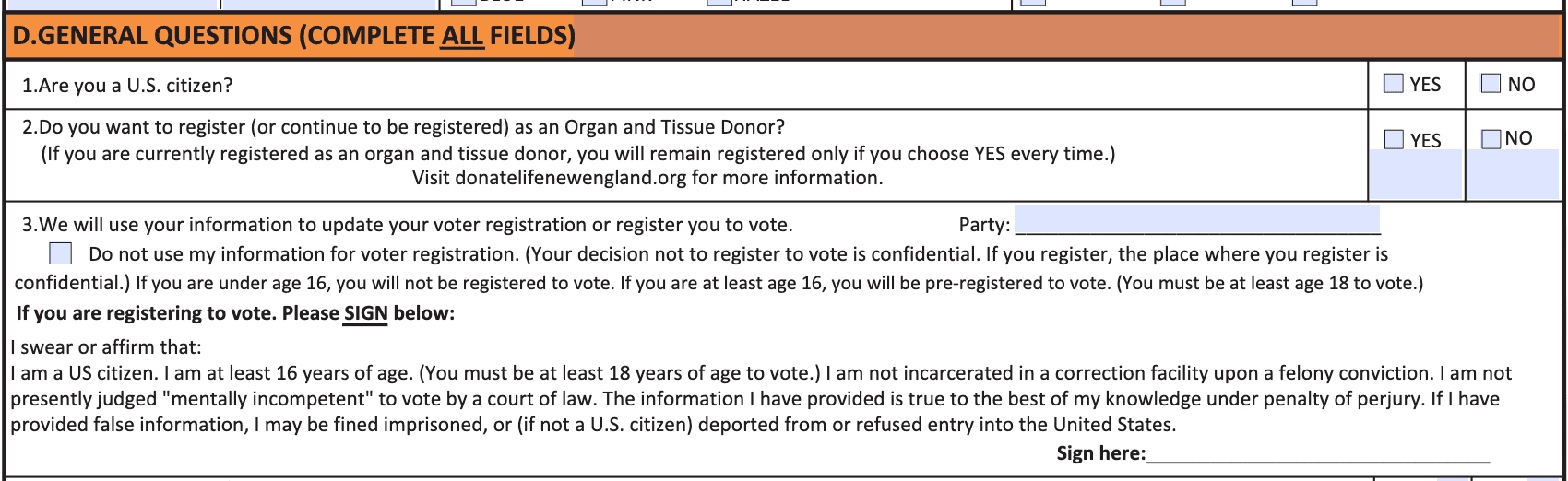
Rhode Island’s LI-1 application for a license, permit or identification card asks the applicant: “Are you a U.S. citizen?”
Immediately below that question, the form states that the applicant’s information will be used to update an existing voter registration or register the person to vote unless the applicant checks a box directing the DMV not to use the information.
Anyone registering must sign an attestation stating that he or she is a U.S. citizen. The form warns that false information may result in fines, imprisonment and—for a noncitizen—deportation or refusal of entry into the United States.
Rhode Island law is also explicit: the DMV “shall not transmit” a voter registration from anyone who has not certified U.S. citizenship.
See section D, enlarged:
Driver privilege cards
Since July 1, 2023, Rhode Island has issued driver privilege cards to residents who cannot establish legal presence in the United States.
State law requires those cards to look identical—front and back—to a regular Rhode Island license that is not a REAL ID. The same law says a privilege card is not valid identification for federal purposes or state voting.
The appearance of the card is not the central voter-registration issue. The important question is whether the DMV’s electronic record properly distinguishes the credential and citizenship response—and whether the correct information is transmitted to the Secretary of State.
Is the process based only on someone’s word?
Not entirely.
A driver privilege-card applicant must present original documents; photocopies are not accepted. The DMV requires state tax verification, either two primary identity documents or a primary and secondary identity document, and two proofs of Rhode Island residency. The DMV also uses facial-recognition technology as part of its credentialing operation.
Those checks help establish that the applicant is a real person, that the identity is not already being used under another record and that the person resides in Rhode Island. They do not, by themselves, establish eligibility to vote.
For voter registration, citizenship is principally a signed certification under penalty of law. Publicly available Rhode Island materials reviewed for this first report do not describe a routine, independent database check of every DMV applicant’s citizenship before the name is placed on the voter roll.
Importantly, someone attempting to register illegally would not necessarily need fraudulent identity or residency documents. A foreign passport, tax-verification record, lease and bank statement could all be genuine and could properly establish identity and Rhode Island residency. The false information could be limited to checking “Yes” on the citizenship question and signing the voter-registration attestation.
That creates two separate risks: a person deliberately making a false citizenship declaration, or a computer system transmitting a registration even when the applicant truthfully answered “No”—the type of failure New Jersey says occurred there.
After registration, the local board of canvassers mails a “Do Not Forward” acknowledgement to verify the address. If it is returned as undeliverable, the voter is placed on the inactive list pending further confirmation. That verifies residence, not citizenship.
Rhode Island orders a review
In a statement provided directly to RINewsToday, the Rhode Island Department of State said:
“The Rhode Island Department of State is aware of the voter registration issue that has been identified in New Jersey.
“The RI Department of State is in close communication with the Division of Motor Vehicles and has requested a meeting with the Division of Motor Vehicles and its vendor.
“At this time, there is no indication that a similar issue has occurred here. Since 2019, at the request of the Elections Division of the RI Department of State, the Division of Motor Vehicles (DMV) conducts a regular audit of a randomized selection of DMV records to ensure that database entries match paper records. This process would identify any potential patterns of irregularities in registrations so that they could be immediately rectified.
“The Elections Division has also requested a complete system review with the Division of Motor Vehicles.
“The RI Department of State remains confident in the integrity of Rhode Island’s voter rolls.”
The paper-to-database audit described by the Department of State is a meaningful check against a data-entry or software-transfer problem—the type of issue alleged in New Jersey. It would not necessarily uncover a knowingly false citizenship declaration if the electronic record accurately matched the applicant’s paper form.
The review should answer several questions:
- Does answering “No” to the citizenship question create an absolute electronic stop against voter-registration transmission?
- Are driver privilege-card and identification privilege-card transactions separately flagged and tested?
- Does the Secretary of State’s system reject a record when the citizenship field conflicts with a voter-registration request?
- How many DMV records are included in the random audits, and are privilege-card applications specifically sampled?
- What document-authentication procedures are used when an identity or residency document may be fraudulent?
- Who is responsible for testing changes to the IDEMIA interface connecting the DMV and the voter-registration database?
This is not evidence that Rhode Island has registered noncitizens through its DMV. It is evidence that the safeguards depend on the form, the applicant, DMV employees, IDEMIA’s software and the Secretary of State’s receiving system all handling the information correctly.
RI Issues NEW RFP
The new RFP from Rhode Island states: “The State of Rhode Island, Department of Revenue, Division of Motor Vehicles is issuing a Request for Proposals (RFP26006341) for the design, development, and implementation of a replacement credentialing system. Qualified vendors are invited to submit proposals to replace the existing motor vehicle credentialing infrastructure with a modernized system.
Who other than IDEMIA provides these services?
IDEMIA is not the only private company involved in producing state driver’s licenses. The highly concentrated market also includes Thales, CBN Secure Technologies and Veridos—multinational contractors that manufacture cards, operate issuance systems or process the photographs and identifying information used to create them.
The leading companies are all foreign-controlled—IDEMIA and Thales are French, CBN is Canadian, and Veridos is German—although they generally perform state work through American subsidiaries and U.S.-based production facilities. That does not mean state data is sent overseas, but it makes contractual data-location, access and change-of-ownership provisions worth examining.
With Rhode Island preparing its next credentialing contract, the timing of the review could not be more relevant.
This is a developing story.
I agree w Glenn! They need to properly add on a license that they are non- citizen. It’s not a difficult thing to do. I think they do not add that on the license is so they could be cheating going on
Maybe RI should put Non Citizen on the drivers license that they issue to non citizens so if they present the license to a voting official when trying to vote it gets flagged. Sort of like the Veteran designation they have on the license now.