
Subscribe!
Ask Chef Walter: Eating in November – Chef Walter Potenza
by Chef Walter Potenza, contributing writer
The long patience of winter cooking. The final step in the cellar: roots and braising, and why November asks more of the cook than any other month while giving more in return.
November comes about as if a door is closing gently behind you. There’s no dramatic show of it, no first frost reported in the papers, and no single morning when all the changes happen at once. It occurs slowly, and then it has occurred, so that one finds oneself in the kitchen on a Sunday afternoon with a pot already on the stove and the afternoon already dark by four o’clock, and realizes that the long season of eating outdoors, of bringing plates to the table still warm from the sun, of meals that came together from things that hardly needed any cooking—that season is over now. What follows calls for different tools, different instincts, and different patience.
What follows is November, and November is serious.
In this month, the cook and the person who feeds themselves are distinguished. November’s ingredients aren’t difficult—they aren’t. Root vegetables are among the most forgiving things to handle in the kitchen; a parsnip will sit in the oven for an hour without complaining, and a turnip stored in the cellar can endure neglect that would destroy a zucchini in minutes. Yet they require time in a way summer produce doesn’t, and they demand dedication. You can’t decide at six o’clock that you’re going to braise short ribs for dinner and then expect to eat before nine.
Cooking in November has to be planned, and the cook who plans it ends up eating exceptionally well—perhaps better than at any other time of year—because the flavors available now have a depth and seriousness that the brilliant, effortless abundance of summer can never quite match.
November rewards those who made stock in October and froze it; if you didn’t, you’ll regret it; if you did, you’ll feel, quietly and unreasonably, virtuous when you take it.
— VEGETABLES —
Turnips and rutabaga. They are sweeter after being frosted. You can roast or purée them with butter and cream.
Parsnips. The month in question. Bake it until the edges are almost black — that’s the idea.
Celery root. It continues to perform well. Blend it while cooking the meat. Absolutely worth experiencing.
Leeks. The winter sweetness is now ready. Put the whole thing in butter and cook it. Just serve it.
Savoy cabbage. Sweet, crinkled, and deeply winterish. Cook it with pancetta and wine.
Brussels sprouts. The harder the frosts, the sweeter they become. Cook them until they are hard; never boil them.
Kale and Cavolo Nero. It is richer and has a deeper flavor than the first crop of September.
The parsnip defines November. If it is roasted correctly—by cutting it into long batons, tossing it copiously with olive oil and a bit of honey, laying it out in a single layer and then baking it in a hot oven until the thin ends are nearly blackened and the thick ends have become soft and caramelized—it shows a sweetness which is almost painfully good, a nuttiness that becomes stronger at the edges where the sugars have darkened, and a creaminess in the center that no other root vegetable can quite match. Serve it with almost any kind of roasted meat. It should form part of a purée served under a piece of braised pork shoulder. And if you are prepared to make that case, it should take center stage on a November plate all by itself, with nothing more than good salt and a drizzle of the best oil you possess.
Braising the leek whole in butter with a little white wine, with the pan covered, until it has completely collapsed into a tender, translucent sweetness is one of those dishes that requires ten minutes of active cooking and forty minutes of patient waiting, the waiting being the real work. Place the braised leeks on a plate, spoon the buttery cooking juices over them, scatter on some capers and add a few drops of good vinegar. You end up with something that belongs at a serious meal — a dish that is quiet, thoughtful, and deeply satisfying in the way only food from November can be.
— FRUITS AND THE CELLAR —
Stored apples. The apples are Cox, Russet, and Bramley varieties, suitable for storage and cooking.
Quince. This is your final opportunity, so make the membrillo now, or you’ll regret it until October next year.
Pears. Comice and Winter Nellis — you can poach them or roast them and serve them with blue cheese.
Pomegranate. The entire season the seeds can be added to salads, sauces, and yogurt. It is an essential acid.
Cranberries. It peaks this month and is more versatile than its single annual appearance suggests.
Persimmons. Hachiya is now soft enough to eat, though Fuyu is still firm and good when raw.
Chestnuts. It will be used later. You can either heat it in milk for a Mont Blanc or incorporate it into the stuffing.
In November, the pomegranate isn’t just a bit; it shouldn’t be treated as such. Its seeds have a tartness that, the same way a squeeze of lemon cuts through butter — not by opposing the fat, but by lifting it and making it less uniform and more interesting — lifts the richness of the heavy dishes typical of that month. If you scatter the seeds over a braised lamb shoulder right before serving, the dish becomes much more vibrant. When you include them in a winter grain salad — for example, one made with farro or freekeh and roasted vegetables and herbs — they give the meal the finishing touch it has been missing. In Mediterranean cooking, especially in the cuisine of Lebanon and Persia and in southern Italy, the pomegranate has always been regarded both as a seasoning and as a fruit, and November is the month in which this point is made most strongly.
The Hachiya Persimmon, having lain on the counter for three weeks and gradually changing from a bitter, inedible thing into something that looks like a small orange lantern and feels like a water balloon, is now ready. To eat it, remove the top and scoop the flesh from the skin with a spoon; it will then taste of honey and apricot, with a nearly floral note, unlike the mouth-puckering tannins that made the fruit unsuitable a fortnight ago. The Fuyu, its short and firm relative, should be included in a November salad with endive, walnuts, and a sharp vinaigrette, where its sweetness contrasts with the endive’s bitterness the way two people who don’t entirely agree yet find each other’s company enlightening.
— DISHES OF THE MONTH —
Braised leeks with capers and brown butter
The leeks were cooked in butter and wine until silky throughout, then dressed with their reduced cooking juices, some capers, and a thread of vinegar; no further ingredients were required.
Roasted parsnips with honey and thyme
Roast the batons until almost dark, then finish with a drizzle of honey and fresh thyme. It is the November vegetable which requires no apology and no supporting actors.
Savoy cabbage braised with pancetta and wine
Cut the central part of the cabbage into wedges and braise it slowly in rendered pancetta together with a glass of white wine until it becomes deeply sweet and has a slight caramelization at the base.
Persimmon, endive and walnut salad
Thin slices of Firm Fuyu persimmon, combined with bitter endive leaves, toasted walnuts, and a Dijon vinaigrette sharp enough to stand up to both, make a dish for November.
Chestnut and celery root soup
Roasted chestnuts are mixed with puréed celery root, stock, and a small amount of cream; the mixture is then finished off with a spoonful of crème fraîche and a very thin strand of good oil.
Slow-braised lamb with pomegranate and herbs
The shoulder or shank is braised for three hours in red wine and various aromatics, then finished at the table with pomegranate seeds and torn flat-leaf parsley. This is the dish that November earns.
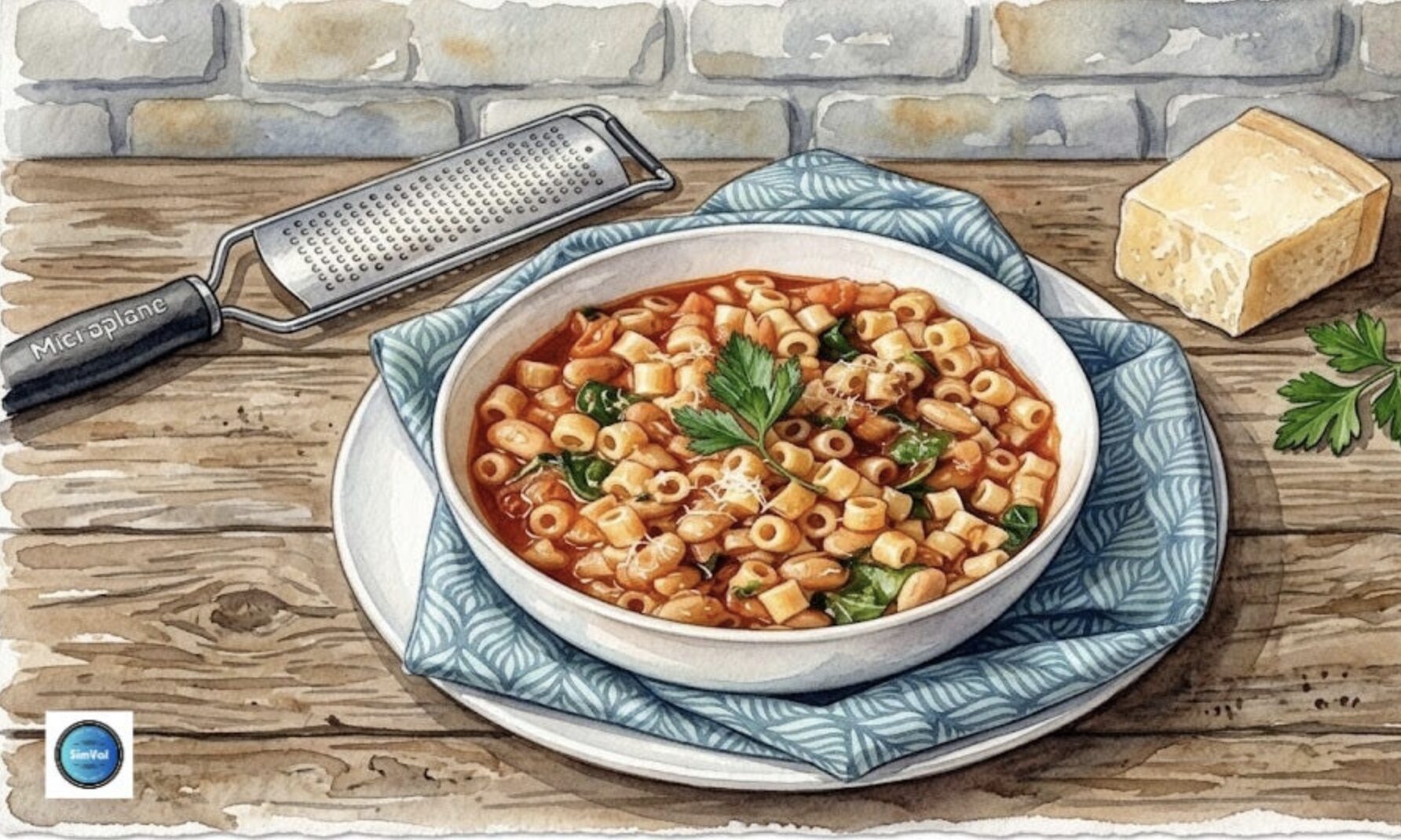
Pasta e Fagioli
A great Italian peasant soup made from pasta and beans — simpler than it appears, more substantial than it ought to be, and evidence that patience is the quality November cooking rewards most. (Use the Converter)
INGREDIENTS — SERVES 4 TO 6
350g dried borlotti beans, soaked overnight
150g small pasta (ditalini or broken spaghetti)
4 tbsp olive oil, plus more to finish
1 large onion, finely diced
3 celery stalks, finely diced
2 medium carrots, finely diced
4 garlic cloves, sliced thin
2 sprigs fresh rosemary
1 sprig fresh sage
1 piece Parmigiano rind (if you have one)
400g canned whole tomatoes, crushed by hand
1.5 liters water or light stock
Flaky salt and black pepper
Best olive oil and Parmigiano, to finish
METHOD
- Remove the beans that have been soaked and place them in a large pot along with fresh cold water, using enough water to cover the beans by several inches. Bring the water to a boil, then skim off the grey foam that forms on the surface, then reduce the heat to a slow, gentle simmer. Add one sprig of rosemary, the sage sprig, and, if you have it, the Parmigiano’s hard too—this rind dissolves almost invisibly in the stock and adds a depth of flavor that’s hard to achieve any other way. Cook the beans uncovered for one to one and a half hours, until fully tender all the way through and with no chalky center left. Add salt only in the last ten minutes and save all the cooking liquid.
- Take about half of the cooked beans aside and set them to one side. Pass the other half through a food mill or blend it coarsely with some cooking liquid until you have a coarse, textured purée—far from smooth but still with somebody. This key choice distinguishes pasta e fagioli from bean soup: the purée thickens the broth, so it becomes more like porridge than soup, and the whole beans suspended in it add texture and substance with each spoonful.
- In the largest pot with a heavy base that you have, warm the olive oil over medium heat and then add the onion, celery, and carrot together with a little salt; cook them gently, stirring from time to time, for exactly fifteen minutes. This mixture is known as the soffritto, and it must not be rushed, since it forms the foundation for the rest of the dish. The vegetables should become completely soft and start to turn a little gold at the edges, releasing a strong, deep fragrance; then add the garlic and the other sprig of rosemary and cook for two more minutes.
- Crush the tomatoes and stir all the ingredients together, then cook them for ten minutes until the tomatoes have thickened. Next, add the bean purée and stir it in well. Include the whole batch of reserved beans. Pour in enough of the reserved bean cooking liquid to achieve a thick and substantial consistency, not a thin and brothy one. Season the mixture generously with salt and black pepper, then simmer uncovered for twenty minutes.
- Bring the soup up to a vigorous simmer and then place the dry pasta directly into the pot. Stir often to prevent the pasta from sticking, and cook until just al dente—typically one minute less than the time suggested on the package, since it will keep cooking in the residual heat. As the pasta cooks, it will absorb some of the liquid and the soup will thicken even more; if it becomes too thick, add a little more water or stock, but don’t think it out too much. Pasta e fagioli should be thick enough for the pasta to stand up.
- Take out the rosemary sprigs as well as any leftover Parmigiano rind, then taste once more and adjust the seasoning—it will probably require more salt than you anticipate. Before serving, let the soup stand, covered, for five minutes. Transfer it to deep bowls, finishing each portion with a thread of your best olive oil—not a drop, but a proper thread, a generous pour—and a good grinding of coarse black pepper. If you like, grate some Parmigiano at the table. Serve it with bread and nothing else. This is the entire meal, and it is enough.
https://chefwaltersfoodtours.com/
https://flavorsandknowledge.substack.com/
___
READ “Ask Chef Walter” every Sunday in RINewsToday

Master Chef Walter Potenza
There is a constant, recognizable thread in the career of Walter Potenza to elevate the level of Italian culinary culture in the United States. Besides his unquestionable culinary talent and winning business perspective, Chef Walter has been a relentless educator with passion and knowledge who defeats stereotypes. His life, career, and values are a model, an example to follow by any chef of Italian gastronomy working outside Italy.
Chef Walter appears regularly on National and International Networks such as Food Network, ABC, CBS, NBC, RAI, FOX, and Publications such as NY. Times, Washington Post, Wall Street Journal, Food & Wine, Saveur, Gourmet, and several Italian media outlets.