
Subscribe!
Mamdani’s map problem: We do not become “one” by erasing what made us unique
by Nancy Thomas, commentary
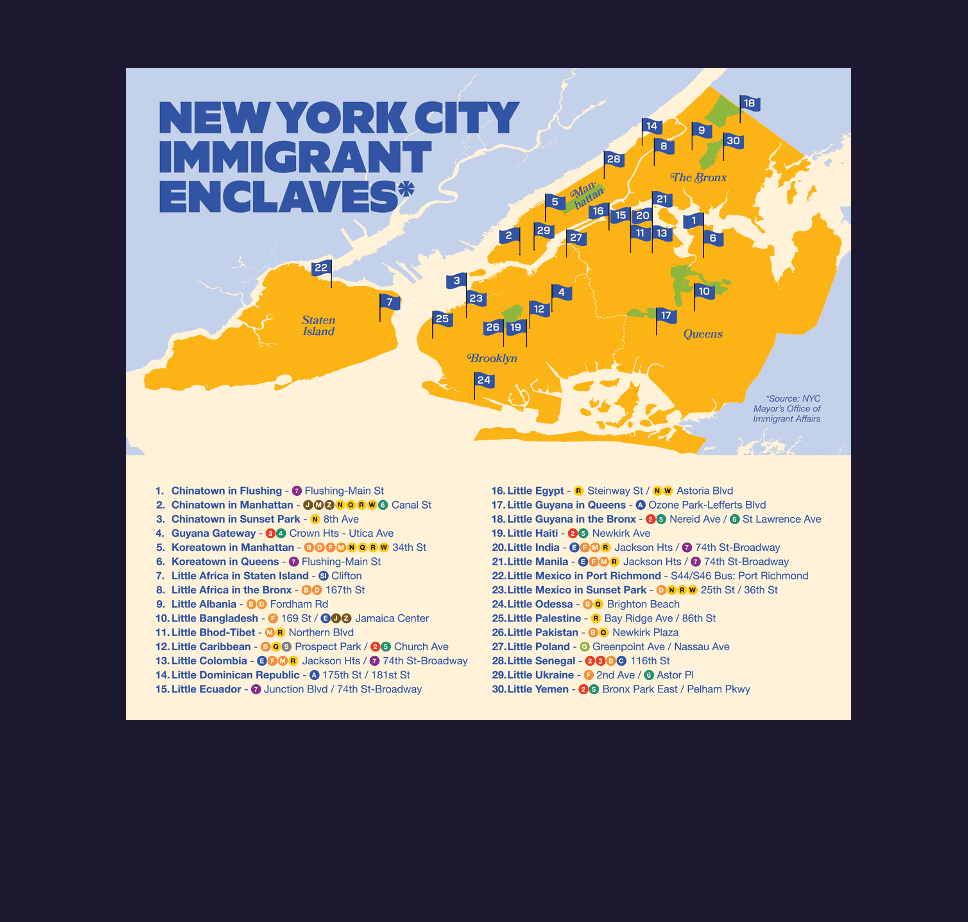
Note: Image above – New York City’s immigrant-enclaves map, part of a cultural-heritage project that began under Mayor Eric Adams and was later promoted under Mayor Zohran Mamdani.
New York City’s immigrant-enclaves map, originally begun as a 2023 cultural-heritage project under Mayor Eric Adams and this week promoted under Mayor Zohran Mamdani, sparked backlash after critics noticed it left out Little Italy, Jewish neighborhoods, Irish neighborhoods and other historic immigrant communities. Mamdani said the map was not intended to be exhaustive and promised to add Little Italy — but the controversy raised a larger question: who gets recognized when a city officially maps culture?
Mayor Mamdani responds to questions about omissions from New York City’s immigrant-enclaves map – saying “Little Italy” would be added – with no reference to missing Jewish community, perhaps making the incident even more concerning giving tensions in the NYC area with the Jewish community.
New York City’s immigrant-enclaves controversy is not really about missing labels on a map.
It is about a much larger question: how do we honor the cultures that shaped a city without turning that city into a checklist of competing identities?
And maybe most importantly: how do we become “one” without pretending we were never many?
The New York Post reported that Mamdani attributed the project’s origins to the prior Adams administration, though the Adams-era project appears to have been an illustration series rather than the same simplified citywide map now drawing criticism.
That distinction matters.
The immigrant-enclaves idea did not begin with the World Cup. The Mayor’s Office of Immigrant Affairs says that in 2023 it launched its Immigrant Enclave Illustration Series as part of Immigrant Heritage Celebration. The purpose, according to MOIA, was to highlight the “endless contributions, rich histories, and unique cultures” of immigrant communities across all five boroughs.
The problem begins when any government map appears to decide which communities count and which do not.
Maps look official. A dot on a map feels like recognition. An omitted neighborhood feels like a slight, even when the omission is accidental. That is why this story touched such a nerve. Little Italy is not just a restaurant district. Jewish New York is not just a religious category. Irish New York is not just old parade memory. These are immigrant histories that helped build the city.
To leave them off an immigrant map raises a fair question: has assimilation made some communities so familiar that they became invisible? In a “One America” way, that might be an explanation to aspire to. But given New York City politics, it doesn’t seem that is the case.
This story becomes more than New York politics
Over time, immigrant families become part of the broader civic life of their new country. They learn the language. They go to school. They start businesses. They enter professions. They move into new neighborhoods. Their children and grandchildren may no longer speak the old language. They may marry outside the group. They may become simply “American” in everyday life. Assimilated, if you will.
But that does not mean the old culture disappeared.
It means it blended.
“For many Portuguese immigrants, the goal in coming to America was to become fully American — to learn and speak English, honor the American flag, work hard, raise families and take part in the country’s evolving culture of freedom. But becoming American did not mean leaving Portuguese identity behind. On weekends, they gathered at Portuguese clubs, danced, shared food, spoke Portuguese and raised children with a rich sense of who they were and where they came from.” – Publisher’s note
The goal of a diverse city should not be permanent separation, with each group frozen forever in its own civic box. Perhaps more of what we have come today. Nor should the goal be cultural amnesia, where every older immigrant story gets wiped away once the group becomes successful, assimilated or mainstream.
The better ideal is people keep who they are, and share it. That is how a city becomes one.
Food usually leads the way.
The Italian bakery, the Jewish deli, the Irish pub, the Dominican bodega, the Chinese banquet hall, the halal cart, the Korean market, the Portuguese bakery, the Greek festival, the Armenian church supper, the Cape Verdean restaurant — these are not museum pieces. They are places where culture becomes public, shared and eventually loved by people far beyond the original community.
Places of worship matter too: churches, synagogues, mosques, temples and meeting halls. So do museums, schools, feast days, parades, cemeteries, cultural centers, social clubs, street names and small businesses. These are the things that make an immigrant neighborhood visible.
But visibility changes over generations.
A neighborhood may no longer be filled with the descendants of its original immigrant group. The families may have moved outward. The language may be heard less often. The old storefronts may have changed. But the memory remains in the architecture, the food, the faith institutions, the festivals and the names people still use.
That is why Little Italy matters even if it is smaller and more touristic than it once was.
That is why Jewish neighborhoods matter even when Jewish identity is not easily reduced to one census category. Jewish New York includes religion, ethnicity, migration, language, food, persecution, scholarship, commerce, politics and memory. It cannot be brushed aside as merely a religious classification.
That is why Irish neighborhoods matter even when Irish New Yorkers have long since become part of the American mainstream.
Sometimes the most successful immigrant cultures are the ones whose contributions become so woven into daily life that people forget they once came from somewhere else.
A good cultural map should not simply show where newer immigrants live today. That is one important layer, but it is not the whole story. A better map would show layers: current immigrant communities, historic immigrant neighborhoods, cultural institutions, food corridors, places of worship, museums, festivals and community landmarks.
What about Rhode Island?
To test the difficulty of building a cultural map, we asked AI to create a Rhode Island version.
It was hard — immediately.
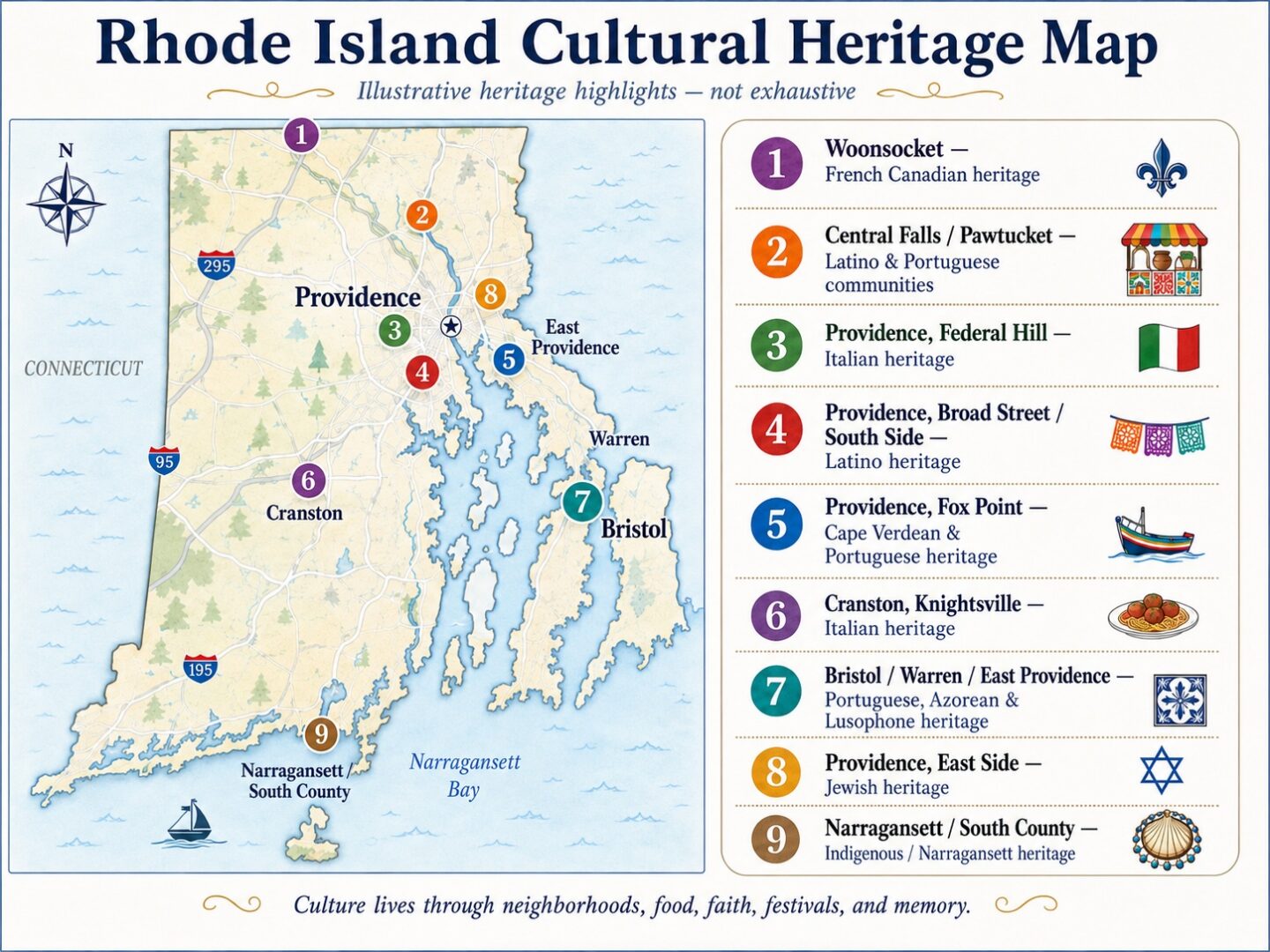
We prompted it through several versions.
Where should Italian heritage go: Federal Hill, Knightsville, Johnston, North Providence, Westerly? Where should Portuguese heritage be placed: Fox Point, East Providence, Bristol, Warren, Pawtucket? Should Jewish heritage be represented only by Newport’s historic Touro Synagogue (in AI’s original iteration), but what about Providence’s East Side, Cranston, Warwick — or all of them?
Where should Indigenous heritage be placed when Indigenous history belongs not to one dot on a map, but to the land itself?
The AI-generated map shown here is not complete or definitive. It is intentionally labeled “Illustrative heritage highlights — not exhaustive.” It is a visual experiment – albeit a flawed one – that proves the larger point: culture does not fit neatly into numbered circles.
A map can celebrate. But it can also accidentally exclude. It would show the living city and the remembered city together. That approach would avoid turning culture into a competition.
New York does not have to choose between Little Yemen and Little Italy. It does not have to choose between Little Palestine and Jewish neighborhoods. It does not have to choose between today’s immigrant communities and the older immigrant communities whose children and grandchildren now live everywhere.
The same lesson applies far beyond New York.
Rhode Island would face the same challenge if it tried to build its own cultural heritage map. Where would it put Italian heritage: Federal Hill, Knightsville, Johnston, North Providence, Westerly? Where would it put Portuguese and Cape Verdean heritage: Fox Point, East Providence, Bristol, Warren, Pawtucket? Where would it put French Canadian heritage: Woonsocket, Central Falls, Pawtucket? Where would it put Jewish heritage: Newport, Providence’s East Side, Cranston, Warwick? Where would it put Indigenous heritage: Narragansett, South County, Bristol, the whole state?
The answer is: not one dot. Not one label. Not one official box. The truthful answer is layers.
Rhode Island’s story, like New York’s, is not a set of sealed-off identities. It is Indigenous history, immigration, mills, parishes, synagogues, churches, festivals, music, food, neighborhoods, family names, businesses and public rituals — all blending over time into something recognizably shared.
That is the real American promise.
We do not become one by sanding off every edge of uniqueness. We become one when each community is allowed to bring something forward: a food, a song, a prayer, a feast, a business tradition, a family story, a moral memory, a way of gathering.
The goal is not to celebrate “differences” as if differences themselves are the point. The goal is to honor uniqueness — and then understand how that uniqueness enriches the whole.
Assimilation, at its best, is not disappearance. It is inheritance shared.
New York City should be big enough to honor both its newest immigrant neighborhoods and its oldest immigrant memories. A map that recognizes Little Italy should also have room for Jewish New York, Irish New York and the many other communities whose stories have become part of the city’s bones.
Because becoming one should never mean becoming blank. It should mean becoming blended.
Tell us what groups we missed and we’ll add it to the map!
This is a developing story/commentary.
My hat’s off to the guys who wrote and illustrated this piece!
This is perfectly said — “We do not become one by sanding off every edge of uniqueness.” Indeed.
Well thank you kindly – this was my piece – occasionally the publisher (me) takes liberties!