
Subscribe!
Cranston now preferred location for RI’s long-planned state hospital — city asks about impact, revenue
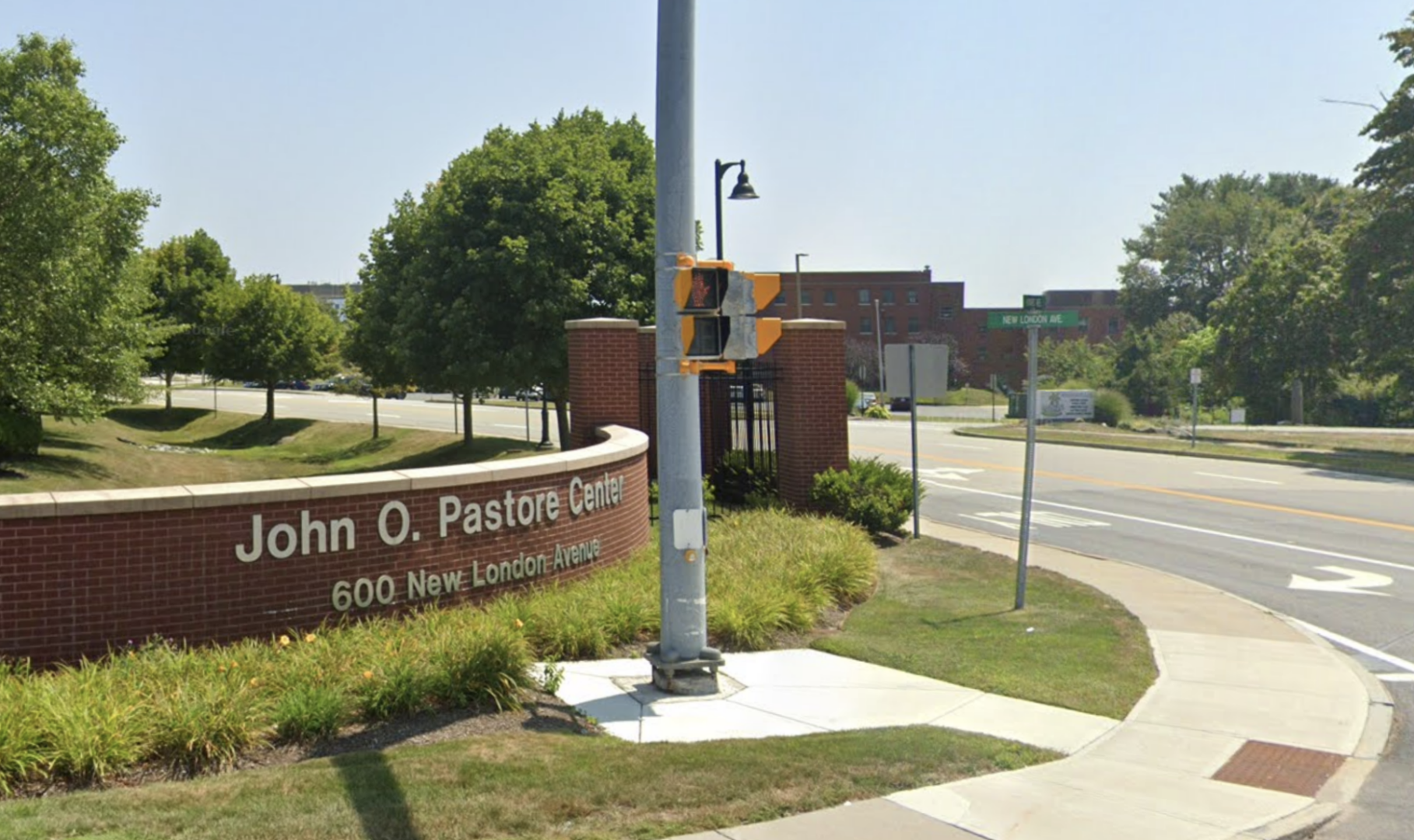
A new state hospital once planned for the Zambarano campus in Burrillville may now be headed for deeper study for its location at other spots, including the top-ranked, Cranston’s Pastore Center. The location is also raising a local question for Cranston about whether the project could also bring new city revenue.
A state engaged study identifies Pastore as the focus for the next phase of planning for the new long-term acute care hospital construction based on cost. Cranston says it has not been briefed or told whether payment in lieu of taxes would change.
Timeline: The Zambarano replacement project had been funded as far back as the SFY 2023 budget, when $108 million was approved for a new facility on the Zambarano campus. The 2023 needs assessment described construction of the new facility as an “Immediate” next step.
The updated May 2026 timeline now points to pre-development beginning in October 2026, a July 2028 groundbreaking, facility completion in July 2030, and full operation in July 2031.
The facility would be new construction: a modern long-term acute care hospital, known as an LTACH, for medically complex patients who need longer hospital stays and specialized care.
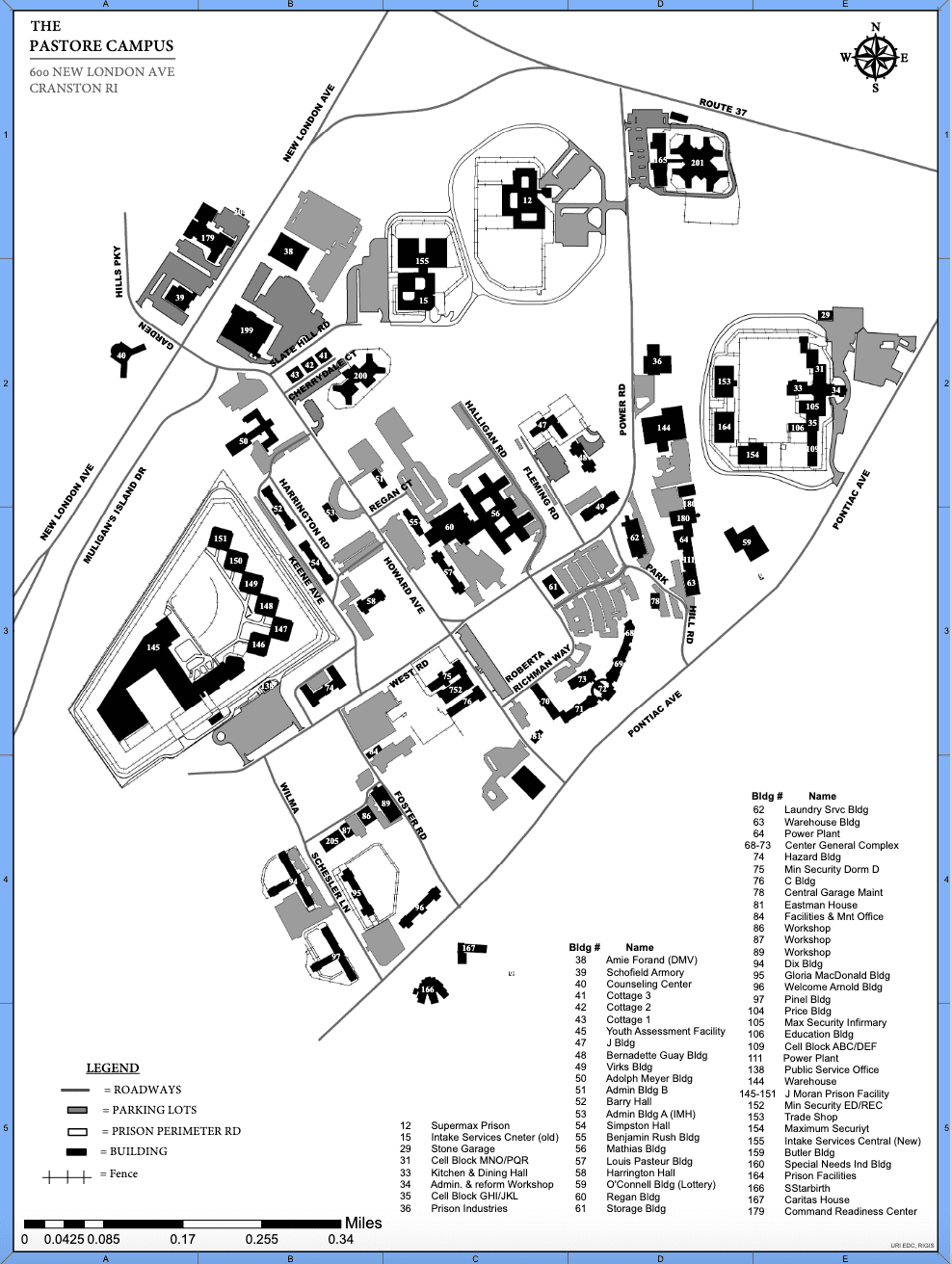
In a May 2026 LTACH Needs Assessment & Site Feasibility Evaluation, the state reviewed multiple potential locations and identified Cranston’s Pastore campus as the strongest-performing operational option for the next phase of planning and due diligence.
Read the study: LTACH Needs Assessment & Site Feasibility Evaluation, May 2026: LTACH Assessment 05.26.26
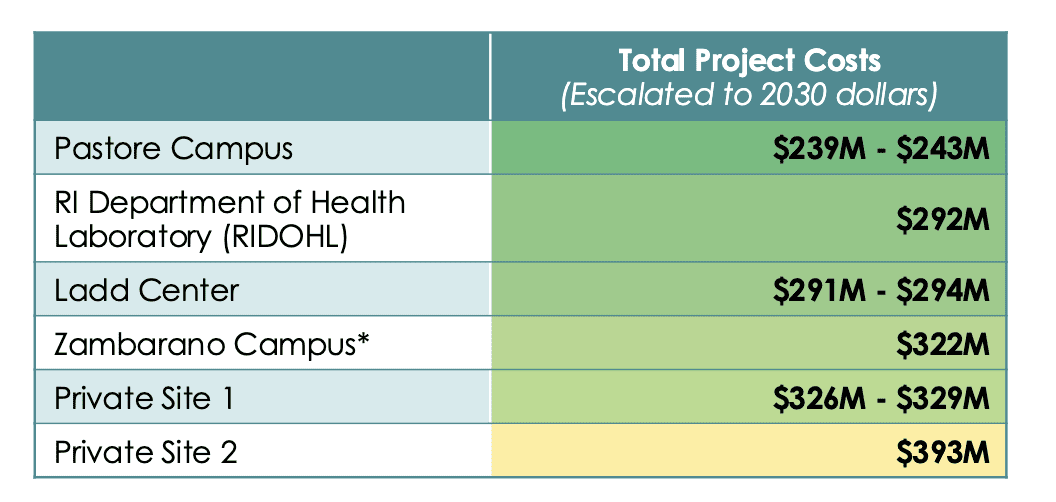
The report ranked Pastore as the lowest-cost option among the shortlisted sites.
A cost-comparison chart in the study estimates the Pastore option at $239 million to $243 million in 2030 dollars. Other options were listed at higher projected costs, including the RI Department of Health Laboratory at $292 million, the Ladd Center at $291 million to $294 million, Zambarano at $322 million, Private Site 1 at $326 million to $329 million, and Private Site 2 at $393 million.
The report says Pastore also offers benefits from existing infrastructure, campus resources, proximity to hospitals and referral sources, access to transportation corridors, and workforce recruitment and retention advantages.
For the state, that may make Pastore the most practical and cost-effective path.
For Cranston, it raises a different question: if another major state facility is built at Pastore, could the city receive additional compensation?
Cranston already receives Payment in Lieu of Taxes, or PILOT, tied to major state facilities at the Pastore Center, including the Adult Correctional Institutions and the Training School. PILOT payments help compensate municipalities for public, tax-exempt property and the city services associated with those properties. City services would be expected for any new facility at the Center, particularly an acute care hospital.
A new state hospital could raise the possibility of additional PILOT revenue, an adjusted payment, or a separate municipal impact agreement.
That question could matter in Cranston, where city officials have been working through budget pressures and have discussed a possible one-year levy cap exemption.
RINewsToday asked the state whether the proposed hospital could affect PILOT compensation to Cranston. Kerri White, Communications Director at the Rhode Island Executive Office of Health and Human Services, responded: “I am told the project is too premature to have those details at this point.”
In an earlier response to RINewsToday, White wrote about the project:
“In response to significant nationwide increases in building material prices and construction costs, the McKee Administration decided to pause the LTACH project to reassess available options and ensure the State was positioned to move forward in a fiscally responsible and sustainable manner.
The State commissioned an updated, data-driven feasibility study to help ensure Rhode Island is making the strongest long-term investment possible for patients, taxpayers, and the state’s healthcare system overall, while also ensuring the highest and best use of public funds. The study reaffirmed Rhode Island’s need for a modern long-term acute care hospital (LTACH) facility and evaluated multiple state-owned and private site options using standardized criteria including implementation feasibility, infrastructure readiness, workforce access, patient access, operational sustainability, and cost.
Based on the updated analysis, the State intends to pursue the next phase of planning and due diligence focused on the strongest-performing operational option, identified in the study at the Pastore campus in Cranston. While additional review and assessment work remains underway, the State found the Pastore campus performed strongly as an LTACH site due to infrastructure availability, recruitment and retention of staff, proximity to referral hospitals and transportation corridors, and lower projected construction costs compared to other evaluated sites.
Governor McKee’s FY27 budget proposal includes $2 million to support this next phase of LTACH planning work, including due diligence, test fitting, continued site evaluation with a focus on the Pastore campus, and evaluation and planning for alternative future uses of the Beazley building and the Zambarano campus that would provide long-term benefits to the Town of Burrillville and the surrounding community. The State remains committed to engaging stakeholders as this work continues.”
The state’s one-page update says no immediate changes are planned for current Beazley patients or staff. It also says the state will continue to engage employees, patients, families, legislators, local officials, and other stakeholders as the work moves forward.
The state materials reviewed do not indicate whether a new LTACH facility at Pastore would retain the Zambarano name, be branded as part of Eleanor Slater Hospital, or receive another name. The current state documents refer to the project as a modern LTACH facility for Eleanor Slater Hospital.
Cranston says it has not yet been briefed. When asked, Nicole Renzulli, Director of Communications for the City of Cranston, said:
“… The City of Cranston has not been formally or informally notified by the State of Rhode Island about any proposal to locate a new hospital at the Pastore Center. Recent reports indicating that the site is under consideration as a finalist location were not shared with the City prior to their publication. Because the City has received no briefing, documentation, impact analysis, or communication from the state, Cranston has not taken a formal position on the proposal. The City cannot evaluate potential impacts on municipal services, infrastructure, traffic, public safety, or finances without information from the state. The City has also not been provided any projections regarding fiscal effects or potential changes to Cranston’s PILOT (Payment in Lieu of Taxes) compensation. No discussions have taken place regarding additional PILOT funding or a municipal impact agreement, as the City has not been informed of any project requiring such consideration.
If the State of Rhode Island intends to advance or evaluate a major new facility at the Pastore Center, the City of Cranston expects, and will formally request, a full briefing, comprehensive impact analysis, and a transparent public engagement process to ensure residents are fully informed and municipal interests are protected. At this time, the City has no further information about the proposal but will continue to advocate for open communication, proper planning, and full transparency on any matter affecting Cranston residents, services, and neighborhoods.”
A rough municipal-finance estimate suggests the question of PILOT funding is not minor. If a new state-owned hospital valued in the range of the study’s projected $239 million to $243 million Pastore project cost were treated as eligible PILOT property, Cranston could reasonably ask whether the facility might generate roughly $1.3 million to $1.4 million annually in additional PILOT revenue. The actual number would depend on the final valuation, which portions of the project are counted, the tax rate in effect, the state PILOT formula, and the General Assembly’s annual appropriation.
While the state has not provided any such projection, and Cranston says it has not received a fiscal-impact analysis, from a municipal finance perspective, the possibility of additional revenue could make the project attractive to Cranston — if the city is compensated for its role as host community.
The other side of the equation is impact. A long-term acute care hospital could require municipal planning around public safety, traffic, utilities, emergency response, infrastructure, and surrounding neighborhoods.
The state may see Pastore as the best fit because of cost, infrastructure, location, and access to the healthcare system – while Cranston may see a potential caring-community fit — and possibly a new revenue source – as well.
For now, the state says PILOT details are premature.
Cranston says it has not been given enough information to take a position.
And the central local question remains: if the new hospital comes to Pastore, what would it mean for Cranston?
The City of Cranston could hold fifty public meetings focused on the potential for a LTACH in the Pastore Center, but the State of Rhode Island will forge ahead with whatever plans THEY have, regardless of Cranston’s concerns.
Pastore Center is state property and they can do what they want with it – the response that needs to come from Cranston PD, FD and EMS, however, results in PILOT payments (Payment in Lieu of Taxes) for services. That would represent some funds for the city, so badly needed.