
Subscribe!
Ask Chef Walter: Eating in July. Panzanella Recipe – Walter Potenza
by Master Chef Walter Potenza, contributing writer
EATING IN JULY
The month that asks nothing of you. On tomatoes, peaches, corn, and the particular freedom of cooking when the ingredients do all the work.
Readers:
July does not require a plan. It does not reward ambition or punish laziness. It is the one month when the correct approach to dinner is to go to the market without a list, buy whatever looks heavy, sun-warm, and slightly too ripe to survive the journey home, then cook as little as possible. When seeking out produce, choose tomatoes that feel heavy for their size, with vibrant skin and a fragrance that is unmistakably of summer.
They should give slightly when pressed and smell rich and almost grassy at the stem. For peaches, look for fruit that yields gently under your thumb and carries a deep, sweet fragrance—color should be golden or rosy, never pale or green near the stem. The tomato that has been sitting on a vine in ninety-degree heat since early June does not need your help. It does not need roasting, reducing, or transforming. It needs a knife, a board, some coarse salt, and enough olive oil to alarm someone who has never tasted a July tomato and does not understand what is at stake.
This is the month when the Mediterranean way of eating stops being a philosophy and becomes the only logical response to the weather. You do not turn on the oven if you can help it. You do not make stocks or braise anything for four hours. You slice. You grill. You tear bread. If you do not have an outdoor grill or balcony, a grill pan on the stovetop or the broiler in your oven will give you nearly the same results—charred edges, softened centers, and a hint of smokiness that belongs to the season as much as the sun does.
You pour things over other things. You eat outside, probably after dark, when it has cooled to merely warm, but if that’s not possible, the freedom of July can be found indoors with windows open and plates balanced at the kitchen counter. You drink something cold and simple and do not think about food in any complicated way because July does not ask you to. It asks only that you pay attention to the peach that gives slightly under your thumb at the market, to the corn that needs no more than three minutes in boiling water, and to the basil growing in a pot on your terrace all month that now, in full July sun, smells like the entire coast of Liguria concentrated into a single leaf.
July is the month that vindicates every farmer’s market visit you made in February when there was nothing worth buying. This is what you were waiting for.
Vegetables.
Heirloom tomatoes. Peak season: every variety, all at once. Eat them raw.
Sweet corn. Three minutes in boiling water. Butter. Nothing else.
Bell peppers. Red and yellow only. Char them all over a flame.
Eggplant. Full season now. Larger, meatier, ready for the grill.
Summer squash. Zucchini and yellow squash both. Grill or roast hard.
Green beans. Full and snappy. Blanch and dress warm with vinaigrette.
Basil. At its absolute peak. Make pesto before the heat turns it.
Hot peppers. Jalapeños, serranos, shishitos — all arriving together.
The tomato deserves its own paragraph — several, really, but we will start with one. The July tomato is not the tomato of the other eleven months. It is not round, red, uniform, odorless, or structurally sound enough to survive shipping across a continent in a refrigerated truck. It is irregular and heavy and thin-skinned, and it bleeds when you cut it, and it smells, when you hold it close, like green and acid and warmth and everything summer is supposed to mean. An heirloom tomato in July, sliced thick, seasoned with flaky salt and black pepper, dressed with nothing but the best olive oil you own, and eaten with bread to catch the juice — this is not a side dish. This is what dinner looks like when you have stopped pretending that cooking is more complicated than it needs to be.
Corn is July’s other insistence. Buy it the same day it was picked if you can, because corn begins converting its sugars to starch within hours of harvest. The difference between morning-picked and two-day-old corn is the difference between a revelation and a vegetable. Pull back the husk at the stall and look at the silk — it should be golden and barely dry, not brown and desiccated. The kernels should be tightly packed and weep a milky liquid when you press a fingernail through one. Take it home, boil it briefly, eat it with butter and salt standing over the sink, and do not pretend you were going to make something more sophisticated with it.
Fruits
Peaches. Full season. White and yellow both. Eat over the sink.
Nectarines. Smooth-skinned, intensely sweet. Better for grilling.
Blackberries. Wild ones, if you can find them. Bittersweet and brief.
Raspberries. Fragile, fleeting, better fresh than cooked.
Watermelon. Full sweetness now. Salt it. Eat it cold.
Plums. Santa Rosa and Italian prune are both ripe. Tart skins, honey flesh.
Figs. First of two seasons. Black Mission and Kadota both.
Cantaloupe. Full sugar now. Wrap with prosciutto. Serve very cold.
The peach is the tomato’s fruit-world equivalent: the ingredient misrepresented by industrial agriculture so comprehensively that many people genuinely believe they dislike it, when what they dislike is the object that shares its name but almost nothing else. A ripe July peach, ripe meaning yielding gently when pressed at the shoulder, not hard or mealy-soft, but giving, smells of flowers and honey from a foot away. It drips. It stains.
It is incompatible with formal clothing. It is best eaten outside, standing, and the only acceptable response to juice running down your forearm is to lick it off and reach for another one. Halve a few, brush them with a little oil, and lay them cut-side down on a very hot grill for two minutes. You have something that can go alongside pork, be draped with prosciutto, or be served with mascarpone and crushed amaretti cookies as a dessert requiring no baking and almost no thought. If you are cooking for vegans or want to avoid dairy or meat, try serving grilled peaches with a dollop of coconut yogurt and toasted nuts, or swap in plant-based cheese and roasted seeds for garnish. For gluten-free guests, replace the amaretti cookies with a handful of toasted gluten-free granola or crumbled almond biscuits.
Figs appear at the end of July in their first of two brief seasons, and they operate by a different logic than most fruit — they do not ripen after picking, which means the ones at the market are exactly as good as they are going to get. The imperfect ones are simply past it. Look for ones that are soft and heavy and beginning to split slightly at the base. Tear them open, lay them over burrata with a thread of honey and a few leaves of prosciutto, and you have composed something that looks considered and tastes inevitable.
My suggestions for this month:
Tomato plate with anchovies and bread. Thick heirloom slices, flaky salt, olive oil, a few anchovies, torn bread. The definitive July dinner that is not technically cooking.
Grilled peaches with prosciutto and mascarpone. Two minutes cut-side down on a screaming grill. Serve with torn prosciutto, a spoon of mascarpone, and a thread of honey.
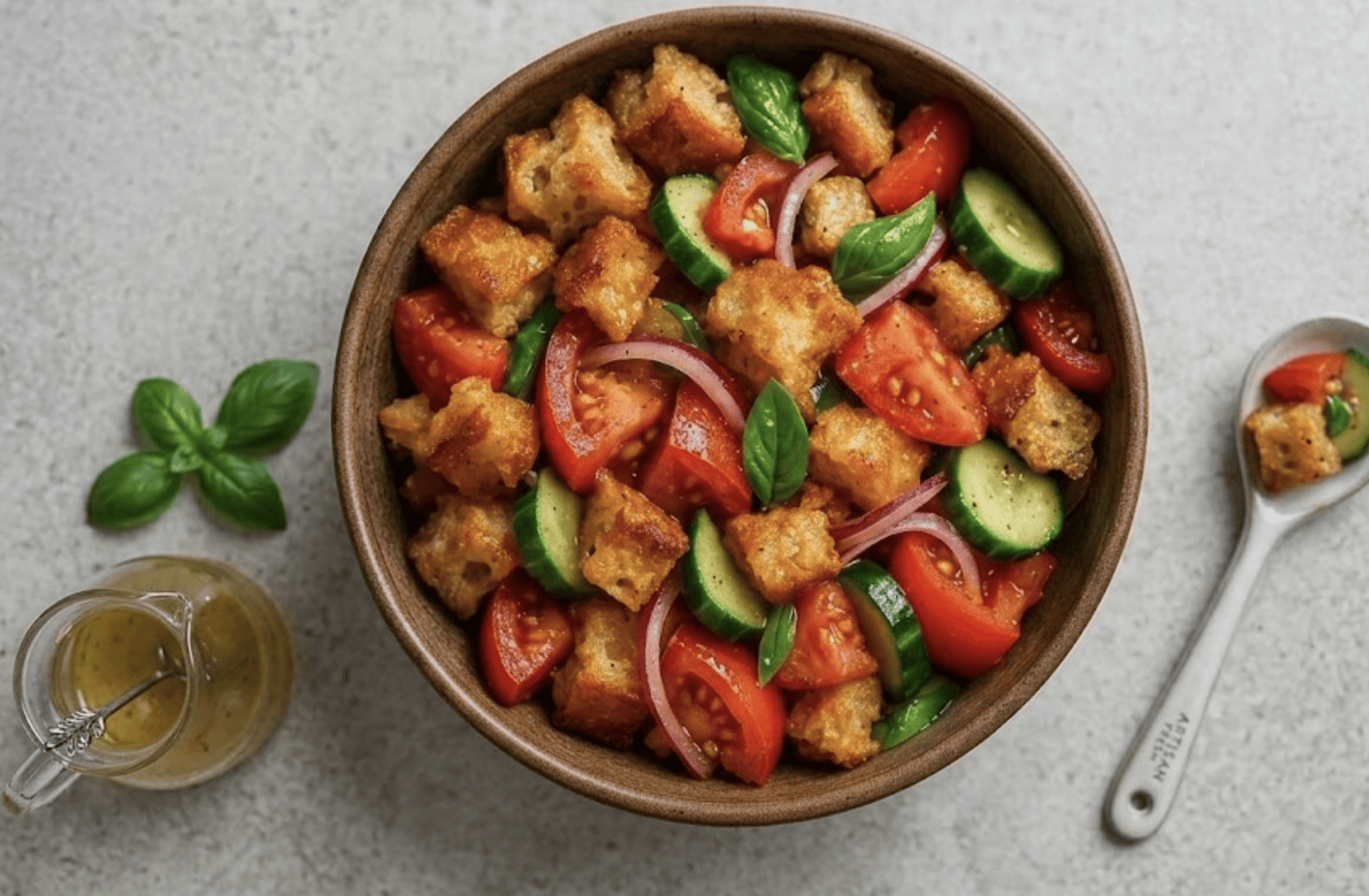
Panzanella. Stale bread soaked in the juice of overripe tomatoes, with red onion, cucumber, basil, and vinegar. Tuscany’s answer to the tomato surplus.
Charred corn and pepper salad. Corn and red peppers grilled whole until blackened, stripped, and tossed with lime, cilantro, and cotija. Serve at room temperature.
Figs with burrata, prosciutto, and honey. Torn figs, torn burrata, draped prosciutto, a drizzle of dark honey, cracked pepper. Assembly, not cooking. Serve with bread.
Watermelon, feta, and mint salad. Cold cubed watermelon with crumbled feta, torn mint, red onion, and a squeeze of lime. Salt it generously — the contrast is the point.
The recipe for this month:
Panzanella
The Tuscan bread and tomato salad — a lesson in using what is almost too ripe to serve any other way
Ingredients — serves 4
3 cups of stale ciabatta or sourdough, torn
4 cups of ripe mixed tomatoes
1 tsp coarse salt, for tomatoes
1 small red onion, very thinly sliced
1 cucumber, seeded and cubed
2 tbsp red wine vinegar
6 tbsp best olive oil
1 garlic clove, halved
A large handful of basil, torn.
Flaky salt & black pepper
Procedure
Cut or tear the tomatoes roughly into large, irregular pieces over a bowl — you want to catch every drop of juice. Season them with coarse salt, toss, and leave them for 20 minutes. They will give up a remarkable amount of liquid. This liquid is the soul of the dish.
While the tomatoes drain, rub the torn bread with the cut face of the garlic clove on both sides. Spread the bread on a sheet pan and toast in a 180°C oven for 10 minutes until golden and dry on the surface but not fully hard. You want it to absorb, not dissolve.
Soak the sliced red onion in cold water for 10 minutes to pull out its sharpness, then drain and pat dry. This step is not optional if you want a salad rather than a breath test.
Combine the bread, tomatoes and all their juice, onion, and cucumber in a large bowl. Add the red wine vinegar and olive oil and toss well. The bread should be saturated but still hold its shape in places — some pieces wet, some with a little bite remaining. That contrast is what makes panzanella worth eating.
Let the whole thing sit for at least 20 minutes before serving—longer if you can wait. Tear the basil over the top at the last moment, finish with flaky salt, black pepper, and another thread of olive oil, and serve at room temperature. Never cold. The refrigerator is the enemy of this dish. If you have leftovers, try to eat them within a few hours, as the bread will continue to absorb moisture and soften further. If you must store panzanella, cover and refrigerate it, then let it reach room temperature before eating. To revive the salad, add a splash of vinegar and olive oil, toss gently, and, if you have more ripe tomatoes, mix in a few fresh slices to bring back some of its original brightness.
Panzanella felt like the only honest choice for July’s recipe — it is the dish that exists specifically because the tomatoes are too good and too abundant. The bread has gone slightly stale, and the Mediterranean cook, who wastes nothing, decided these two facts should solve each other. The note in the method about the refrigerator being the enemy of this dish is not an exaggeration. The cold kills it entirely.
https://flavorsandknowledge.substack.com/publish/post/203066450
___
READ “Ask Chef Walter” every Sunday in RINewsToday

Master Chef Walter Potenza
There is a constant, recognizable thread in the career of Walter Potenza to elevate the level of Italian culinary culture in the United States. Besides his unquestionable culinary talent and winning business perspective, Chef Walter has been a relentless educator with passion and knowledge who defeats stereotypes. His life, career, and values are a model, an example to follow by any chef of Italian gastronomy working outside Italy.
Chef Walter appears regularly on National and International Networks such as Food Network, ABC, CBS, NBC, RAI, FOX, and Publications such as NY. Times, Washington Post, Wall Street Journal, Food & Wine, Saveur, Gourmet, and several Italian media outlets.