
Subscribe!
Cranston’s First Retail Cannabis Store was planned for the former Pizza Hut. Now? Maybe Not.
Investors say Rhode Island erased a $500,000 investment, but no cannabis license was issued—and the proposed Reservoir Avenue location sits immediately beside homes.
What You Need to Know Now
Drivers along Reservoir Avenue in Cranston cannot miss the message.
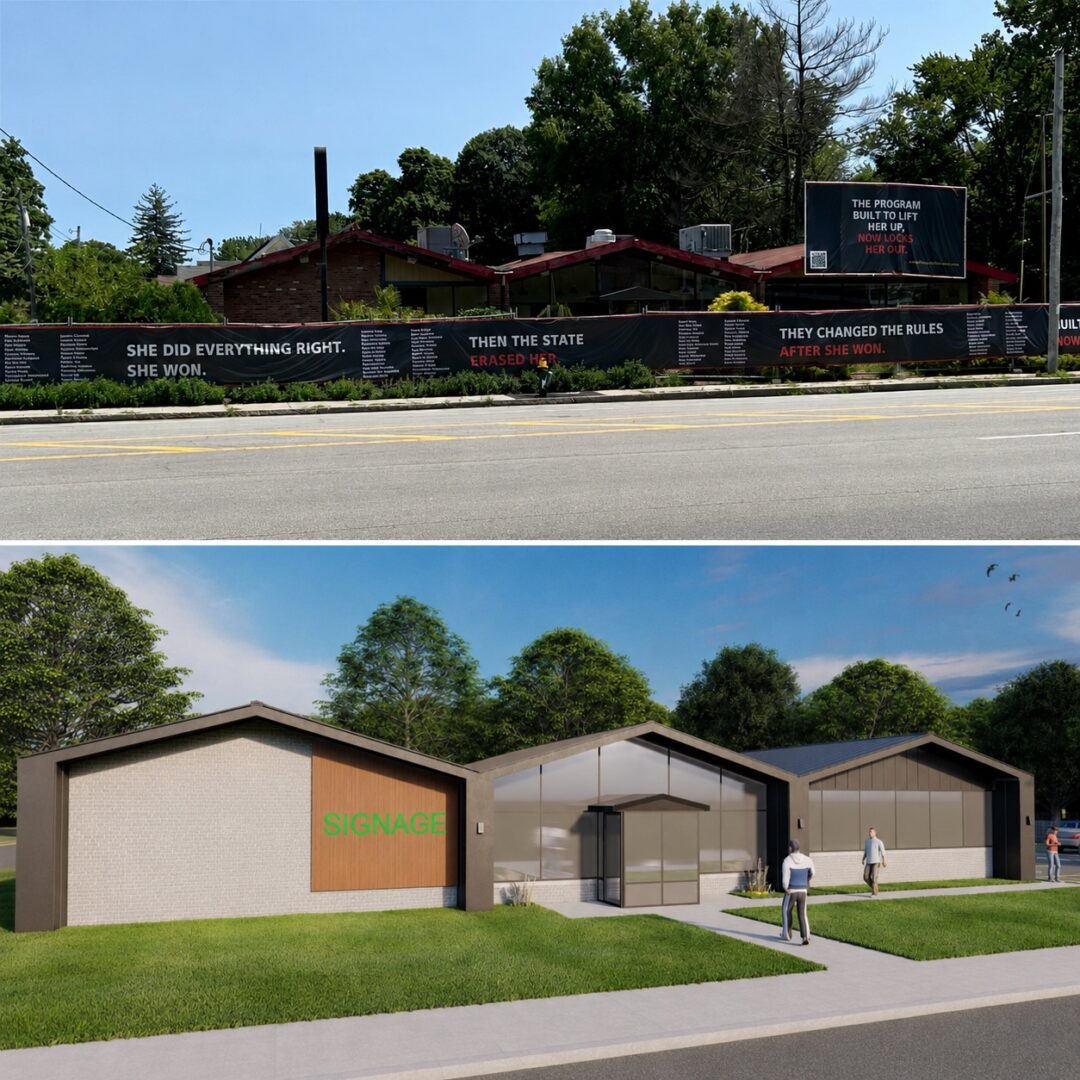
Enormous black banners now cover the fence and former Pizza Hut at 1112 Reservoir Avenue:
“She did everything right. She won.”
“Then the state erased her.”
“They changed the rules after she won.”
The banners direct motorists to a political advocacy website, name the 92 Rhode Island lawmakers who supported legislation resetting the state’s cannabis-licensing process, and urge voters to remove them from office.
But the public record reveals a more complicated story.
Ancora Partners LLC, doing business as Flower & Pot, proposed converting the former restaurant into what would apparently become Cranston’s first adult-use cannabis retailer open to the general public.
The investors say they committed more than $500,000 of their own money, completed their state application on time, obtained necessary municipal approvals and were the only Zone 4 social-equity applicant to do so by the deadline.
However, the Rhode Island Cannabis Control Commission never issued Flower & Pot a cannabis license.
Ancora argues that its application was complete, that the state’s review period had expired and that issuing the license should have been a ministerial act. The company is asking a Superior Court judge to preserve its application and social-equity certification.
That remains Ancora’s legal position—not an uncontested determination that the company had “won” a license.
Who is “she”?
The campaign does not name the woman whose story is displayed across the building.
State records and earlier news reporting identify her as Lisa Ann Pontarelli, a part-owner of Ancora Partners. Pontarelli has worked in opioid-treatment services and is currently listed as program administrator at CODAC’s Royal Little Drive behavioral-health center in Providence.
In April, Pontarelli told Rhode Island Current that she and her partners had collectively invested “at least six figures” in the former Pizza Hut location.
“Everything’s in order, everything is waiting,” she said at the time.
That statement confirms that Pontarelli was involved and that the application was waiting for state action. It does not establish that a license had been awarded.
Ancora’s website describes its unnamed social-equity participant as a lifelong Cranston resident who spent her career helping people recover from addiction and had lived in a neighborhood disproportionately affected by cannabis enforcement. The company has not publicly disclosed Pontarelli’s ownership percentage, voting authority or controlling interest in Ancora.
The state identifies three natural-person interest holders in the company:
- Lisa Ann Pontarelli of Johnston
- David Rozen of Warwick
- Robert Coupe of Cranston
Rozen, described by Ancora as an investor and chief financial officer, is the man appearing in the company’s five-minute campaign video. Coupe’s role is not explained on the campaign website.
Rhode Island started over
A federal judge halted Rhode Island’s cannabis retail rollout in April after finding that the state’s residency requirement likely violated the Constitution’s Commerce Clause.
The General Assembly subsequently passed H8544, sponsored by Providence Democratic Rep. Scott Slater, with a Senate companion sponsored by Sens. Jacob Bissaillon and Jonathan Acosta.
The new law removed the challenged residency provisions but went further: it nullified the pending licensing process and directed regulators to begin again under revised social-equity standards.
Ancora says Pontarelli qualified under the former standards but does not qualify under the replacement criteria, which focus more directly on people who personally experienced covered cannabis enforcement or are members of an impacted family.
The House approved H8544 by 63–1, and the Senate concurred 29–8. Gov. Dan McKee signed it June 10.
The federal injunction may soon be dissolved following appellate action, but that would only remove the federal obstacle to licensing. It would not automatically revive Ancora’s old application because the newly enacted state law independently voided that process.
The Cannabis Control Commission is preparing a replacement application process. It has not promised that new licenses will be issued by January 1.
The Rest of the Story
How did this particular location receive approval?
The proposed dispensary would occupy the former Pizza Hut at the corner of Reservoir Avenue and Delway Road.
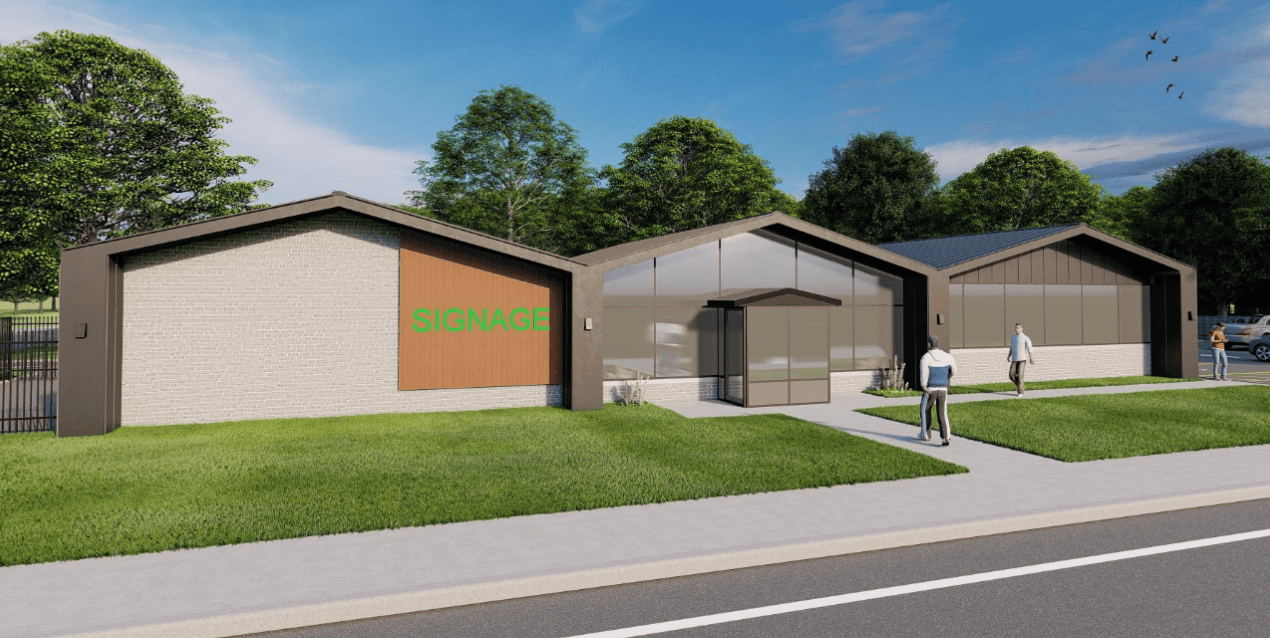
Applicant proposed renderings depict a substantially renovated, landscaped commercial building. The conceptual drawing contains a placeholder marked “SIGNAGE” where the Flower & Pot name would go.
Photographs of the existing property provide context not readily apparent in the rendering: small residential properties sit immediately beside and behind the proposed dispensary site along Delway Road.
The project did not receive a specific vote of the Cranston City Council.
Ancora submitted its development application on December 15, 2023. Three days later, the City Council adopted a citywide ordinance restricting future cannabis retailers and hybrid retailers to M-1 and M-2 industrial districts.
The ordinance was sponsored by Mayor Kenneth Hopkins and approved 7–2.
The former Pizza Hut property is zoned C-1 commercial—not M-1 or M-2 industrial, the only districts in which Cranston’s current ordinance permits cannabis retailers.
During the council discussion, Assistant City Solicitor John Verdecchia warned that applicants might attempt to establish rights under the city’s existing rules before the new ordinance took effect. Council members asked whether any applications had already been filed, but Verdecchia said he did not know.
Council President Jessica Marino said businesses moving forward without a state cannabis license were proceeding “at their own peril.”
On January 16, 2024, Cranston’s building official issued Ancora a zoning certificate concluding that the newly adopted restriction did not apply to the Reservoir Avenue project. The apparent basis was that Ancora’s earlier application had vested under the previous rules.
The following day, Cranston’s Development Plan Review Committee approved the preliminary plan by a 3–0 vote, with one member recused. That was municipal development approval. It was not authorization to sell cannabis and was not a state cannabis license.
Traffic analysis relied on a restaurant comparison
Traffic was raised during Cranston’s January 2024 review, but the analysis presented by the applicant did not evaluate an operating cannabis dispensary directly.
Ancora’s traffic engineer, Derek Hug, compared the expected activity with that of a fast-casual restaurant previously permitted at the property. He projected a maximum of approximately 35 trips during the morning peak hour and 20 during the evening peak hour.
The public record does not establish whether those projections accounted for the purchasing patterns of an adult-use cannabis retailer, including customer turnover, online-order pickups, security procedures, product deliveries or the possibility of unusually heavy traffic when a new store first opens.
This is significant because Flower & Pot would apparently be Cranston’s first recreational cannabis dispensary open to the general public.
The site plan proposed 23 parking spaces, although the city calculated that 12 were required. Ancora also projected approximately 15 to 20 employees working during a shift.
That creates an obvious capacity question. If most employees drove separately and parked on the property, they could occupy much of the proposed parking before customer vehicles arrived.
City staff raised the possibility of off-site employee parking, but the public minutes do not document a final off-site parking arrangement.
The applicant said security personnel would help manage circulation and vehicles. Proposed daily operating hours discussed at the hearing were 9 a.m. to 7 p.m.
The property has access near Delway Road, where small homes sit immediately beside and behind the commercial parcel.
William Scott of Delway Road told the committee that traffic had not been adequately addressed. John Bartlett and Jose Fernandez spoke in support, and Ancora said five neighbors had signed a petition favoring the project.
The engineer reported no crashes at the site and four crashes at the Delway Road intersection during the preceding three years. One involved an injury; none was fatal.
The Development Plan Review Committee approved the preliminary plan with several traffic-related conditions. Ancora was required to address parking calculations, space dimensions, curb cuts and pavement markings; install left-turn-only arrows and a “No Right Turn” sign at Delway Road; and consider a physical sweep or other barrier preventing vehicles from turning right onto Delway, subject to review by the fire marshal.
Those conditions indicate that the committee recognized the potential for dispensary traffic to enter the residential street.
The documents reviewed by RINewsToday do not show a city-commissioned independent traffic study or an analysis based on actual operations at a comparable Rhode Island cannabis dispensary. The principal projections were presented by the applicant’s engineer using a restaurant comparison.
Traffic figures from the Thomas C. Slater Compassion Center on Corliss Street in Providence are not publicly available. At a March 28, 2023 Warwick Board of Public Safety meeting, Chairman Anthony Benson said he had seen “a lot of traffic problems with the one on Jefferson Boulevard.” At that time, Warwick – which has TWO locations – was said to be doing 3,100 per day—citywide. The Jefferson Blvd. location has since relocated within Warwick.
Cannabis retail can generate very heavy, repeated short-duration vehicle turnover, even if statewide rules do not prohibit a prominent main-road location.
Before Flower & Pot could open, Cranston and the state should clarify:
- how many employees would park at the site;
- whether enforceable off-site employee parking has been secured;
- the expected number of customer visits per day and during peak periods;
- how online pickups and product deliveries would operate;
- whether vehicles would be physically prevented from entering Delway Road;
- and how the restaurant-based projections would change for a public cannabis retailer.
Current Cranston law would prohibit this location
The proximity of the proposed dispensary to neighboring homes raises an unusual legal and public-policy question. Cranston’s current zoning ordinance states that no cannabis retailer or hybrid cannabis retailer may be located within 400 feet of a residential zoning district or a property being used as a residence.
The distance is to be measured directly from the nearest residential property line to the nearest portion of the building used for the cannabis business.
Photographs taken by RINewsToday show small homes immediately beside and behind the proposed Flower & Pot property along Delway Road. They appear to be well within the 400-foot residential separation Cranston now requires, although RINewsToday has not independently measured the distance.
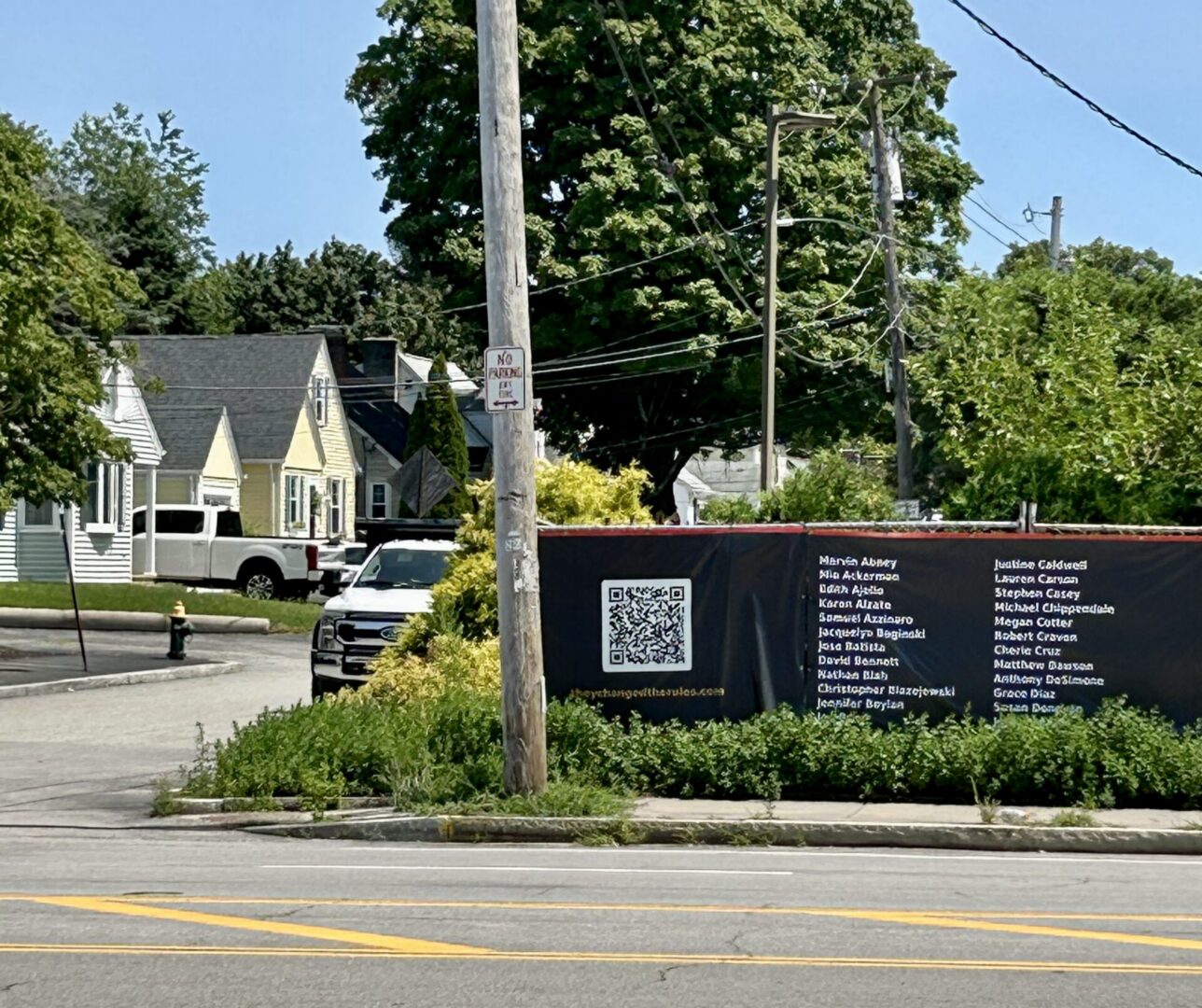
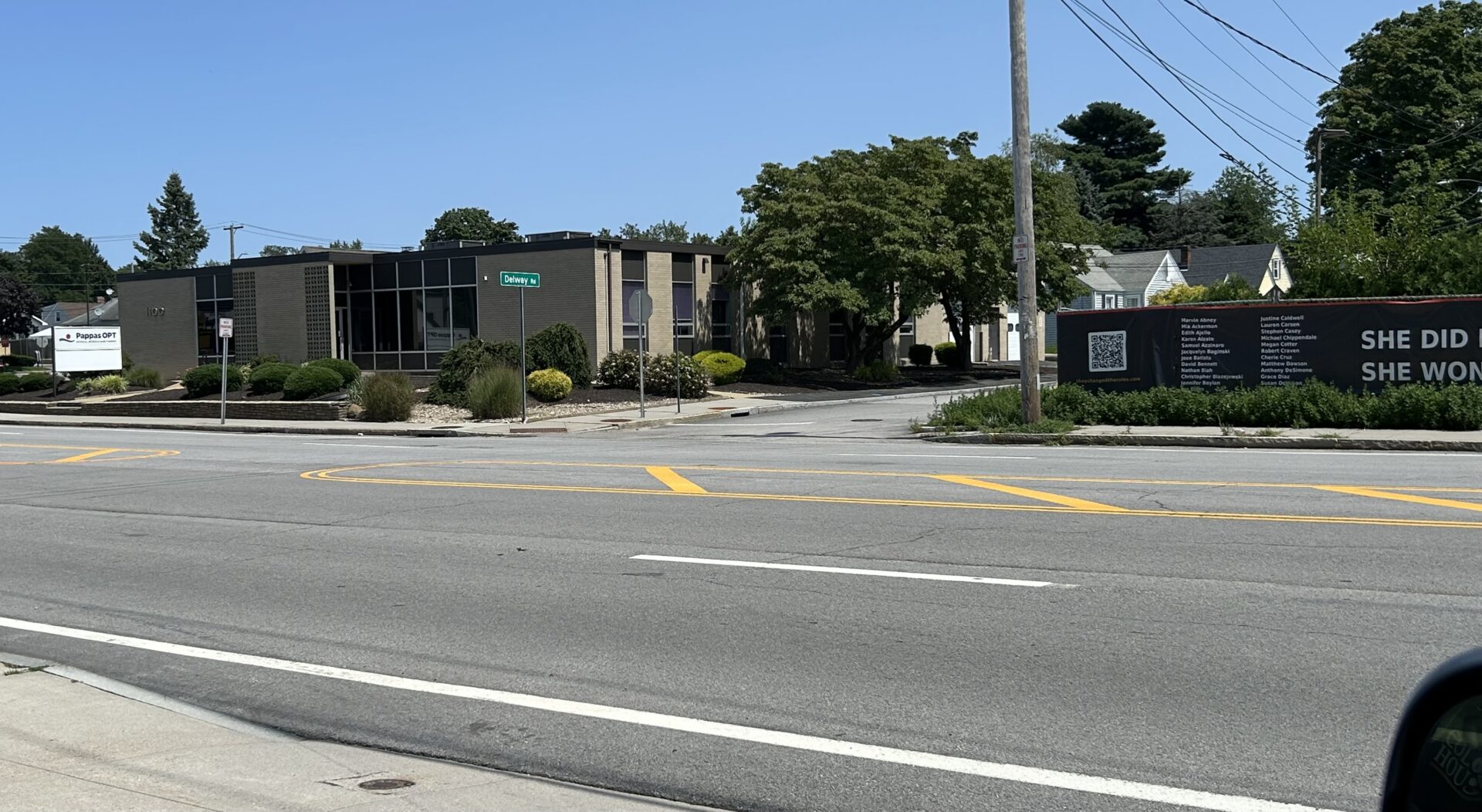
PHOTO: HOMES ON DELWAY ROAD/CLOSE BY MEDICAL OFFICE
Small homes along Delway Road sit immediately beside the proposed cannabis-retail property at 1112 Reservoir Avenue. Cranston’s current ordinance generally prohibits cannabis retailers within 400 feet of a residential district or residential use. City officials determined that Ancora’s application preceded—and was not governed by—the new restriction. Across Delway is a physical therapy treatment office. Photo/RINewsToday.
Under Cranston’s current ordinance, a newly filed application for a cannabis retailer at this location would appear to be prohibited.
The ordinance also restricts cannabis retailers to the city’s M-1 and M-2 industrial zones. The former Pizza Hut property is in a C-1 commercial zone.
Ancora avoided both restrictions because of timing.
The company’s municipal development application is dated December 15, 2023. The City Council adopted the new cannabis restrictions three days later, on December 18.
During the council meeting, Verdecchia warned that an applicant might attempt to establish conformity under the previous rules before the ordinance became effective. Council members specifically asked whether any cannabis applications had already been filed, but Verdecchia said he did not know.
On January 16, 2024, Cranston’s building official issued Ancora a zoning certificate determining that the newly enacted cannabis restrictions did not apply to the Reservoir Avenue proposal. The following day, the Development Plan Review Committee granted preliminary approval.
The city’s apparent conclusion was that Ancora’s December 15 submission had vested the project under the rules in effect before the council’s December 18 vote.
As a result, Flower & Pot is being treated as exempt from a residential-separation rule that Cranston now imposes on later cannabis-retail applications.
State regulations do not supply an equivalent residential buffer. Rhode Island requires an adult-use cannabis establishment to remain at least 500 feet from a preexisting public or private school, but the state rules reviewed by RINewsToday do not establish a minimum distance from private homes.
The state instead requires applicants to obtain municipal zoning approval and comply with local siting restrictions.
The unresolved questions include:
- Was Ancora’s December 15 submission sufficiently complete to vest the project?
- What did city officials know about the application when the council discussed possible last-minute filings three days later?
- Why was the council not told that this particular application had been submitted?
- Does the January 16 zoning certificate remain valid after the state nullified the licensing process for which Ancora applied?
- If Ancora must submit a new state application, does that also reopen municipal review under Cranston’s current 400-foot residential buffer?
- Can an applicant preserve local zoning rights indefinitely when the related state license was never issued?
That final question may become decisive.
Ancora argues that its original state application and municipal approvals must be preserved. If a court instead determines that the company must begin again, Cranston may have to decide whether the Reservoir Avenue proposal remains vested—or whether the present prohibition against cannabis retail within 400 feet of homes controls.
Any others in Cranston?
Cranston already hosts four licensed cannabis cultivators—RI Cultivation Company, Emerald Leaf Organics, Tier 401 and Ocean State Botanicals—but none sells cannabis directly to the public. Cranston also has Sherlock Hemp Farms, licensed for industrial hemp. The proposed Flower & Pot dispensary would be Cranston’s first retail cannabis store open to adult consumers.
What made Ancora a social-equity applicant?
Under the former regulations, one path to social-equity status required at least 51% ownership and control by one or more people who had lived in a designated disproportionately impacted area for at least five of the preceding ten years.
The qualifying business did not have to be located in that same area. The Cannabis Control Commission’s own guidance expressly allowed a social-equity retailer to locate elsewhere.
Neither 1112 Reservoir Avenue nor Pontarelli’s presently identified place of residence appears to fall within a disproportionately impacted area on the commission’s interactive map.
That does not resolve the question because the regulation looked back over ten years, and Pontarelli could have lived at another qualifying address during that period.
Ancora says its qualifying woman had lived in one of the neighborhoods most heavily affected by cannabis enforcement. It has not publicly identified the census tract or years of residence on which that assertion is based.
Nor has Ancora released a commission document showing precisely how its social-equity certification was approved.
The former regulations required applicants to disclose ownership shares, control, financing arrangements and agreements that could affect control. Those materials are important because the public list identifies interest holders but does not disclose how much of Ancora each one owns.
Another unexplained name appears in Cranston’s records.
During the January 2024 city review, Lasondra Pontarelli was identified in the minutes as a “principal” of Ancora Partners. She does not appear on the Cannabis Control Commission’s subsequent public list of Ancora interest holders.
Ancora has not explained Lasondra Pontarelli’s relationship to Lisa Pontarelli or her role in the company.
Did Ancora spend $500,000?
Ancora’s website says its partners invested more than $500,000 of their own capital. It also says Pontarelli took out a loan and faces possible bankruptcy.
The company has not publicly provided a breakdown showing how much was spent on rent, design, construction, permitting, professional fees, security, equipment or other costs.
In April, Pontarelli described the collective investment more generally as “at least six figures.” That is not necessarily inconsistent with the present $500,000 claim, particularly if costs continued to accumulate, but the amount has not been independently verified.
The company also projects that the dispensary would generate approximately $300,000 annually for Cranston through the local 3% cannabis tax.
That figure depends on assumed future sales and is not guaranteed revenue.
The banners become another dispute
Ancora installed the banners on July 18.
On July 22, Cranston’s building and zoning official contacted the property owner and demanded that the banners be removed immediately, warning that the city might remove them and place a lien on the property.
Ancora refused and sought assistance from the American Civil Liberties Union of Rhode Island.
The city subsequently acknowledged that the banners might qualify as political signs, which are treated differently from ordinary commercial signs.
It then raised two other issues: whether the banners interfere with required intersection visibility and whether the fabric displays require a building permit and engineered wind-load calculations.
Ancora calls those changing enforcement theories an attempt to suppress its political speech. The city has raised them as zoning and public-safety concerns.
The banners remain in place.
The cannabis fight meets Cranston politics
Ancora is represented by former Cranston Mayor Allan Fung. That creates a significant political overlap.
Rep. Christopher Paplauskas, the Republican who represents House District 15, voted for H8544 on June 4. Gov. McKee signed it June 10.
On June 24, Fung announced that he had left the Republican Party and would challenge Paplauskas for the District 15 seat as an independent. The district was previously represented by Fung’s wife, Barbara Ann Fenton-Fung, having defeated Rep. Nicholas Mattiello.
The proposed dispensary sits in House District 16, represented by Democrat Brandon Potter, who voted for H8544. Republican Rep. Chris Paplauskas, whom Allan Fung is challenging in neighboring District 15, also voted for the measure—but Paplauskas does not represent the Reservoir Avenue property.
Ancora’s banners and website name Paplauskas among the lawmakers who voted for H8544 and tell voters to “vote them out.”
Fung is therefore representing a client whose public political campaign urges voters to defeat one of his election opponents. There is no evidence presently establishing that Fung entered the race because of H8544, directed Ancora to install the banners or coordinated his legislative campaign with Ancora’s political effort.
The timing and overlapping legal, business and electoral interests nevertheless warrant disclosure and questions for both candidates.
Paplauskas is also regarded as a possible candidate for Cranston mayor in 2028, when Hopkins will be term-limited. Whether that potential race has anything to do with the current dispute has not been established.
Kim Ahern, candidate for RI Attorney General, former Chair of Cannabis Commission, and the existing dispensaries
Ancora places part of the blame for the delay on former Cannabis Control Commission Chair Kim Ahern, who resigned in October 2025 and is now seeking the Democratic nomination for attorney general.
Ahern chaired the commission during a prolonged rulemaking and implementation period. She did not select the Reservoir Avenue site, participate in Cranston’s municipal approval or sponsor H8544.
Ancora’s website alleges that state delays protected Rhode Island’s existing cannabis retailers and highlights campaign contributions from cannabis interests to McKee and Ahern.
The contributions and the continued financial benefit enjoyed by incumbent retailers are legitimate subjects for examination. They do not, by themselves, prove that Ahern, McKee or an existing dispensary delayed licensing to target Ancora or protect particular businesses.
One incumbent dispensary has a separate reality-television connection.
RHORI cast member Liz McGraw has publicly described herself and her husband as owners of the Thomas C. Slater Compassion Center in Providence, although a state filing identifies her as dispensary sales manager with no operational control or ownership.
The center is named for the late Rep. Thomas C. Slater, father of H8544 sponsor Scott Slater.
No evidence has been found showing that the Slater Center requested H8544, participated in drafting it or has any ownership connection to Ancora.
Likewise, no documented relationship has been established between Lisa Ann Pontarelli and RHORI cast member Rulla Nehme Pontarelli. Rulla acquired the surname through her husband, Brian Pontarelli. Neither Rulla nor Brian appears on the state’s list of Ancora interest holders.
What happens next?
Ancora’s lawsuit, Ancora Partners LLC d/b/a Flower & Pot v. Rhode Island Cannabis Control Commission, is pending in Providence County Superior Court.
The company wants the court to preserve its prior application and social-equity status and prevent the commission from forcing it to start again.
The commission is moving toward a new licensing process under H8544.
If Ancora cannot satisfy the revised social-equity criteria, it may have to seek another category of retail license, restructure its ownership or prevail in court to preserve its former position.
For now, the former Pizza Hut remains closed. The state has issued no license authorizing Flower & Pot to sell cannabis there.
The large black and red banners cover the building, complete with a QR code, and tell motorists that a woman won a license and had it erased.
Cranston moved to have the banners removed
According to correspondence published by Ancora Partners, Cranston’s Building and Zoning Office emailed the property’s landlord on July 22, directing that the banners be removed immediately. The email warned that otherwise the city might remove them and place a lien on the property.
Ancora refused, characterized the banners as protected political speech and requested assistance from the ACLU of Rhode Island.
In a follow-up letter, the city said the banners “may be considered political signs” after consultation with the city solicitor. The city nevertheless raised two additional concerns: whether the banners interfere with the required visibility area near the Delway Road intersection and whether the large fabric installations require a building permit and engineering documentation showing they can withstand wind loads.
Ancora disputes those requirements and has said the banners will remain. Photographs taken July 25 show that they were still in place.
The documented story is narrower but still consequential: Lisa Ann Pontarelli and her partners spent heavily preparing a business under one set of rules, given the cautions of local officials; Rhode Island delayed the rollout and then discarded the process before issuing the company a license.
Whether that amounted to an unlawful deprivation, an avoidable government failure or a financial risk undertaken before final approval is now a question for the courts—and for voters encountering the names printed across Reservoir Avenue.
This is a developing story
It sounds like the City of Cranston should have had their facts and records updated before they had their hearings! The City’s legal representative should have known whether there were any pending applications at the time of the council meeting! The new owners relied on the information that was available to them at the time and followed the rules! This is another example of why the State of RI is listed as 48th in the country to do business in!
No, this was the state licensing – not the city – and the state that changed the ground rules. If you saw it in the article, the council tried to warn the woman developer that nothing had approved it officially, but she insisted on pursuing the opportunity,
I really don’t care anymore but it was Marino who said “at their own peril”. She seemed to know quite a bit for a council person (I won’t get into the pool and what was done to Aneice Germain who actually represented her constituents).
So I’ll go into a minor detail about traffic. “install left-turn-only arrows and a “No Right Turn” sign at Delway Road; ” I’m assuming (and I do know what assume means) the left turn would be on Reservoir, heading south on Rt. 2 and the No right turn onto Delway would be Reservoir, heading north on Rt. 2.
Because I live in this neighborhood, I always take a right on Delway to avoid the light at Taco Bell. It’s too narrow and I’ve had too many close calls trying to turn that corner. Aqueduct Rd. is now like a freeway. These people never saw a stop sign they couldn’t outrun (unless the CPD is sitting in front of my house. It’s a money maker for the City.)
I honestly don’t care what goes in. Based on the timeline, I would say the owner wins. Everything was up to date. All they needed was the license. They should be grandfathered in.
Fortunately, I’m out of this side of Cranston in 2 weeks, Unfortunately, I’ve waited for 6 years to use the pool and now won’t be around to walk over for a dip. You win some, you lose some.
Pool is open until the end of August – please go – it is quite the experience – nothing like it that we’ve seen…even just to watch the glee of the chiildren – opens at noon
Is Robert Coupe (one of 3 investors listed in article ) on Cranston’s planning commission ? Of course they voted for this.
Yes, Robert Coupe is the Vice President of the Cranston Planning Commission. Steven Frias is the President.