
Subscribe!

Georgia poll once again shows tightest races rest on Voters Over 50 – Herb Weiss
By Herb Weiss, contributing writer on aging issues
With just over three months until the 2026 midterm elections on Tuesday, Nov. 3, control of both the U.S. House and Senate chambers could hinge on the gray vote—Americans age 50 and older—one of the nation’s most reliable voting blocs.
That was the key takeaway message delivered during AARP’s July 23 virtual media briefing, where the Washington, D.C.-based organization released the findings of its latest bipartisan battleground-state survey examining Georgia’s closely watched and contested governor’s and U.S. Senate races.
According to AARP, Georgia is the second state in its 2026 battleground polling series, following Ohio, whose survey was released on June 25. Additional surveys are scheduled for Alaska, Arizona, Maine, Michigan, New Hampshire, North Carolina and Texas to be released before the upcoming midterm elections. The bipartisan polling team of Fabrizio Ward (R) and Impact Research (D) was commissioned to conduct these surveys.
The Georgia poll findings suggest that voters age 50 and older are once again poised to play a very decisive role in determining the state’s election outcomes in one of the nation’s premier battleground states.
In Georgia’s May 19 primary election, voters age 50 and older cast 68% of all ballots. The survey also found that 88% of voters age 50 and older rated themselves a “10” on a 10-point motivation-to-vote scale, compared with 62% of voters under age 50. These findings reinforce a long-established demographic trend: older Americans remain among the nation’s most dependable and motivated voters and are likely to have a significant impact on the November election.
The Power of the Gray Vote
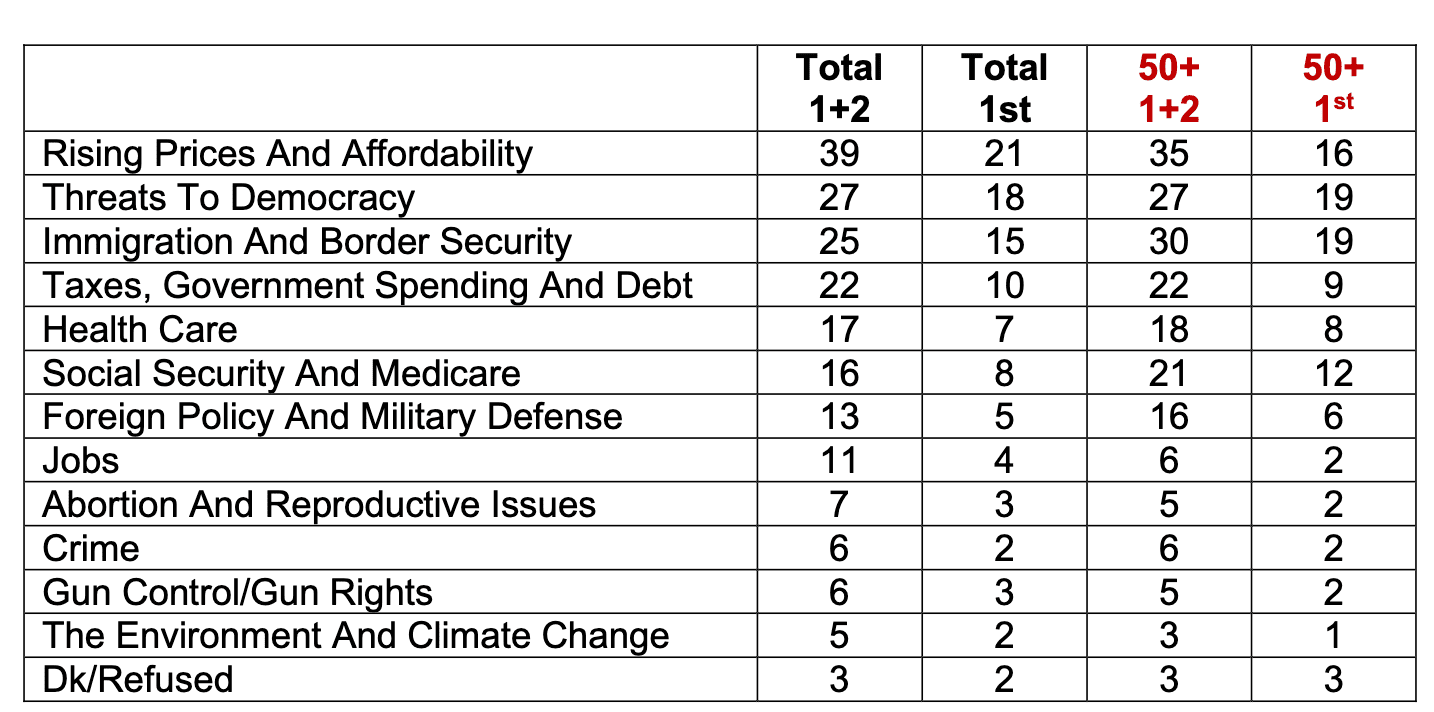
“Voters age 50 and older will decide this November’s Georgia races,” said Nancy LeaMond, AARP Executive Vice President and Chief Advocacy Officer, in announcing the poll’s release. “Candidates who speak directly to the issues these voters care about most—including rising prices, protecting Social Security and Medicare, and lowering health care costs—will have the greatest opportunity to earn their support,” she explained.
During the nearly 30-minute morning briefing, AARP Georgia State Director Vanessa Payne joined Republican pollster Bob Ward of Fabrizio Ward and Democratic pollster Matt Hogan of Impact Research to discuss the poll’s findings and what they reveal about the priorities of older Georgia voters. Jen Jones, AARP’s Vice President of Government Affairs, participated during the Q&A to address questions, particularly around Social Security and retirement security, drawing on broader AARP research beyond the Georgia polls. Ilse Zuniga, AARP’s Director of External Relations, moderated this briefing.
According to the new AARP poll, Democrat Keisha Lance Bottoms leads Republican Rick Jackson, 48% to 46%, in the governor’s race, within the poll’s margin of error. Age remains one of the race’s defining dividing lines. Jackson leads by 13 percentage points among voters age 50 and older, driven by strong support from voters age 65 and older, while Bottoms holds a 23-point advantage among voters under age 50.
The survey also examined Georgia’s competitive U.S. Senate race, one which could prove critical in determining which party controls the Senate. Incumbent Democratic Sen. Jon Ossoff leads Republican Rep. Mike Collins, 52% to 43%. Ossoff enjoys a 30-point advantage among voters under age 50 and a narrow lead among voters ages 50 to 64, while Collins holds a 24-point advantage among voters age 65 and older. The poll’s findings found that age 50 and older remain a key swing constituency, while Ossoff leads among swing voters age 50 and older by 23 percentage points.
Opening the media briefing, Payne emphasized that AARP’s mission is not to predict election winners or tell voters how to cast their ballots.
“Our mission isn’t to tell people how to vote or who will win,” Payne said. “It’s to ensure that the priorities of Georgia’s voters age 50 and older, the largest and most reliable voting bloc in our state, are part of the conversation throughout the election season.”
Payne remarked that Georgia has become one of the nation’s most competitive battleground states, where narrow margins often decide statewide elections.
“One in eight voters over 50 are swing voters, making them one of the most influential voting blocs in this election,” she observed. “Georgians are focused on key issues affecting their daily lives—from protecting Social Security and Medicare to managing the rising cost of living. Candidates who understand those priorities will be best positioned to earn their votes,” she added.
Although older voters represent every political persuasion, Payne noted that they share many of the same concerns.
“What unites them isn’t party affiliation,” she said. “It’s a shared focus on protecting their financial security, maintaining their health and being able to live as independently as possible as they age.”
Democratic strategist Matt Hogan agreed with Payne that voters age 50 and older are likely to determine the outcome of Georgia’s upcoming midterm elections.
“Voters 50-plus will be the deciders in the Georgia election,” Hogan predicted. “The share who say they are extremely motivated to vote is 26 percentage points higher among voters 50-plus than among voters under 50,” he said.
Hogan also pointed to a significant shift in voter sentiment on the generic congressional ballot.
“Democrats now lead by a seven-point margin, with that shift especially pronounced among independents, who now favor Democrats by an 18-point margin on the generic ballot,” he said, noting “That’s a 26-point swing from 2024.”
Link to the survey:
AARP 2026 Georgia Statewide Survey: Annotated Questionnaire
“It’s Social Security & Medicare, Stupid”
Turning to the issues driving older voters, Republican strategist Bob Ward stressed that financial security remains at the center of their concerns. “Seniors, those voters 65 and older, are equally concerned about immigration and protecting Social Security and Medicare, which are very much economic issues for older voters,” Ward explained.
“More than two-thirds of seniors tell us that Social Security makes up a major part of their income. It’s a big deal,” he added. “The importance of Social Security continues to rise to the top and will be just as influential on older voters this fall as rising prices,” he says.
Ward also noted broad bipartisan support for lowering prescription drug costs through Medicare.
“Fighting to lower prescription drug prices by expanding Medicare’s drug price negotiations is a winner on both sides of the political aisle,” Ward said, noting that 87 % of voters say they would be more likely to support a candidate who expands Medicare drug negotiations.
The poll found that among voters age 50 and older, 48% said Social Security is or will become a major source of household income. An overwhelming 92% said they would be more likely to support a candidate who will ensure they receive the Social Security benefits they earned through a lifetime of work.
Reflecting national polling trends, the survey findings indicated that grocery prices remain the affordability issue weighing most heavily on older Georgians.
“Voters in Georgia worry about the price of groceries more than any other issue, and that concern cuts across every political and demographic subgroup,” Ward said.
AARP’s poll also found respondents expressed a growing concern about the impact of expanding artificial intelligence data centers on household utility bills. Seventy-five percent expressed concern that new AI data centers could increase residential electric rates, while 85% said policymakers should ensure those costs are not passed on to residential utility customers.
A Final Note…
AARP’s Georgia battleground poll sends a clear message to candidates running for the U.S. Senate and Congress: older voters remain one of the nation’s most reliable and influential voting blocs. They vote consistently, they are highly motivated, and they are focused on issues that directly affect their financial security and quality of life.
AARP notes that in every election since 2002—the first year voting data by age became available—Americans age 65 and older have voted at higher rates than younger age groups.
Protecting Social Security and Medicare, lowering prescription drug costs, keeping groceries affordable, and controlling rising utility bills are not simply campaign talking points. For many older American voters, they are everyday concerns that will influence how they will cast their ballots in November.
Political observers have long referred to Social Security as the “third rail” of American politics. The phrase comes from the electrified third rail that powers many rail systems—touch it, and the consequences can be fatal. In politics, this metaphor suggests that proposals perceived as threatening Social Security can carry equally serious political consequences. While people usually attribute the phrase to U.S. Sen.Tip O’Neill, William Safire documented in The New York Times that O’Neill’s chief counsel, Kirk O’Donnell, actually coined it.
As voters in Georgia, Ohio, and the other battleground states head to the polls this November, the 2026 midterm elections may once again test whether Social Security remains America’s political third rail. When the dust settles, we’ll see whether older voters reward candidates who they believe will protect Social Security and Medicare—or reject those they believe will weaken these programs.
AARP’s Georgia battleground poll, conducted by the bipartisan team of Fabrizio Ward (R) and Impact Research (D), surveyed 1,060 likely Georgia voters between July 13 and July 16, 2026, using live telephone interviews and SMS-to-web methodology. According to the pollsters, the survey has a margin of error of plus or minus three percentage points.
For more information, contact Kate Bridges at [email protected].
Additional information about AARP’s 2026 battleground polling series is available at https://www.aarp.org/pri/topics/voter-research/politics/2026-midterm-election-polls/?msockid=31611274a2d760231f7a0578a3f86192.
___
To read more articles by Herb Weiss, go to: https://rinewstoday.com/herb-weiss/

Herb Weiss, LRI, 12, is a Pawtucket-based writer who has covered aging, healthcare, and medical issues for more than 45 years. To purchase his books, Taking Charge: Collected Stories on Aging Boldly and its two sequels, visit herbweiss.com.
