
Subscribe!
Ask Chef Walter: Thomas Jefferson’s Macaroni Machine – Walter Potenza
by Executive Chef Walter Potenza, contributing writer
How the third president brought a European kitchen tool home to Monticello — and how history has since dressed up his role in America’s love affair with macaroni and cheese
Friends,
This week, we’ll step back into some fascinating history which I find very interesting considering that for decades we have been confronted with the myth of the Mac + Cheese initial discovery. So, let’s look into the chronology.
At a formal dinner at the President’s House in 1802, guests accustomed to plain American fare found something unfamiliar on the table: pasta, baked in a crust with a rich sauce. The Reverend Manasseh Cutler, a guest that evening, later recorded his impression of what he called a “pie called macaroni”—strongly flavored and not entirely to his taste. Some diners hesitated over the unfamiliar dish; others praised its richness. At the head of the table sat Thomas Jefferson, one of early America’s most enthusiastic advocates for pasta.
Jefferson’s fascination with macaroni was not a passing curiosity. It sent him searching for the right equipment to make it, inspired one of his hand-drawn inventions, and left behind a paper trail — recipes, sketches, purchase notes — that historians still consult today. But it has also produced one of the most persistent myths in American food history: that Thomas Jefferson invented macaroni and cheese. He did not. What he did was help bring pasta-making into elite American dining, and the true story is more interesting.
A Taste Acquired Across the Atlantic
Jefferson’s appreciation for macaroni began in Europe. Serving as the American Minister to France from 1784 to 1789, he developed a taste for French wine, Roman-inspired architecture, and Continental cuisine generally. Italy held a particular fascination for him. During a tour of northern Italy in 1787, Jefferson encountered pasta in its country of origin, where it had been made for centuries, and came away determined to bring the technique home.
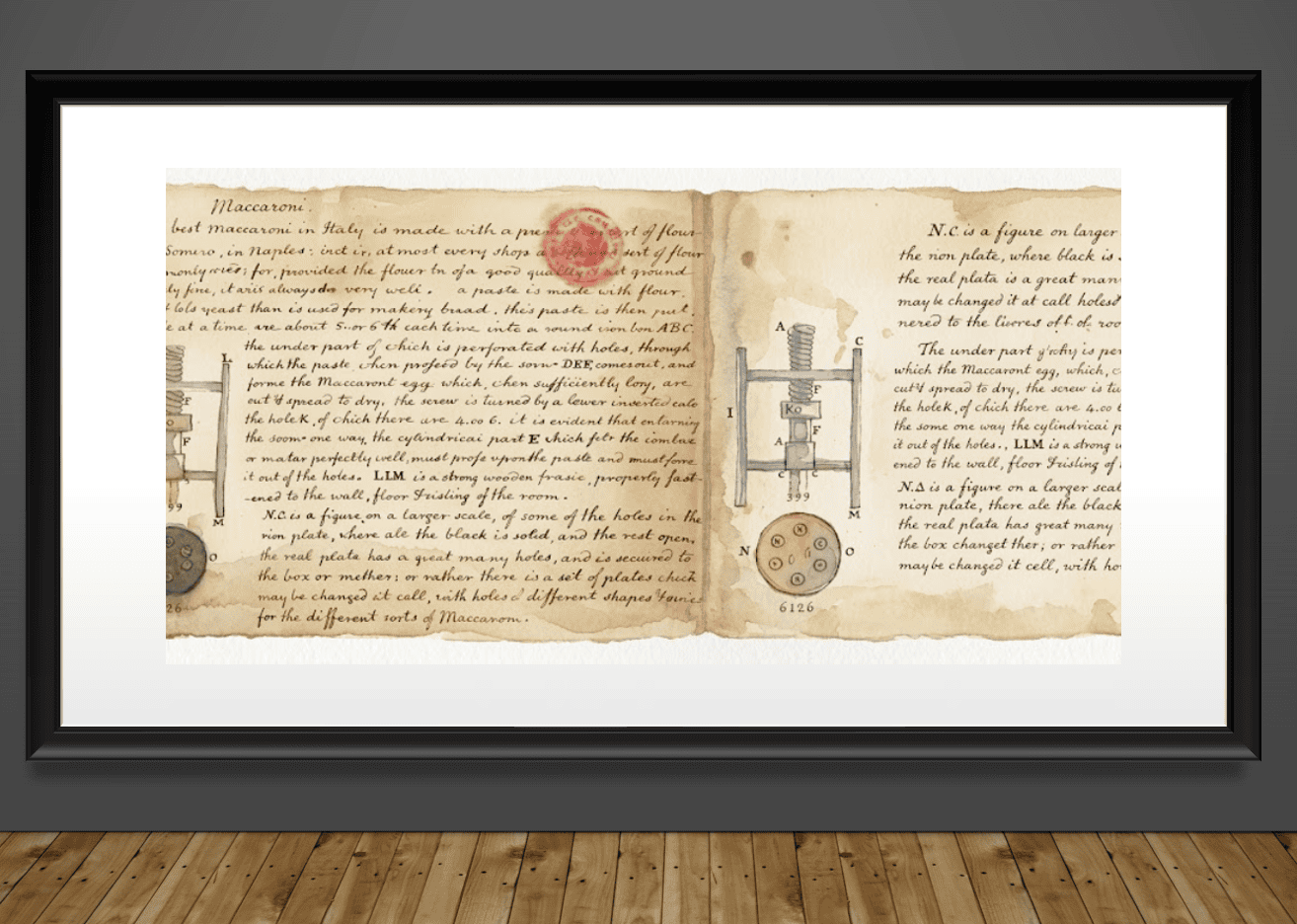
Among Jefferson’s papers at the Library of Congress is a hand-drawn diagram of a pasta-making machine, accompanied by his own notes on its construction. The sketch depicts a device built around a cylindrical chamber, a plunger, and a perforated end plate — the working principle of a modern pasta extruder. Jefferson labeled each part and recorded exact measurements, matching the rigor he brought to his other inventions.
“Jefferson was, above all, a product of the Enlightenment — a man who believed reason and mechanical ingenuity could improve daily life, one gadget at a time.”
Rather than build the machine himself, Jefferson acquired a “mold for making maccaroni” from Naples, along with his own notes and drawing of how such devices operated. A handwritten recipe for fresh pasta noodles, attributed to Jefferson, ends with instructions to “dress them as maccaroni” — that is, to layer the cooked noodles with cheese and butter. Historians believe the recipe itself was likely dictated by one of his enslaved chefs rather than composed by Jefferson’s own hand; both the recipe and the machine’s drawing survive today in the Library of Congress and Monticello archives.
The Machine Comes to America
Upon his return to the United States in 1789, Jefferson brought his taste for macaroni with him and is widely credited with helping popularize it among the American elite. As Secretary of State under George Washington, and later as Vice President, he served the dish at his own dinner parties, introducing guests to a food most had never encountered.
At Monticello, Jefferson’s Virginia estate, macaroni was produced using the imported extruder. Dough made from semolina flour and water was pressed into a barrel, where a screw or plunger forced it through a brass or iron plate fitted with shaped holes, producing uniform tubes of pasta that were then dried before cooking. According to Jefferson’s own sketches, the resulting noodles were closer in thickness to modern rigatoni or large penne than to the slender macaroni sold today.
Jefferson’s chef, James Hemings, who had trained in French cuisine during the household’s years in Paris, was especially skilled at preparing macaroni and similar dishes. Hemings and the other enslaved cooks at Monticello did the essential work of adapting and refining these European techniques, and their skill was central to the reputation Jefferson’s table would come to enjoy.
Macaroni at the President’s Table
After his election to the presidency in 1801, Jefferson relocated to the Executive Mansion and continued to prioritize ambitious, internationally minded cooking. Working alongside his French chef, Honoré Julien, he served macaroni regularly to senators, diplomats, and other guests, many of whom, like Reverend Cutler in 1802, were tasting it for the first time. Whatever Cutler made of the dish personally, the episode shows how novel macaroni still was to most Americans at the turn of the nineteenth century.
Jefferson’s interest in pasta was not purely gastronomic. As a lifelong advocate for American agriculture, he saw macaroni as a way to put domestically grown wheat to good use. A nutritious, economical dish made from local grain, he believed, could benefit American farmers and reduce the nation’s reliance on imported food — a small piece of his broader vision of a self-sufficient agrarian republic.
Setting the Record Straight
For all of this, Thomas Jefferson did not invent macaroni and cheese, and he was neither the first person to bring pasta to American shores nor the first American to eat it. Baked combinations of pasta and cheese appear in medieval European cooking, and a printed recipe for a dish very like it was published in Elizabeth Raffald’s The Experienced English Housekeeper in 1769 — well before Jefferson’s diplomatic posting to France. By the time he arrived in Paris in 1784, baked pasta with cheese was already an established part of French culinary tradition. Jefferson’s role was later and narrower: he helped popularize the dish among elite Americans.
Pasta had likewise reached American shores independent of Jefferson. Italian immigrants, merchants, and French-trained chefs in port cities such as Philadelphia, New York, and Charleston were preparing and eating macaroni by the mid-1700s, and colonial cookbooks of the period include recipes for macaroni and similar pasta dishes, particularly among affluent households along the East Coast. As Monticello’s own historians have put it, Jefferson did not invent macaroni and cheese, nor did his enslaved chef James Hemings — but its appearance on the White House menu was, at the time, seen as a genuine novelty. The myth comes from Jefferson’s prominence, not from the dish’s origins.
What Jefferson did do was help move the dish from a regional curiosity to a fixture of elite American dining, through his own enthusiasm, his imported equipment, and his household’s culinary skill. The dish’s wider popularity came later, spread through Southern cookbooks — most notably Mary Randolph’s The Virginia Housewife, published in 1824 — which carried macaroni and cheese from elite tables into home kitchens across the country. From there it became one of the most enduring dishes in the American repertoire. This is the historical correction that matters.
A Legacy in Flour and Water
Jefferson’s drawing of the macaroni machine is, in its own small way, a window into the man himself. Amid his work on constitutions, land surveys, and architectural plans, he found time to sketch the inner workings of a pasta extruder in careful, engineer’s detail — a reminder that the Founders’ curiosity extended well beyond the political questions for which they are remembered.
Today, when an American family sits down to a bowl of macaroni and cheese, they are connected, in a small way, to that curiosity — to a Virginia estate, a Neapolitan mould, and the skill of the enslaved cooks who turned Jefferson’s imported machine into a dish worth remembering. The machine later went industrial, but the basic idea has not changed: dough pressed through a mold, becoming something new.
Walter Potenza
(Sources + References upon Request)
(Heading Image of Jefferson’s initial design, via The Library of Congress.)
___
READ “Ask Chef Walter” every Sunday in RINewsToday

Master Chef Walter Potenza
There is a constant, recognizable thread in the career of Walter Potenza to elevate the level of Italian culinary culture in the United States. Besides his unquestionable culinary talent and winning business perspective, Chef Walter has been a relentless educator with passion and knowledge who defeats stereotypes. His life, career, and values are a model, an example to follow by any chef of Italian gastronomy working outside Italy.
Chef Walter appears regularly on National and International Networks such as Food Network, ABC, CBS, NBC, RAI, FOX, and Publications such as NY. Times, Washington Post, Wall Street Journal, Food & Wine, Saveur, Gourmet, and several Italian media outlets.