
Subscribe!
HHS launches federal Tick initiative in New Hampshire as Rhode Island heads into peak Lyme season
By RINewsToday News Team
Tick season is not waiting for summer — and the federal government is moving more aggressively on Lyme disease and other tick-borne illnesses.
On May 29, U.S. Health and Human Services Secretary Robert F. Kennedy, Jr. was in Concord, New Hampshire, to launch a new federal initiative aimed at Lyme disease, tick control, Alpha-gal syndrome, diagnostics, research, patient care and provider access.
The location was significant. HHS described New Hampshire as “one of the states hardest hit by Lyme disease,” and Kennedy made the announcement after convening a roundtable with state lawmakers and Lyme disease advocates as part of his “Take Back Your Health” tour.
The announcement came as the Centers for Disease Control and Prevention is already warning that emergency room visits for tick bites are running higher than normal in many parts of the country. In all U.S. regions except the South Central United States, CDC says weekly rates of emergency room visits for tick bites are the highest for this time of year since 2017.
For Rhode Island, the timing is especially relevant. The state remains a high-risk area for Lyme disease and other tickborne illnesses, with cases typically rising during the warmer months.
According to the Rhode Island Department of Health, Rhode Island had 2,563 cases of Lyme disease in 2024, with a statewide incidence rate of 233.6 cases per 100,000 people. Washington County consistently has the highest Lyme disease rate in Rhode Island, with a 2024 rate of 723 cases per 100,000 people. RIDOH says most Lyme disease cases are reported during the summer months, with a peak in July.
Rhode Island also reported 86 cases of anaplasmosis in 2024, with a rate of 7.8 per 100,000 people, and 161 cases of babesiosis, with a rate of 14.7 per 100,000 people. Babesiosis is most commonly reported in older male adults, and Washington County again had the highest rate, with 38.5 cases per 100,000 people in 2024.
RIDOH notes that babesiosis in Rhode Island peaks in the summer months, with 80 percent of cases occurring between June and August in 2024.
Rhode Island has had 79 confirmed cases of Alpha-gal syndrome, to date.
What HHS is launching
HHS called the new effort a major federal response to Lyme disease and other tick-borne illnesses.
The initiative includes a multi-million-dollar tick-control pilot program, up to $2.5 million in innovation challenges, NIH-supported work on Alpha-gal syndrome, and a public-private collaboration to help patients connect with experienced Lyme disease providers.
Kennedy said HHS is trying to address Lyme disease “at its source,” with faster diagnostics, new prevention strategies and more urgent action for patients and families.
One of the most notable pieces is the new tick-control pilot. HHS says the pilot will be led by CDC and HHS in collaboration with tick-control researchers. The goal is to develop and deploy practical strategies to target and eliminate ticks on wildlife before they can spread disease to people.
That approach is important in New England, where ticks move through the environment on deer, mice and other wildlife before people encounter them in yards, woods, fields, trails, leafy edges, parks, campgrounds and other outdoor spaces.
HHS says the work will begin with researchers at the New England Center of Excellence in Vector-Borne Diseases in Amherst, MA and will build on community collaboration, including work with the Indian Health Service and the Wampanoag Tribe in Massachusetts.
The department also reaffirmed a national goal of reducing Lyme disease cases by 25 percent by 2035 compared with 2022 levels.
LymeX, diagnostics and AI
HHS is also expanding attention on LymeX, the Lyme Innovation Accelerator.
The agency announced three new LymeX innovation challenges offering up to $2.5 million in total prize funding. The challenges are focused on public awareness, treatment and patient care, including educational tools, possible drug-repurposing strategies, and technology to help patients with Lyme disease and other invisible illnesses get answers and access care more quickly.
One challenge, the TOPx HHS Tech Sprint for AI and Invisible Illness, offers up to $2 million in prizes, including a $1 million grand prize, to use artificial intelligence and open data to support patients with Lyme disease and related chronic conditions.
HHS also says LymeX recently launched a $10 million Diagnostics Prize aimed at faster and more accurate Lyme disease testing. According to HHS, two improved FDA-cleared Lyme disease diagnostics have reached the market through the LymeX innovation ecosystem over the past two years.
HHS says NIH currently invests nearly $50 million annually in Lyme disease research and approximately $122 million annually in broader tick-borne disease research, including prevention, diagnostics and treatment.
Alpha-gal syndrome now part of the federal response
The new HHS initiative also includes Alpha-gal syndrome, a tick-associated condition that can cause allergic reactions to red meat and other mammalian products.
Alpha-gal syndrome has been linked most often to the lone star tick, which has expanded its range northward, though researchers continue to study the full pattern of risk. Symptoms can appear hours after eating beef, pork, lamb, venison or related products, and may include hives, stomach upset, swelling, breathing problems or, in severe cases, anaphylaxis.
HHS says CDC estimates nearly 500,000 Americans are living with Alpha-gal syndrome, though emerging evidence suggests the true number may be higher.
HHS says NIH has preliminarily identified promising private-sector products that may help protect people from developing Alpha-gal syndrome after a tick bite. Under the anticipated collaboration, participating companies would provide candidate products, while NIH would support and fund clinical research to evaluate their effectiveness. More details are expected in the coming months.
In Rhode Island and Southern New England, the blacklegged tick — often called the deer tick — remains the major concern for Lyme disease and several other tickborne infections. Lone star ticks, however, have increasingly become part of the tick conversation in the Northeast.
To date, Rhode Island has had 79 confirmed cases of Alpha-gal syndrome, though reporting is not required.
Patient access and chronic symptoms
The HHS announcement also speaks directly to patients who say they have struggled to find answers after Lyme disease or other tick-borne illnesses.
HHS has launched a Lyme disease information page describing Lyme as a tick-borne infection that can lead to chronic, often invisible, multi-system illness. The agency says that even after treatment, some patients may develop persistent fatigue, pain, cognitive issues, neurological complications and other lasting health problems.
The department is also launching a public-private collaboration with the International Lyme and Associated Diseases Society. Through HHS’ Lyme disease information page, patients will be able to access ILADS’ clinician locator tool to help connect them with clinicians experienced in Lyme disease and related chronic conditions.
That part of the announcement is likely to draw attention because Lyme diagnosis, treatment and long-term symptoms have been debated for years by patients, physicians, researchers and public health officials.
Kennedy also said he supports reauthorization of the bipartisan Kay Hagan Tick Act, which created a coordinated federal strategy for preventing and controlling vector-borne diseases.
Rhode Island’s own tick expert
Rhode Island has one of the country’s best-known tick resources in its own backyard: the University of Rhode Island’s TickEncounter Resource Center.
Led by Dr. Thomas Mather — URI’s “TickGuy” and one of the nation’s foremost tick experts — TickEncounter provides practical, plain-language guidance on tick identification, tick-bite prevention, and what to do after finding a tick. URI’s TickEncounter site also includes tools and videos to help people understand which ticks are active and how to reduce the risk of tickborne disease.
Mather has long emphasized that conditions matter. Ticks do not like dry weather, while damp, shady, leafy areas create more favorable tick habitat. In a URI summer-prevention update, he said Rhode Islanders can often judge tick risk by looking at yard conditions, including whether lawns and surrounding areas are dry or damp.
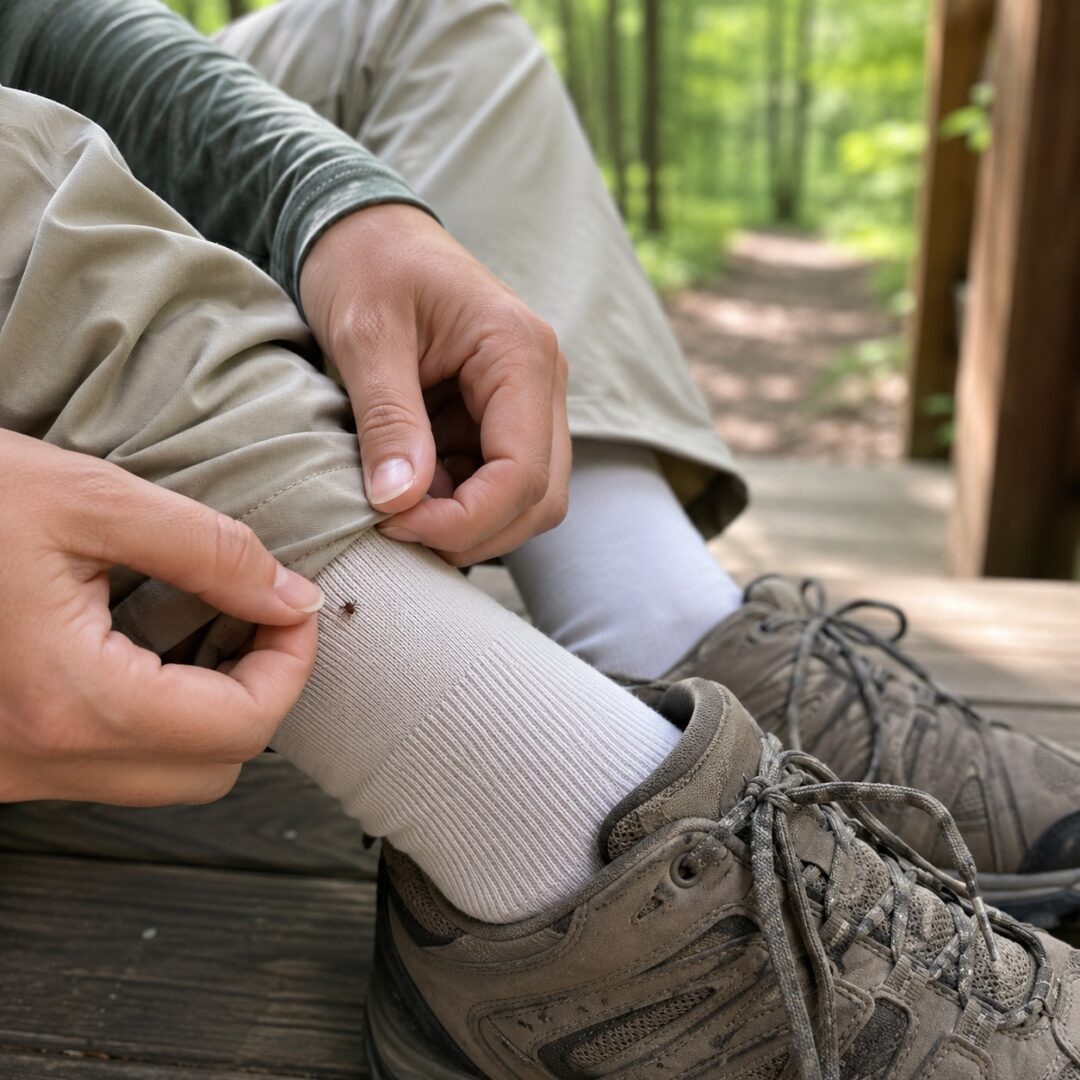
If you find a tick, remove it with tweezers and consider submitting a photo to URI’s TickSpotters. Within 24 hours, TickSpotters can help identify what kind of tick bit you and recommend what steps you should take next.
What to do now
CDC says prevention remains the best form of protection throughout tick season.
Wear long pants and long sleeves in wooded, brushy or grassy areas.
Use an EPA-registered repellent.
Consider permethrin-treated clothing for outdoor activities.
Check yourself, children and pets after being outdoors.
Shower after outdoor activity when possible.
Remove attached ticks promptly with fine-tipped tweezers, pulling straight upward.
Do not wait to go to the emergency room simply to have a tick removed. CDC says removing attached ticks as quickly as possible — ideally within 24 hours — can help prevent Lyme disease.
If you develop a rash, fever, chills, joint pain, fatigue or other symptoms in the days or weeks after a tick bite, seek medical care promptly.
Ticks are not the only warm-weather pest concern. Mosquitoes can breed in small amounts of standing water and may transmit illnesses such as West Nile virus and Zika virus. Stinging insects are also a seasonal risk, especially for people with allergies.
The advice is simple, but important: act early, before pest activity peaks.
Empty standing water from flowerpots, gutters, birdbaths, buckets, outdoor toys and other containers.
Keep outdoor food covered to avoid attracting stinging insects.
Do not try to remove a stinging-insect nest yourself.
The bottom line: check early, check often, and do not assume tick season starts later in the summer. It is already here — and now Lyme disease, Alpha-gal syndrome and tick-borne illness are drawing new federal attention, with New England directly involved.
Now here is an outstanding example of two things:
1. A news source reporting specific information, much-needed and helpful information, about a major, serious situation that can affect almost anyone, rather than reports about personal events that do not concern the wider society, or, presenting commentators and/or comment that merely speculate on what MAY happen in political matters.
2. Government action that has a good chance to be helpful, and an example of when and why governments should act — because government can be effective tackling a problem where the individual or a small group of people could not be effective. This is a very smart, on-target initiative, and I’m glad to see Robert F. Kennedy, Jr. out there being the spokesman.
Thanks for this story.
Thanks, Alan! Much appreciated…