
Subscribe!

RI Assault-Weapons Sales Ban effective today, July 1 — SCOTUS to take up ban constitutionality next session
RI assault-weapons sales ban takes effect July 1 — what it changes, and what gun ownership still allows
NOTE: The U.S. Supreme Court yesterday announced that it has agreed to consider whether state and local assault-weapons bans violate the Second Amendment – which they will do in next year’s agenda – more, below.
Rhode Island’s new assault-weapons sales ban takes effect TODAY – Wednesday, July 1, 2026 – turning one of the state’s most debated gun laws from a State House issue into a practical question for gun owners, dealers and residents thinking about home security.
The law does not ban all gun ownership in Rhode Island.
It does not make every rifle, shotgun, pistol or revolver illegal.
And it does not require people who already lawfully own covered firearms to turn them in.
What the law does do is this: beginning July 1, no person may “manufacture, sell, offer to sell, transfer, or purchase” a firearm that falls under Rhode Island’s new definition of a “prohibited firearm,” unless one of the law’s limited exceptions applies. A violation carries penalties of up to 10 years in prison, a fine of up to $10,000, and forfeiture of the firearm.
The Governor’s office described the law as a ban on the manufacture, purchase, sale or transfer of certain military-style weapons, including certain semi-automatic rifles and shotguns. The office also said lawful owners may continue to possess those firearms and may sell them to federally licensed firearms dealers or to lawful buyers outside Rhode Island.
That distinction is the core of the new law: future in-state sales, purchases, transfers and manufacturing are restricted. Existing lawful possession is treated separately.
Why some dealers warned buyers about June 20
In the days leading up to July 1, gun-rights groups and gun shops warned customers that anyone trying to buy a firearm covered by the new law needed to complete the process early enough to account for Rhode Island’s waiting period.
Rhode Island law generally says a pistol or revolver may not be delivered until seven days have elapsed from noon of the day after the purchase application. The law also requires buyers of pistols or revolvers to be 21 or older and to present a pistol/revolver safety certificate issued by the Department of Environmental Management.
A similar seven-day waiting period applies to rifles and shotguns. Rhode Island law says a rifle or shotgun may not be delivered until seven days have elapsed from noon of the day after the application, and buyers generally must be 21 or older.
That is why some dealers were warning that the practical deadline could come earlier than July 1. If a covered firearm could not legally be delivered before the new law took effect, the transfer may no longer be allowed after July 1.
Is there a printed list of banned guns?
Not exactly. The Rhode Island law does not simply publish one easy make-and-model list of banned firearms. Instead, it defines “prohibited firearm” by type, capacity and features.
That means the question is not only, “What is the brand or model?” It is also: Is it semi-automatic? Does it have a fixed or detachable magazine? How many rounds can the magazine hold? Does it have one of the listed features?
Firearms covered by the July 1 law
Under the statute, firearms covered by the new law include:
Semi-automatic shotguns with a fixed magazine capacity of more than six rounds.
Any shotgun with a revolving cylinder.
Semi-automatic rifles with a fixed magazine capacity of more than 10 rounds.
Semi-automatic rifles that can accept a detachable magazine and have at least one of these listed features:
A folding or telescoping stock.
A bayonet mount.
A grenade launcher.
A barrel shroud that allows the firearm to be held with the non-trigger hand without being burned, except for certain stock extensions.
A pistol grip or thumbhole stock.
A flash suppressor or threaded barrel designed to accommodate a flash suppressor.
Semi-automatic pistols with a fixed magazine capacity of more than 10 rounds.
Semi-automatic firearms that can accept a belt ammunition feeding device.
The law also says “prohibited firearm” does not include a semi-automatic rifle with an attached tubular device that can operate only with .22 caliber rimfire ammunition.
What kinds of firearms are still possible for home security?
For Rhode Islanders legally allowed to own firearms, many types of gun ownership remain possible after July 1.
Common examples include many handguns, revolvers, pump-action shotguns, break-action shotguns, bolt-action rifles, lever-action rifles and firearms that do not meet the state’s new prohibited-firearm definition.
For home-security purposes, the July 1 law does not create a total ban on handguns or revolvers. It also does not ban every shotgun or every rifle. A firearm’s legality depends on its type, action, magazine capacity and features.
A standard pump-action shotgun, for example, is different under the law from a semi-automatic shotgun with a fixed magazine over six rounds. A bolt-action or lever-action rifle is different from a semi-automatic rifle with a detachable magazine and listed military-style features. A revolver is different from a semi-automatic pistol with a fixed magazine over 10 rounds.
The practical impact is that Rhode Islanders may still be able to buy firearms for lawful purposes, including home security, but some firearms that were previously available for sale or transfer in Rhode Island will no longer be available in the state after July 1.
The 10-round magazine limit still applies
The July 1 law is not Rhode Island’s only firearm restriction.
Rhode Island already bans most large-capacity feeding devices. State law prohibits most people from manufacturing, selling, transferring, purchasing, possessing or controlling a large-capacity feeding device, with limited exceptions. The 2022 law required people who already had such devices to modify them so they could not hold more than 10 rounds, surrender them, or transfer or sell them to a federally licensed dealer or lawful out-of-state person or firm.
That means even firearms not covered by the new assault-weapons sales ban may still be affected by Rhode Island’s separate 10-round magazine limit.
Blue card and ammunition rules
Rhode Island’s “blue card” requirement also remains part of the gun-ownership landscape.
The Department of Environmental Management says possession of a Pistol/Revolver Safety Certificate, commonly called a blue card, is required as part of the process to purchase a handgun and/or ammunition in Rhode Island. DEM says the blue card certifies that the applicant has passed the state’s required safety exam, and that the blue card is not the same as a concealed-carry permit.
As of January 1, 2023, DEM says a blue card or Rhode Island hunter education card is needed to purchase both a handgun and any ammunition.
Safe storage remains part of the home-security question
For anyone thinking about a firearm for home security, Rhode Island’s safe-storage law is also important.
State law says a person who stores or leaves a firearm in any place must secure it in a locked container or equip it with a tamper-resistant mechanical lock or other safety device, unless the firearm is being carried by, or can be readily carried by, a lawfully authorized user who is nearby.
The law includes civil penalties for unsafe storage and criminal penalties if a child or person prohibited from possessing firearms gains access to the firearm, especially if it is used in a crime or causes injury.
What do people think?
RINewsToday surveyed its newsletter subscriber and here is the result:
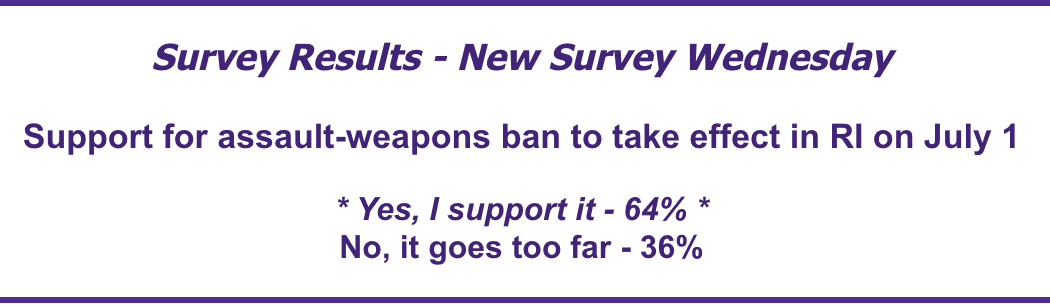
While our survey indicated support, it is the first time a survey like this resulted in a positive result for a ban. Gun stores report people lined up around the block with 80% increase in sales.
The bottom line – but not done – yet!
The July 1 law does not end private gun ownership in Rhode Island. It does not ban ordinary home-security firearms across the board. But it does create a major new restriction on the future sale, purchase, transfer and manufacture of firearms that fit the state’s definition of a “prohibited firearm.”
Supreme Court to take up assault-weapons bans
NEW: The US Supreme Court said they will hear challenges to firearms ban cases from two states, which, depending upon their decision, could change this new Rhode Island law.
The Supreme Court on Tuesday said it will consider whether the Second Amendment guarantees the right to have AR-15-style rifles. In a brief order the high court agreed to take up a pair of cases challenging local and state laws outlawing AR-15s and similar semi-automatic rifles. One involves an ordinance in Cook County, Illinois, and the other centers on Connecticut’s law.
As Rhode Island’s new law takes effect, the U.S. Supreme Court has agreed to hear challenges to assault-weapons bans in Connecticut and Cook County, Illinois, setting up a major Second Amendment case for the court’s next term. The cases challenge restrictions on AR-15-style and similar semiautomatic firearms, with gun-rights advocates arguing that the weapons are commonly owned and protected by the Second Amendment. Supporters of the bans argue that states and local governments may restrict weapons they view as especially dangerous and tied to mass shootings.
The Supreme Court’s decision to hear the cases does not immediately block Rhode Island’s July 1 law. But the eventual ruling could affect how far states may go in banning or restricting the sale or possession of assault-style firearms. That means Rhode Island’s new law may take effect now, even as the broader constitutional question moves toward the nation’s highest court.
Jeff Gross is in direct contact with the DOJ 2A section every 2 days. He stated the DOJ is coming at the RI State house. This Anti-2A agenda will come to an end. 100% of the population could support banning guns, HOWEVER, the Constitution overrides all public opinion and “Feelings”. People have been brainwashed by the left and MSM therefore they cannot think clearly or for themselves anymore.