
Subscribe!
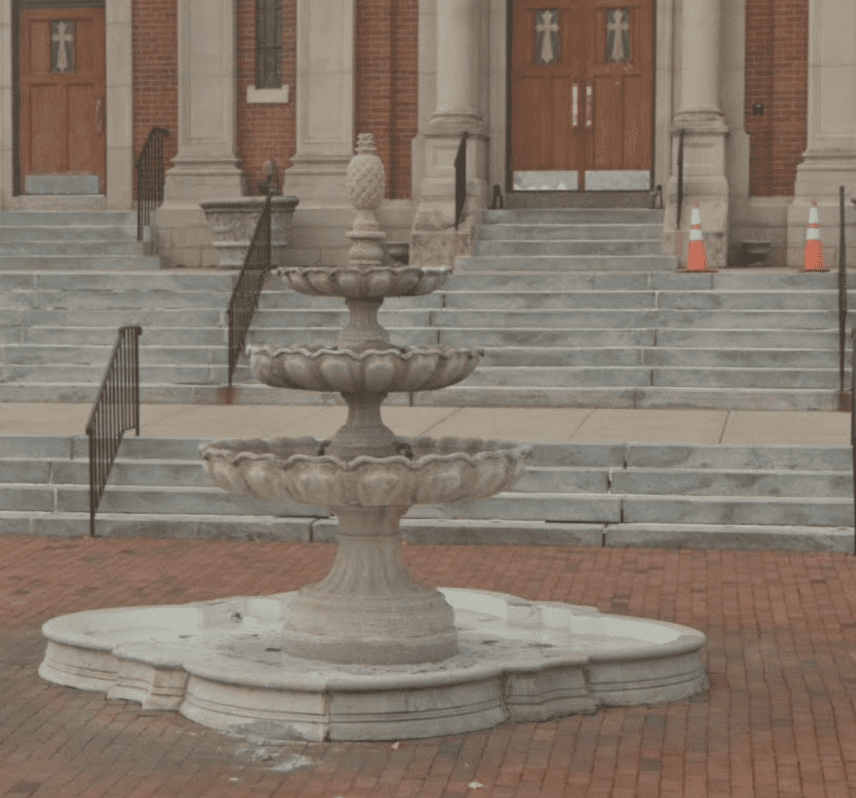
Updated: Cranston’s Knightsville Fountain: Historic Landmark – or Another Political Grandstand
Cranston’s Knightsville fountain: restoring a landmark at the center of tradition, history and revitalization
In Knightsville, the fountain in front of St. Mary’s Church has never been just a fountain.
It sits at the center of one of Cranston’s most recognizable public spaces — along Cranston Street, in front of St. Mary’s, near St. Ann’s, and at the heart of a neighborhood shaped by generations of Irish and Italian immigrant families, small businesses, parish life, public celebrations and civic tradition.
Now, as part of Phase 3 of the Knightsville Improvement Project, the City of Cranston is replacing the long-deteriorated fountain and restoring the surrounding brickwork as part of a broader streetscape effort.
The project has drawn political attention because of its cost for the replacement fountain, fully installed. But reducing the project to a single price tag misses the larger story of what the fountain is, where it sits, and why the city would include it in a major revitalization project.
The fountain is located at one of the most visible points in Knightsville. It sits in the public-facing plaza area in front of St. Mary’s Church, surrounded by brick sidewalk and open gathering space. It is visible from Cranston Street and stands near the center of the streetscape improvements now underway – and a new development about to start on the other side.
It is also a focal point of St. Mary’s Feast, Cranston’s largest annual festival and one of the city’s most enduring traditions. The Feast draws tens of thousands of people to Knightsville for food, music, religious procession, family gatherings and neighborhood celebration. For many Cranston families, the fountain area is part of the memory and geography of the Feast — a place to meet, gather, begin and return.
That is why the fountain cannot be understood simply as a decorative feature in front of a church. It is part of the public identity of Knightsville.
A neighborhood with layered history
The location carries a deeper neighborhood history.
St. Ann’s and St. Mary’s were not simply two nearby Catholic churches. They reflected two distinct immigrant communities in Cranston: St. Ann’s historically associated with the Irish community, and St. Mary’s with the Italian community that became central to Knightsville’s identity.
In earlier generations, parish identity mattered. It shaped family life, neighborhood life, social networks, celebrations and community pride. Over time, the public space in front of St. Mary’s became more than church frontage. The widened brick plaza and fountain area helped create a shared civic space where those histories came together.
That is part of what makes the fountain significant. It stands at the intersection of religious tradition, ethnic history, public space and neighborhood commerce. It is a visible marker of a Cranston neighborhood that has changed over time while holding on to its identity.
Restoring it is not only about water, stone and plumbing. It is about preserving the public setting around a tradition that still brings people into the city.
Councilperson Campopiano even informed the committee that the fountain was in such bad shape that parisoners had built mold to put styrofoam in, which no one knew until now.
Part of a larger Knightsville project
The fountain replacement is included in Phase 3 of the Knightsville Improvement Project, which is jointly funded by the City of Cranston and the federal government.
According to information provided by the city, the City Council approved $2.8 million in capital spending, and the project received an additional $1.95 million in federal funding, for a total of approximately $4.75 million. Following a competitive procurement process, the Board of Contracts and Purchasing awarded the Phase 3 construction contract to Narragansett Improvement for $3,539,900.
Because the project is being carried out as a single integrated streetscape effort — including but not limited to the area in front of St. Mary’s Church — the city says it is not possible to assign a specific portion of the total project cost solely to that location.
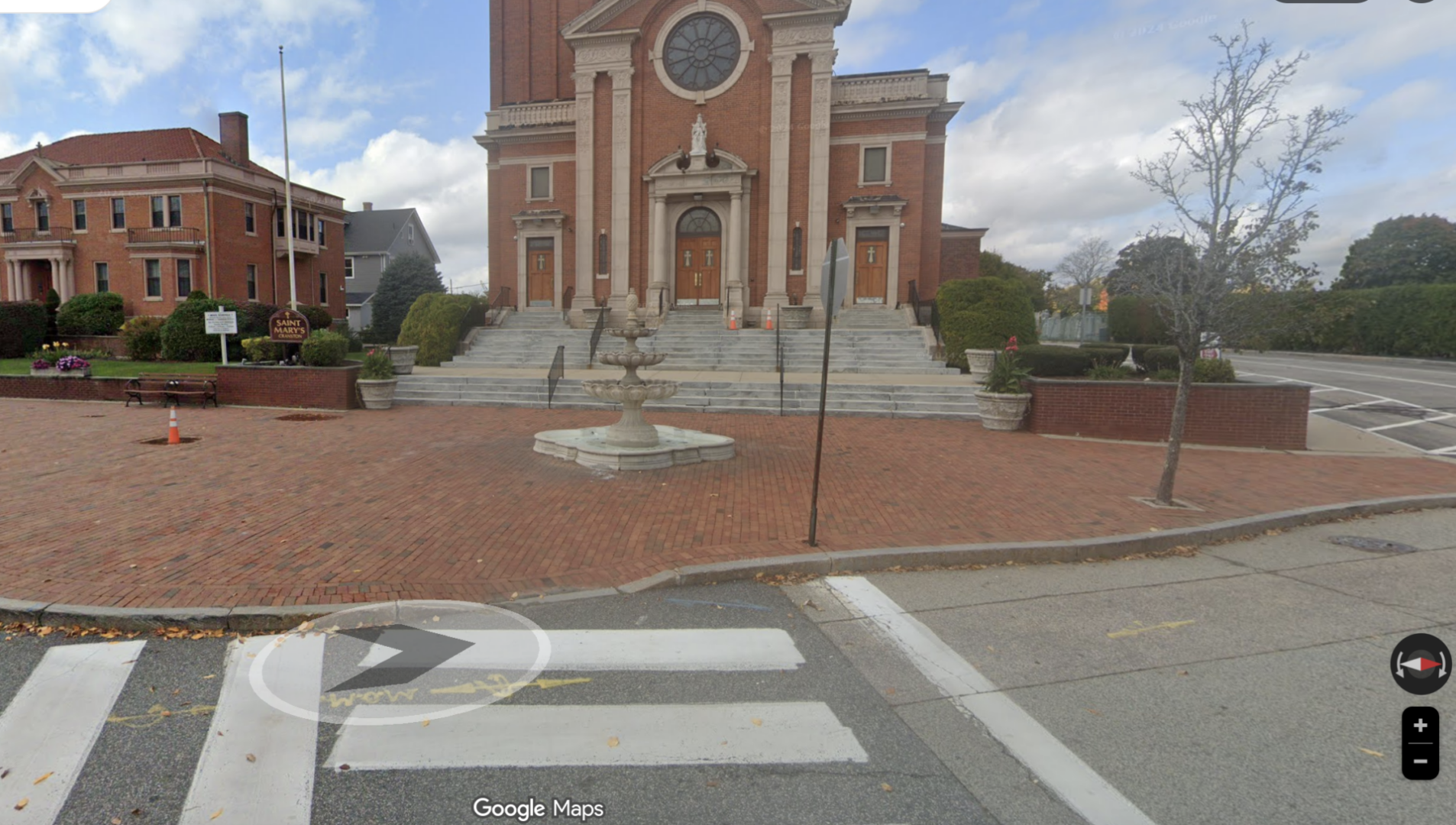
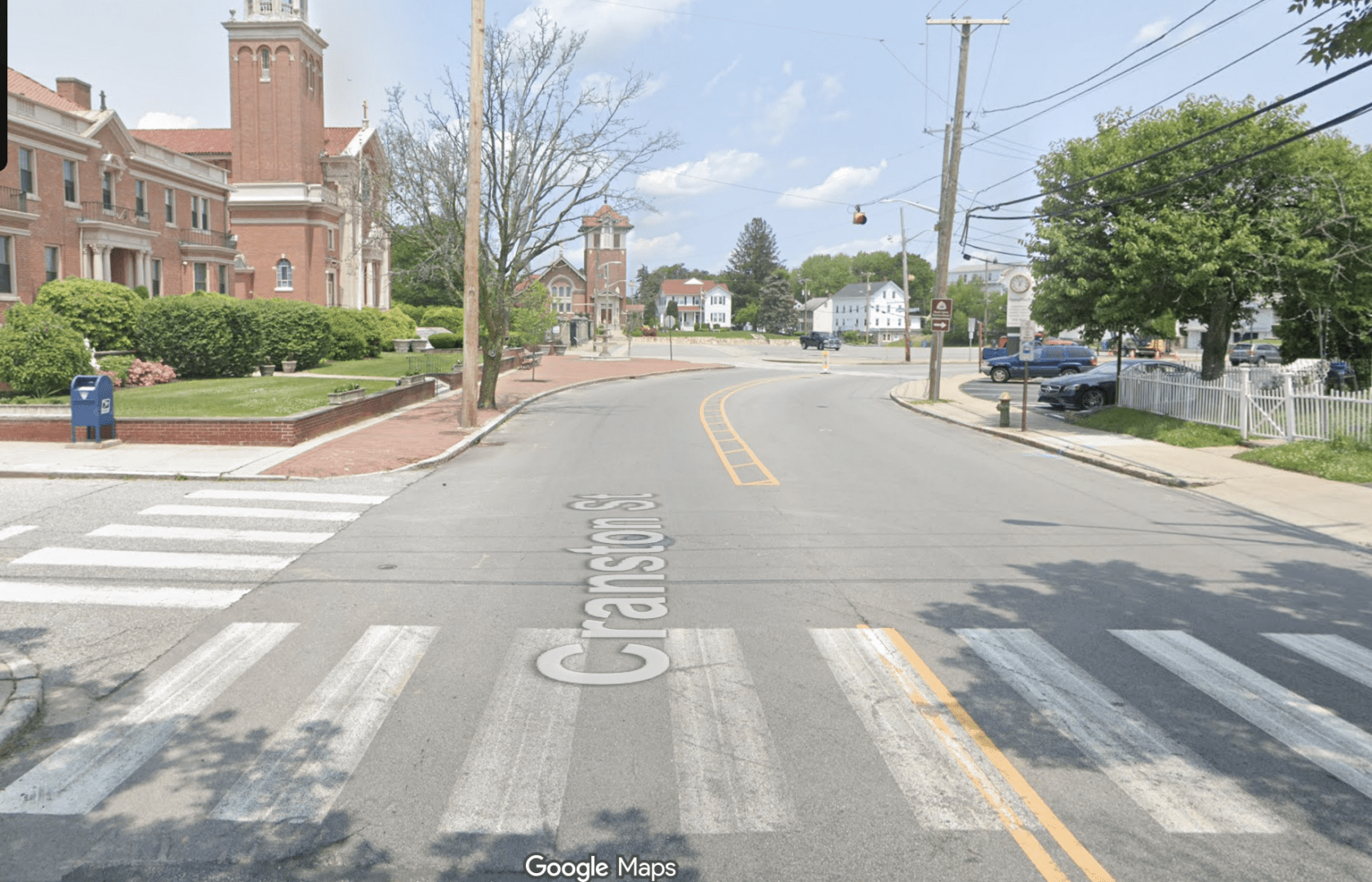
The city says the old fountain had significantly deteriorated. The fountain bowls and underlying foundation had deteriorated, resulting in ongoing water leakage and maintenance concerns. The fountain had been patched and repaired over time, but the city ultimately determined it could not be repaired in a lasting way.
Historical records on the original fountain appear to be limited. The city says it has been informed that the fountain was donated years ago by a parishioner. Records identifying the donor, installation date, value of the original donation or formal acceptance by the city have not yet been located.
But the absence of a complete historical paper trail does not erase the role the fountain came to play. For decades, it has been visually tied to St. Mary’s, the Feast, Cranston Street and the Knightsville streetscape.
Where the fountain came from – and where it stands now
During a meeting of the Ordinance Committee of the Cranston City Council, where members had clearly done less homework than was done to produce this article, it was revealed who the donor of the fountain was. While known to us we wanted to be clear about its disclosure. Gene Richmond donated the fountain to the city in the 1990s. Not the church. They did not know that the fountain is gone and the bricks ripped up. And construction is underway.
A letter was received from Richmond to the Council expressing his emotional reasons for giving the fountain to the city and how much it has meant over the years.
Listen to the Committee HERE: https://www.youtube.com/live/YxC5jiVSPEM?si=VYAlMwEWubA-BUiH
The discussion on the fountain is a microcosm of ineptitude, lack of preparation, and more that has tied the city up in knots for year. After over an hour of bitter arguing, it became clear that the members speaking did not know that the fountain that existed is gone, the brickwork is ripped up, and piping is underway. How could they take the city’s time and the public’s confidence in engaging in this way? That’s a question that every voter needs to make – going forward.
What began as a private civic gift now has become a public landmark
Why the fountain matters now
The practical question is simple: if Cranston is investing in sidewalks, brickwork, lighting and streetscape improvements in the center of Knightsville, would it make sense to leave a failed fountain at the middle of that public space?
The answer from the city appears to be no.
The fountain sits in the middle of a district the city has been working to revitalize. A major redevelopment of an old factory site is also taking place nearby, adding to the importance of the corridor. The city’s investment in the fountain, brickwork and surrounding public space is part of a broader effort to improve the appearance, walkability and public identity of Knightsville.
That kind of investment matters to business districts. Public spaces shape how residents, visitors and investors experience a neighborhood. A working fountain, restored brickwork, improved sidewalks and a more attractive streetscape can help reinforce a district’s identity and support nearby businesses, restaurants, events and redevelopment.
The St. Mary’s Feast adds another layer. A festival drawing tens of thousands of people over several days brings attention, foot traffic and spending into Knightsville. Even without a formal Cranston economic-impact study, it is clear that the Feast is not only a cultural and religious event. It is also a major annual economic and civic event for the city.
In that context, restoring the fountain is not a stand-alone ornament. It is part of maintaining the public stage on which one of Cranston’s largest traditions takes place.
Public fountains can be cost-prohibitive public infrastructure if not up to modern standards
The cost of fountain work can surprise people because fountains are often viewed as decorative. But public fountains are infrastructure. They involve foundations, plumbing, pumps, water systems, masonry, drainage, electrical work, winterization, public safety and long-term maintenance. Those made of concrete need winterizing, while those that are metal need less worry about the weather.
Providence’s DePasquale Square fountain on Federal Hill offers a useful comparison.
That fountain, another highly visible public landmark tied to a restaurant and cultural district, required years of repair and renovation. Earlier repair figures were reported at roughly $210,000 to $265,000, and a later restoration was reported at about $500,000.
Adjusted for inflation, those amounts would be substantially higher today.
The comparison does not mean Cranston and Providence are identical. But it does show that public fountains in active civic spaces can become six-figure projects when deterioration, plumbing, masonry and public-space work are involved.
There are several churches throughout the state with fountains in front of them, maintained and paid for by their city.
A public investment in place
Grant-funded projects still involve public money, and residents have every right to ask questions about cost, timing and priorities. But grant funding is often restricted to specific public-improvement purposes. It usually cannot simply be redirected to cover unrelated operating expenses or avoid local budget pressures. In this case, the fountain replacement is tied to a larger streetscape and revitalization project, not treated as an isolated purchase.
That matters.
The stronger story of the Knightsville fountain is not that Cranston is buying a fountain. It is that Cranston is restoring a landmark in one of the city’s most important public spaces — a place tied to immigrant history, parish tradition, small businesses, annual celebration, neighborhood identity and redevelopment.
For some, the fountain may be an easy political target.
For Knightsville, it is part of the neighborhood’s front door.
And for Cranston, restoring it is a statement that public spaces, traditions and neighborhood centers still matter.
Cranston will not find its way out of its troubles by thinking small – putting spirit and joy back into the city is more than what it appears on the surface.
Cranston continues to play victim to individuals who grab on low-hanging fruit to make political stance – the pool, the fountain – Cranstonians need to be skeptical when they see this beginning to happen, and look beyond the surface of political strategies.
As one former councilman wrote, “Bottom line is that Hopkins continues to ignore the financial deficit and has done nothing to stop the wasteful frivolous spending. He should resign.” That might give people an idea on why all this is coming out – now.
As Councilman Buonanno said, “Most of you know I’m not running for re-election, because I sit here and get kicked in the teeth by decisions made by people not on this council today”.
One only wonders how the opening of the Budlong Pool will be positioned by those who can’t find much good to say about anything.
I don’t know any council person, past or present. The present council is fairly new & the previous council didn’t get along with the Mayor. Saying the council didn’t do its homework is wrong. There has been little transparency for 4 yrs. By the time the council & citizens find out, it’s a done deal. The pool is a perfect example. The Knightsville area is another example. $4+ million was spent in Knightsville for a ”gazebo” ( gold-plated??).Lesley No pool for 6 yrs. because of no maintenance. Bragging rights for the less than $1 million spent between Auburn and Pawtuxet (big deal??). A splash pad that only worked for 1 yr. and the promised 2nd one at Doric must have been installed elsewhere. Eden Park school is in its “20th” phase & no place to park. The play park at Dutemple is a dump. Granted, people are slobs but there’s no oversight by Parks. If one has the Mayor’s ear, it gets done; otherwise, forget it. There are busy bees in the Mayor’s office if they can get by Moretti. Cranston is the definition of Rhode Island – I know a guy.
There are a few with institutional history on the council such as the former mayor – Traficante. When Mr. Moretti let them know the fountain was so broken and dangerous that it was taken down they didn’t know. We knew because we drove by and we asked so we could be prepared to write about it. Neither the pool – nor the fountain (which had been approved in 2024) needed to be approved on such detail by the council – members may be unclear as to what their charge is and purview vs. administration. The DPW person – at the end of the video – explains it all – it was a master class in how major construction/beautification projects with federal money are done. To say they were mostly uninformed is sadly quite accurate.
As someone who attended last night’s Public Works Committee meeting, I feel it’s important to also share that Mr. Richmond’s letter states “to the best of my recollection, I donated the fountain to the city”. That’s not exactly proof of any such gift. When, in fact, former mayor and now councilman Trafficante clearly stated that he was mayor when the fountain was originally installed and it absolutely WAS NOT a gift to the city. Secondly, councilman Buonano attested to the fact that, not only did a relative of his help build the church, but also that the fountain was a gift TO THE CHURCH, where he was a parishioner . In short, the church owns it but it sits on public right of way space. Essentially, the city replacing it on our dime crosses the laws defining the separation of church and state; the city is gifting the church a brand new fountain. I believe that the city should have given the church the option to replace it from their private money. City funds should NEVER be used to gift religious entities.
The fountain is NOT being given to the church. It sits on city land and will be watched for problems by the city in partnership with the church if they agree. I would not want to assume Mr. Richmond was lying but details were not written down at the time by the city which leaves recall subjective.
This was beautifully written and researched! The level of discourse and absence of facts these days is disheartening. I’m originally from Cranston and my father and aunts grew up in Knightsville; thus, it pains me to read that this area does not deserve funding and revitalizing, not to mention the anti-Catholic tropes. Keep up the great work and continue to hold elected officials accountable.
This area is city property and the end (or the beginning) of the Knightsville project – imagine if this one piece of blight because it was damaged, didn’t work, and a safety issue – were left as it was. That would make no sense at all. Businesses want to locate where the community cares about all of its community.