
Subscribe!
Major Questions Remain with the Mt. Hope Bridge. Response to the latest RITBA Update – Nick Landekic
By Nick Landekic, for the Mt. Hope Bridge Watch
On October 15 RITBA (Rhode Island Transportation and Bridge Authority) management gave a presentation on the Mt. Hope Bridge at the Rogers Library as part of the Bosworth lecture series.
We sincerely appreciate RITBA management taking the time to update the public on activities with the Mt. Hope Bridge and making themselves available for questions. The bridge is a vital lifeline for anyone who lives, works, or enjoys the East Bay. Justifiable questions have been raised regarding its condition and we all have a vested interest in its future.
Despite the upbeat presentation, important questions still remain.
First and foremost, the true condition of the crucial main suspension cables is still unknown. The last formal inspection of the cables was done in 2015, over ten years ago. RITBA said the cables are being inspected now as part of the ongoing dehumidification project but the results are not yet known. The safety and future of the bridge rests on these cables which support the entire structure.
A question was asked how the public would be made aware of the cable inspection results. After a few moments of consternation it was suggested that a FOIA (Freedom of Information Act) or APRA (Access to Public Record Act) claim would be the way. This does not seem like transparency to us. Suggesting the public must file a legal claim to see the results of a critically important inspection report appears to fly in the face of a stated commitment to transparency. It should not take legal action for the public to know the condition and safety of the Mt. Hope Bridge.
We appreciate RITBA acknowledging the essential importance of transparency. Candor and forthrightness are essential to have trust with the people served by government – us. There have been missteps in the past, most notably with the obfuscation over releasing the November 2024 inspection report – which RITBA fought for a year and a half to not provide and ultimately required a bold lawsuit in Federal court by Bristol township to compel its release. It turned out there were no Transportation Security Agency Sensitive Security Issue concerns with the bridge after all.
The results of the ongoing inspection of the main suspension cables will be decisive to understanding the future of the Mt. Hope Bridge. Cable dehumidification is considered to significantly extend the life of a bridge, but the question with the Mt. Hope Bridge still remains: is it too little, too late?
Questions have been raised because the 2015 inspection, revealed in the 2021 cable dehumidification grant application, that a total of 31% of the wires within the cables had broken over time due to rusting. How many more have broken in the over 10 years since that last inspection?
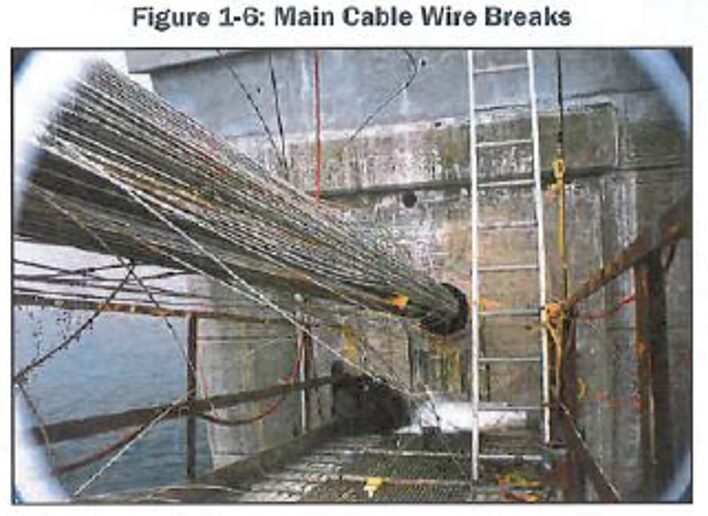
RITBA said some broken wires have been repaired. Is this a method validated by the national engineering organizations AASHTO or ASTM? Our own research has not identified any industry-validated method for field repair of broken wires, and rather the industry consensus that once an individual internal wire breaks due to corrosion or fatigue, it cannot be practically re-spliced or tensioned back to parity with the surrounding bundle.
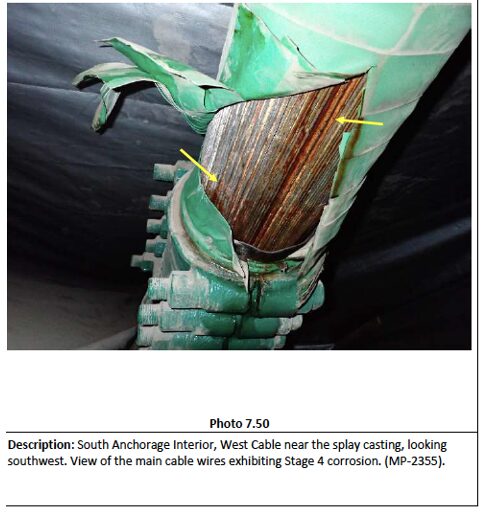
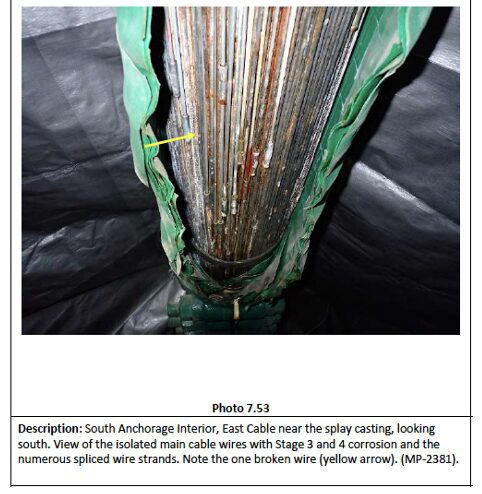
RITBA said the same in the 2021 grant application: “There is no practical way to replace the strength lost in a cable due to corrosion,” and additionally: “From the 2015 laboratory tests, the wires indicated a lower ductility than expected from bridge wire and are consequently more prone to cracking and breaking.” The November 2024 inspection noted areas of “widespread stage 4 corrosion.” A cable is only as strong as its weakest point.
Photos from the November 2024 inspection report:

Second, both in the presentation and a prior article in the Bristol Phoenix RITBA said the dehumidification project should extend the life of the bridge by 50 to 75 years. From the Phoenix: “Professional assessments indicate that with appropriate maintenance andrehabilitation the Mt. Hope Bridge can remain in service for another 50 to 75 years.”
Which engineering firm did this “professional assessment,” and where is the report with their opinion? From the presentation it sounded as if this speculation may be conjecture based on experience with other bridges. What might be true for another bridge doesn’t necessarily apply to the specific situation with the Mt. Hope Bridge. If there was a professional assessment specific to the Mt. Hope Bridge with an engineering opinion on the possible life extension, it needs to be publicly disclosed. Otherwise such extrapolations would be unjustified and misleading.
An independent engineering technical review of current condition of the bridge coupled with economic analysis is required, following the model that the Army Corps of Engineers used in coming to the replacement decision over continued repairs for the Cape Cod bridges.
Third, RITBA thoughtfully presented a list of 17 priority repair items recommended by ATANE Consulting, the inspection company. Unfortunately, it appeared that despite two years having passed since the inspection, only one repair has been completed with the others in ‘design phase.’ If these were high-priority items one would hope they would have been addressed in less than two years. Rust and further deterioration has continued since the November 2024 inspection. The bridge is coming up for its next scheduled biennial inspection, in January 2027. What is the current condition of the priority items?
An independent review of the ongoing repair/refurbishment cycle is needed.
Additionally, no mention was made of the 29 pages of structural deficiencies identified in the November 2024 inspection. Again, rusting and deterioration has only continued. What is their current condition?
Fourth, RITBA acknowledged that replacing the bridge could cost over $2 billion and would take 20 to 25 years (though Massachusetts seems to have a plan to replace the two larger and more complicated Cape Cod crossing bridges in 10 years). The time and cost for a new bridge seems to be the justification for continuing with repairs to the current one. However, one does not follow the other. Just because a replacement bridge would be expensive and take a long time doesn’t automatically mean the current bridge is sound and justifies further spending – money that might potentially be better used planning for a replacement bridge.
AASHTO’s benchmark service life for newly designed and constructed bridges is 75 years. The Mt. Hope Bridge was built in 1929 and is 97 years old, and used century-old construction and metallurgical technology. Is it realistic to expect the bridge will last for 175 years? Recent video reports by professional engineer Casey Jones, and the engineering group MegaBuilds, opine the Mt. Hope Bridge might have 5 to 10 years of unrestricted service life left. If this is the case, doesn’t it make it that much more important to plan for its replacement?
The gubernatorial election is next week. We hope the future Governor will consider dissolving RITBA and combining their responsibilities under RIDOT, the Rhode Island Department of Transportation. It makes no sense and does not best serve the interests of the people of Rhode Island for the smallest state in the country to have two separate transportation and bridge authorities, which seems to only increase the chances for inefficiency, waste, insider dealing, and confusion.
Gubernatorial candidate Helena Foulkes has pledged transparency regarding state infrastructure and promised to release all bridge inspection reports as well as appoint a new head of RIDOT from outside of Rhode Island as part of her extensive transportation reform platform. Helena Foulkes is also pledging a transparent, full investigation into the Washington Bridge failure, and an audit of every state bridge.
Rhode Island is ranked as having the very worst condition roads in the entire country, and among the worst condition bridges – despite spending far more than other states. More of our tax dollars per capita are spent on infrastructure than other states yet we have much less to show for it. Rhode Island has a long history of corruption and fiscal irresponsibility – the Washington Post named Rhode Island as one of the six most corrupt states in the country. If we want to change this, we have to elect someone committed to making it happen. You might want to keep this in mind when you decide who to vote for our next Governor.
___
The Mt. Hope Bridge Watch is a working group of engaged citizens and engineers from across the East Bay keeping a close eye on this treasure which is essential to our daily life. Nick Landekic of Bristol is a retired C.E.O. and biotechnology entrepreneur who has spent more than 35 years working in the pharmaceutical industry.
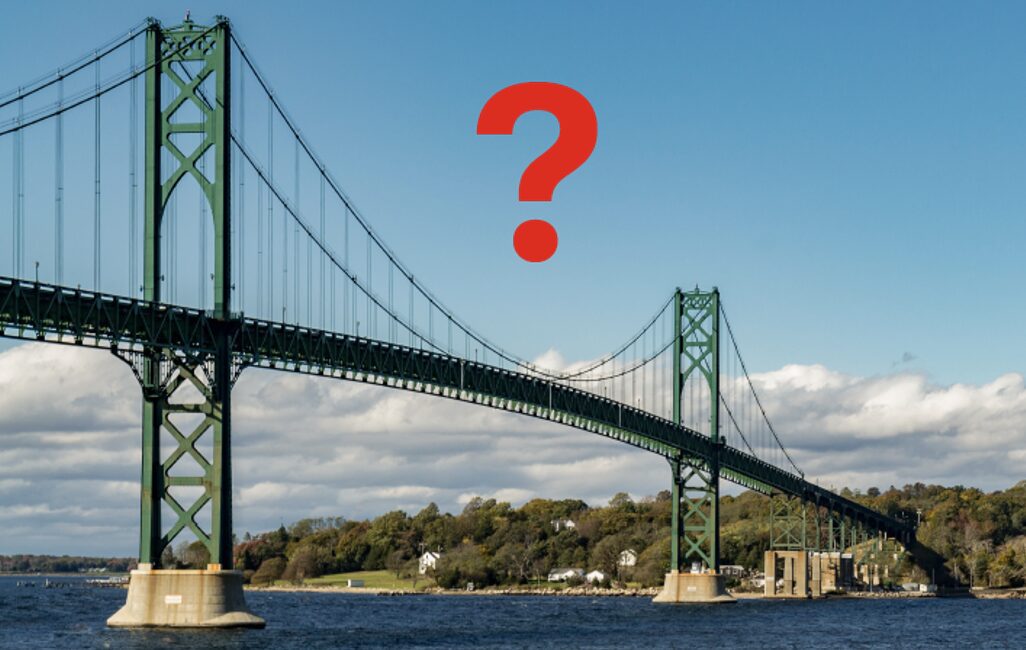
(Photo, top of page: Eric Harrison / Wikimedia Commons, CC BY-SA 2.0. – Erosion photos, RITBA’s November 2024 inspection report)
