
Subscribe!

Rhode Island is a Model of Fiscal Irresponsibility – Commentary, Nick Landekic
(NOTE: Budget summary on the way to the Governor for signature is provided at the end of the article)
By Nick Landekic, contributing writer, commentary
In the past few weeks there have been some interesting news items:
- Construction Coverage’s 2026 report rated Rhode Island as having the worst roads in the country with over 36% rated in poor condition. The next lowest state, Massachusetts, wasn’t even close at 29%.
This is despite Rhode Island’s roads budget of $1 billion, more than doubling in recent years, and spending over $500,000 per mile of road repaired – more than double the national average of $226,000 per lane mile. Our overall highway performance is worse than Connecticut’s (7th), New Hampshire’s (13th), Maine’s (16th), and Massachusetts.
- Wallet Hub’s 2026 report on state economies rated Rhode Island at a dismal 47th place – the third worst. In comparison neighboring Massachusetts has the number 1 best economy in the country.
- Daily Passport’s 2026 report on the best states to retire rated Rhode Island among the 10 worst, in a dismal 41st place – the 9th
Where is all our money going, and why do we have so little to show for it?
Rhode Island Spending is Out of Control
Put simply, Rhode Island spends more per capita than most other states, but we have less to show for it.
Even a cursory analysis suggests Rhode Island is wasteful when it comes to spending money. Looking at our roads, bridges, services, state support for public health, library budgets, and consumer protection suggests we don’t receive the same level of either state support or quality of services as residents of Massachusetts or other nearby states.
Where is all our money going, and why do we have so little to show for it?
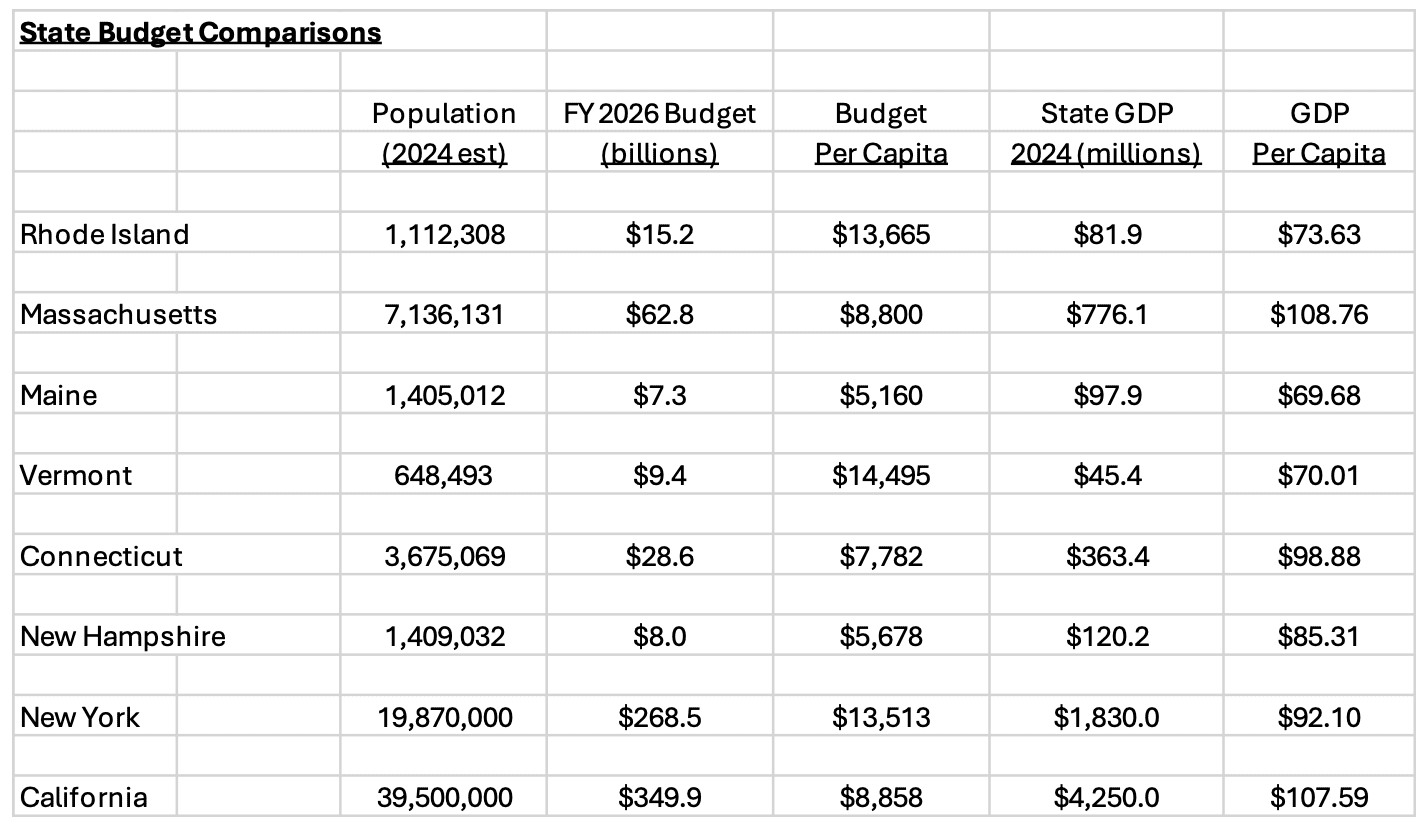
Compared with other states on a per capita basis Rhode Island spends 55% more than Massachusetts, 76% more than Connecticut, and a staggering 165% more than Maine. Yet we have less to show for all this spending than these other states.
Rhode Island spends over two and a half times more per capita than Maine, and more than one and a half times more than Massachusetts.
Rhode Island even spends about 55% more per capita than California, a state known for towering bureaucracy and wasteful spending.
Exactly what do we have to show for this exorbitant level of state spending?
A Deeper Look
Governor McKee’s proposed FY 2026-2027 budget of $15.2 billion is a 7% increase over last year’s budget of $14.2 billion. Unbelievably, it assumes $5.5 billion coming from the federal government, 36% of the total, making Rhode Island among the most dependent of states on federal aid whether as a percent of total spending or per capita. In the new reality of the Trump administration where the President has said states must be more self-reliant and cannot rely on the federal government for financial support for things like Medicare, Medicaid, day care and other expenses, this is untethered from reality.
Rhode Island is at or near the bottom in road conditions, bridges, the state economy, healthcare, attractiveness to retire, and desirability to start a new business
In addition to the worst roads in the country and one of the worst state economies our performance lags in a number of other measures as well.
The Reason Foundation rates Rhode Island’s bridges as the third worst in the country in 47th place, with 15.4% of our bridges being structurally deficient.
Given the fiasco with the Washington Bridge – which Rhode Island rated in “fair” condition right up until the day it was closed in an emergency action because an engineer happened to notice multiple structural tie down rods were rusted through and broken – and RITBA’s continued refusal to disclose critical inspection information on the Mt. Hope Bridge despite serious questions other than also calling it in ‘fair’ condition – one cannot help but wonder if the real situation could be even worse.
Looking at healthcare from the perspective of the 250 highest ranked hospitals in the U.S. (as reported in Newsweek), Massachusetts has 8 hospitals in the top 250, New York has 6, Maine has 3, and Connecticut has 2. Rhode Island is experiencing a shortage of healthcare providers and difficulties in attracting new doctors in part because insurance reimbursement and compensation are lower than in Massachusetts and Connecticut. As a result because of our overworked doctors and overstressed hospitals Rhode Island has no hospitals in the top 300. Rhode Island’s healthcare system is in crisis, even acknowledged by some state leaders, though little is being done to head off the coming calamity.
Why does Rhode Island spend so much with little to show for it?
The state GDP (Gross Domestic Product) does not seem to support such a level of budgetary spending. On a per capita basis our GDP is on the lower end compared with other New England states, being almost 33% below that of Massachusetts. Again even a casual look suggests bureaucracy, waste, and inefficiencies in Rhode Island’s operations as a factor.
There are 32 school districts in Rhode Island and 48 public libraries, distributed among 39 towns and municipalities. There are 158 fire stations in Rhode Island – more than either Los Angeles (106) or Chicago (92). All that bureaucracy results in duplicative, redundant organizational structures – and spending. Consolidation into a much smaller number of systems could save a great deal of money.
The Washington Post Has Called Rhode Island One of the Six Most Corrupt States in the Country
Perhaps even more expensive is the history and ingrained culture of corruption, graft, bribery, and payoffs in Rhode Island. It’s impossible to put a number on this but there seem to be many examples of state spending that are questionable and difficult to see the value for our taxpayers.
A few examples, small and large:
- Wasting public money on falsified bridge inspection reports.
- Awarding a $46 million contract to demolish the failed section of the Washington Bridge – which cost overruns more than doubled the price to about $100 million. Despite this Rhode Island proudly put up signs proclaiming “On Time and On Budget” – it seems reasonable to ask, who’s time and who’s budget?
- Spending an eye-popping more than $52 million – to produce just 200 rental units, a cost of $260,000 per unit.
- $65 million for a dehumidification project for the main suspension cables of the Mt. Hope Bridge – despite serious question and concerns that this may simply be ‘too little too late’ and the money could be better spent on planning for a replacement of an obsolete and decaying bridge.
- Awarding construction contracts to the HIGHEST bidder – three times – to Aetna Bridge totaling $210 million, the same firm Governor McKee is suing over the Washington Bridge.
It seems we, the taxpayers who fund and pay for all of this, have the right to ask, Exactly who benefits from such bloated, wasteful spending? It’s clear the builders, contractors, and other companies doing the work make money, but how does it benefit the rest of us?
Outside groups have raised questions as well. The Rhode Island Public Expenditure Council raises concerns that state spending in Rhode Island continues to rise at an unsustainable rate amid slowing revenues and uncertainties about federal funding. State revenues increased by 6.4% over the past two years while spending increased by almost twice as much, 10.9%.
This is going broke on the installment plan.

In the face of all this House Speaker Christopher Blazejewski wants to increase the Rhode Island state budget by $1 billion, to increase the size of state government and the number of state employees. This would balloon our state spending to an incredible $14,570 per capita, the highest in the northeast and among the highest in the country.
What spending could be
The bottom line is Rhode Island is one of the highest spending and highest tax states in the nation.
If Rhode Island spent money at a comparable per capita rate to Maine that would make the state budget about $6 billion – less than half of current levels and $9 billion less than we presently spend. Yet despite spending so much less than Rhode Island, the state of Maine delivers superior performance on many measures of infrastructure, quality of life, and public health (notwithstanding Maine is vastly larger than Rhode Island which would be expected to have higher costs).
Even if Rhode Island spent as much per capita as Massachusetts – which we shouldn’t because Massachusetts has the strongest economy in the nation while we have one of the weakest – our state budget would still be about $5 billion less.
Think of what could be done with billions of dollars if it were used productively instead of wasted. There is a long list of things in Rhode Island that would be better uses for our money.
Public health. Healthcare, especially for those who can’t afford it. Housing. Repairing our crumbling roads and failing bridges. Helping the homeless and others experiencing financial hardship. Food for the hungry. Legal defense for those who can’t afford it. Energy independence with more wind and solar power. Education. Economic opportunities to create jobs. Wouldn’t any of these benefit more Rhode Islanders than how much of the state budget seems to be spent?
We must evolve if we are to survive
Rhode Island cannot continue to function with delusion and fiscal irresponsibility, kicking the can down the road. The unofficial state motto might well be “That’s the way we’ve always done it” but if we don’t start doing things differently we risk becoming a failed state. Neither the federal government nor anyone else is going to save us.
Think carefully about who to vote for in the coming elections this fall, both the gubernatorial primary in September and November elections. Think about a candidate’s actual demonstrated accomplishments, track record, capabilities, experience, and expertise. Remember all the things that have gone wrong in Rhode Island in recent years and who has been responsible.
Consider voting for candidates who might be ‘outsiders,’ who have not spent their lives immersed in Rhode Island’s political system. Government is supposed to be a public service, a privilege, with a duty of responsibility to look out for the best interests of all Rhode Islanders and not just special interests. Any elected official has a moral and fiduciary responsibility to spend our money as wisely as possible. Professional state politicians who have spent many years mired in Rhode Island politics may not know any other way than wasteful spending and fiscal irresponsibility.
The life, and money, you save will probably be your own.

Update
On June 9 the Rhode Island General Assembly formally approved the $15.2 billion budget for FY2027. The budget contains some minor changes from Governor McKee’s proposal including amounts to help some groups of Rhode Islanders in need, such as $22 million to help those who either lost federal subsidies or became ineligible for Medicaid, and $5 million in 2027 for startup costs for the proposed new medical school of the University Rhode Island.
The budget also increases the top marginal personal income tax rate by 1% each year over three years on incomes of over $1 million, reaching a 3% increase to make the new top marginal tax rate 8.99% when fully implemented (the “millionaire’s tax”).
The budget is described as “balanced.” However, this is somewhat misleading as the budget projects a total of $9.7 billion in revenues (general tax revenues of $6.04 billion plus $3.65 billion from gasoline taxes and lottery earnings). Importantly, the budget assumes receiving $5.51 billion from the federal government – 36% of the total. To the extent the Trump administration may not send any portion of that amount, the state budget will not be ‘balanced.’ A more rigorously and truly balanced budget would match revenues with spending, which in Rhode Island’s case would be about $9.7 billion.
If Rhode Island’s state budget totaled $9.7 billion it would actually be balanced from internal revenue sources and not dependent on the now unpredictable whims of the Trump administration and would represent a still healthy $8,723 per capita, about the same as Massachusetts and California but still higher than Connecticut, New Hampshire, and Maine.
___
RI Budget on the way for Signature
With a 32-6 vote in the Senate today, the General Assembly has approved a balanced $15.2 billion budget for the 2027 fiscal year. The bill (2026-H 7127Aaa), which passed the House on a 65-10 vote Friday, now goes to the governor.
Here is the General Assembly’s analysis of the budget as provided in a press release:
Healthcare
Medicaid rates will be increased to fully implement the recommendations in the Office of Health Insurance Commissioner’s (OHIC) September 2025 rate review in 2027. The governor had proposed spreading the increases over the next two years and capping rates at the Medicare rate, but implementing the $115 million in increased support completely in one year will better position the state financially for future years.
Legislators have added $15 million over what the governor proposed for uncompensated care to the state’s hospitals.
The budget includes $22 million to help Rhode Islanders who either lost federal subsidies or became ineligible for Medicaid as a result of President Trump’s H.R.1 to access affordable health insurance through Health Source RI.
The budget allocates $1.6 million for the Newport Hospital Birthing Center to support continued operations.
As part of a continuing effort to address the state primary care provider shortage, the budget includes $5 million in 2027 for startup costs for the proposed new medical school of the University Rhode Island.
Education
Lawmakers have added more than $24 million to the governor’s proposal to fully fund direct state education aid and increase the student success factor, which provides greater support for students from families with low incomes, to 43%.
The city of Central Falls will also regain immediate control of its school district after more than three decades of state control.
The budget includes $750,000 for a new Support and Access to Bilingual Education (SABE) fund within the Department of Education to support multilingual learning programs in schools. Lawmakers also added $740,000 to support the Rhode Island Auditory Oral Program, which provides critical early intervention, school-based programming, technology support and outreach services to children with hearing loss.
For higher education, the proposal authorizes a ballot question asking voters to approve $275 million in borrowing for improvements at higher education facilities aimed at strengthening workforce preparedness, including $165 million for new the Integrated Health Building at URI, $50 million for renovations to the Adams Library at Rhode Island College to accommodate a student success and career readiness center, and a $60 million career and technical Workforce Innovation Center at the Warwick campus of the Community College of Rhode Island.
Rhode Island College’s Hope Scholarship will also be extended an additional three years.
Relief for Rhode Islanders
The budget includes a proposal to institute a high-earner’s tax of 1% a year over three years on income exceeding $1 million a year. The marginal tax rate takes effect gradually over three years as measures passed last year as part of President Trump’s H.R. 1 affect the state more acutely. This will also allow the state to collect information on its impacts.
Legislators have also expanded eligibility for the Social Security income tax exemption by removing the age threshold, which is the same as the first year of the governor’s proposal.
To support families, lawmakers have included a new refundable child tax credit of $330 per child. This proposal will help families when combined with the current dependent exemption, which remains unchanged.
Childcare assistance eligibility will also be increased to 285% of the federal poverty level, and childcare providers’ reimbursement rate for infants will increase.
Legislators have raised the amount of child support a family enrolled in RI Works can keep to the federal maximum, which is $100 per month for one child, and $200 per month for more than one child. The budget also directs the Department of Children, Youth and Families to establish segregated savings accounts for foster children receiving federal benefits Social Security, conserving them for the children’s later use rather than using them to offset the cost of their care.
The budget provides $2.95 million to Rhode Island Community Food Bank to help address food insecurity.
Government reform
The budget includes Speaker Blazejewski’s proposal to create an independent Office of the Inspector General to investigate the state and quasi-public agencies, as well as municipal programs that use state funds, to prevent and detect fraud, waste, abuse and mismanagement.
The budget will require an efficiency and performance audit of the Rhode Island Department of Transportation’s maintenance programs.
Housing
The bill includes a $120 million housing and community development bond question for November’s ballot, to support affordable housing construction and redevelopment and for homeownership programs.
Transportation and public transit
The proposal addresses the Rhode Island Public Transit Authority’s operating budget shortfall and provides additional funds for buses and improvements to bus shelters. The budget also prohibits the director of the Department of Transportation from serving as the chair of RIPTA’s board of directors, as is currently the case, to address potential conflict, since RIPTA and RIDOT are often competing for funding from the same sources.
Environment
Lawmakers have addressed energy rates without jeopardizing the state’s efforts to reduce reliance on carbon-emitting fossil fuels. The state’s 2033 goal for fully utilizing renewable energy for electricity generation remains intact by expanding the state’s renewable energy standard to include nuclear and hydro power generation, and modifying the net metering program, which will bring down rates for consumers.
The proposed green bond has become greener by expanding the bond total to $55 million and adding funds for open space and climate resiliency measures.
More
Legislators have not included proposals by the governor to raise tobacco taxes or to raise cruise ship landing fees. They have also declined his proposal to seek voter approval for a $50 bond for new career and tech education programs, both to keep the total borrowing costs in check and because the funding wouldn’t cover the proposal.
Other bond questions in the budget include $100 million for economic development initiatives and a $50 million cultural economy bond for grants to cultural institutions and a state archives and history building.
___
Nick Landekic of Bristol is a retired C.E.O. and biotechnology entrepreneur who has spent more than 35 years working in the pharmaceutical industry.
Excellent and Fact Filled!
Stunning!
Thank you Ed.