
Subscribe!
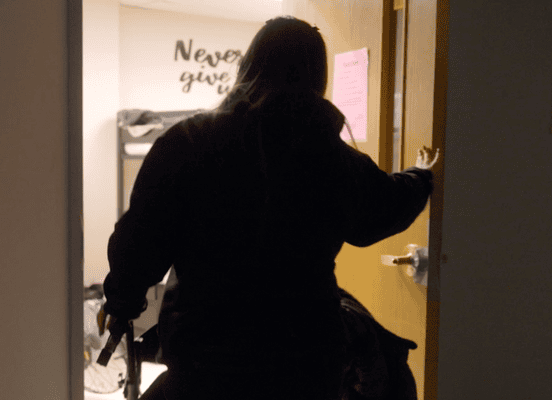
Homeless in RI: Woonsocket Shelter Resident’s Recovery with GLP-1 Treatment – VIDEO
We thank Nick Horton, Open Doors RI, for sharing this story – as we share now.
Jessica Vega arrived at OpenDoors’ Woonsocket shelter homeless and drinking a bottle a day. She is now housed and has gone more than seven months without a drink, the longest stretch of her adult life. She will be featured in an upcoming PBS NewsHour segment, on an Arnold Ventures’ “Fighting Crime” podcast, and appears in a new short documentary that has just been released.
A national PBS NewsHour audience is about to meet a Woonsocket woman named Jessica Vega.
Last fall, Vega was one of the fifty people staying at OpenDoors’ emergency shelter on Cumberland Street. She was 44, homeless for the first time in her life, and in constant pain from a surgery that had damaged her bladder and pelvis. Every day she walked to the liquor store with her walker and bought liquor, and every day she finished it before she got back.
In January, a case manager told her about She Thrives, an OpenDoors program that pairs housing and recovery support with GLP-1 medication, the class of drugs best known for treating diabetes and obesity, which a growing body of research suggests also quiets cravings for alcohol. Vega did not believe it.
“I thought, this girl is crazy,” she said. “I thought they were lying to me.”
She took the first injection anyway. That day was the last day she drank.
“It was like a miracle,” she said. “It was like they changed my head.”
She is careful about how much credit she gives the medication. “It does 90 percent,” she said. “I have to put the other 10 percent.”
Since January, Vega has moved out of the shelter and into an apartment with her daughter. Her children, who had put her out of the house and stopped speaking to her, now call and visit. It is the first time since 2002 that she has gone five months without a drink, let alone seven.
“We’ve been able to offer this treatment at our shelters, and I have seen it make a tremendous difference,” said Dina Bruce, Deputy Director of OpenDoors and a certified peer recovery specialist. “Jessica was able to escape homelessness, recover, and then move on and reunite with her family. That is what we hope for everyone.”
OpenDoors became the first social service agency in the country to offer GLP-1 medication as part of addiction treatment in April 2025. Early results show a 72 percent reduction in self-reported cravings after eight months, and the model is now the subject of an upcoming randomized controlled trial with researchers from Brown University Health.
Vega has a direct answer for those who say the science is not settled.
“If they don’t try, how are they going to know it’s going to work?” she said. “This medication is going to change a lot of lives, for sure.”
About She Thrives:
The OpenDoors She Thrives program is a new, integrated women’s reentry and family reunification initiative. As part of this project, OpenDoors operates two transitional women’s houses, the Foundations House and the Women and Children’s House. Each program provides a host of supportive services to justice-involved women as they work towards wellness and recovery. Over the past two years, we have helped over 100 women in this program. Women in She Thrives can now access GLP-1 medication for addiction treatment, providing another critical tool to help them in their journey and initial evaluation results indicate that women in the program report reduced cravings and increased well-being.
Too often, women struggling with addiction and mental health issues are arrested and incarcerated instead of provided with the treatment they need. The majority of women in the Rhode Island prison are themselves victims of violence, and they are also mothers striving to take care of their children. Instead of a punishment only system, the She Thrives program works with the courts and prison system to provide women facing prison time to be diverted into our program.
About OpenDoors
OpenDoors operates the 50-bed emergency shelter at 181 Cumberland Street in Woonsocket, in a city-owned building with funding from the Rhode Island Executive Office of Housing. OpenDoors is a Rhode Island nonprofit providing housing, shelter, recovery and reentry services statewide. 401-214-1821, [email protected]
This is so inspiring and hopeful. Thanks for sharing.
THIS IS THE KIND OF OUTCOME I WANT TO SEE IN WOONSOCKET — BUT WE NEED A SYSTEM THAT WORKS FOR EVERYONE.
I read the story about Jessica Vega and what OpenDoors was able to accomplish with her, and I want to be very clear: I support this kind of transitional housing and recovery model.
Jessica came into the shelter homeless and struggling with alcohol addiction. She received recovery support, found a treatment approach that worked for her, got housed, became sober, and ultimately began rebuilding her relationship with her family.
That is a success story. That is what a social service system should be trying to accomplish.
I’m not against shelters.
I’m not against transitional housing.
I’m not against helping people who are struggling.
What I am against is a system that doesn’t distinguish between someone who is trying to recover and someone who is actively using dangerous hard drugs on our streets.
Those are different situations and they require different interventions.
If someone is homeless, clean, and ready to rebuild their life, I want Woonsocket to have a shelter and transitional housing system designed specifically to help them succeed.
Give them a safe place to stay.
Give them mental-health services.
Give them employment assistance.
Give them job training.
Help them obtain identification and necessary documents.
Connect them with permanent housing.
Give them case management and the support they need to become independent.
Don’t just give someone a bed. Give them a pathway out.
But when we’re talking about someone actively using fentanyl or other dangerous hard drugs — particularly someone injecting drugs in our neighborhoods and public spaces — I believe we need a different approach.
Treatment has to come first.
I believe there should be a mandatory 90-day rehabilitation pathway for people actively struggling with serious hard-drug addiction, with appropriate legal safeguards and professional medical oversight.
The goal isn’t punishment.
The goal is recovery.
Because what good is putting someone into transitional housing if they are still actively trapped in the addiction that put them on the street in the first place?
We have to stop confusing housing someone with solving homelessness.
Housing is part of the solution.
Recovery is part of the solution.
Mental-health treatment is part of the solution.
Employment is part of the solution.
And accountability has to be part of the solution too.
Jessica’s story demonstrates something important: when people receive the right combination of support and treatment, their lives can change.
She went from homelessness and addiction to sobriety, housing, and reconnecting with her family.
That’s the kind of outcome I want for people in Woonsocket.
But we need a system built around the individual person’s situation.
For the person who is clean and ready to rebuild: shelter, transitional housing, employment, mental-health support and a path to permanent independence.
For the person actively battling serious hard-drug addiction: recovery and treatment first.
And for everyone: dignity, accountability, and a real opportunity to build a better life.
I don’t believe compassion means allowing people to remain trapped in addiction.
I don’t believe accountability means abandoning people.
We can do both.
We can protect our neighborhoods while helping people recover.
We can keep needles out of our parks while giving people struggling with addiction a genuine chance to get their lives back.
We can help the homeless without creating a revolving door between the streets, the shelter, the hospital, and the streets again.
And we can build a system where success isn’t measured by how many people we temporarily house.
Success should be measured by how many people no longer need the system.
That’s the difference between managing a problem and actually solving it.
Recovery first.
Housing with purpose.
Mental health.
Employment.
Accountability.
A real path forward.
That’s the kind of system I believe Woonsocket needs.
Thank you, Nick Horton, for sharing Jessica’s story of victory over addiction. We need more of these stories. And thank you, Jessica Vega, for your courage and strength to help others by sharing your success story. My brother is currently homeless, in part, due to his addiction to alcohol. He will be helped to know of you and Open Doors and GLP-1. Thank you!
Such hope this brings! And if it works for alcohol addiction can it work for drug addiction, and so on… ?
That would be amazing if it did ! My youngest is drug addicted and it’s a sad and lonely road ..
Truly amazing work at Open Doors, She Thrives and GLP-1s!