
Subscribe!
Executive Order Signed to Accelerate Medical Treatments, Research for Serious Mental Illness
A New Federal Push on Psychedelics — With Veterans at the Center
A new Executive Order is opening the door wider to one of the most debated frontiers in mental health treatment: psychedelic-assisted therapy and research into the mechanisms of this treatment, available legally now only outside of the United States.
Framed as a response to what federal officials describe as a worsening national mental health crisis, the order places particular urgency on the needs of U.S. veterans — a group that continues to experience disproportionately high rates of suicide, post-traumatic stress disorder (PTSD), and treatment-resistant depression.
For years, traditional therapies — including antidepressants, counseling, and other psychiatric interventions — have fallen short for many patients. Among veterans, the stakes are even higher: more than 6,000 die by suicide each year, a rate more than double that of the general adult population.
Now, the federal government is signaling a shift. Rather than relying solely on existing medications, the order calls for accelerated research and potential approval of psychedelic compounds — including substances like ibogaine — that early clinical studies suggest may help patients who have not responded to standard care.
Supporters see the move as long overdue, pointing to growing evidence that controlled, medically supervised use of psychedelics could provide lasting relief for PTSD and severe depression. Critics caution that the science is still emerging and emphasize the need for careful oversight.
But the message from Washington is clear: after decades of limited progress, new approaches are being prioritized — with the hope of reducing suicide rates and offering new options to those who have run out of them.
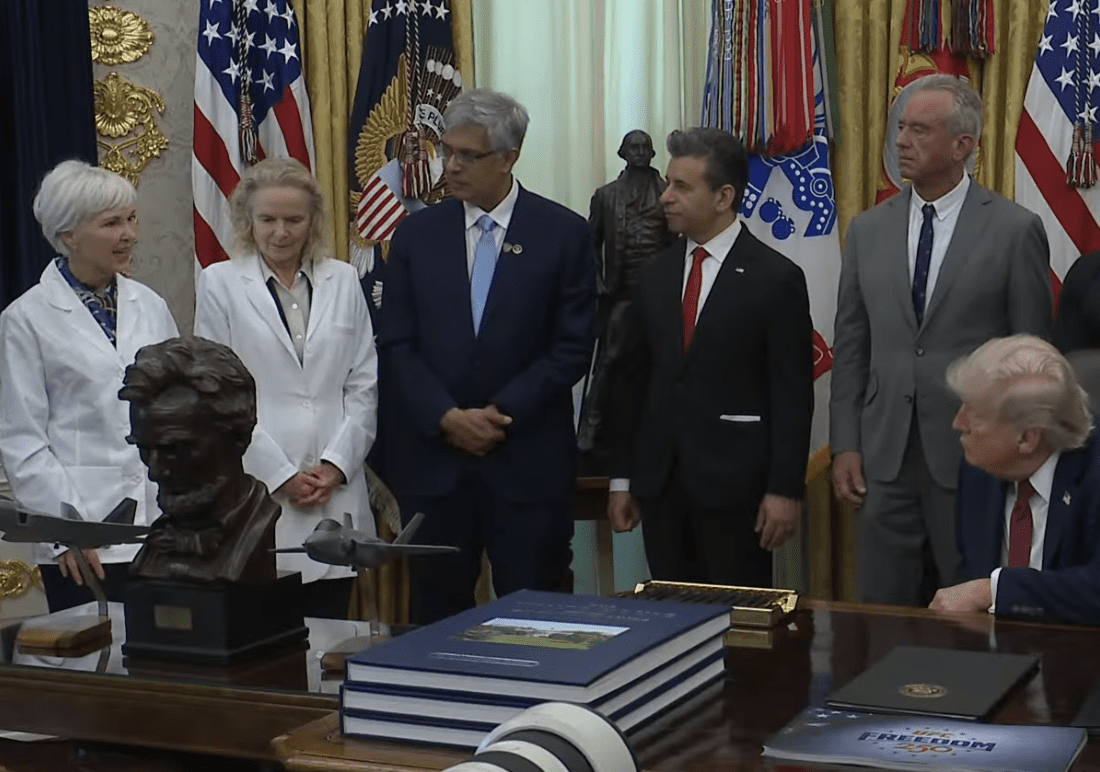
In an unusual Saturday morning press conference and EO signing, President Trump was surrounded by administration officials and invited guests, including veterans and medical advocates, some with personal experience in treating chronic mental illness, some with PTSD, some on the brink of suicide, who sought treatment with psychedelics out of the country and credit the experience with saving their lives.
Executive Order: ACCELERATING MEDICAL TREATMENTS FOR SERIOUS MENTAL ILLNESS
Section 1. Purpose and Policy. Policymakers and the medical field have long struggled to address the burden of suicide and serious mental illness rates in America. Today, over 14 million American adults have a serious mental illness, defined as having a diagnosable mental, behavioral, or emotional disorder that substantially interferes with a person’s life and ability to function, and about 8 million are on prescription medication for these conditions.
Suicide rates tragically increased by 37 percent from 2000 to 2018. During my first term, we made historic progress in helping those struggling with some of the most insidious mental illnesses, and suicide rates decreased by 5 percent from 2018 to 2020. The COVID-19 pandemic and the Biden Administration’s prolonged shutdown stunted this progress and suicide rates rebounded upwards again to their peak rate in 2022. Critically, veterans often suffer in greater measure from this tragedy. For over 20 years, there have been more than 6,000 veteran suicides per year, and the current veteran suicide rate is more than twice as much as the non-veteran adult population.
Individuals suffering from major depressive disorder and substance abuse disorder, among other serious mental illnesses, can relapse or not fully respond to standard medical and psychiatric therapies. Despite massive Federal investment into researching potential advancements in mental health care and treatment, our medical research system has yet to produce approved therapies that promote enduring improvements in the mental health condition of these most complex patients. Innovative methods are needed to find long-term solutions for these Americans beyond existing prescription medications.
Psychedelic drugs, including ibogaine compounds, show potential in clinical studies to address serious mental illnesses for patients whose conditions persist after completing standard therapy. Indeed, the Food and Drug Administration (FDA) has granted Breakthrough Therapy designation to specific psychedelic drugs, and there are numerous products currently in the clinical trial pipeline for review of safety and efficacy. It is the policy of my Administration to accelerate innovative research models and appropriate drug approvals to increase access to psychedelic drugs that could save lives and reverse the crisis of serious mental illness in America.
Sec. 2. FDA Review Prioritization and Right to Try. (a) The Commissioner of Food and Drugs shall provide Commissioner’s National Priority Vouchers to appropriate psychedelic drugs that have received a Breakthrough Therapy designation and are in accordance with the criteria of the National Priority Voucher Program.
(b) The FDA and Drug Enforcement Administration shall facilitate and establish a pathway for eligible patients to access psychedelic drugs, including ibogaine compounds, under the Right to Try Act (21 U.S.C. 360bbb-0a), including any necessary Schedule I handling authorizations for treating physicians and researchers, consistent with 21 U.S.C. 823, and any applicable waiver authority under the Controlled Substances Act.
Sec. 3. Department of Health and Human Services Funding for Federal-State Collaboration. The Secretary of Health and Human Services shall, through the Advanced Research Projects Agency for Health, allocate at least $50 million from existing funds to support and partner with State governments that have enacted or are developing programs to advance psychedelic drugs for serious mental illnesses, including through Federal funding, technical assistance, and data sharing as appropriate and consistent with applicable law.
Sec. 4. Department of Health and Human Services and FDA Collaboration with the Department of Veterans Affairs and the Private Sector. The Department of Health and Human Services (HHS) and FDA shall collaborate with the Department of Veterans Affairs (VA) and, as appropriate and consistent with applicable law, including any privacy restrictions from the Privacy Act of 1974 and the Health Insurance Portability and Accountability Act of 1996, with the private sector, to increase clinical trial participation, data sharing, and real-world evidence generation regarding psychedelic drugs, and shall prioritize drugs that have received a Breakthrough Therapy designation. The HHS, FDA, and VA are directed to sign data-sharing memoranda as appropriate to ensure that data from relevant clinical studies conducted by other executive departments and agencies is made available to FDA to facilitate the timely evaluation and approval of drugs that meet standards for approval under section 505 of the Federal Food, Drug, and Cosmetic Act.
Sec. 5. Timely Rescheduling. The Attorney General shall, in consultation with HHS, initiate and complete review of any product containing a Schedule I substance that has successfully completed Phase 3 clinical trials for a serious mental health disorder, so that rescheduling, if appropriate under 21 U.S.C. 811, may proceed as quickly as practicable for such specific products that are ultimately approved under section 505 of the Federal Food, Drug, and Cosmetic Act.
Sec. 6. General Provisions. (a) Nothing in this order shall be construed to impair or otherwise affect:
(i) the authority granted by law to an executive department or agency, or the head thereof; or
(ii) the functions of the Director of the Office of Management and Budget relating to budgetary, administrative, or legislative proposals.
(b) This order shall be implemented consistent with applicable law and subject to the availability of appropriations.
(c) This order is not intended to, and does not, create any right or benefit, substantive or procedural, enforceable at law or in equity by any party against the United States, its departments, agencies, or entities, its officers, employees, or agents, or any other person.
(d) The costs for publication of this order shall be borne by the Department of Health and Human Services.
DONALD J. TRUMP – THE WHITE HOUSE
___
Pushback, Caution — and Hope from Patients
The Executive Order’s embrace of psychedelic research is drawing a mix of cautious support and pointed criticism from medical experts, veterans’ advocates, and policymakers – as expected.
Concerns from the Medical Community
Some psychiatrists and public health experts warn that enthusiasm may be moving faster than the science. All while science is nearly non-existent in the US on this type of “experimental therapy”.
While early clinical trials involving substances like psilocybin and MDMA have shown promise for PTSD and severe depression, critics note that most studies remain small, tightly controlled, and conducted under highly supervised conditions. They caution that scaling these treatments nationwide — particularly through accelerated approval pathways — could introduce risks if safeguards are not firmly in place.
Others point to the history of mental health treatment in the United States, where “breakthrough” therapies have at times been adopted before long-term effects were fully understood. There are also concerns about:
- potential psychological side effects in vulnerable patients
- misuse outside clinical settings
- and the challenge of training enough qualified providers to administer these therapies safely
A key point in the presser yesterday was that it is time “to listen” – to people who are in the midst of life-saving struggles, who have succeeded – and to the stories of those who have not.
Veteran and Patient Endorsements
Many veterans and patient advocates are among the strongest voices supporting expanded access.
For individuals living with severe PTSD, treatment-resistant depression, or substance use disorders, the current system often feels like a dead end. Some veterans describe cycling through years of medications and therapy with limited relief.
In recent years, a growing number have traveled abroad — to countries where certain psychedelic treatments are legal — seeking alternatives. Many report profound, and in some cases lasting, improvements in symptoms after guided psychedelic therapy sessions.
Advocacy groups representing veterans have increasingly pushed for U.S.-based research and access, arguing that:
- the suicide crisis demands urgency
- existing treatments are not working for everyone
- and patients should have the option to try emerging therapies under medical supervision
Veterans die by suicide at about twice the rate of the general populatio. That equals roughly 17–18 veteran suicides per day .
Veterans experiencing a crisis — or those concerned about one — can reach the Veterans Crisis Line by dialing 988 and pressing 1, texting 838255, or chatting online. Support is available 24/7 and connects callers with trained responders, many of them veterans themselves.
The Suicide & Crisis Lifeline is available by calling or texting 988, or via online chat, connecting people in crisis with trained counselors 24 hours a day, seven days a week.
For these supporters, the Executive Order is less about experimentation — and more about catching up to what they see as a critical, unmet need.
A Dividing Line: Speed vs. Certainty
At the heart of the debate is a fundamental tension: how quickly to move. But researchers and clinicians who long resisted treatment discussed in the EO are now coming round to embrace the need to learn more, do more research, find not only how psychedelics, made from natural substances, work, but how to capture their treatment protocols for a wider group in need. And to welcome in the chronically suffering patients – and to listen. Framed within the “snail’s pace” description that often surrounds federal medical research and in contrast to the growing need for solutions to chronic mental illness, supporters argue that waiting for perfect data costs lives. Critics counter that moving too quickly could create new risks in an already vulnerable population.
What both sides agree on is the scale of the crisis — and the need for better answers than the system has provided so far.
At first glance I thought this was an order to expand mental health care availability. The research might be a benefit, time will tell, but it will not help patients without access to care with health professionals who can prescribe and monitor the effects of the meds.