
Subscribe!
CDC Imposes Ebola Restrictions as WHO and Canada Expand Response Measures
by RINewsToday News Team
Cases and deaths are rising
Current publicly reported numbers vary slightly by agency because the situation is moving quickly, but reports overnight now indicate:
- roughly 500 suspected cases
- over 130 deaths
- spread across northeastern Congo and into Uganda
A U.S. doctor working in Congo tested positive after treating patients there. Several other Americans considered high-risk contacts are also being medically evacuated for monitoring and care
It has recently been reported that Ebola should have been reported weeks ago and its late reporting is responsible for controls not being put in place and for the swift transmission happening now.
___
CDC issues travel ban and preventive measures – May 18.
Centers for Disease Control and Prevention (CDC), and the Department of Homeland Security (DHS), and other appropriate federal agencies, are taking proactive measures to protect the health and safety of the American public in response to ongoing Ebola Virus Disease (EVD) outbreaks.
Under authority granted by Sections 362 and 365 of the Public Health Service (PHS) Act, 42 U.S.C. §§ 265, 268, and their implementing regulations, CDC is implementing targeted public health measures intended to reduce the risk of Ebola disease caused by the Bundibugyo virus (EVD) by preventing its introduction into the United States. These actions are based on current epidemiological evidence, ongoing risk assessments, and the highly serious nature of EVD. This order will be in effect for 30 days, effective immediately.
Effective immediately, CDC will:
- Enhance public health screening and traveler monitoring for individuals arriving from areas affected by Ebola outbreaks in the region.
- Entry restrictions on non-US passport holders if they have been in Uganda, DRC, or South Sudan in the previous 21 days.
- Coordinate with airlines, international partners, and port-of-entry officials to identify and manage travelers who may have been exposed to Ebola virus.
- Enhance port health protection response activities, contact tracing, laboratory testing capacity, and hospital readiness nationwide.
- Continue deployment of CDC personnel to support outbreak containment efforts in affected regions.
At this time, CDC assesses the immediate risk to the general U.S. public as low, but we will continue to evaluate the evolving situation and may adjust public health measures as additional information becomes available.
If you have traveled through the affected countries you are encouraged to monitor CDC travel health notices and seek medical attention immediately if you develop symptoms consistent with Ebola, including fever, weakness, vomiting, diarrhea, or unexplained bleeding, within 21 days of travel to affected areas.”
___
From the WHO:
The World Health Organization officially declared the outbreak in the Democratic Republic of Congo and Uganda a “Public Health Emergency of International Concern” (PHEIC) — the same top-level designation used for major international outbreaks.
FIFA World Cup Travel and Ebola Concerns
In discussing new Ebola travel restrictions and screening measures, CDC officials specifically acknowledged they are still “working on final plans” regarding Democratic Republic of Congo World Cup athletes and international travel hubs tied to the tournament.
Reuters noted that Houston, Texas is scheduled to host the DRC team during the World Cup, while other U.S. cities will host additional teams and fans from around the globe.
There are also multiple public-health preparedness documents now explicitly tying infectious disease surveillance to FIFA 2026 planning. A federal preparedness document for World Cup host jurisdictions recommends modifying surveillance systems to rapidly assess exposures “before, during, and after the FIFA World Cup 2026 games and events,” including enhanced contact tracing and monitoring systems.
The Public Health Agency of Canada has additionally issued a formal infectious disease risk assessment for FIFA 2026 that specifically mentions monitoring the evolving Ebola outbreak in Congo and Uganda as part of World Cup preparation planning. The document says the purpose is to estimate the risk of importation of high-consequence pathogens related to World Cup matches and fan festivals.
On the medical side, some U.S. host-city health systems are already telling clinicians to “Think Travel History” ahead of FIFA 2026 because of expected international arrivals from around the world.
There appears to be not about panic and more about “mass gathering medicine” — a major public-health field that routinely plans for outbreaks, surveillance, and international disease monitoring whenever millions of people converge from dozens of countries.
What is Ebola?
Ebola disease is caused by a group of viruses, known as orthoebolaviruses (formerly ebolavirus)1. These viruses can cause serious illness that, without treatment, can cause death. Orthoebolaviruses were discovered in 1976 in the Democratic Republic of the Congo and are found primarily in sub-Saharan Africa.
While there are FOUR types of Ebola, Bundibugyo virus (species Orthoebolavirus bundibugyoense) causes Bundibugyo the virus disease that we are seeing now.
Signs and symptoms
People with Ebola disease may experience “dry” symptoms early in the course of illness. These symptoms may include fever, aches, pains, and fatigue. As the person becomes sicker, the illness typically progresses to “wet” symptoms and may include diarrhea, vomiting, and unexplained bleeding.
How long it takes for signs to show
Someone with Ebola disease may start getting sick 2 to 21 days after contact with an orthoebolavirus. However, on average, symptoms begin 8 to 10 days after exposure.
Risk factors
Healthcare providers and family members caring for someone with Ebola disease without proper infection control methods have the highest risk of infection.
The viruses that cause Ebola disease pose little risk to travelers or the general public.
How it spreads
People can get Ebola disease through contact with the body fluids of an infected sick or dead person. Rarely, some people can get the disease from contact with an infected animal, like a bat or non-human primate.
The outbreak involves the Bundibugyo strain
This is important because the current outbreak is tied to the rarer Bundibugyo Ebola strain, not the more common Zaire strain. Officials say:
- there is no approved vaccine specifically for this strain
- there is no targeted treatment
- historical fatality rates have ranged roughly 25%–50%
Ebola vaccine
Likewise, while public discussion often states that “there are no treatments” for Ebola, the CDC notes that two FDA-approved treatments are currently available — Inmazeb and Ebanga — but both are approved only for Ebola disease caused by the Zaire Ebola virus species, formally known as Orthoebolavirus zairense. Because the current outbreak has been identified as the genetically different Bundibugyo Ebola strain, it remains unclear whether these therapies would provide effective treatment in this situation.
Supportive care:
Patients have a much better chance of surviving if they receive:
- Fluids and electrolytes (body salts) by mouth or into their veins.
- Medicine to support blood pressure, reduce vomiting and diarrhea, and to manage fever and pain.
- Treatment for other infections, if they occur.
Ebola R&D
There isn’t one single organization or scientist “doing the most” Ebola research globally — it’s a network of major government labs, international agencies, universities, and pharmaceutical groups. But a few stand out as the dominant players.
Major global Ebola research leaders
Centers for Disease Control and Prevention (CDC)
The CDC has been one of the world’s central Ebola research and response organizations for decades. It:
- runs outbreak investigations
- studies transmission and containment
- develops diagnostics
- trains international response teams
- operates high-containment labs
The CDC was deeply involved in:
- the 2014–2016 West Africa outbreak
- Congo outbreak responses
- vaccine and treatment evaluation
National Institutes of Health (NIH)
Particularly:
- the National Institute of Allergy and Infectious Diseases (NIAID)
NIH scientists helped develop:
- monoclonal antibody treatments
- vaccine platforms
- animal model research
- immune response studies
Dr. Anthony Fauci was heavily associated with U.S. Ebola research leadership for years.
World Health Organization (WHO)
WHO coordinates:
- international outbreak response
- surveillance
- research collaboration
- vaccine trial coordination
- global data collection
WHO itself does less bench science than NIH or CDC, but it orchestrates much of the worldwide effort.
Institut National de Recherche Biomédicale
Usually called INRB, this Congo-based institute became hugely important because many outbreaks occur there. Its scientists:
- detect outbreaks
- run field laboratories
- sequence viral genomes
- coordinate with WHO/CDC teams
A major Ebola researcher associated with INRB is Jean-Jacques Muyembe, who is considered one of the most important Ebola scientists in history and helped discover Ebola in 1976.
Top high-security research labs
US Army Medical Research Institute of Infectious Diseases (USAMRIID)
This military biodefense lab:
- studies Ebola as a high-consequence pathogen
- works on vaccines and therapeutics
- operates top-level biosafety labs (BSL-4)
It has long been one of the most advanced Ebola research facilities in the world.
Public Health Agency of Canada
Canadian scientists played a massive role in the vaccine that eventually became Ervebo. The original vaccine platform came from Canada’s National Microbiology Laboratory in Winnipeg.
Pharmaceutical and biotech leaders
Merck & Co. – manufactures Ervebo, the FDA-approved Ebola vaccine.
Regeneron Pharmaceuticals developed Inmazeb.
Ridgeback Biotherapeutics – associated with Ebanga.
Universities heavily involved
Some of the most influential academic Ebola programs include:
- Emory University
- Harvard University
- Tulane University
- University of Texas Medical Branch (in Galveston has one of the world’s major BSL-4 labs dedicated to dangerous pathogens like Ebola).
The practical reality
Much of the most important Ebola work today happens through collaboration:
- African field researchers
- WHO coordination
- CDC epidemiology
- NIH lab science
- military biodefense labs
- pharmaceutical development
The Congo-based scientists often detect and contain outbreaks first, while U.S., Canadian, and European labs handle much of the advanced vaccine, antibody, and molecular research.
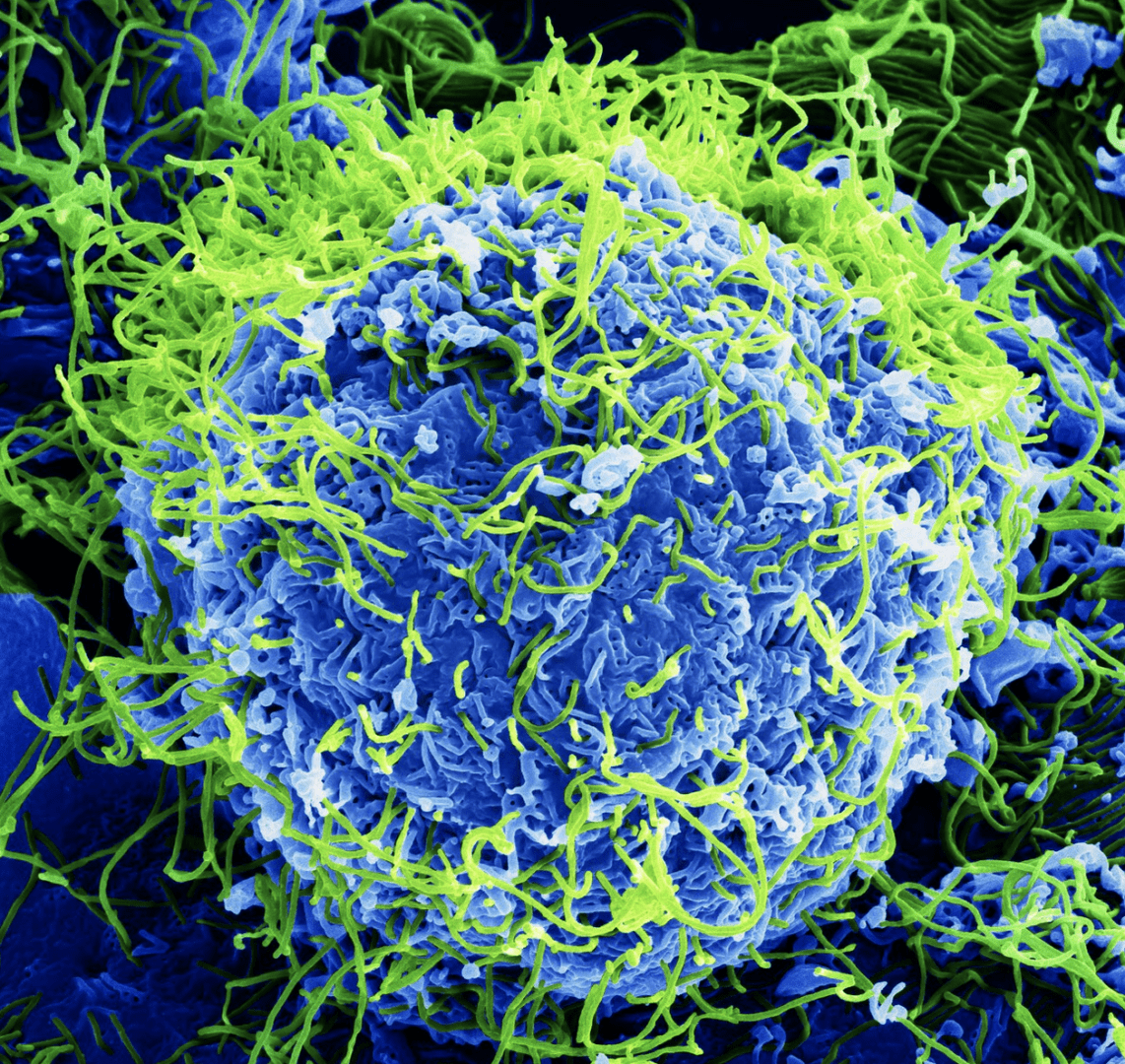
Note: photo: Image courtesy CDC / Dr. Frederick A. Murphy