
Subscribe!
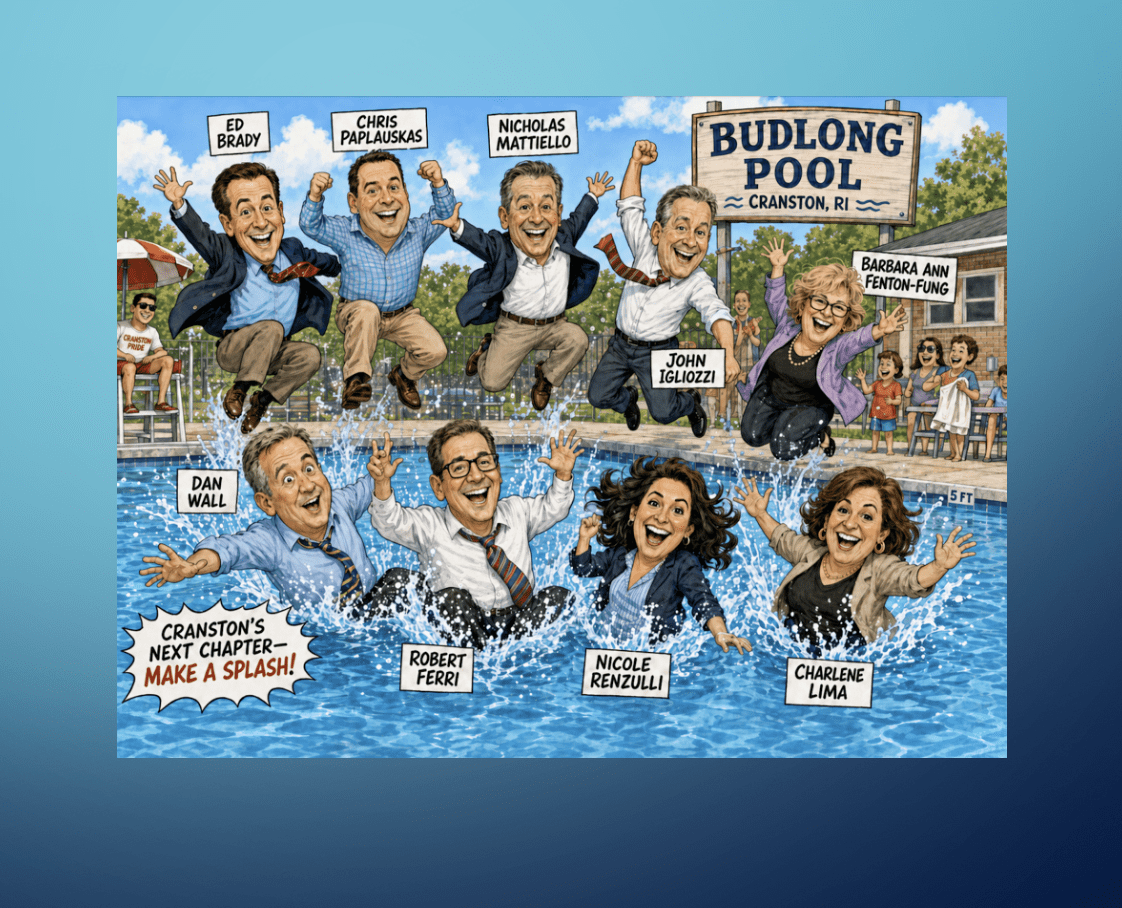
Cranston at the Crossroads: Who Can Lead Rhode Island’s Second-Largest City Through What Comes Next?
by Nancy Thomas, publisher
Cranston’s next mayoral race is already beginning, and it is not waiting for 2028.
Mayor Kenneth Hopkins is term-limited. That alone would make the next election one of the most important in the city’s recent history. But this is not a routine open-seat race. It is beginning at a moment when Cranston is wrestling with budget strain, public frustration, leadership turnover, a bruising fight over Budlong Pool, questions about economic development, homelessness and public order, and a City Council that has too often looked volatile, divided, and with a recent past of public embarrassment.
The next mayor will not simply replace Hopkins.
The next mayor will have to restore confidence in City Hall.
Cranston is Rhode Island’s second-largest city. It is home to established neighborhoods, changing demographics, strong civic institutions, major public assets, and one of the state’s premier commercial centers in Garden City Center. It is also one of the most important remaining places where Rhode Island Republicans can point to executive leadership in a state otherwise dominated by Democrats.
That is what makes the 2028 race bigger than one city election.
For Rhode Island Republicans, Cranston is a must-hold. For Democrats, it may be their best opportunity in years to reclaim City Hall. For independents and frustrated voters, it may be a chance to reject both parties and demand basic competence.
For residents, it may come down to something simpler:
Who can make Cranston feel well-led again?
The Hopkins record: complicated, damaged, but not empty
Hopkins remains a complicated figure in Cranston.
Many Cranstonians still remember him as a soft-spoken, good guy — familiar from years around school athletics and respected for the personal strength he showed during the health struggles and death of his beloved wife. That goodwill is real. Those who know him know he is personally pained by what has happened with the budget and with the public confidence of the city.
But goodwill is not governance.
The buck stops with the mayor. The budget crisis happened on his watch, and Cranston is likely to face another difficult budget year. Residents can bank on that. The city’s fiscal problems are not going away because one budget was patched together or one finance official was removed.
Hopkins’ record is difficult to reduce to one defining achievement.
Topgolf opened in Cranston on his watch, giving the city a major regional entertainment venue and the first Topgolf location in New England. That is a real ribbon-cutting. But Topgolf has been surprisingly quiet as a broader economic-development story since then. Whether it has become the kind of economic driver once promised is a story for another day.
Costco remains an ambition, not an accomplishment. It may yet happen. But it has not happened.
Budlong Pool may finally reopen this summer, and there will likely be photos, public officials, speeches, smiles, and families happy to see a long-closed public space returned to use. Yet even if the new pool is attractive, the process has been politically damaging. The pool has been closed for years, delayed repeatedly, and turned into one of Cranston’s most divisive civic issues — a fight that separated residents, energized activists, and created a needless symbol of distrust.
The city did, however, open a basic splash pad when the full pool opening was delayed. That belongs in the good column for Hopkins.
It was not a massive project. It was not a substitute for the pool. But it was a practical answer to a public need. Hopkins used the authority of the mayor’s office to get something done. In a city tired of process, studies, objections, meetings, delays, and political theater, that kind of executive action matters.
Cranston voters may criticize the administration’s handling of Budlong, the budget, or communication, but they are not opposed to strong mayoral authority. Quite the opposite. Cranstonians often respond well when a mayor acts with confidence, solves a problem, and owns the result.
The council is the council. The mayor is the mayor.
And in a strong-mayor city, residents expect the mayor to lead.
Hopkins also knows media. He understands how to use a sound bite, how to speak directly, and how to project authority when he chooses to. Cranston needs to see that version of him again — not defensive, not isolated, not hidden behind process, but visible and in command.
His removal of the city’s finance director during the budget crisis was more than a face-saving moment. It was one of the few clear moments of decisive leadership during the toughest issue to hit the city in years. Whether viewed as accountability, damage control, or both, the action acknowledged that something had gone badly wrong and could not simply be explained away.
The proposed closure of the Michael A. Traficante Enrichment Center also deserves more context than it received in the heat of the budget fight. On paper, closing or cutting the senior center looked politically stunning — almost unthinkable in Cranston, where the center is one of the city’s shining stars and recognized statewide. But the proposal may have been less a realistic plan to eliminate the center than an alarm bell intended to force the council and the public to confront the scale of the budget problem.
If that was the strategy, it worked in one sense: people paid attention. But it came at a cost. Threatening a beloved senior resource frightened residents, angered families, and deepened the sense that City Hall had lost control of the narrative.
Leadership is not only making hard choices. It is explaining them before panic fills the vacuum.
Hopkins still has time to change the closing chapter of his administration. Term limits can weaken a mayor, but they can also free one. With no reelection campaign ahead, Hopkins has an opportunity to act less like a politician under siege and more like the city’s chief executive — visible, decisive, compassionate, and willing to tell the city the truth before the next crisis arrives.
If Hopkins wants to change the final impression of his administration, the splash pad may point the way: do not wait for every critic to agree, do not let the council define the pace, and do not disappear into process. Identify the public need, use the power of the office, communicate clearly, and deliver.
Economic development: the missing plan
Topgolf is the ribbon-cutting. Costco is the unfulfilled promise. Budlong Pool is the wound. The splash pad is the reminder that Hopkins can act decisively when he chooses.
Economic development is the missing plan.
Cranston still has major assets: Garden City Center, Chapel View, Topgolf, strong neighborhoods, highway access, redevelopment potential, and private-sector interest. But the city has not had a visible, coordinated economic-development strategy that residents can easily understand. And now, amid budget pressure, the economic-development function itself has been eliminated or diminished as part of the city’s fiscal repair.
The city is left with scattered private projects rather than a public strategy.
Garden City Center remains a shining commercial beacon. Chapel View, meanwhile, appears to be quietly issuing its own challenge — adding restaurants and lifestyle tenants, picking up Applebee’s after the Garden City fire, and looking toward its own reinvention. At the same time, Carpionato’s plans for the former Davol property remain quiet, and internal legal disputes within the Carpionato world add another layer of uncertainty around some of Cranston’s most important private development assets.
Then came Newport Creamery.
The loss of Newport Creamery at Garden City Center after more than six decades is not simply a lease dispute. The mayor cannot order a private landlord to keep a tenant. But for average Cranstonians, Newport Creamery was not just another restaurant. It was a family memory, a senior routine, a post-game stop, a place tied to Garden City before Garden City became upscale. Its planned departure left many residents with a “say it isn’t so” feeling — another reminder that Cranston is changing faster than City Hall can shape, soften, or explain.
For 2028, this becomes a major test. The next mayor will not only have to close budget gaps or manage council fights. He or she will have to rebuild Cranston’s economic-development confidence — turning scattered private projects into a coherent city strategy, and making sure the city is not simply waiting for the next developer to call.
Politics has its own survival instincts. Cranston Democrats can see that Republicans are bruised — by the budget crisis, the Budlong fight, and the uncertainty over who can carry the party forward after Hopkins. That makes 2028 their clearest opening in years. But sensing weakness is not the same as proving readiness to govern.
The Republican legacy — and why Cranston matters statewide
Cranston’s Republican mayoral tradition has never been only about national party politics.
At its best, it has been about local management: public safety, neighborhood services, fiscal restraint, senior services, parks, schools, and a mayor who looks like someone is in charge.
That is why Allan Fung’s shadow still hangs over Cranston politics.
Fung’s strength was not simply that he was a Republican. It was that he combined two qualities voters often want but rarely get in the same leader: command and accessibility. He could look firm when the city needed order, but he could also show up in a very human way — the kind of mayor who would jump into Budlong Pool, work a crowd, and make city government feel close to residents.
In 2020, under Fung, Cranston responded aggressively to threats around Garden City Center and Chapel View after unrest and looting in Providence. Curfews, police presence, National Guard deployment, and barricades sent a clear message: Cranston would protect its neighborhoods and its commercial centers.
Hopkins inherited that expectation. His early posture on illegal ATVs and dirt bikes fit the same Cranston instinct: draw a line at the city border, back police, and make clear that what was overwhelming Providence would not define Cranston.
The problem for Republicans now is that Cranston voters may still want firmness on public safety while also wanting more competence on budgets, capital projects, economic development, communication, and council management.
The party’s challenge is delicate: hold Cranston without making the race a defense of every criticism of Hopkins.
That is why the 2028 race has statewide stakes. Rhode Island’s governor, congressional delegation, and General Assembly are all controlled by Democrats. Cranston City Hall remains one of the few visible places where Rhode Island Republicans can claim executive leadership. A Republican mayor of Cranston cannot replace a U.S. senator or member of Congress, but he or she can provide a rare Republican governing voice in Rhode Island — someone with executive credibility who can speak to national Republicans when power shifts in Washington.
If Rhode Island needs something from Washington, the state is represented federally by four Democrats. That may work well when Democrats hold power. But when Republicans control Congress or the White House, Rhode Island has fewer natural Republican channels. Cranston’s mayoralty has been one of the few remaining bridges.
Will the Rhode Island Republican Party treat Cranston like a must-hold seat? Or will a divided field, lingering resentment from the Hopkins years, and an independent candidacy fracture the vote and hand Democrats an opening?
Politics has its own survival instincts. Cranston Democrats can see that Republicans are bruised — by the budget crisis, the Budlong fight, and the uncertainty over who can carry the party forward after Hopkins. That makes 2028 their clearest opening in years. But sensing weakness is not the same as proving readiness to govern.
That may be one of the biggest questions of the next two years.
(As we go to press, media are noting that 9 for 9 President Trump endorsed Republicans have won their primaries – “if you want to win as a Republican, seek the President’s endorsement” – True here? Not so sure, but it is interesting.)
Traficante, Gallo, and the old power lines
No discussion of Cranston politics is complete without Michael A. “Traf” Traficante.
Traficante, now the Ward 5 councilman and nearly 90, remains one of Cranston’s most important political validators. A former mayor, former council president, and longtime figure in Cranston’s old municipal culture, Traficante represents a kind of neighborhood-based politics that still matters to many voters.
Though associated with old-school Cranston Democratic politics, Traficante has repeatedly shown that his loyalty is not purely partisan. His loyalty is to what he believes is best for the city.
Traficante supported Hopkins, giving him old-school institutional credibility. In a crowded 2028 field, his role may again be less candidate than kingmaker — the figure whose support, silence, or criticism signals which contender is viewed as serious, experienced, and acceptable to older Cranston voters.
If Traficante represents old municipal power, Sen. Hanna Gallo represents a different kind of Cranston power: current State House influence that has not always translated into visible local leadership.
Gallo, a Democrat representing Cranston and West Warwick, is one of the city’s most senior and influential legislative figures. Her political roots include grassroots Cranston activism around the old Davol site. Through seniority and attrition, she has risen to one of the more powerful posts in the Senate.
Yet locally, her voice has often seemed quieter than her résumé would suggest.
That matters because Cranston’s next mayor will need strong State House relationships. Schools, housing, development, homelessness, senior services, and state-local funding all require more than City Hall. Whoever succeeds Hopkins will need to work with Cranston’s legislative delegation — including Gallo, whose education and leadership roles could be valuable if the city wants help beyond Park Avenue.
Public order, homelessness, and compassionate strength
Public order may become one of Cranston’s next major leadership tests.
The city has already dealt with encampments near New London Avenue and Chapel View. Similar concerns are now visible around Route 10 and the Cranston-Providence line. Residents and businesses have legitimate concerns about safety, sanitation, fire risk, panhandling, and encampments near major commercial entrances. People living outside are also human beings in crisis, often with nowhere else to go.
The next mayor cannot solve homelessness alone. But Cranston also cannot pretend the issue belongs only to Providence.
Panhandling adds another layer. Courts have allowed significant First Amendment protection around asking for help, but cities still have responsibility for traffic safety, obstruction, intimidation, sanitation, and the condition of public spaces. The challenge is to respond to what residents and businesses are seeing without pretending that police alone can solve poverty, addiction, mental illness, or housing scarcity.
This is where Police Chief Col. Michael Winquist has often shown the balance residents may want: compassionate strength. On encampments, Winquist has projected both firmness and restraint — acknowledging the human difficulty of homelessness while drawing a clear line around private property, public safety, and neighborhood impact.
In a city where elected leadership has often seemed hesitant, reactive, or buried in political conflict, Winquist has at times looked like the steadier public face of government.
Overpass demonstrations and sign-hanging present another test. Peaceful protest is protected. But hanging signs from highway overpasses, distracting drivers, blocking pedestrian passage, or creating a traffic hazard is a different issue. The city and state cannot treat political speech as a nuisance simply because officials dislike the message. They also cannot ignore public-safety risks on roads and overpasses.
That is a harder leadership test than ATVs or riots. It requires order without overreaction, enforcement without escalation, and respect for free speech without letting every national outrage become Cranston’s next local crisis.
Cranston voters may be less interested in who can win the next argument than who can lower the temperature and run the city.
Cranston Forward, Democrats, and the activist problem
The Democratic side is not without its own complications.
Maria Bucci, the former Democratic mayoral nominee and former councilwoman, remains chairwoman of the Cranston Democratic Committee even after a DUI arrest and body-camera video became an embarrassing, viral national story. Bucci’s earlier campaign against Hopkins had been notably restrained. She vowed not to run a nasty race and largely held to that promise. But civility alone was not enough to defeat Cranston’s Republican mayoral structure.
Her later arrest video now gives Cranston Democrats another problem: how to argue for professionalism and a reset at City Hall while their own committee remains led by someone whose worst public moment went national.
At the same time, groups such as Cranston Forward and allied progressive organizers have operated in their own lane — often outside traditional party discipline. Cranston Forward rose through local fights such as Budlong Pool, helping turn the pool into a prolonged public battle. More recently, progressive activism has moved into broader national protest themes, including “No Kings” activity and visible sign standouts.
That activism may energize part of the Democratic base. It is not the same as proving readiness to govern Cranston.
Standing with signs, filling public meetings, and turning national politics into local confrontation can command attention. But it does not necessarily persuade voters who are tired of dysfunction and want competence, budgets, services, and a city that feels less divided.
The danger for Democrats is that the activist wing may become more visible than the governing wing. The danger for Republicans is assuming frustration with protest automatically becomes support for the Hopkins record.
The opportunity for the next mayor — from either party or no party — is to speak to residents exhausted by all of it.
The City Council problem — and Dan Wall’s test
The Cranston City Council has been central to the city’s damaged image.
For years, meetings have too often been volatile, personal, and difficult to watch. The double resignation of Council President Jessica Marino and council solicitor Stephen Angell was a public embarrassment that left the council shaken and the city looking unstable.
That moment thrust Dan Wall into leadership.
Wall entered the council through a 2023 special election and later became council president under difficult circumstances. He did not have decades of apprenticeship. He was a relatively new councilman pushed into one of the hardest leadership roles in city government.
To his credit, Wall has proven himself under fire.
During the budget crisis, he was a steady and effective chair. He kept meetings moving through long, emotional, and often contentious sessions. He showed patience, command of procedure, and an ability to let the public be heard without allowing the process to collapse.
But Wall’s broader public profile remains less developed. His communication skills with the public and media have not yet matched his performance in the chair. If he is looking toward 2028, he would need to become more comfortable explaining not just what the council is doing, but why — and doing so in a way that reaches voters outside the council chamber. Not buying into the fear of the media – because not all are about “gotcha” political moments and finding that clickbait sweet spot.
Wall’s lane is clear: battle by fire. A newer councilman forced into leadership during crisis, who helped stabilize a chamber that had become part of the city’s problem.
The question is whether procedural competence can translate into citywide leadership.
Women to watch
Cranston’s next leadership field should not be discussed as though it belongs only to the familiar men of city politics.
Barbara Ann Fenton-Fung remains the most obvious Republican woman in the conversation. A former state representative and 2024 Republican primary challenger to Hopkins, she has continued writing publicly about Cranston’s financial and management problems. That matters. It keeps her in the policy conversation and gives her a lane: not anti-Republican, but anti-mismanagement.
Her former tact of saying she would do what her husband – former Mayor Allan Fung – did earned her the Fung 2.0 moniker – and we think an unfortunate one, not to mention somewhat antifeminist – and a surprising path to her defeat.
Her challenge is to turn criticism into a governing case. Cranston voters may agree mistakes were made. But they will want to know who can fix them, not simply who can prove they were right.
Nicole Renzulli also belongs prominently in the discussion. A former citywide councilwoman, Renzulli now serves in a highly visible role in the Hopkins administration and has become one of the most public-facing figures in City Hall. In a government often criticized for poor communication, she has increasingly become the person residents and media see explaining, defending, or translating what the administration is doing. She even stepped in for an absent role of City Clerk during a Council meeting so the group could move along – demonstrating the One Cranston slogan of her boss, the Mayor.
That visibility gives her a profile few others have. It also gives her risk. If voters see her as competent, accessible, and willing to engage, she could emerge as part of the next Republican leadership bench. But because she is now tied closely to the Hopkins administration, she would also have to answer for the broader record — the budget crisis, Budlong Pool, economic-development questions, and public frustration with City Hall. The need to say “watch your back” should not go without saying, because nasty politics will use every moment, often not fair to a woman candidate, to plot.
If Fenton-Fung represents the Republican critique from outside City Hall, Renzulli represents the Republican future being tested inside it.
Charlene Lima is another name worth noting, if only because she represents a type of Democrat who may better fit Cranston’s mood than louder ideological factions. A longtime Democratic state representative from Cranston, Lima has often presented herself as independent, pro-police, pro-veteran, attentive to seniors and families, and willing to challenge party bosses. There is no clear sign she is preparing a mayoral run, but in a city tired of political combat, her old-school constituent-service profile should not be ignored. Her staunch position with the sadness of the Newport Creamery leaving Garden City was a solid moment – shouldn’t be a flash in the pan if she’s interested.
Jessica Marino, once considered one of the stronger Democratic women in Cranston politics, is now more a fading, cautionary figure than a likely contender. Her resignation as council president badly damaged her public standing. Whatever private tensions remain in Cranston politics, her path back to citywide credibility appears extremely difficult. Her actions behind the scene bear watching. As Cranstonian leadership has a hard time moving on, showing how to do that should be her focus now.
The field taking shape – Who’s on first? Ed Brady
The first declared candidate is Ed Brady. Brady, a former Republican councilman and businessman, is running as an independent. His candidacy immediately complicates the map. He can appeal to voters tired of both parties, but he could also draw from the same center-right or anti-establishment pool Republicans need if they are to hold City Hall.
Chris Paplauskas may be the most obvious Republican succession figure. A state representative, former council president, and current Deputy Chief of Staff in the Hopkins administration, Paplauskas has governing experience and direct City Hall knowledge. But that connection cuts both ways. Experience is an asset. Proximity to the Hopkins administration may be a burden.
Fenton-Fung offers the Republican correction lane. She warned about Cranston finances, challenged Hopkins, and has continued writing about what she believes the city got wrong. Her task would be to show that she is not simply revisiting old grievances, but offering a serious path forward.
Renzulli represents the newer, more media-facing Republican bench. Whether or not she runs, she is now part of the city’s visible leadership structure.
Nick Mattiello is the experienced operator — or perhaps the alternative kingmaker. Former Speaker of the RI House of Representatives, and a power broker, Nicholas Mattiello would bring deep budget, legislative, and State House experience. A mayoral run would let him argue that Cranston needs someone who understands budgets, labor, legislation, and the realities of turning around a struggling city. But he also has a strong legal and lobbying practice, and may decide his influence is better used behind the scenes than on the ballot.
If Mattiello does not run, his support could still matter. Like Traficante on the municipal side, Mattiello could shape the Democratic field through fundraising, counsel, and political judgment.
John Igliozzi gives Democrats another experienced name, with years in Providence municipal government and a role in Cranston Democratic politics. He would likely argue experience and governing know-how.
Dan Wall has the “tested under pressure” argument.
Robert Ferri, the 2024 Democratic nominee and former councilman, remains a softer possibility because he has run citywide before. But unless there is a fresh public signal, he belongs lower on the list, with few wishing to revisit the divisiveness of social media posts, and one particular harsh banging of the fist at a public city council meeting leaves questions of tolerance for the stress of executive Cranston politics.
And hovering over all of them are the figures who may not run but may help decide who is taken seriously: Traficante, Mattiello, Fung, Gallo, party leaders, neighborhood networks, and voters who no longer fit neatly into old Cranston categories.
Cranston’s changing electorate
Cranston is still Cranston — neighborhood-based, family-oriented, politically alert, and deeply attached to its civic institutions. But the electorate is not frozen in the Fung, Laffey, Traficante, or DiPrete eras.
The city has grown modestly, become more diverse, and added voters with less attachment to the older political networks that once shaped City Hall. For some voters, names like Traficante still carry enormous weight. For others, the test may be simpler: who can keep taxes stable, deliver services, maintain schools, manage public safety, and stop the city from looking divided?
That is why party labels may matter less than leadership style.
Cranston residents have learned that party politics, nationalized outrage, personal rivalries, and positioning for power have done little to help the city solve its most basic problems. The word “dysfunctional” is overused in politics, but Cranston has too often lived down to it — with volatile meetings, budget battles, leadership resignations, prolonged fights over Budlong Pool, and a public sense that too much energy has gone into combat and too little into governing.
Cranston should not be defined by dysfunction. It is Rhode Island’s second-largest city. It has major commercial assets. It has strong neighborhoods. It has a senior center recognized statewide. It has public-safety leadership. It has a diverse and changing population. It has political talent in both parties and outside them.
What it needs now is a reset.
The real question
The 2028 mayor’s race may come down to a simple question:
Who can run Cranston?
Not who can win the next argument. Not who can embarrass the other side. Not who can fill a meeting room. Not who can post the sharpest sign or deliver the angriest speech.
Who can run the city?
Who can manage a budget before it becomes a crisis? Who can protect Garden City and Chapel View while also treating homelessness with humanity? Who can open Budlong Pool without reopening old wounds? Who can rebuild economic development? Who can speak clearly to residents before fear fills the silence? Who can work with the council, the State House, police, seniors, businesses, schools, and neighborhoods?
The next mayor will inherit more than City Hall.
He or she will inherit a divided civic culture — shaped by old loyalties, new activists, budget pressure, changing demographics, public-order concerns, and voters who may be less interested in partisan warfare than in seeing the city work.
Cranston does not need another faction.
It needs leadership.
___
Who we asked for comments – and how they responded – or didn’t:
Ed Brady – first out of the box with a public statement:
“Our family is currently planning and exploring a run for Mayor of Cranston in 2028. I plan to run as an independent because I believe our city is hungry for leadership that puts Cranston first and people before politics. Cranston does not need more division or career politicians. Cranston needs collaboration, transparency, fiscal responsibility, and a real vision for the future.
As a social entrepreneur, community leader, producer and someone deeply invested in Cranston’s arts community, small businesses, neighborhoods, schools, and families, I’ve spent years building, bringing people together, and fighting for this city in unique and meaningful ways. I believe the next chapter for Cranston should be about listening, unity, innovation, and restoring pride and trust in our local government.
Residents are frustrated by rising costs, political noise, and feeling unheard. I want to build a movement that listens to people from every neighborhood and every political background across our entire city. Independent means independent … accountable to the people of Cranston, not party bosses or special interests.
This campaign, when formally launched, will be about creating opportunity, investing responsibly in our community, supporting public safety and education, strengthening our local economy, expanding pathways for seniors and students, and making Cranston a city where the next generation wants to stay, work, build, and raise a family.”
Brady’s political CV, as submitted: Cranston native Ed Brady is a social entrepreneur, creator, producer, and community leader dedicated to building community through business, arts, entertainment, and service. A graduate of Bryant University, where he studied business, communication, and film, Ed began his career in Hollywood working behind the scenes on production sets while also hosting red carpet events. He now proudly lives back in Cranston with his wife Taylor and their son Maverick.
Ed is the co-founder of The Thirsty Beaver, a locally grown hospitality group with active locations in Cranston, Smithfield, and North Kingstown, currently celebrating its 13th year. He is also part of the founding family behind Restaurant.com and co-founder of both the RI Night Market and the Garden City Farmers Market.
Over the past fifteen years, Ed has helped raise millions of dollars for nonprofits, local initiatives, and community-driven ventures throughout Rhode Island. Through his grassroots nonprofit, Cranston Cares, he has helped adopt and revitalize dozens of parks and public spaces while leading initiatives rooted in service, compassion, and human connection. In collaboration with the Rhode Island Dream Center, he has also helped support and feed more than 100,000 individuals and families facing hardship across the region. Ed currently serves on the board of Comprehensive Community Action Program.
During the COVID-19 pandemic, Ed served as an advocate for Rhode Island’s small business community while serving as Vice President of the Cranston City Council. In 2022, he went “all in” to help save and protect Park Theatre while also supporting efforts to rehabilitate the Cranston West Alumni Theatre. As the Park Theatre celebrates its 100-year anniversary, Ed continues working to reimagine the historic venue as a hub for arts, culture, education, and entertainment.
In the entertainment industry, Ed helped bring the production of Good Burger 2 to Rhode Island alongside Kenan Thompson, Nickelodeon, Paramount, and the Rhode Island Film & TV Office. He also worked with Verdi Productions as an associate producer on Acting Coach Nightmare and The Roaring Game, both filmed in his hometown.
Ed is also the co-creator of The Search, a community-driven artist showcase and creative platform designed to give emerging talent an opportunity to be seen, heard, and celebrated through live performances, mentorship, and collaboration. More than a showcase, The Search is rooted in building community, creating opportunity, and inspiring the next generation of artists and leaders throughout Rhode Island and beyond.
___
Mayor Ken Hopkins on Ed Brady
“Ed Brady and I served together on the Cranston City Council, and I have known him for many years. I respect his love for Cranston and his willingness to reengage in public service.
The next mayoral election is still more than two years away, and my focus remains on the responsibility I have today, the residents we serve, and the work still before us as a city.”
“I have been asked to run for mayor by many people, Democrats, Republicans, and Independents, who have expressed their confidence in my ability to manage the city and its budget. I am grateful for their confidence. I will make a decision next year.” Thank you, – Nick Mattiello
We also asked Mr Ferri, and Mr. Igliozzi for comment – no responses were received at press time