
Subscribe!
Ask Chef Walter: FERRAGOSTO, The Italian Summer Holiday – Walter Potenza
by Executive Chef Walter Potenza, contributing writer
Ferragosto is a day dedicated to the simple pleasures of life—good food, warm company, and the awareness that sometimes the greatest luxury is doing nothing at all.
Friends:
There is a day in the middle of August when Italy seems to hold its breath. The cities empty, the shutters close, and the entire country tilts toward the coast. That day is Ferragosto, and it is not merely a holiday but a feeling—a collective exhale after months of work, a celebration of summer at its most golden and generous. It is the day when families gather under the shade of pine trees or beach umbrellas, when the air smells of salt and grilled food, and when time itself seems to slow down.
This tradition is ancient, born long before any modern calendar could contain it. It began as a moment of rest for the people and the land; a pause granted after the heavy labor of the harvest. (“Ferragosto in Italy: Origins and Tradition” ) Over the centuries, it absorbed new meanings and rituals, but its heart never changed: Ferragosto is about stopping, being together, and honoring the season’s abundance.
The Catholic Church later placed its own feast on this same date. (“Ferragost”) Still, for most Italians, the day remains dely secular—a national permission slip to abandon routine and embrace leisure. (“Ferragosto: History and Culture Behind This Typically Italian Holiday”) From that broad history, the holiday takes on a more local life (Feinstein) in the central and southern regions of the country. (Bennetts) In the central and southern regions of the country, Ferragosto is lived with particular intensity. (Feinstein)
Here, the holiday is not complete without a long, lazy lunch that stretches into the late afternoon, accompanied by laughter, wine, and the slow rhythm of conversation. Every region adds its own touch to the table. In the Marche, you might find a rich fish soup, while in Sicily, a cool watermelon jelly offers relief from the heat. In Puglia, baked pasta takes center stage, and in Calabria, some families still follow the old custom of a midnight swim before the feast.
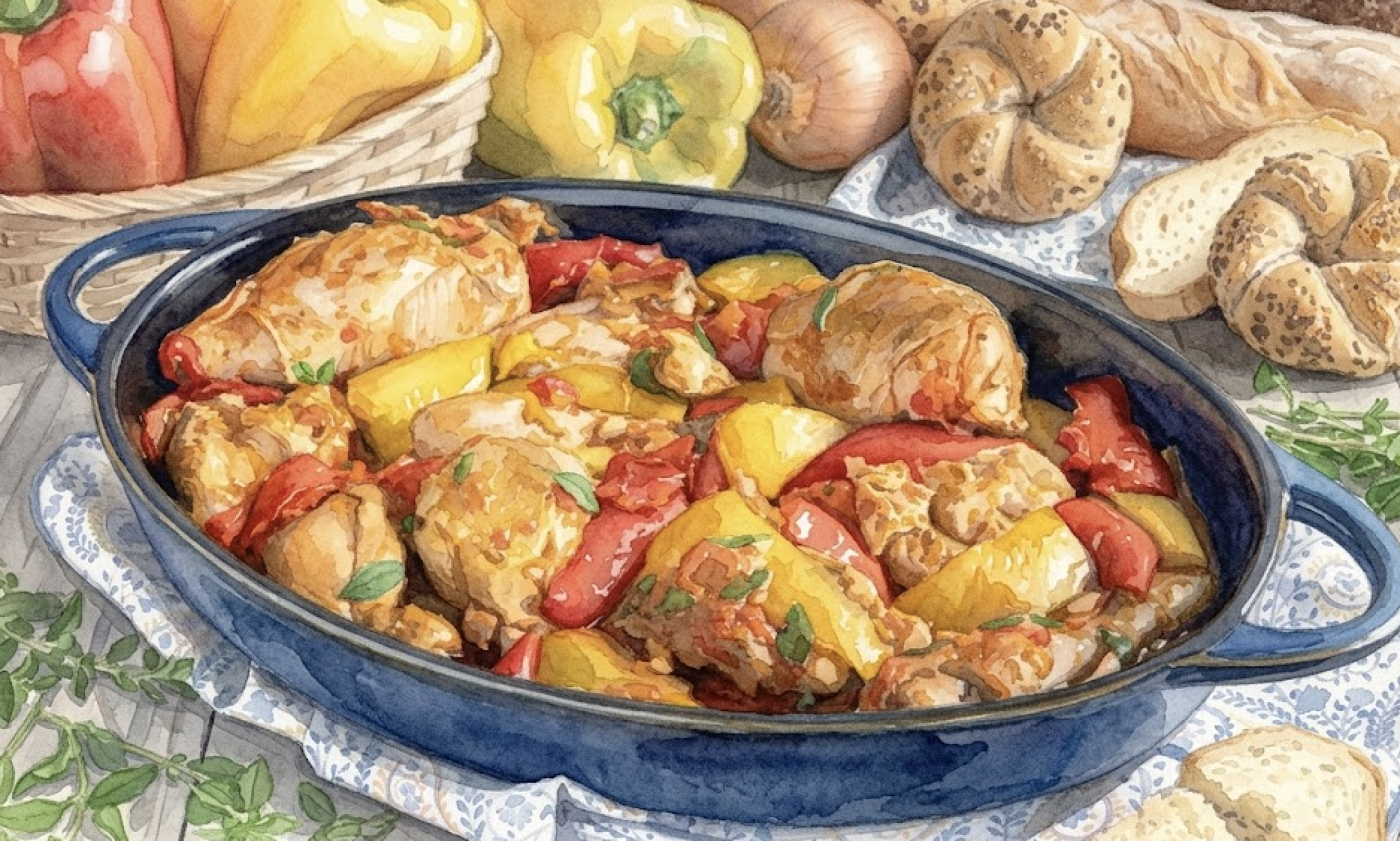
Yet, amid all this variety, one dish stands out as the true emblem of Ferragosto in the center and south: chicken with peppers. It is a humble plate, born from the kitchens of everyday people who knew how to turn simple ingredients into something unforgettable.
The chicken is succulent, the peppers are sweet and slightly charred, and the sauce that forms around them is so deeply flavored that no one can resist sopping it up with a piece of crusty bread. This is the kind of food that tastes of memory, of summer gardens, and of the patient, unhurried cooking that defines Italian home life. It is also the dish that leads naturally into the recipe that follows. (Feinstein)
To make this dish at home is to bring a little piece of Ferragosto to your own table. The process is straightforward, but it asks for care and attention, just like any good summer ritual.
Here is a good recipe to make it.
_
Classic Chicken with Peppers (Pollo con Peperoni)
Serves 4 to 6 people
What you will need:
One whole chicken, about 1.5 kilograms, cut into serving pieces, or roughly 2 pounds of chicken thighs if you preferThree large bell peppers, preferably red and yellow for their natural sweetness
One medium onion or a shallot, finely chopped
One clove of garlic, left whole but lightly crushed.
One cup of dry white win
One can of tomato puree, about 400 grams, or six ripe San Marzano tomatoes, roughly chopped.
Extra virgin olive oil, enough to generously coat the pan
Line salt and freshly ground black pepper
Optional, for a Roman-style warmth: one teaspoon of turmeric and a pinch of dried chili pepper
Procedure
Begin by washing the chicken pieces and patting them completely dry with paper towels. This step matters more than you might think—dry skin browns beautifully, while wet skin steams.
Season the chicken all over with salt and pepper.
Place a large, heavy-bottomed pan or casserole dish over medium heat and pour a decent amount of olive oil. When the oil shimmers, add the chicken pieces in a single layer, being careful not to overcrowd the pan. If necessary, work in batches. Let the chicken brown slowly and undisturbed for several minutes on each side, until the skin turns a deep, golden amber. Remove the browned chicken and set it aside.
Return the pan to the heat if needed, then add the whole garlic clove to the oil and let it sizzle for a minute, releasing its fragrance. Then pour in the white wine. It will hiss and bubble—this is good. Let it cook until the wine has almost completely evaporated, using a wooden spoon to scrape every browned bit from the bottom of the pan. Those tiny carmelized pieces are liquid gold
Now add the chopped onion and let it soften gently for a few minutes. While the onion cooks, wash the bell peppers, remove the stems and seeds, and slice them into thick strips about two centimeters wide. Add the pepper strips to the pan, followed by the tomato puree or the chopped fresh tomatoes. Stir everything together until the peppers are coated in the red sauce.
Pour in about half a cup of warm water, just enough to create a loose sauce. Return the browned chicken to the pan, nestling the pieces into the peppers and sauce. Cover the pan with a lid, reduce the heat to low, and let everything simmer for about forty-five minutes. Stir occasionally, checking that the sauce does not dry out—if it seems too thick, add a splash more hot water. The chicken is ready when it is fork-tender and nearly falling off the bone, and the peppers have softened into silky, sweet ribbons.
If you are using the turmeric and chili, sprinkle them in during the last ten minutes of cooking, stirring well to distribute their warm, earthy color and gentle heat.
To serve:
Trnsfer the chicken and peppers to a large serving dish, spooning all that rich, rust-colored sauce over the top. The only accompaniment you truly need is a basket of crusty country bread. Place it on the table and watch as every guest tears off a piece to mop their plate clean—this is the ritual of scarpetta, and it is as much a part of the meal as the chicken itself. (Capatti and Montanar
Serve it warm, preferably outdoors, with a glass of chilled white wine and the lazy afternoon stretching ahead of you. In that final, easy silence, the meal delivers its true payoff: simple food, shared well, and the feeling of summer lingering just a little longer.
Ferragosto is many things: a historical echo, a religious feast, a summer escape. But above all, it is a day dedicated to the simple pleasures of life—good food, warm company, and the awareness that sometimes the greatest luxury is doing nothing at all. And on that day, in kitchens across central and southern Italy, the scent of chicken and peppers drifting through open windows is the soundless music of a country at peace with itself. That is the final payoff of Ferragosto: a shared table, an unhurried afternoon, and summer felt at its fullest.
https://flavorsandknowledge.substack.com/
___
READ “Ask Chef Walter” every Sunday in RINewsToday

Master Chef Walter Potenza
There is a constant, recognizable thread in the career of Walter Potenza to elevate the level of Italian culinary culture in the United States. Besides his unquestionable culinary talent and winning business perspective, Chef Walter has been a relentless educator with passion and knowledge who defeats stereotypes. His life, career, and values are a model, an example to follow by any chef of Italian gastronomy working outside Italy.
Chef Walter appears regularly on National and International Networks such as Food Network, ABC, CBS, NBC, RAI, FOX, and Publications such as NY. Times, Washington Post, Wall Street Journal, Food & Wine, Saveur, Gourmet, and several Italian media outlets.