
Subscribe!
Ask Chef Walter: The Red Strips – Walter Potenza
by Master Chef Walter Potenza
Exploring Rhode Island’s Most Beloved Bakery Food
Friends:
Some foods define a region. Others go further: they become the region itself, woven so tightly into the fabric of daily life that eating them feels less like a meal and more like an act of memory. In Rhode Island, that food is the pizza strip — and if you have never encountered one, the name alone will tell you almost nothing about what it is or why it matters.
Around the state, it travels under different names. Pizza strip. Red strip. Bakery pizza. Party pizza. The name shifts depending on who you ask, how old they are, and which corner of Providence or the Ocean State they consider home. What does not shift is the food itself, or the great and slightly possessive pride Rhode Islanders bring to it. The pizza strip is one of the most cherished culinary traditions in the state, and it remains, stubbornly and deliberately, a secret to almost everyone outside the state’s borders.
That secrecy is not accidental. Unlike the New York slice or the Chicago deep dish — both of which were eventually packaged, franchised, and exported to every shopping mall in America — the pizza strip has always lived in small, family-run Italian bakeries. It was born there, and it has never left. Its roots in neighborhood bakery culture kept it close to home, close to the people who made it, and far from the kind of commercial ambition that turns regional food into a national brand. In Rhode Island, that is considered a feature, not a flaw.
“Pizza strips give us all a sense of place, rooting us in ways we probably don’t even fully understand.” — Eric Palmieri
What a Pizza Strip Actually Is
Before anything else, a word of clarification — because if you arrive expecting a conventional slice of pizza, you will be pleasantly surprised in ways that might initially confuse you.
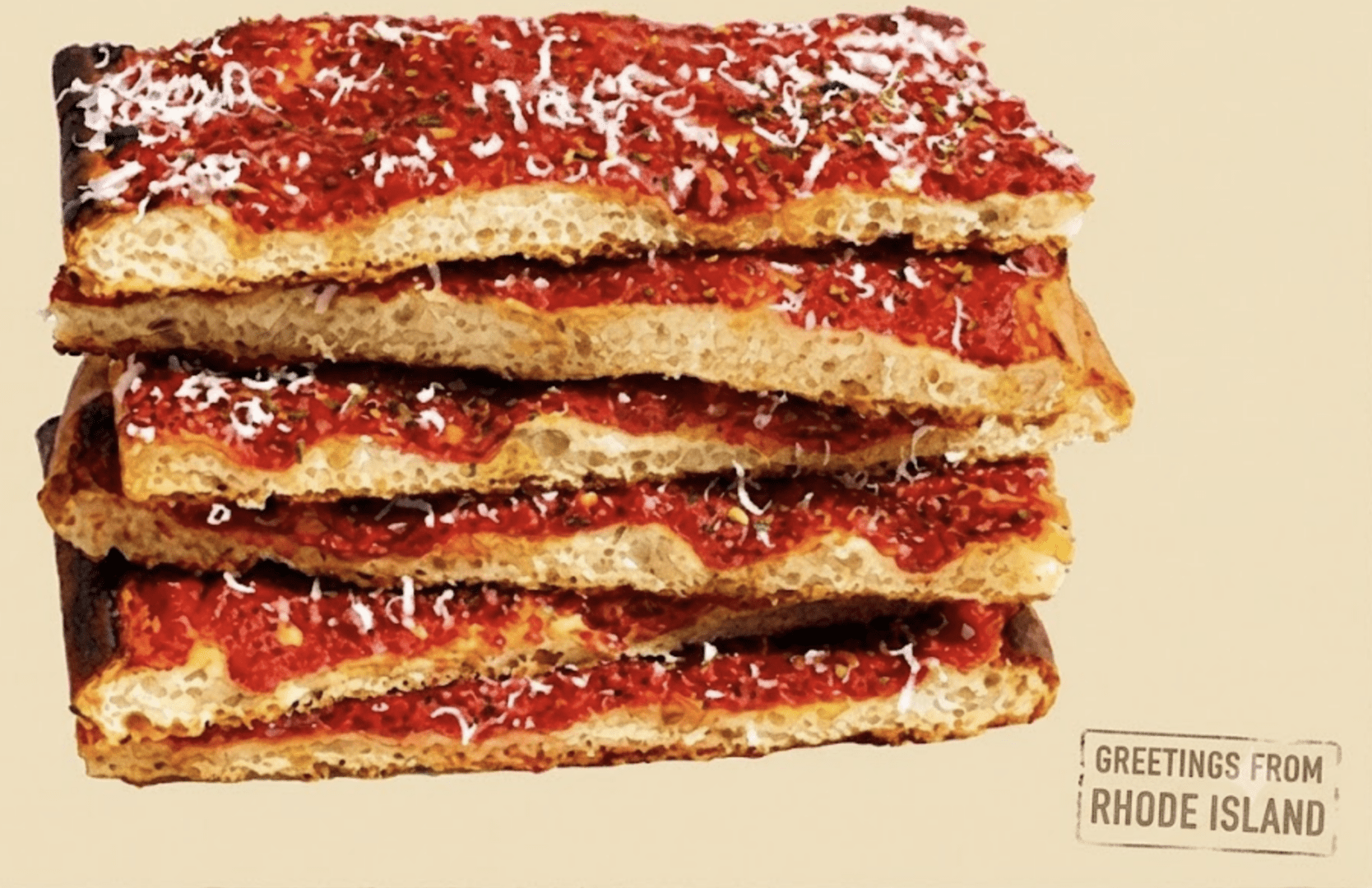
A pizza strip is a rectangular piece of thick, focaccia-style bread topped with a bold, herb-seasoned tomato sauce. That is the whole of it: no mozzarella, no toppings, no cheese pull. The sauce is what Rhode Islanders sometimes call “spicy,” which, in this tradition, means not heat but complexity: dried oregano, generous amounts of basil, cracked black pepper, and occasionally a whisper of red pepper flakes. The result is something intensely savory, aggressively herbed, and entirely satisfying without the softening presence of cheese.
Pizza strips are properly served at room temperature. Not warm from the oven. Not cold from the refrigerator. Room temperature — and if you challenge this convention with someone who grew up eating them, expect a firm and affectionate defense of the practice. There are practical reasons for it, and there are historical ones, and both go back more than a century.
Visually, the strip sits somewhere between Roman pizza al taglio and Sicilian sfincione. Like Sicilian pizza, it is baked in large rectangular pans and cut into substantial pieces. Like Roman street pizza, those pieces are long and narrow, wrapped in wax paper, and carried out the door. But the pizza strip is neither of those things exactly — it is something Rhode Island made its own, an adaptation shaped by the constraints and ingenuity of working-class immigrant life.
You will not find pizza strips at a pizzeria. You find them at Italian bakeries: places where the air smells of fermented dough and slow-cooked tomato, where stainless trays lined with bright red strips sit behind glass cases, where the regulars know the baker by name and have been ordering the same amount since childhood. Many Rhode Island supermarkets now carry them in their bakery sections as well, but the originals — the ones that matter, the ones people drive across the state for — still come out of the same family-owned shops they always have.
Italian Providence and the Origins of the Strip
The history of the pizza strip is inseparable from the history of Italian immigration to Rhode Island, and both histories begin in earnest at the turn of the twentieth century.
Beginning in the 1880s and accelerating through the early 1900s, thousands of Italians arrived in Providence, most of them from the southern regions of Campania, Sicily, and Calabria. They settled in the Federal Hill neighborhood, a dense, hilly district just west of downtown, gradually displacing earlier Irish residents and transforming it into one of the most vital Little Italies in the American Northeast. By 1920, Italians were the largest foreign-born ethnic group in Rhode Island. Federal Hill became the culinary and cultural heart of the city — a place of bakeries, butcher shops, produce markets, and social clubs, where the dialects of the old country mixed on the sidewalks and the smell of baking bread drifted through the streets every morning.
The Italian immigrants who arrived in Providence brought their food traditions with them, but they also brought the necessity of adaptation. The ingredients of home were not always available or affordable. They made do with what was accessible — canned tomatoes from American canneries, flour from local mills, olive oil when they could get it — and in the process, they refined and transformed what they knew.
The pizza strip almost certainly has its origins in the home kitchens and communal baking traditions of southern Italy, where bread dough topped with tomato and herbs was a staple long before the cheese-crowned Neapolitan pizza claimed the world’s attention. Food historians note that pizza itself began as a humble, cheeselike dish from Naples in the early nineteenth century, and the famous margherita — with its mantle of melted mozzarella — was not documented until 1889. The Associazione Verace Pizza Napoletana still recognizes pizza marinara, made with tomato, garlic, oregano, and olive oil but without cheese, as one of the three authentic Neapolitan pizzas, predating the cheese-topped versions by decades. The pizza strip is, in this sense, a direct heir of that older, more austere tradition.
In Providence’s early Italian bakeries, the strip emerged as much from practicality as from tradition. Bakers already had hot ovens running through the morning. They already had dough prepared for bread. They had tomatoes, herbs, and oil. The logical extension was to stretch leftover dough across a pan, coat it in sauce, and slide it into the oven alongside the day’s bread. The result was inexpensive, filling, and portable — a snack that could sit in the bakery case all morning at room temperature without spoiling, carried home in a paper bag, passed around at gatherings without ceremony, and eaten without utensils.
The pizza strip was born from abundance and want simultaneously — from the immigrant’s gift for turning almost nothing into something deeply nourishing.
The Sicilian Sfincione — a thicker, denser relative made with more flour and yeast, topped with tomato, anchovy, and breadcrumbs — almost certainly shaped the early Rhode Island strip. Immigrant bakers from Sicily would have recognized the form and adapted it, leaning into the dough’s bread-like depth while simplifying the topping for a market that demanded economy above all else.
Hard Times and Lasting Traditions
If the pizza strip was born in the early twentieth century, it was the Great Depression that cemented its place in Rhode Island’s food culture.
During the 1930s, when families across the country were stretching whatever resources they had, the pizza strip was among the most affordable foods a bakery could sell. A tray of dough and seasoned tomato sauce costs almost nothing to produce and could feed a large family or a table of guests. Eric Palmieri, whose family has run D. Palmieri’s Bakery in Johnston for five generations, believes the strip became a cornerstone of Rhode Island’s food identity precisely during those lean years, when affordability was not a selling point but a lifeline.
The room-temperature tradition became an economic asset as much as a culinary one. Pizza strips, along with other bakery staples like spinach pie, required no refrigeration and could sit in an open case all day without violating health codes. This practical advantage helped define the culture around the food: it was meant to be grabbed, not plated; eaten standing up, not at a table; wrapped in wax paper and carried out into the day.
Donald DePetrillo, owner of the Authentic Italian Bakery in Johnston, recalls that in the late 1960s, a full sheet of red strips cost just a few dollars. The price has risen modestly since then, as have all food prices, but the strip has remained a remarkable value. Today, most bakeries sell a full sheet for under fifteen dollars; individual pieces typically cost one or two dollars. In an era when a fast-food meal regularly exceeds ten dollars, the pizza strip remains one of the most generously priced foods in New England.
A Food That Stays Home
One of the most striking things about Rhode Island pizza strips is not what they are, but where they are — and where they are not. Unlike nearly every other regional American pizza tradition, the pizza strip has not spread. It has not been franchised. It has not appeared on menus in Brooklyn, Los Angeles, or Chicago, nor has it been reinterpreted by ambitious chefs who discovered it on a research trip. It has stayed in Rhode Island, held close by the community that created it.
Eric Palmieri, who has spent his life around food, thinks this containment is part of the strip’s appeal. “It’s so strange,” he has said, “that nobody outside of Rhode Island knows what to make of it.” That strangeness, that slight impossibility — how can a food this good remain this local? — has become an element of its identity. To know the pizza strip is to know something about Rhode Island that most of the world does not know.
For the people who grew up with them, pizza strips are sheer nostalgia in edible form. They carry the smell of a Saturday morning bakery, the sound of a crowded room, the image of a grandmother’s kitchen, the particular ease of a family gathering where no one counts who takes the last piece. There is almost always a white cardboard box at Rhode Island celebrations — the kind tied with red-and-white string — opened flat on a table, the strips arranged in neat rows, and people reaching for them the way you reach for something that has always been there.
The tradition is very much alive. D. Palmieri’s Bakery in Johnston continues to operate under the fifth generation of the founding family. La Salle Bakery in Providence — one of the most beloved institutions in the city — still starts baking before dawn so that customers can find fresh product waiting when they arrive in the morning. Vienna Bakery in Barrington, which has been open since 1923, sells pizza strips by the box, sized for a room. Sal’s Bakery on Chalkstone Avenue in Providence remains a neighborhood fixture for its pizza strips and baked goods.
Colvitto’s in Narragansett has, since 1992, packaged individual pieces for beachgoers — perhaps the most Rhode Island delivery mechanism imaginable.
How to Make Rhode Island Pizza Strips at Home
The pizza strip is deceptively simple. Its ingredients are few; its technique is forgiving; its results, when done correctly, are quietly extraordinary. What matters most is the dough’s texture — open and airy, with genuine chew — and the sauce’s depth, which must carry the entire dish without any help from cheese.
The recipe below draws on the methods of several Rhode Island bakeries, including La Salle Bakery in Providence, where owner Michael Manni builds his dough around a biga — a pre-fermented mixture of flour, yeast, and water that contributes complexity and structure. A biga requires planning, but a same-day dough works well for the home baker who wants to begin in the morning and eat in the afternoon.
For the dough · Makes one 13×18-inch sheet pan
2¼ tsp active dry yeast
1⅔ cups room-temperature water
3½ cups bread flour (or all-purpose flour)
1½ tsp kosher salt
3–4 tbsp olive oil, for the pan and dough surface
Combine the yeast and water in the bowl of a stand mixer fitted with a dough hook. Let the mixture sit until foamy, five to ten minutes. Add the flour and salt and mix on medium-low speed until the dough is smooth, supple, and pulls cleanly from the sides of the bowl, six to eight minutes. The dough should be slightly tacky but not sticky.
Lightly oil a large bowl, transfer the dough to it, cover with plastic wrap or a damp towel, and set aside in a warm spot until doubled in volume, about 1 to 2 hours. Meanwhile, grease the bottom and sides of an 18-by-13-inch rimmed baking sheet generously with olive oil — more than you think you need. Turn the risen dough out onto the pan and begin pressing it gently toward the edges. If it springs back stubbornly, cover it and let it rest for fifteen minutes before continuing.
The rest allows the gluten to relax.
For the Sauce
One 28-oz can of San Marzano, Cento, or Mutti whole tomatoes, crushed by hand
3 tbsp olive oil
2 tsp dried oregano
1 tsp granulated garlic
½ tsp dried basil
½ tsp freshly ground black pepper, or to taste
Salt to taste
Optional: a pinch of sugar to balance acidity; a pinch of red pepper flakes for warmth
Combine all sauce ingredients in a bowl and stir well. Do not cook the sauce. The raw mixture will concentrate, deepen, and bloom in the oven, and precooking it would push it past the point of brightness. The sauce should be thick — thick enough to mound slightly on a spoon — so if your canned tomatoes are particularly watery, drain some of the liquid before mixing. Quality tomatoes make an enormous difference in a dish with nowhere to hide.
Assembly and Baking
Once the dough has stretched to fill the pan, spoon the sauce over the surface and spread it with the back of a spoon, leaving a half-inch border around the edges. Set the pan aside, uncovered, and allow the dough to puff for twenty to thirty minutes. This final rest gives the crust lift and an open crumb.
Position a rack in the center of the oven and preheat to 425°F. Bake the pizza, rotating the pan once halfway through, until the crust is golden and slightly crisp on the bottom and the sauce has thickened and darkened at the edges, for 20 to 25 minutes. Use a spatula to check the bottom of the crust; it should be deeply golden, not pale.
For the characteristic char that many Rhode Islanders consider essential — those dark, caramelized spots across the sauce’s surface — move the pan to the top rack and broil for two to four minutes, watching closely. The difference between perfect char and burned sauce is less than a minute.
Remove the pizza from the oven and transfer it immediately from the pan to a wire rack. This step prevents the bottom crust from steaming and softening as it cools.
Finishing and Serving
Now the most important instruction in this entire recipe: do not serve the pizza strips hot. Allow them to cool to room temperature completely before cutting. This is not merely tradition — it is the point at which the dough firms into the right texture and the sauce settles into its full, concentrated flavor. Every true Rhode Islander will tell you this, and they are right.
Using scissors or a sharp knife, cut the pizza in half lengthwise down the center, then slice across into strips three to four inches wide. Wrap each piece in a folded square of wax paper for the authentic bakery experience. A light dusting of grated Romano or Parmesan is traditional and welcome; red pepper flakes or a thin thread of olive oil are acceptable additions. Beyond that, resist the urge to embellish. The sauce is the star, and the sauce needs room.
Pizza strips keep well for two to three days stored in an airtight container at room temperature. If refrigerated, bring them fully back to room temperature before eating. Under no circumstances should they be reheated. That is not how this works.
A Persistent Legacy
Rhode Island pizza strips are genuinely singular in American food culture. They represent a tradition that began in poverty and immigrant ingenuity, survived the Depression, outlasted a century of changing tastes, and refused every opportunity to be exported, replicated, or diluted. They are a reminder that not all great regional foods need to become national phenomena to matter — and that sometimes the best thing a community can do for the food it loves is to keep making it the same way, in the same places, for the same people.
They are also, at their core, extraordinarily good: thick, doughy bread with a sauce that has been seasoned with the accumulated wisdom of five generations of Italian bakers who understood exactly what those ingredients needed to become. No cheese necessary. No heat required. Just dough, tomato, and time, wrapped in wax paper, passed across a counter in a city that knows exactly what it has.
For anyone from Rhode Island, or just passing through, that is exactly how it should be.
— Rhode Island Chronicles —
___
READ “Ask Chef Walter” every Sunday in RINewsToday

Master Chef Walter Potenza
There is a constant, recognizable thread in the career of Walter Potenza to elevate the level of Italian culinary culture in the United States. Besides his unquestionable culinary talent and winning business perspective, Chef Walter has been a relentless educator with passion and knowledge who defeats stereotypes. His life, career, and values are a model, an example to follow by any chef of Italian gastronomy working outside Italy.
Chef Walter appears regularly on National and International Networks such as Food Network, ABC, CBS, NBC, RAI, FOX, and Publications such as NY. Times, Washington Post, Wall Street Journal, Food & Wine, Saveur, Gourmet, and several Italian media outlets.
This is an extraordinary piece of writing. Like Ernest Hemingway covering the pizza strip. I can’t tell you how much I enjoyed reading this. I untied that white and red string from those cardboard boxes many times at family gatherings as a kid and they’d be gone in minutes. I’m going to make some this weekend. Thank you
Such a wonderful read. Pizza strips were part of every Catholic school kid’s diet as they were sold for ten cents each once a week in school. Thanks for the memorable article!
Excellent