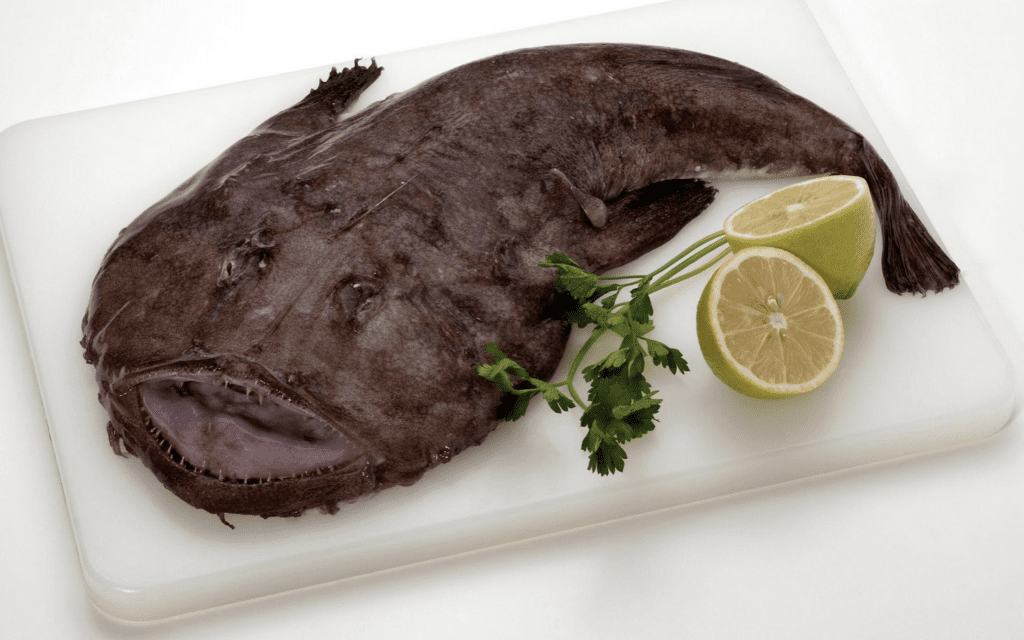
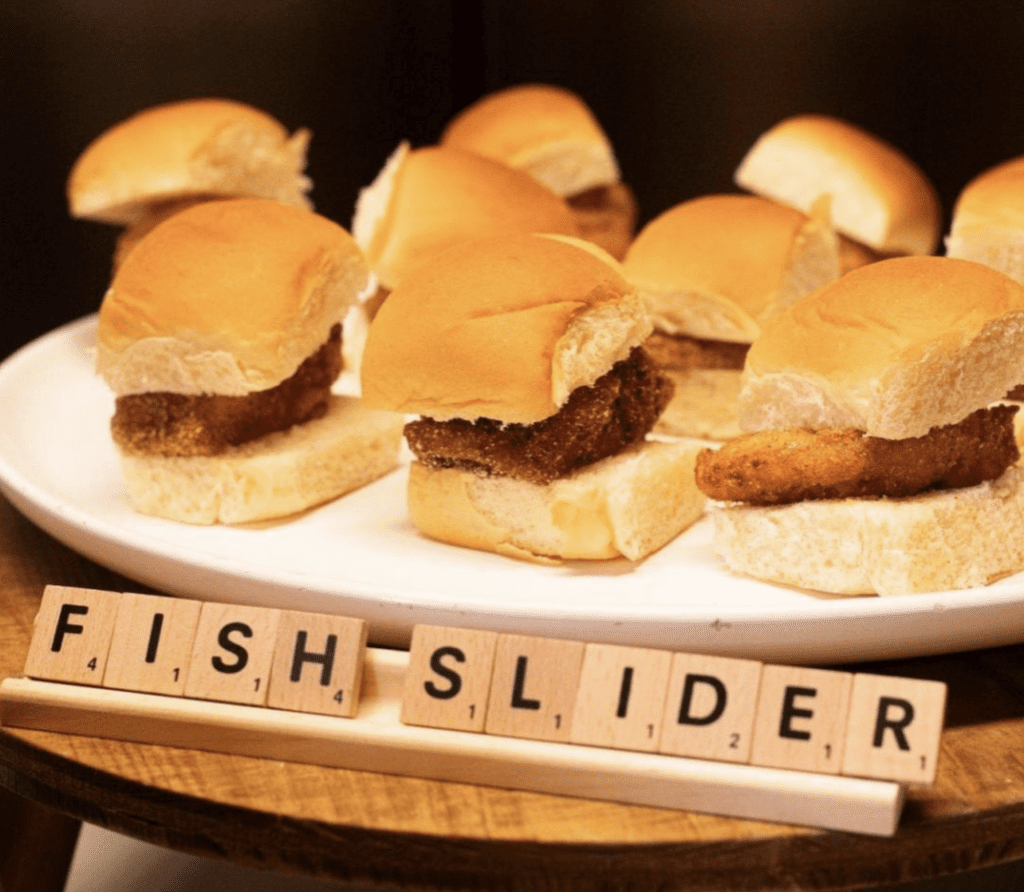
Publisher’s note: We asked Chef Potenza to talk about the use of Monkfish coming into the RI School Lunch program. In a twist on school lunch, students are being served monkfish sliders—in an effort to turn one of the ocean’s most unusual-looking fish into a kid-friendly favorite. As part of local “sea-to-school” efforts led by Farm Fresh Rhode Island, the firm, mild fish—often compared to lobster—has been reimagined in approachable formats that support both students and the state’s fishing industry, even as Janet Coit—former head of the Rhode Island Department of Environmental Management and a senior official at National Oceanic and Atmospheric Administration—now leads the group through a major federal funding loss.
by Master Chef Walter Potenza, contributing writer
From the cold Atlantic floor to the heart of the French kitchen — the unlikely, extraordinary story of the monkfish.
Friends:
If you’ve ever wondered what’s inside the beloved fish sticks sold in the USA, the answer is fairly straightforward: the vast majority are made from 100% real, wild-caught Alaska Pollock, chosen for its mild Flavor, tender texture, and sustainability, though the full ingredient list also includes a wheat-based breading or batter (usually containing wheat flour, water, yellow corn flour, sugar, salt, yeast, and spices like onion and garlic powder), vegetable oil (usually canola and/or soybean oil), and small amounts of binders and leavening agents such as modified corn starch, whey, and baking powder, all of which help create that familiar golden, crunchy coating.
Major brands like Gorton’s, Mrs. Paul’s, and Van de Kamp’s all rely on wild-caught Pollock, with Gorton’s often using whole fillets and advertising that it contains no fillers or artificial colors. At the same time, Mrs. Paul’s sticks to a classic crunchy breading, and Van de Kamp’s offers both traditional sticks and fun shapes like Shark Bites.
Manufacturers prefer Pollock over the Cod used in restaurant fish and chips because Pollock has a very mild, non-fishy taste that appeals to picky eaters. This tender texture works well in minced or cutlet form, and is more affordable and abundant.
You might wonder why we begin with fish sticks when discussing monkfish. Fish sticks represent the most common way children in American schools encounter seafood, especially in cafeterias and lunchrooms, because of their accessibility, mildness, and kid-friendly appeal. (Note: RI is also introducing Monkfish Sliders – same thing but in a familiar bun.) Understanding what goes into these familiar processed fish products provides a useful starting point for comparing other seafood options, such as monkfish, which is gaining popularity in school meals in certain regions. This context makes it easier to understand the qualities that could make monkfish a suitable—and even preferable—choice for nutritious, easy-to-prepare, and child-friendly fish dishes beyond the standard breaded stick.
Let’s imagine a fishing boat pulling its nets off the Breton coast on a gray fall morning in the early nineteenth century. The usual mix of sea bass, mackerel, and a few bream thrashes in the catch, but then something strange appears. It is flat and wide, with a huge mouth, ragged skin flaps, tiny spines, and cold, glassy eyes. The crew knew this creature well and usually cursed it. They would toss it back into the sea or give it to the cats. No one ate the sea-devil.
But over time, people started to eat it. Eventually, a country known for trying almost everything realized that the sea-devil was actually one of the Atlantic’s best offerings. The journey from being considered ugly to becoming a highlight of French cuisine is the story of the monkfish, Lophius piscatorius, and it’s an account worth recounting.
This long history of French cooking is not just an interesting background; it also matters for those serving fish in schools today. Because monkfish has already found acceptance in traditional recipes and is valued for its versatility, it is easier to introduce children in school meals. Understanding how this fish became popular, despite its unusual appearance, shows how its taste, texture, and kitchen versatility can help create nutritious, appealing dishes for students.
The creature itself
And since we are here, allow me to introduce you to the monkfish. It belongs to the order Lophiiformes, the anglerfishes, which are known for a unique adaptation. Over time, the first dorsal spine moved forward and became a long, flexible rod called the illicium, ending in a fleshy lure called the esca. In deep-sea species, this lure glows in the dark. For the European monkfish, which lives on the continental shelf from Norway to West Africa, it is just a wriggling flap of flesh hanging above its patient mouth.
And its mouth is impressive. It faces upward, is extremely wide, and is lined with inward-curving teeth, making it almost impossible for anything to escape once inside. The head makes up about half the animal’s length, flattened and hidden by uneven skin fringes that help it blend into the sandy or muddy bottom where it stays completely still.
The monkfish does not pursue its food. Instead, it waits on the seafloor, sometimes for hours, until prey comes close. It eats fish, crustaceans, squid, and even, on rare occasions, diving seabirds. There have been cases where a monkfish was found with a cormorant in its stomach.
Species at a glance — Lophius piscatorius
-
Range: Northeast Atlantic, Norway to Mauritania, including the Mediterranean
-
Depth: 20–1,000 m; most common at 200–500 m on the continental slope
-
Maximum length: up to 2 m; typical commercial catch 60–120 cm
-
Maximum weight: recorded over 57 kg; commercial fish 3–15 kg
-
Lifespan: up to 24 years
-
Reproduction: females release a buoyant gelatinous veil containing up to one million eggs
-
Commercial cousins: L. budegassa (black-bellied) in Iberian waters; L. americanus in the North Atlantic
Two main species are important in the European market. Lophius piscatorius is found throughout the North Atlantic. At the same time, Lophius budegassa, the black-bellied monkfish, lives in deeper, warmer southern waters and is slightly more valued by Iberian buyers for its more delicate flesh.
In American waters, Lophius americanus is very similar, with the same habits and cooking uses. The New England Fishery Management Council manages it, and, following stock concerns in the 1990s, it is now considered reasonably healthy.
How it is caught
Because monkfish are ambush predators that stay still, they are fairly easy to catch. The main method is bottom trawling, in which heavy nets are dragged along the seabed, which works well for fish that wait on the ocean floor. However, this same stillness also makes monkfish easy to catch with bottom-set gill nets and longlines, which usually result in a cleaner catch with less bycatch and less damage to the fish. Monkfish caught by trawl often arrive compressed or bruised, while line-caught fish, handled one by one, are of higher quality and fetch a better price.
The main European fishing areas stretch from the Celtic Sea and
Bay of Biscay through the Irish Sea and around the Iberian shelf. Scotland, Ireland, and France all catch large amounts. The monkfish that reaches the market looks very different from the whole animal. In almost every fishery, the head is removed at sea or at the dock before the fish is weighed or sold. The head can account for up to 60% of the total weight, so removing it makes transport and storage easier.
(Monkfish – CooksInfo, 2004) When buyers talk about a
“monkfish tail,” they mean everything behind the large head—the muscular back part and the two lobes of sweet white flesh on either side of the backbone, which is what matters most.
“The head can be sixty percent of the animal. What arrives at market is almost pure flesh—which is, of course, the whole point.”
Centuries in French kitchens
The French have known monkfish for a long time. Medieval records from Brittany and Normandy mention baudroie, an old regional name for the fish, as a common and inexpensive catch in harbors. (A brief history of aquatic resource use in medieval Europe, 2004, pp. 1-10) It fed fishing families during tough times but was rarely served to those with other options. Its appearance worked against it. In a culture that valued beautiful food, the sea-devil was not popular.
But things changed in the South. By the nineteenth century, monkfish started to appear regularly in Provençal and Basque recipes, often braised with tomatoes, herbs, white wine, and garlic, cooked slowly in the relaxed style of southern French kitchens.
(Falco, 2025) These methods suited the fish well. Its heavy, sturdy flesh holds up in long braises that would break apart more delicate fish. It also takes on aromas without being overpowered.
Bourride, a well-known Provençal fish stew finished with aioli, became one of the best ways to serve monkfish, helping it slowly gain respect.
(Bourride, 2020)The rise of monkfish sped up after World War II. In the 1970s, the nouvelle cuisine movement, led by Master Chefs like Guérard, Bocuse, and the Troisgros brothers, focused on ingredients that could hold their shape and be cooked accurately, rather than being covered in heavy sauces. (Myhrvold, 2023) Monkfish was perfect for this style, as it holds up well to quick sautéing, high-heat roasting, and poaching without falling apart. By the 1980s, lotte à l’américaine—monkfish tail in a rich sauce of tomato, cognac, and tarragon originally made for lobster—became a mainstay in top Parisian restaurants. (Warren, 2024) The sea-devil had finally arrived.
Not lobster — but neighbors on the ocean floor
Monkfish has long been called “poor man’s lobster” in English-speaking fish markets. While this nickname is not completely off base, it does not do justice to either fish, and hides a more interesting story about what they really have in common.
Biologically, monkfish and lobster are very different. Lobster is a crustacean, related to crabs, shrimp, and barnacles, with an external skeleton and blue-tinted blood due to copper-based hemocyanin. Monkfish is a bony fish with red blood, an internal skeleton, and a completely different nervous system. They are not closely related, but they have ended up in the same place by different paths.
That place of existence is the benthic zone, or the ocean floor. Both monkfish and lobster live at the bottom of the cold North Atlantic, in the same continental shelf waters. They eat the same foods: fish, mollusks, crustaceans, and whatever else they find on the bottom. This shared, protein-rich diet, free from the iodine-heavy plankton that gives pelagic fish their Flavor, results in flesh that is clean, mild, and sweet in both animals. The similarity in taste and texture—white flesh, firm, low in fat, and delicate rather than fishy—comes from their common environment, not from being related.
What they genuinely share — benthic neighbors of the North Atlantic
-
Habitat: Continental shelf and slope, cold Atlantic waters, at or near the seabed
-
Diet: Fish, crustaceans, mollusks — identical high-protein benthic prey
-
Flesh character: White, dense, low-fat, mild sweetness derived from shared diet
-
Temperature: Both are at their best in cold-water seasons; quality dips in warm months
-
Fishing method: Both taken by bottom-contact gear — trawl, trap, longline
-
Price trajectory: The gap has nearly closed; monkfish now rivals lobster tails per pound in many markets
French cooks recognized the connection between monkfish and lobster long before it was widely discussed. The bones and head trimmings from monkfish, which are usually thrown away, make a stock that is richer and more gelatinous than most white fish broths, and is closer to a crustacean bisque.
Lotte à l’américaine uses this directly: the fish is cooked in a sauce originally meant for lobster, and the result tastes surprisingly like both. In recent years, the price difference that earned the
“poor man’s lobster” nickname has largely disappeared. In some places, monkfish tail now costs as much as lobster tail. What was once a consolation prize is now a highly sought-after dish.
If you are courageous in the kitchen, let’s begin!
(Or have your fishmonger clean it for you).
First, deal with the membrane. Every monkfish tail has a thin, purplish-gray covering that looks almost see-through when raw and seems harmless. But under heat, it tightens, squeezes the flesh, changes its shape, and adds a slight bitterness and toughness. Removing it takes about five minutes with a sharp, flexible knife. Slide the blade just under the surface, grab the flap, and pull it off in strips. This is the most important step in cooking monkfish, and beginners often miss it.
For large-scale preparation in school kitchens, remove the membrane before cutting the tails into portions. Use a long, thin boning knife and work along one side at a time, peeling the membrane away with a steady motion. Refrigerate the tails first, as the membrane comes off more cleanly when the fish is cold. To save time, set up an assembly line: one person slices beneath the membrane, another pulls it away, and a third trims off any bits left behind. If you have access to a mechanical skinning tool, as some institutional kitchens do, it can speed up the process and ensure consistency across dozens of tails. Always inspect each tail after skinning, and remove any remaining membrane before cooking. Doing this prep ahead keeps your portions uniform and ensures every serving is tender and appealing.
Once the membrane is removed, monkfish becomes one of the easiest and most versatile fish to cook. Its heavy flesh can handle a hot sear in a pan without sticking. It stays together in stews and braises that last an hour. You can skewer and grill it without it falling apart. It absorbs flavors like curry, saffron, pancetta, or tarragon without losing its own taste. If you wrap it in thin ham or pancetta and roast it, the meat fat keeps the fish moist. In short, monkfish is a cook’s friend: easy to work with, sturdy, and reliable.
Monkfish cheeks are a hidden gem. They are cut from the head before it is thrown away, so you need a whole fish or a fishmonger who will save them for you. The cheeks are small, round pieces of flesh that do not require the membrane to be removed and cook in about 3 minutes in a hot pan with butter. Add capers, lemon, and a bit of parsley, and they are as delicious as anything from the sea. They are hard to find outside fishing communities, so if you see them, buy as many as you can.
Here’s a recipe to try, which has been on my menus since 1986
Roasted Monkfish Tail with Garlic, Thyme & Brown Butter
The simplest way to understand what the fish actually is.
For cafeteria settings, monkfish can be easily scaled up and prepared in large pans or steam tables. Instead of individual tails, ask your supplier for larger monkfish tails (or pre-portioned pieces), aiming for roughly 50-70 grams of cooked fish per student portion.
For batch cooking, remove the membrane and season the portions as directed in the main recipe. Arrange them in single layers on oiled, rimmed baking trays or hotel pans. Scatter peeled garlic cloves and fresh herbs between the pieces and drizzle with olive oil. Large trays can be roasted in a convection oven at 200°C (fan) until the fish is just cooked through, usually 10–15 minutes, depending on thickness. Use a food thermometer; the internal temperature should reach at least 63°C (145°F). Keep portions warm and juicy by covering them loosely with foil while holding for service.
For steam tables, monkfish can be held in a shallow pool of light fish stock or seasoned butter to prevent drying out. Finish with chopped parsley and a squeeze of lemon, then serve. Offer cooked vegetables or potatoes to balance the plate. If making brown butter in bulk, prepare it in a saucepan, add capers and parsley at the end, and ladle a small amount over each serving before they leave the line.
At home:
Serves: 2–3 | Prep: 20 min | Cook: 25 min | Rest: 5 min
Ingredients
The fish
Monkfish tail, membrane removed — 700–800 g
Flaky sea salt — generous
Black pepper, coarse — to taste.
Olive oil — 2 tbsp
Aromatics
Garlic cloves, unpeeled — 6
Fresh thyme sprigs — 6–8
Fresh rosemary — 1 sprig
Lemon, halved — 1
Brown butter finish
Unsalted butter — 60 g
Capers, drained — 1 tbsp.
Flat-leaf parsley, chopped — small handful
Lemon juice — ½ lemon
Method
1. Remove the membrane. This is not optional. Working from one end, slide a sharp, flexible knife just under the purplish-gray membrane and cut it free in strips, pulling with your other hand. Take your time—any left behind will tighten under heat and distort the flesh. Pat the tail completely dry once it is clear.
2. Season and rest. Season the tail all over with flaky salt and coarse black pepper. Be generous—monkfish is lean and absorbs seasoning readily. Let it sit at room temperature for 20 minutes while you heat the oven to 220°C (200°C fan / 425°F).
3. Sear. Heat a heavy ovenproof skillet—cast iron is ideal—until very hot. Add the olive oil, then sear the monkfish tail for 2 minutes per side, turning to color all sides. You want deep golden-brown, not pale. The sear is the Flavor
4. Add the unpeeled garlic cloves, thyme, and rosemary to the pan around the fish. Place the lemon halves cut-side down in the pan—they will be caramelized. Transfer to the oven and roast for 16–20 minutes, depending on thickness. The fish is done when a thin blade inserted into the thickest part meets no resistance and comes away warm throughout.
5. Rest. Transfer the monkfish to a warm plate, tent loosely, and rest for 5 minutes. Do not skip this—the dense flesh needs time to relax and the temperature to equalize.
6. Brown butter to a nutty finish. Return the skillet to medium heat. Add the butter and let it foam, then continue cooking until the foam subsides and the milk solids begin to color nut-brown, about 3 minutes—watch it closely; the line between beurre noisette and burnt butter is thirty seconds. Add the capers, let them sizzle for 30 seconds, then remove from the heat and add the parsley and lemon juice. Spoon immediately over the rested fish.
7. Serve. Carve thick slices off the bone at the table. Squeeze the roasted lemon halves over everything. Serve alongside crushed new potatoes or a simple green salad dressed with nothing but olive oil and salt—the fish and the butter are the thing, and everything else should stay out of their way.
A note on variations: a few rashers of pancetta or thinly sliced jambon wrapped tightly around the tail before searing will baste the lean flesh as it roasts and add a layer of salted, cured depth. This is a classic French preparation and requires no other adjustment to the recipe. If you have monkfish cheeks, cook them separately in the same butter at the end—two minutes a side—and serve them alongside as a bonus.
Stand over that pan while the butter turns. Watch the foam, watch the color shift from yellow to gold to the color of a hazelnut. That moment—when the milk solids catch, and the kitchen fills with the smell of something nutty and oceanic at once—is French cooking distilled to its essence. And when it hits the flesh of an animal that spent its life on the floor of the Atlantic, patient and motionless and waiting, the result has been worth the wait for a very long time.
Is it safe for children in schools?
This is a good question, and to answer it, we need to briefly look at the fish’s biology.
To be clear, monkfish is safe to eat for children, adults, and anyone who eats fish. However, there is one important point to keep in mind.
Some concerns about monkfish come from a different species found in other parts of the world. In the 1990s, scientists found that monkfish from waters near Japan and Korea—a related but different species, Lophius litulon—could have small amounts of mercury and, rarely, a natural toxin from eating certain small crustaceans. This was a real issue in that region. Still, it does not apply to the European or American monkfish (Lophius piscatorius, L. budegassa, or L. americanus) sold in French, British, or North American markets.
Monkfish served in school kitchens in places like Brittany or Boston comes from the North Atlantic, where it is carefully tested by agencies such as the European Food Safety Authority (EFSA), the French agency ANSES, and the U.S. Food and Drug Administration (FDA). These tests have shown that monkfish is safe. The FDA classifies monkfish as a “Good Choice” for mercury, meaning it has less mercury than tuna or halibut and is similar to haddock or flounder. (EPA, 2004) The EFSA also lists monkfish as a common white fish that is safe for all ages, including young children. (Authority, 2004)
Bones constitute a common concern in schools. Monkfish is almost always sold as a tail, with a single, central backbone and two thick fillets attached. This backbone is large and easy to remove before cooking. Unlike trout or sardines, monkfish does not have small bones hidden in the flesh. When prepared correctly, monkfish tail yields solid, boneless white meat. In schools, it is usually served as fillets or chunks, with no bones, ready to eat with a fork.
Here are a few useful tips for school kitchens:
Where the fish comes from is important. The standard is wild-caught North Atlantic monkfish from managed fisheries, preferably MSC-certified. Avoid monkfish from unknown sources, especially unverified Asian suppliers—not because they are always unsafe, but because knowing where your fish comes from is key to food safety.
Cook monkfish thoroughly. Like all fish, it should reach an internal temperature of 63°C (145°F). Its heavy flesh makes it easy to cook through without drying out. There is no need to serve it rare.
Be aware of allergies. Monkfish is a fin fish, so children who are allergic to Cod, haddock, salmon, or other white fish may also react to monkfish. Follow standard fish-allergy guidelines.
Start with small servings. If your school is serving monkfish for the first time, a portion of 50-70 grams per child is generous. The Flavor is mild and clean, less “fishy” than mackerel or sardines, and more like Cod or halibut. To encourage children to try monkfish, consider preparing it in child-friendly formats such as bite-sized nuggets, crispy fish bites, small fillets, or gently flavored stews. Serve these in familiar ways, such as with mild dipping sauces or alongside favorite side dishes, to help make monkfish approachable for even picky eaters.
French schools in coastal areas have served monkfish for decades without problems. In Brittany, lotte is on school menus several times a year, often braised with leeks or in a light tomato sauce. (French Monkfish Stew (Lotte à l’Américaine), 2023) The fish is popular because it is easy to eat: there are no small bones, no strong taste, and nothing that would discourage a picky child.
To sum up:
Monkfish is safe for schoolchildren. It is low in mercury, free of the toxins found in some Pacific species, and easy to prepare as a boneless fillet. The only real issue is the price, since monkfish tail is no longer a cheap fish, but that is a budget concern rather than a health one. For schools working within a tighter budget, there are other safe and mild white fish that make excellent alternatives. Species like Pollock, hake, flounder, whiting, and Cod are all widely available, low in mercury, and generally more affordable. These fish can be prepared similarly, offer a mild flavor that appeals to children, and are easy to serve boneless. By considering these alternatives, school kitchens can balance nutrition, safety, and cost while expanding students’ seafood choices.
If a school can afford it and the children are used to eating fish, monkfish is an excellent option. It is mild, tender, and is about as close to a “gateway” white fish as you can find in the Atlantic. The sea-devil, in the end, makes a very friendly lunch.
Master Chef Walter M.E. Potenza
___
Sign up HERE for RINewsToday daily newsletter – and look for my column this SUNDAY!
Meet Chef Walter!
There is a constant, recognizable thread in the career of Walter Potenza to elevate the level of Italian culinary culture in the United States. Besides his unquestionable culinary talent and winning business perspective, Chef Walter has been a relentless educator with passion and knowledge who defeats stereotypes. His life, career, and values are a model, an example to follow by any chef of Italian gastronomy working outside Italy.
Chef Walter appears regularly on National and International Networks such as Food Network, ABC, CBS, NBC, RAI, FOX, and Publications such as NY. Times, Washington Post, Wall Street Journal, Food & Wine, Saveur, Gourmet, and several Italian media outlets. And now – RINewsToday!

![Monkfish[3]](https://rinewstoday.com/wp-content/uploads/2026/04/Monkfish3.jpg "Monkfish[3]")