
Subscribe!
The Use of Force: a Short Story by Michael Fine
The Use of Force
By Michael Fine
© 2026 by Michael Fine
This is a work of fiction. Names, characters, businesses, places, events, locales, and incidents are either the products of the author’s imagination or used in a fictitious manner. Any resemblance to actual persons, living or dead, or actual events is purely coincidental.
.
The central problem in any rules-based system is that the system depends on people following the rules – and not everyone does. Analogous to the philosophy of trust but verify, no rules-based system is sustainable without an enforcement mechanism to change the behaviour of those people, organizations and governments that don’t follow the rules. People will always test the rules – so any rules-based system needs vigilance and a rigorous approach to enforcement for rules to be effective and sustainable over time. Hard power must always underlie soft power, if soft power is ever to work. Soft power is the clothing. But hard power is always the body on which soft power lie.
We need the strong arm of the law to be strong. We need fair trials but speedy trials. And we can’t wimp out. Our rules are only as good as our focus and discipline. Personal responsibility matters.
.
She had no discipline whatsoever, but she was also a shining star, a bright moment in a dull sky but one that was frozen in the midwinter sky.
When Eric got off the bus, he expected to find Annamaria waiting for him, but as usual she was nowhere to be found. Eric didn’t hesitate though. He didn’t look for a pay phone. He just began walking.
The dirt road up the mountain was decent walking but was hell on earth to drive on, up or down. Switchbacks and hairpin curves. Steep climbs or sudden drops. You had to drive in low gear on the way up, and pray some asshole wasn’t hotdogging it on the way down, riding the middle of the road. You could see headlights coming at night. But in daylight you were on your own.
Now the night cold and the road deserted, Eric walked in silence, alone with his thoughts. He huffed and puffed some on the steep up segments, his hot breath a cloud in front of him, fogging his glasses. But he was in good shape – and felt more powerful than a locomotive, despite everything. It was a hill. A mountain. So what? That’s what legs and lungs are for. Use that body. That’s why it’s there.
Before long, he could see the lights from the port, and beyond them the lights of the smaller city. When the road turned back on itself, he could see the mainland and the lights of the bigger city across the bay and its port twinkling in the distance, enough light to erase the stars above it, in that section of the sky, over there, over that part of the sea. Who cares? Out of sight, out of mind. Or far enough away not to matter, not to them, not to him, not now.
The moon rose as he walked, a bright spot over the city at first, and then enough light to see by. The moon cast shadows of the trees on the road. Eric couldn’t see the mountain, but he could see the shore line as it wove in and out amongst the distant whitecaps, and he could see the hills of the next island, and as the road turned back, he could see how the city lay next to the sea, its outskirts fading to black as the land rolled away from it, the lights falling away into a darkness different from the sea, like the shoulders of a beautiful woman, the far places away from the eyes and the mouth and the neck, but still warm and even sensuous, the curves of the shoulder shrouded in darkness but themselves provocative, leading to distant places and imagined heat, passion and delight.
There were lights on in a few of the houses on the mountain, but not very many.
.
The house was dark and cold when Eric reached it, which was what he expected and feared. The faucets were dripping. The wood stove was out and empty. Stone cold. Cast iron cold, which is colder than stone. No one had damped it down, so the draft sucked through it when Eric opened its door. Hissing, almost whistling, the soft wind sucking whatever heat remained in the house up and out, wasting it. There wasn’t any tinder in the wood box and none of the wood Eric had split for them before he left. Just chips of wood, pieces of bark, old newspapers and dust.
Lucky the pipes haven’t frozen, Eric thought. Yet.
He turned on more lights. There would be wood in the woodshed. He was sure of that. He went out there. The woodshed was three quarters empty, but there was enough left for the night and for a week or so. He’d cut and split this week. And maybe into the next to catch up.
He loaded their wheelbarrow with dried split wood – ash, oak, maple and black locust. Dry as a bone. This will make me a good fire, and fast, he thought. Then he wheeled the wheelbarrow to the back door and scooped up an arm load, which he brought into the house and dropped into the wood box, each piece thudding into the empty space, the thuds resonating in the wood floor and log walls, a kind of lonely music. The fire will come. It will fix things, he thought. A bit.
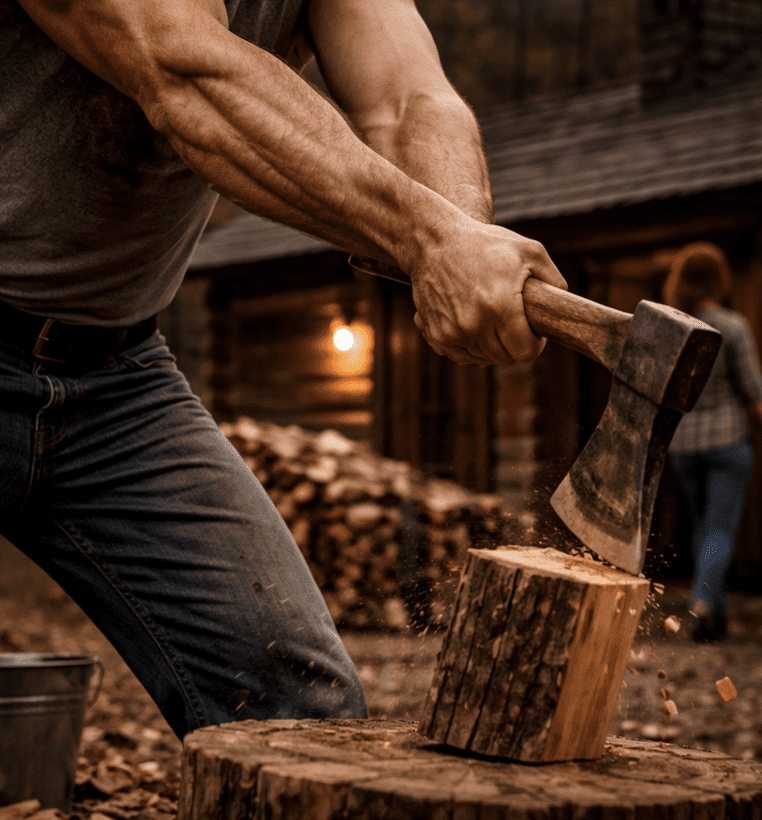
He started the fire using newspaper and shards and splinters of wood he broke off from bigger pieces, the half splits and the curled edges left hanging by his maul when the wood cracked, following the grain – but didn’t completely come apart. His fingers were as strong as his arms and shoulders. They finished what his axe had started.
Soon he had enough small wood. The logs caught from the tinder because the wood was dry. The fire cracked and spat in the wood stove, the wood hissing and singing; the cast iron clunked and shifted as it expanded with the heat, the air above it shimmering in barely visible waves, warm right next to the stove but the rest of the room cold and damp in a way that made Eric shudder as he moved around. Even Eric, as strong as he was.
There wasn’t much in the fridge or the cupboard. A little pasta in a half empty box. Old oatmeal in a three-quarters empty box that looked ten years old. Salt. She left me with nothing, Eric thought. Again. Just like her. She gets distracted and forgets. And I’m left here. In a cold house. Halfway up a mountain. Hungry. Alone. The story of my life.
Annamaria smelled wood smoke as she drove up their long driveway and so she knew what was up. The house was dark except for the light over the kitchen door, which she could have left on herself, of course. But the smoke told a different story.
Damn, she thought. I forgot. And there isn’t any food in the house. Oh well. I can go out again tomorrow.
She killed her headlights, parked, got out of the car as quietly as she could and eased her car door closed. Then she walked quietly into the house. The steps creaked when she walked on them, as did the floorboards of the front porch. The house wasn’t warm yet, but it wasn’t chilled any more either. She threw her yellow coat over an old wooden chair that sat next to the door. Dumped it there. She didn’t drape it neatly and she didn’t hang it in the closet.
She turned on a single light.
The wood box had been filled. But the kitchen sink was choked with dishes, there were half-filled coffee cups on the counter, some growing a little mold, and ashtrays filled with cigarette butts scattered about the living room and kitchen. A garbage can filled with empty beer bottles and cans, and some of those cans scattered on counters and tabletops. On top of the microwave. On end tables. On top of the pie safe. On the cooking island. On the coffee table. Next to the TV set.
Whoops, Annemarie thought. Just whoops. I forgot.
She thought about leaving again, to forestall the inevitable. But hell, she thought. It’s my house too. It’s mostly my house. I picked out the curtains. I refinished the pie safe. I’ll wash the dishes, eventually. I live here.
So she rearranged the cushions on the couch, took the orange comforter her grandmother made for her from the big red living room chair and a white and blue one that Eric’s aunt made from the couch, and made herself a place to sleep. Better later than never, she thought. There’s a ton of stuff I’ll do tomorrow. But I need to get some rest now.
It will blow over, she thought. It always does.
It was still morning when Annamaria awoke, but only barely. There was a cloud on the mountain again, so there was no light from the windows, only fog so dense that she couldn’t see the trees –and certainly not the sea or the other islands. She smelled the woodsmoke before she opened her eyes and heard a fire crackling in the stove, and her feet, which were closest to the stove were warm. Comfortable. She was comfortable, and she started to drift back to sleep when she heard the thuds, the grunts and the crack of wood being split, just a few feet away. The sound of those thuds echoed off the mountain. A chain saw whined in the distance. A neighbor cutting wood. Not Eric. Eric was splitting, just outside the kitchen door, just like always. He was home. She remembered.
She wanted to stay asleep, to stay under the covers where it was warm. But it was what it was. She threw off the comforters, leaving them strewn over the floor, got herself to stand up, and took herself to the bathroom. I’m a mess, she thought, when she looked at herself in the mirror. But no time to make myself pretty now. Get ready, she told herself. Or not. He’ll come in all sweaty and big and look at me with those hurt angry eyes of his, and then he probably won’t say a word. But I know what he is thinking. I always know. And he’s right to think like that. Maybe. But it is what it is. I am who I am. He knew what he was getting into. So it’s his problem. But how I wish that he would say his piece, just once. So we don’t have to go through the same charade one more time. Like he’s so generous and tolerant. Which means I’m the problem. Again.
She picked up a few beer cans and took them into the kitchen. He knows I don’t drink Bud, she thought. Maybe he won’t notice. But he notices everything, damn him. He just won’t say a word. He still knows what’s what.
She turned on the kitchen light and clenched her back and shoulders, as if preparing herself for what she knew would come next. I need to pick up these ashtrays, she told herself. But instead, she moved some of the dishes in the sink so she could get to the faucet, filled a pot with water, placed the pot on and lit the stove. Then she sat down at the kitchen table and lit a cigarette.
Ten. Nine. Eight. Seven. Six. She told herself. He’ll see the kitchen light.
The thudding, grunting and cracking stopped. She heard his feet on the gravel behind the house, where he used to park his truck, when he had a truck.
Five. Four. Three.
Footsteps on the two rear stairs.
The door opened.
Two. One. Zero.
“Yo,” Eric said as he came through the door. The storm door banged on its aluminum framing. He pushed the heavy wood kitchen door shut, pushed it firmly, without slamming it, but firmly enough that the outside kitchen wall shook.
Annamaria was draped over a kitchen chair, her hair a mess, her back to the door and to Eric. She took a drag of her cigarette.
Eric leaned over to take off his boots. He stood them on a rug next to the door.
The water on the stove began to boil.
.
“All right,” Annamaria said. “Say it. I’m a slovenly whore.”
Annamaria stood up, turned off the lit burner, walked back to the living room and lay down on the couch again, her back still to Eric.
“Welcome home. Nice to see you,” Eric said.
“The place is a mess,” Annamaria said, “Beer cans and cigarette butts all over.”
“Did you have a good trip?” Eric said.
“Can’t you wash your own dishes, just once,” Annamaria said. “And where the hell were you, out to three in the morning.”
“Was it three?” Eric said. “I was out like a light.”
“It was more like four-thirty, if you want to know the truth,” Annamaria said.
“I don’t,” Eric said. He stood up to his full height and walked through the kitchen, into the living room. At his full height, Eric was quite a man. Quite a specimen. He was six foot three and broad shouldered. He had black hair that he combed back behind his ears, a broad forehead, a strong nose, piercing dark eyes, and an open, determined, focused expression.
The wind had picked up but the sky had darkened, the fog having grown denser. Intermittent rain spattered on the windowpanes.
Eric walked to the front door where Annamaria’s yellow coat lay scattered over that chair, abandoned. He lifted the coat, almost gingerly, and hung it on a hook next to the door.
Then he lifted the chair over his head in a swift seamless motion and threw it against the wall with all his might.
It shattered. The house shook, the boom from the exploded chair echoing in the loft above them where their bedroom was. Two pictures fell off the wall, the glass from the picture frames shattering as well, the shards falling to the floor with an almost musical ring.
Then Eric turned to Annamaria, who put her cigarette out in the ashtray on the coffee table that was still covered with beer cans.
Two steps and he was next to her.
Annamaria put up her hands, as if she was trying to brace herself for a fall, and started to sit up.
Eric raised both his fists on bent elbows, as if they were hammers. He leaned over, towering over Annamaria, his bulk blocking the light, almost suffocating her because he was so much bigger and stronger, obliterating her even before he touched her, before he laid one finger on her.
Then he opened his hands, slipped one hand under Annamarie’s waist and one hand under her neck, and lifted her in one smooth motion. As if she were a sack of flour, the same smooth motion with which he had lifted that chair before he threw it.
Then he held Annamaria to his chest, brought her close, hugged her, and stood up, sliding one hand under her knees and carried her to the stairs, and kissed her neck and eyes as he walked up those stairs, two steps at a time as if he was about to leap over a tall building with a single bound.
___
Many thanks to Carol Levitt for proofreading, and to Lauren Hall for all-around help and support.
Please click here to receive Michael Fine’s monthly short stories and his new series, What’s Crazy in Health Care. Please invite others to join by sending them the link here.
Or join us on Substack: https://michaelfinemd.substack.com/
Information about Michael’s books, stories, posts, talks and performances is available at www.MichaelFineMD.com or by clicking the link here. Join us!
___
Read more short stories by Michael Fine, go here: https://2×8.ea2.myftpupload.com/dr-michael-fine/

Michael Fine, MD is currently Health Policy Advisor in Central Falls, Rhode Island and Senior Population Health and Clinical Services Officer at Blackstone Valley Health Care, Inc. He is facilitating a partnership between the City and Blackstone to create the Central Falls Neighborhood Health Station, the US first attempt to build a population based primary care and public health collaboration that serves the entire population of a place.He has also recently been named Health Liaison to the City of Pawtucket. Dr. Fine served in the Cabinet of Governor Lincoln Chafee as Director of the Rhode Island Department of Health from February of 2011 until March of 2015, overseeing a broad range of public health programs and services, overseeing 450 public health professionals and managing a budget of $110 million a year.
Dr. Fine’s career as both a family physician and manager in the field of healthcare has been devoted to healthcare reform and the care of under-served populations. Before his confirmation as Director of Health, Dr. Fine was the Medical Program Director at the Rhode Island Department of Corrections, overseeing a healthcare unit servicing nearly 20,000 people a year, with a staff of over 85 physicians, psychiatrists, mental health workers, nurses, and other health professionals.He was a founder and Managing Director of HealthAccessRI, the nation’s first statewide organization making prepaid, reduced fee-for-service primary care available to people without employer-provided health insurance. Dr. Fine practiced for 16 years in urban Pawtucket, Rhode Island and rural Scituate, Rhode Island. He is the former Physician Operating Officer of Hillside Avenue Family and Community Medicine, the largest family practice in Rhode Island, and the former Physician-in-Chief of the Rhode Island and Miriam Hospitals’ Departments of Family and Community Medicine. He was co-chair of the Allied Advocacy Group for Integrated Primary Care.
He convened and facilitated the Primary Care Leadership Council, a statewide organization that represented 75 percent of Rhode Island’s primary care physicians and practices. He currently serves on the Boards of Crossroads Rhode Island, the state’s largest service organization for the homeless, the Lown Institute, the George Wiley Center, and RICARES. Dr. Fine founded the Scituate Health Alliance, a community-based, population-focused non-profit organization, which made Scituate the first community in the United States to provide primary medical and dental care to all town residents.Dr. Fine is a past President of the Rhode Island Academy of Family Physicians and was an Open Society Institute/George Soros Fellow in Medicine as a Profession from 2000 to2002. He has served on a number of legislative committees for the Rhode Island General Assembly, has chaired the Primary Care Advisory Committee for the Rhode Island Department of Health, and sat on both the Urban Family Medicine Task Force of the American Academy of Family Physicians and the National Advisory Council to the National Health Services Corps.
All of Michael Fine’s stories and books are available on MichaelFineMD.com or by clicking here
