
Subscribe!
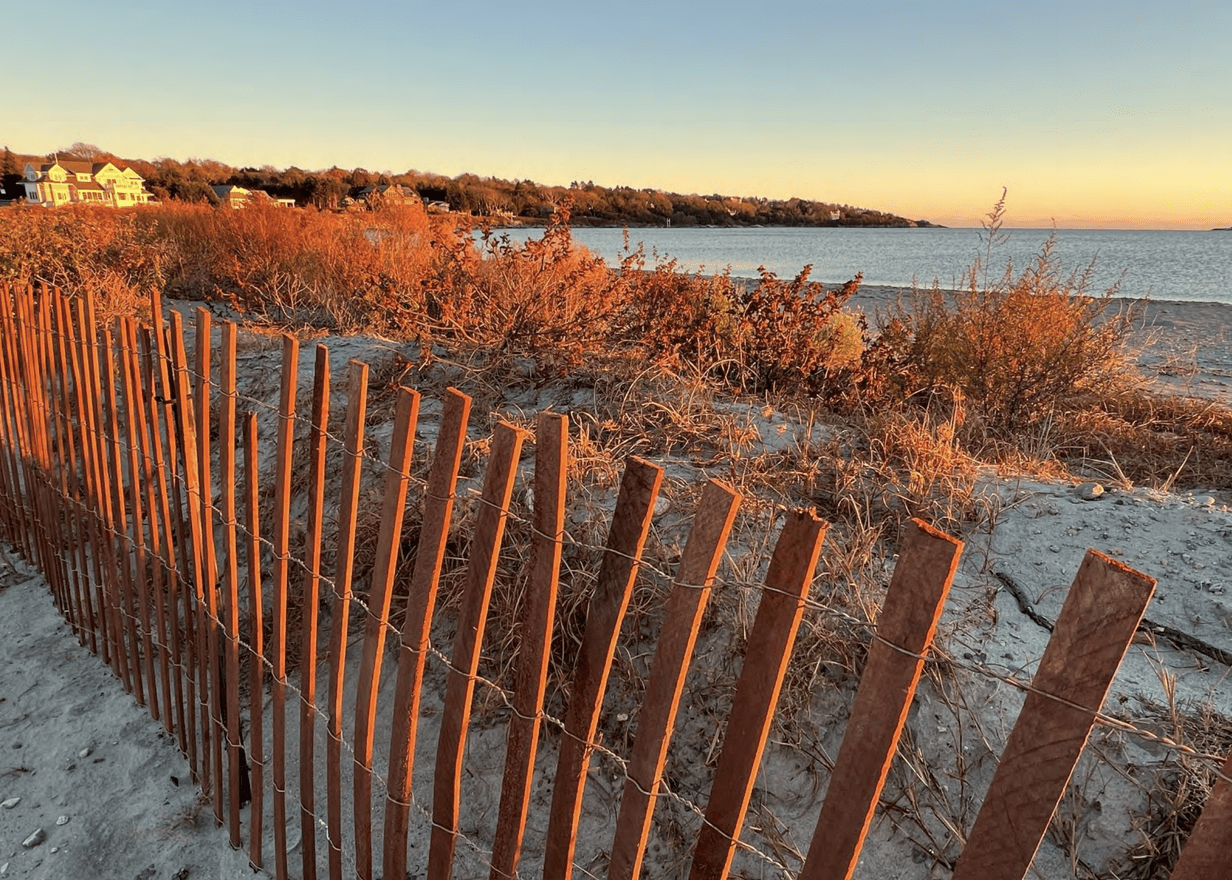
“A Vision for Jamestown”: A Plan for Coastal Resilience by URI Students
URI landscape architecture capstone earns statewide recognition for its vision of Jamestown’s waterfront – as rising seas and stronger storms reshape Rhode Island’s coastline, URI students transformed a vulnerable stretch of Jamestown into an award-winning vision for coastal resilience
A student project re-imagining Jamestown’s vulnerable coastline has earned awards from the Rhode Island Chapter of the American Society of Landscape Architects. Supported by Rhode Island Sea Grant and led by professor Hongbing Tang, the work was done by 19 students in the Department of Landscape Architecture’s capstone studio and two ocean engineering and civil engineering students.
Receiving awards for their work were:
Merit Student Award in Communication
Madeline Ashenfelter ’25
Merit Student Award in Planning and Analysis
Spencer Asofsky ’25, Stephanie Nordhoff ’25, and Tim Purcell ’25
“These awards are significant because they highlight the next generation of landscape architects, elevate high‑quality academic work to the broader professional community, and showcase contributions that respond to Rhode Island’s pressing environmental and coastal challenges,” says Tang, a licensed landscape architect and teaching professor in URI’s Department of Landscape Architecture. “For students, the awards affirm that their academic work meets real‑world expectations.”

Jane Buxton, Spencer Asofsky, Hongbing Tang, Tim Purcell, Stephanie Nordhoff, and Courtney Goode. (Photos / URI Landscape Architecture)
A vulnerable coast
Jamestown’s Mackerel Cove and Sheffield Cove are among the most vulnerable coastal areas in Rhode Island. Recent storms have severely damaged the dune system at Mackerel Cove Beach, washed sand across Beavertail Road, and repeatedly closed the only roadway connecting the northern and southern portions of Conanicut Island.
The engineering students conducted a year-long technical study that included beach surveying, storm-inundation mapping, dune-restoration research, and flood-risk modeling. Landscape architecture students then developed design strategies focused on ecological rehabilitation, dune restoration, flood control, and accessible public spaces.
Beyond an academic exercise, the successful partnership reflects real-world needs. “Coastal resilience requires solutions that address both environmental processes and human needs,” Tang says. “Interdisciplinary collaboration integrates engineering analysis with landscape architecture’s strengths in creative problem-solving, ecological restoration, and community-responsive design.”
“What surprised me most was how much more effective designs become when we stop trying to control nature and start listening to it,” adds Nordhoff. “Coastal resilience depends on working with natural dynamics, not against them.”
Community at the center
The course began with a kickoff meeting at Jamestown Town Hall and a site visit where students met with town officials and residents to learn firsthand about flooding, erosion, and access concerns. Students also hosted a community workshop in Jamestown that drew nearly 60 residents. Online surveys reached even more residents.
“Community members spoke with genuine affection for the cove’s character and peaceful atmosphere, which emphasized the importance of protecting its natural beauty while improving accessibility and long-term resilience,” says Asofsky.
“Professor Hongbing Tang did a wonderful job keeping the community involved in the project,” Lisa Bryer, town planner for the Town of Jamestown, says. “The public workshop they hosted was praised by the community, in large part due to its interactive nature. When people can be informed and provide meaningful input, they feel heard and empowered, which is a critical element of a successful democracy.”

URI Photo / Monica Allard Cox
Lasting impact
The final report provides Jamestown officials with a set of conceptual design options for improving coastal resilience at Mackerel and Sheffield coves. “Importantly, our strategies operate at both ecological and social levels: interventions intended to improve habitat and shoreline stability also structured safer, more accessible ways for people to engage with the waterfront while preserving the site’s character,” says Asofsky.
From conservation-focused strategies to visionary infrastructure solutions, the ideas range from accessible pathways and habitat restoration to engineered interventions such as artificial reef systems and elevated roadways to address the long-term impacts of climate change.
“Given the urgency of storm damage and sea-level rise,” Tang says, “the students’ work offers valuable starting points for future resilience investments.”
Town leaders praised the range and quality of the proposals, noting their usefulness in addressing real problems the community faces—particularly the protection of Beavertail Road, a critical transportation link.
“The report is comprehensive, creative, inspiring, and informative,” says Anne Kuhn-Hines, Jamestown’s Conservation Commission chair. “I am thoroughly impressed with this final report. What a wonderful gift to the Town of Jamestown!”
Access the full 125-page report, HERE:

https://drive.google.com/file/d/1JhLbBIXv49RmeC9hd9IPs2AyMqN_XVvp/view
This story was written by Anna Gray in the College of the Environment and Life Sciences.
Photo, top: Hongbing Tang