
Subscribe!

Outdoors in RI: Rough waters – Hunter Class – Songbirds on Block Island – Bat & Mosquito Watch
Hurricane Erin to make waters rough
Governor Dan McKee and the Rhode Island Department of Environmental Management (DEM) advise the public to exercise caution along shoreline areas and beaches due to dangerous surf and life-threatening rip currents as Hurricane Erin passes offshore southern New England. The National Weather Service (NWS) has issued a high surf and rip current advisory and dangerous conditions are expected to affect southern facing beaches Tuesday through Friday. DEM urges the public to use caution along shoreline areas until the hazardous conditions pass.
The storm will produce powerful waves that will break larger and farther onshore, creating hazards for boaters, beachgoers, anglers, and onlookers. Do not stand on rocky coastal areas and stay far away from areas where waves might splash over. These waves can easily sweep a person into the water from what seems like a safe viewing area.
DEMÂ is monitoring state beach conditions closely. Beachgoers should stay close to lifeguards, listen to safety announcements, and pay attention to the beach warning flags. Staff will update flags at state beaches throughout the week as conditions change and implement swimming restrictions as needed. Learn more at www.riparks.ri.gov/beachsafety.
Boaters should safely moor vessels and secure paddlecraft. Loose boats trigger emergency searches that divert resources and put first responders at risk.
So – drive down and all around and look at the force of nature – but stay clear away – this is a dangerous one!
___
Block Island bird study good news for island’s migrating songbirds
URI graduate’s study of long-term Block Island bird data reveals stable numbers since the 1980s at important migration site
Block Island welcomes scores of tourists all summer long, with the Block Island ferry pulling into port 15 times a day. Come fall, new visitors arrive: migrating birds by the thousands. A new University of Rhode Island graduate is publishing some good news on their numbers.
Lauren Michael, who received her master of science degree in biological and environmental sciences in May, analyzed 66,288 birds from 22 species, which visited the island between 1970 and 2021. Her coauthored paper, with URI professor of natural resources science Scott McWilliams and Steve Reinert ’75 ’78, on songbird levels on Block Island will be published in the November issue of Ornithological Applications.
The Hopkinton resident came to URI with a decade of experience studying birds at sites across North America, before making her way to the island nine miles off the coast of Rhode Island that’s an important stopover site for migratory birds. The bird monitoring station, known as the Block Island Banding Station, was established by Elise Lapham in 1967. She operated the station each fall and spring alongside her daughter, Helen Lapham, and Kim Gaffett, who joined in 1981. Gaffett, now a naturalist at the Block Island office of The Nature Conservancy, has continued the banding operation to this day.
Michael says that stepping into a project started before she was even born was a humbling experience and credits the Laphams and Gaffett for their decades of commitment to the study of birds on Block Island.
“Without their dedication, this project would not have been possible,†she says. “The Block Island Banding Station is one of the longest continuously running bird banding stations in the country. All of these women were volunteers and dedicated decades of their lives to this study.â€
Island destination
While Block Island is known as a draw for the young each summer, that’s true of the fall bird visitors, too, for different reasons.
In fall, young birds undertake their first migrations south. Inexperienced, they are disproportionately pushed to the coast, while adult birds opt to stay inland, where it’s safer, away from open water.
This southern New England “coastal effect†gets an added push from overnight north-west winds, meaning huge numbers of these young birds are pushed out over the water and end up on Block Island. As a result, most of the birds captured on Block Island are young. The exhausted and inexperienced birds find a good stop-over in the fruiting shrubs that cover the island, getting a brief rest and nutrition before continuing their journeys.
Michael’s paper strikes a somewhat positive note as bird populations in North America have declined at an alarming rate, with an estimated loss of 3 billion birds since the 1970s. Many songbirds saw drastic declines through the 1980s, possibly from changes in weather, local land use and habitat, or cyclical breeding.
Eighteen of the species studied on Block Island saw a sharp decline in the 1970s and 1980s, followed by stabilization, recovery, or slower decline for the remainder of the study. These steady numbers are cause for celebration — and education. With increasing pressures on these birds, determining which species are at the greatest risk is vital.
The team used “breakpoint†models to identify changes in abundance trends over time. Although applying this kind of model to bird banding data is novel, these models have been used in ecological research and in other disciplines. These models are applicable anytime you see or expect an abrupt change in slope in response to something, Michael says — similar to a stock market crash, response to a new social policy, or a physiological response to a medical treatment. In wildlife biology, they’re used to identify changes in physiology, find ecological thresholds, or detect sudden changes in abundance.
-
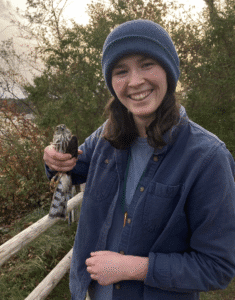
- Recent graduate Lauren Michael has coauthored a study of long-term Block Island bird data, revealing stable numbers at this important migration site.
-
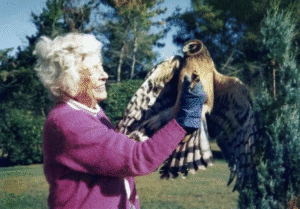
- The banding station was established on Block Island by Elise Lapham in 1967, providing the foundational work for long-term study of bird populations on the island.
While species analyzed on Block Island have not fully rebounded to their 1970 abundance, their sustained recovery since the declines in the 1970s and 1980s indicates that environmental conditions may be adequately supporting these smaller current populations.
“Had we interpreted these trends using the entire 52-year time series, outside of a breakpoint model, as other studies have, we would have concluded that these species had simply declined,†says Michael, “rather than acknowledging that though they may have dramatically declined in the 1970s and 1980s, they have been recovering over the last several decades.â€
Michael found that 18 species with breakpoints exhibited a consistent pattern: a steep decline in abundance within the first two decades of the study, followed by stabilization, recovery, or a more gradual decline. After the breakpoint, most species were stable; many even showed increases. Fourteen of the 18 species recovered relative to 1970 levels, and two — the Blue-headed Vireo and Eastern Phoebe — even made a full return. Only Gray Catbirds continued to decline after their breakpoint in the late 1970s, though at a much slower rate.
Michael hopes to take the inspiration she found on Block Island to make environmental education and science communication a larger part of her career, leaving URI with a memorable souvenir of her academic studies in the Ocean State.
“Block Island is an incredibly unique place to study birds,†she says. “This was more than data; it’s really the culmination of decades and decades of people’s lives and dedication. I was honored that I got to be a small part of it.â€
___
BAT Reports!

2 bat reports come to us this week. One at the Pawtucket Senior Center – and one at the DCYF building on Fountain Street. The DCYF building has been closed after the incident.
Some good resource information on preventing bats from entering your building, or getting a bat out of your building, as well as rabies and exposure should it happen to you and/or your family members/pets – is this page at the CDC.
___
2-Day Hunter Education Class – with RIDEM at Tiverton Rod & Gun Club

While waiting for the ocean to settle down, make your plan to attend the Hunter Education Class on September 6th and 7th. All day events,, from 8am to 5pm, both days are required.
Rhode Island law states that no license to hunt shall be issued to any person unless that person has held a license in a prior year or unless that person presents a hunter education card issued by Rhode Island or under an equivalent hunter safety program adopted by any other state. Persons who are serving in or have been honorably discharged from the Army, Navy, Air Force, Marine Corps or Coast Guard are exempt from the hunter education requirement.
Through a blend of classroom and hands on instruction participants will learn…
- Firearm Safety: Understanding the proper handling, storage, and use of firearms and archery equipment to prevent accidents and injuries.
- Hunting Ethics and Responsibilities: Emphasizing respect for wildlife, landowners, and other hunters, as well as ensuring sustainable and humane hunting practices.
- Wildlife Conservation: The importance of wildlife management, preserving habitats, and maintaining healthy ecosystems for future generations.
- Legal and Ethical Considerations: Knowledge of local, state, and federal hunting regulations, as well as responsible hunting practices that support the conservationÂ
The course is ideal for beginners, new hunters, and anyone seeking to refresh or expand their knowledge of safe and responsible hunting practices. Participants under the age of 16 or those who cannot transport themselves, must have an adult or legal guardian with them for the class duration. To legally hunt in Rhode Island, you must be at least 12 years old.Â
Upon sufficient course completion and passing a final exam, consisting of 100 questions multiple choice and true and false. Participants will receive a Hunter Safety Education certification, which is required to purchase a firearm hunting license in the state of Rhode Island.Â
This class encourages not only safety and skill but also a lifelong appreciation of nature and the outdoors.
To REGISTER –https://forms.gle/Ybzx7UvbCsPXVvRFA
For any questions, please contact: Derrick Foley – (508) 558-2920 -Â [email protected]
___
West Nile Virus Detected in East Providence, Westerly, and West Greenwich
The Rhode Island Department of Environmental Management (DEM) and Rhode Island Department of Health (RIDOH) have confirmed detections of West Nile Virus (WNV) in the state. The virus was found in mosquito samples collected by DEM in East Providence, Westerly, and West Greenwich on August 12 and tested by the Rhode Island State Health Laboratories. The other samples collected statewide showed no signs of Eastern Equine Encephalitis (EEE) virus, Jamestown Canyon Virus (JCV), or additional WNV. Check RIDOH’s arboviral surveillance data webpage for updated weekly test results.

WNV is the main mosquito-borne disease in the US. While most people with WNV don’t get sick, about one in five people who are infected develop a fever and other symptoms. There are no vaccines to prevent or medications to treat WNV in people. For more information about WNV, visit www.health.ri.gov/wnv.
To learn ways to prevent mosquito bites and the diseases carried by mosquitoes, please visit health.ri.gov/mosquito. For mosquito control info, visit dem.ri.gov/mosquito.