
Subscribe!

From “You Can Keep Them” to “You Can’t Have Them”: RI Gun Bill Draws National Attention
A proposed change to Rhode Island’s assault weapons law is drawing national attention — not for its length, but for its impact — and raising new questions about enforcement, constitutional limits, and the direction of gun policy in the state.
House Bill 8073 (H8073) and Senate Bill 2710 (S2710) would amend existing law by adding a single word: “possession.” That change would make it illegal not just to sell or transfer certain firearms, but to own them outright.
While the bill itself is brief, the implications are sweeping.
And increasingly, the conversation is no longer confined to Rhode Island.
A Small Change — A Major Shift
Under current Rhode Island law, enacted after last year’s legislative session, in 2025, the state bans the sale, manufacture, and transfer of certain firearms commonly referred to as “assault weapons.” However, individuals who owned those firearms were allowed to keep them — a provision that lawmakers and advocate emphasized repeatedly during debate.
That distinction — between restricting future sales and allowing existing ownership — was central to the law’s passage.
H8073 comes forward in 2026 – and it would remove that distinction.
If enacted, individuals who legally purchased affected firearms could be required to sell, transfer, or otherwise dispose of them within a compliance period. Failure to do so could result in felony charges, with penalties that may include significant prison time and forfeiture of the firearm.
A change of a single word would shift Rhode Island law from regulating the marketplace to regulating possession itself.
Lawmaker: “We Should Be Honest About That”
Speaking in favor of the bill Wednesday, Rep. Teresa Tanzi acknowledged that last year’s law was only a first step.
“Last year, we as a body, banned the sale, manufacture, and transfer, of certain ‘assault weapons’ as defined in that law. That was an important step, but it was only a partial one. We should be honest about that,” Tanzi said.
She continued:
“Right now our law draws an arbitrary line. We have said that these firearms cannot enter the marketplace going forward, but we continue to allow them to remain in circulation indefinitely… If these weapons are too dangerous to be sold in Rhode Island then we really should have addressed possession at the same time. We didn’t, and this bill [H8073] corrects that.”
Her remarks frame the bill as a logical extension of existing policy — moving from limiting access to addressing continued ownership.
Rep. Tanzi’s testimony has been circulating online:
Banning the sale of semi-automatic firearms wasn't enough for the gun grabbers in Rhode Island.
They are coming for your property. pic.twitter.com/BX8l3C2gBq
— Firearms Policy Coalition (@gunpolicy) April 8, 2026
___
From Local Debate to National Spotlight
The proposal has quickly moved beyond a local legislative discussion.
Coverage from Breitbart News and other national outlets has highlighted the bill, focusing on the potential legal consequences for current gun owners — particularly the possibility of felony charges if they fail to comply with a requirement to dispose of their firearms.
Clips of lawmakers discussing the bill have circulated widely on social media, drawing reactions from gun policy advocates on both sides and placing Rhode Island’s legislation into the broader national debate over firearms regulation.
For critics, the bill represents a shift from regulating sales to restricting possession. For supporters, it closes what they view as a gap — allowing firearms deemed too dangerous to sell to remain in circulation.
Part of a Broader Legislative Push
H8073 is not an isolated proposal.
The Rhode Island Senate Judiciary Committee is scheduled to hear testimony on a wide range of firearm-related bills TODAY, reflecting a broader push to revisit and expand gun policy in the state.
Among the measures under consideration are bills that would:
- Restrict possession of certain firearms
- Limit firearm purchases to one per 30-day period
- Expand firearm safety training requirements
- Establish a voluntary list allowing individuals to restrict their own ability to purchase or possess firearms
Taken together, the volume and scope of the bills – approximately 20 – signal continued momentum on firearm regulation in the General Assembly this session.
Enforcement Questions — and Police Perspective
As the debate intensifies, one key question continues to surface:
How would such a law actually be enforced?
H8073 establishes possession as a criminal offense, but does not create a system for identifying who owns affected firearms and how they are removed.
Rhode Island does not maintain a comprehensive firearm registry, meaning there is no centralized list of individuals who possess specific weapons. However, gun shops do keep a list of sales.
In practice, enforcement would likely rely on:
- Police encounters during unrelated investigations
- Reports or tips from individuals
- Evidence developed through other criminal cases
Daria Bruno, owner of Lock, Stock & Daria, firearms instructor, said: “Representative Tanzi has made it clear, this isn’t just about banning future sales, it’s about confiscating firearms that Rhode Islanders already legally own by using police force. For many of us, that crosses a serious constitutional line and raises real concerns about government overreach. If they can destroy our Second Amendment they will destroy them all.”
Providence Police Chief Oscar Perez responded to RINewsToday’s request for a comment on the enforcement aspect and he noted that it would follow existing legal and constitutional standards.
“The Providence Police Department is committed to reducing gun violence and protecting our communities,” Perez said. “Should new firearm legislation take effect, our officers will enforce the law professionally and constitutionally. As with any new statute, clear guidance, resources, and community education are critical to ensure safe, consistent, and fair enforcement.” – Chief Col. Perez
Legal experts note that any search of a home would still require compliance with the Fourth Amendment to the United States Constitution, meaning police must establish probable cause and obtain a warrant.
Simply put, while the law could make possession illegal, proving possession remains the central challenge.
Constitutional Questions Ahead
If enacted, the bill would almost certainly face legal challenges.
Supporters have framed the proposal as an exercise of the state’s authority to regulate for public safety, rather than a “taking” under the Fifth Amendment to the United States Constitution — a distinction that could determine whether compensation would be required.
Opponents argue that forcing individuals to give up legally acquired firearms raises serious constitutional concerns, including under the Second Amendment to the United States Constitution.
Any law banning possession of commonly owned firearms would likely be tested in court, particularly under the framework established by New York State Rifle & Pistol Association v. Bruen, which requires firearm regulations to be consistent with the nation’s historical tradition.
The Bottom Line
What appears to be a minor amendment — the addition of a single word — represents a major shift in Rhode Island gun policy.
It moves the state from restricting future sales of certain firearms to potentially prohibiting their possession altogether.
The proposal has already drawn national attention, sparked constitutional debate, and raised fundamental questions about enforcement.
And as lawmakers consider the bill alongside a broader slate of firearm legislation, one question remains at the center of the discussion:
If possession becomes illegal, how will the state actually enforce it — and what happens next?
___
Senators Mack, Lauria, Valverde, Kallman, McKenney, DiMario, Euer, Zurier, and Ujifusa are the sponsors of S2710 – the senate companion to H8073. The only change to last year’s bill is this edit:

The Second Amendment to the United States Constitution protects “the right of the people to keep and bear Arms,” a provision that sits at the center of ongoing legal and political debates over firearm regulation.
The types of firearms targeted by bills like H8073 and S2710 are not rare — estimates suggest tens of millions are in circulation nationwide, underscoring the scale of the policy debate.
- These are not niche weapons
- They are among the most commonly owned rifles in the U.S.
- Any possession ban is dealing with very large numbers of existing firearms
___
There are nearly 20 being presented for testimony. On the House side the bills have been “held for further discussion” – while many bills that meet this fate end up never rising to the surface again, gun bills have a way of getting action in the last hours of session.
As lawmakers consider a wide slate of firearm legislation, some observers are also questioning whether the focus on high-profile proposals like H8073 could function as a “red herring” — drawing public attention to one controversial measure while other bills advance with less scrutiny.
More than a dozen firearm-related bills are scheduled for hearing, covering a broad range of policy areas, including:
- Limiting firearm purchases to one per 30-day period
- Requiring mandatory safety training for firearm ownership
- Creating a voluntary do-not-purchase/do-not-possess list
- Increasing penalties for crimes involving stolen firearms
- Expanding rules around concealed carry permits and reciprocity
- Allowing or regulating suppressor use in hunting
- Restricting access to firearms for minors
- Including certain firearm-related offenses within domestic violence statutes
While there is no direct evidence that any single bill is being used strategically in that way, the volume and scope of proposals may make it difficult for the public and advocates to track each measure closely — a dynamic that has been noted in past legislative debates on firearm policy.
The committee is scheduled to meet Tuesday, April 14, at the rise of the Senate (about 5 p.m.) in Room 313 on the third floor of the State House. Advocates on both sides are expected to bill the RI State House.
The committee will hear several bills related to animal protections and weapons. Click on the hyperlinks to read more:
- 2026-S 2151 — by Sen. Lori Urso (D-Dist. 8, Pawtucket), which would allow animal control officers in the cities and towns to lawfully take charge of and provide adequate care to any animal found abandoned or neglected or hazardously accumulated and includes them as agents authorized to enforce the provisions of this law.
- 2026-S 2298 — by Sen. Andrew R. Dimitri (D-Dist. 25, Johnston), which would increase the penalty for cruelty to animals, first offense, from 11 months to 12 months incarceration.
- 2026-S 2397 — by Sen. Lori Urso (D-Dist. 8, Pawtucket), which would increase penalties for a second or subsequent offense with a fine of not less than $500 or no more than $2,500 and up to two years imprisonment, for violating the law on the care of dogs.
- 2026-S 2610 — by Sen. Lori Urso (D-Dist. 8, Pawtucket), which would create a cause of action for the intentional or negligent injury or death of a pet.
- 2026-S 2723 — by Sen. Andrew R. Dimitri (D-Dist. 25, Johnston), which would include animal cruelty offenses to the domestic violence crimes committed by a family or household members against another.
- 2026-S 2153 — by Senate Minority Whip Gordon E. Rogers (R-Dist. 21, Foster, Scituate, Coventry, West Greenwich), which would allow the attorney general to enter into agreements with other states to recognize a concealed handgun permit as valid and authorizes Rhode Island to recognize and honor a concealed weapon permit from out of state with certain requirements.
- 2026-S 2155 — by Senate Minority Whip Gordon E. Rogers (R-Dist. 21, Foster, Scituate, Coventry, West Greenwich), which would permit Rhode Island residents, 21 years of age or older, to carry a concealed handgun, without a permit.
- 2026-S 2163 — by Senate Minority Leader Jessica de la Cruz (R-Dist. 23, North Smithfield, Burrillville, Glocester), which would provide the review and appeal process for individuals applying for a permit or license to carry a handgun with the licensing authority or attorney general.
- 2026-S 2164 — by Senate Minority Whip Gordon E. Rogers (R-Dist. 21, Foster, Scituate, Coventry, West Greenwich), which would define suitable person, establish reasons for applying for concealed carry permit, establishes what information is required on applications, establishes appeal process for denials, provides that records are not public, permits hunting with suppressor.
- 2026-S 2277 — by Senate Minority Whip Gordon E. Rogers (R-Dist. 21, Foster, Scituate, Coventry, West Greenwich), which would define suitable person for purposes of concealed carry pistol permit establishes reasons and information needed for applying for the permit, an appeal process and provides that records are not public records.
- 2026-S 2283 — by Senate Minority Leader Jessica de la Cruz (R-Dist. 23, North Smithfield, Burrillville, Glocester), which would provide for a cause of action against an individual or entity that prohibits the possession of firearms on real property, except residences, by an individual that is authorized and licensed to carry a firearm.
- 2026-S 2285 — by Sen. Leonidas P. Raptakis (D-Dist. 33, Coventry, West Greenwich), which would increase sentences for carrying a stolen firearm when committing a crime of violence and for possessing a stolen firearm. The bill would also require that a person convicted of these offenses serve a period of time in which they would not be eligible for parole or probation.
- 2026-S 2295 — by Sen. Mark McKenney (D-Dist. 30, Warwick), which would prohibit purchases of more than one firearm in any 30-day period.
- 2026-S 2306 — by Senate Minority Whip Gordon E. Rogers (R-Dist. 21, Foster, Scituate, Coventry, West Greenwich), which would permit possession or use of device that muffles sound on any firearm longer than 17 inches in length and permits the use of such a device by any person while hunting, provided that they have a valid hunting license.
- 2026-S 2314 — by Sen. Leonidas P. Raptakis (D-Dist. 33, Coventry, West Greenwich), which would make a first offense of possessing a large capacity feeding device a misdemeanor and subsequent offenses felonies.
- 2026-S 2395 — by Sen. Brian J. Thompson (D-Dist. 20, Woonsocket, Cumberland), which would allow a person over 18 to purchase a stun gun or electronic dart gun and prohibit the sale of a stun gun or electronic dart gun to a person under 18 and criminalizes using a stun gun or electronic dart gun in a crime or against a police officer.
- 2026-S 2611 — by Sen. Pamela J. Lauria (D-Dist. 32, Barrington, Bristol, East Providence), which would establish the Rhode Island Firearm Industry Accountability Act of 2026.
- 2026-S 2710 — by Sen. Tiara T. Mack (D-Dist. 6, Providence), which would restrict the possession of prohibited firearms.
- 2026-S 2726 — by Sen. Mark McKenney (D-Dist. 30, Warwick), which would change the application to purchase a firearm. Further, this act would require all persons seeking to possess a firearm except for police and military personnel to complete and pass a basic firearm safety training course.
- 2026-S 2958 — by Sen. Louis P. DiPalma (D-Dist. 12, Middletown, Newport, Tiverton, Little Compton), which would require shooting ranges to post signs in any area in which shooting occurs that contain the following language: “WARNING: If you or a loved one is experiencing distress and/or depression, call the 988 Suicide and Crisis hotline or text ‘HOME’ to 741741.”
- 2026-S 2971 — by Sen. Bridget Valverde (D-Dist. 35, North Kingstown, East Greenwich, South Kingstown), which would create a process for an individual to voluntarily be either temporarily or indefinitely added to a list restricting their rights to purchase or possess firearms. The bill would also add civil fines and misdemeanor for violations.
- 2026-S 3108 — by Sen. Louis P. DiPalma (D-Dist. 12, Middletown, Newport, Tiverton, Little Compton), which would allow a law enforcement agency to consider expunged records when issuing a license or permit to carry a pistol or revolver.
- 2026-S 3110 — by Sen. Jacob Bissaillon (D-Dist. 1, Providence), which would specify that it is unlawful for any person under the age of 18 to possess a firearm.
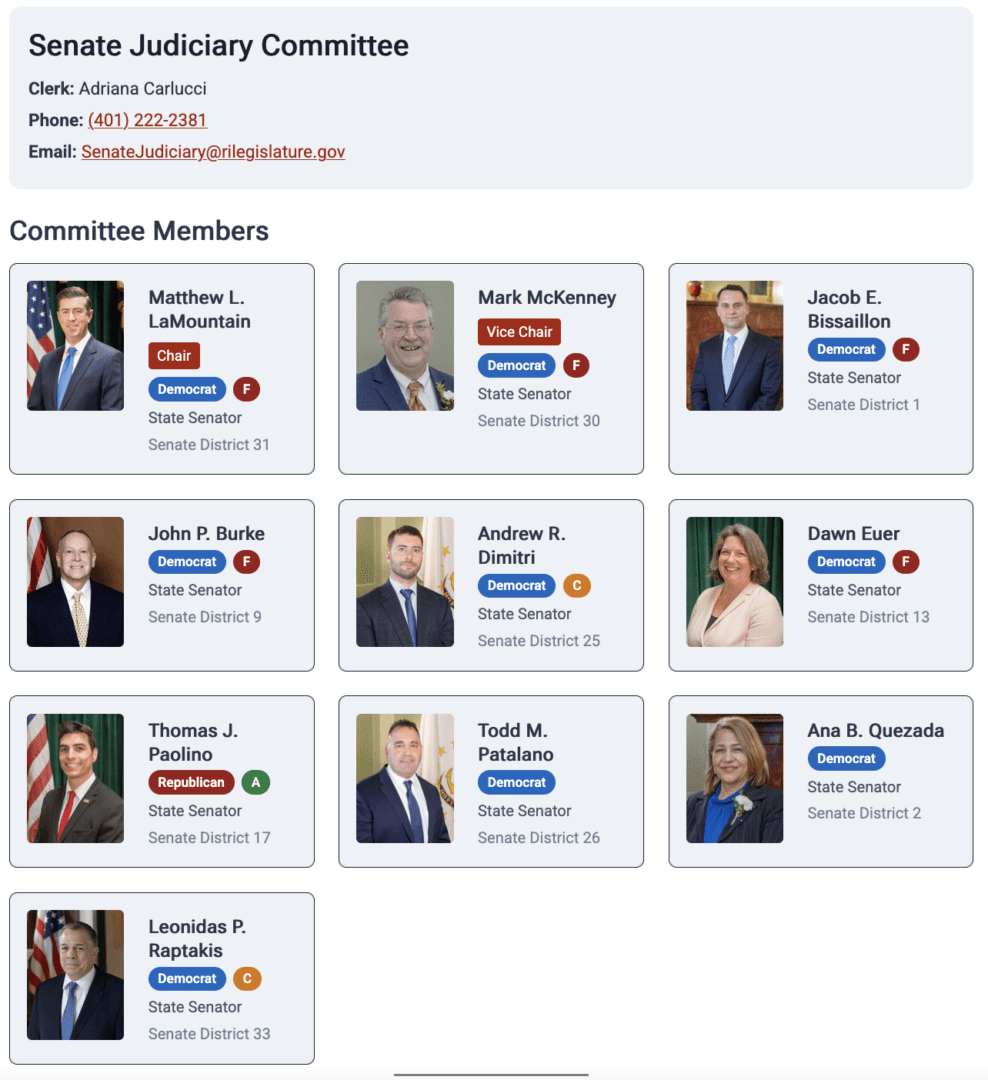
The Senate Judiciary Committee is chaired by Sen. Matthew L. LaMountain (D-Dist. 31, Warwick, Cranston).
The Senate Judiciary Committee:
The meeting will be broadcast live on Channel 75 for Cox customers. It will also be livestreamed at capitoltvri.cablecast.tv.