
Subscribe!
Everyone Is Outraged—Right on Schedule: Political Issues Made to Go Viral
by Nancy Thomas, Analysis & Commentary
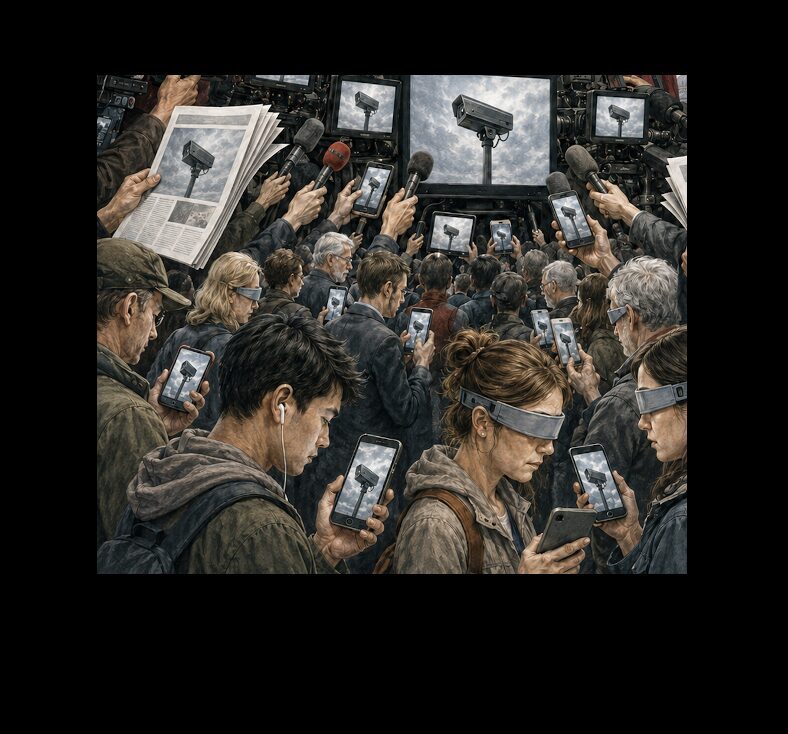
Flock cameras provide a revealing case study in calendar-driven activism, repeated messaging, media amplification—and the larger agendas that may be hiding behind a suddenly “spontaneous” controversy.
Something unusual happened this week.
Flock license-plate-reader cameras—technology that has been installed and debated for years—suddenly became a national emergency everywhere at once.
There were protests, petitions and packed council chambers. Governors and police chiefs announced reviews. The same slogans appeared in city after city. National stories landed in Wired, Vox and The Guardian within days of one another. Local television stations found angry residents standing beneath the same distinctive black cameras.
To the casual news consumer, it looked like a spontaneous public awakening.
It was not.
The concerns surrounding Flock are real and deserve serious examination. But this particular eruption had a date, a national organizer, a toolkit, coordinated local events and a larger political objective that went well beyond any one town’s cameras.
That does not make the issue false. It makes the public’s failure to recognize how an issue is being made viral worth examining.
The scene that gave the game away
On Thursday night, the New Bedford City Council was considering four motions involving Flock cameras.
The Police Department had already suspended its camera system while investigating allegations that an officer used Flock searches to follow a former romantic partner. One council motion called for the cameras to remain off during a review. Others proposed public hearings, stronger privacy and transparency standards, examination of other surveillance technology used by the city—and even possible abolition of the Flock system.
The councilors did not all agree on the final outcome, but virtually no one was defending business as usual.
It did not matter.
Residents shouted from the balcony, booed, interrupted councilors and continued after Council President Ryan Pereira called a recess. At 7:53 p.m., he adjourned the meeting for “lack of decorum.” No Flock motion was voted upon. The people demanding immediate action had succeeded in delaying it.
The scene left an almost comic question hanging over the chamber – even the media noticed this one and reported on it with a quizzical expression – But we agree that something must be done—so why are you still screaming? Even the media noticed this one and reported on it with a quizzical expression.
The answer is important. Many of the most committed participants were not there to help councilors write better restrictions. They were participating in a movement whose stated goal is to end the police use of all automated license plate readers, and maybe more than that.
Limitations were not the objective. Total removal was.
Once that is understood, the behavior makes more sense. The council and the crowd were not actually negotiating the same question.
The outrage had been placed on the calendar
DeFlock, an open-source project that maps surveillance devices, designated August 16–22 as the National Week of Action Against Automated License Plate Readers. Spectrum News reported that people in approximately 460 cities were participating.
The organization’s national toolkit explains how to hold “ALPR 101” sessions, organize town halls, conduct camera scavenger hunts, canvass neighborhoods, create local social-media groups, stage marches and turn out people at city council meetings. It urges every participating community to hold an event that will move local officials closer to canceling “any and all” ALPR contracts.
DeFlock was founded in October 2024 by Will Freeman, a software engineer and privacy advocate who says he began investigating after seeing hundreds of the pole-mounted cameras on a cross-country trip. A crowdsourced map evolved into a national organizing network.
Other organizations were already positioned to amplify the campaign.
The national ACLU launched its “Get the Flock Out” campaign in June. The ACLU of Massachusetts released a municipal advocacy toolkit in July with background material, model messages and sample public-records requests. The ACLU of Rhode Island has written to local councils, promoted contract cancellations and built its own Flock action page.
Fight for the Future offers another step-by-step “Flock Out” guide containing research questions, messaging, petitions and printable organizing materials. Local coalitions include civil-liberties and immigration groups and, in some cities, political organizations such as the Democratic Socialists of America and the Party for Socialism and Liberation.
This was not a conspiracy uncovered by digging through secret documents. It was an openly announced political campaign.
Yet how many news reports told the audience that in the first paragraph?
Why repetition makes us gullible
People naturally treat repetition as confirmation.
If we see the same concern on a local television station, in a newspaper, on social media and then in a national publication, it feels as though four independent sources have verified its sudden importance.
Sometimes they have. But sometimes all four are reacting to the same campaign calendar, the same press release, the same research, the same slogans and the same handful of dramatic examples.
The repetition creates a false impression of spontaneous consensus.
The modern amplification cycle is remarkably efficient:
- A real incident or legitimate grievance provides the fuel.
- An advocacy group gives the issue a simple villain, memorable slogan and coordinated date.
- Toolkits make it possible for small local groups to reproduce the campaign anywhere.
- Protests and council disruptions generate strong pictures and emotional video.
- Local media cover the conflict.
- Social-media algorithms promote the angriest moments.
- National media collect the local reports and declare a nationwide wave.
- Officials and the targeted company respond, producing another news cycle.
By the end, the public is no longer asking why the story appeared everywhere on the same day. Its ubiquity has become proof that it must be the most urgent issue in America!
The press can become part of this machinery without intentionally conspiring with anyone. Newsrooms follow conflict, novelty, pictures, emotion and momentum. “Flock off” fits into a headline far more easily than a sober examination of data-retention periods, audit procedures, interagency agreements and warrant standards.
An advocacy campaign understands that. It creates the conditions the media are most likely to cover.
Virality can also do good
The point is not that every viral campaign is manipulative or harmful. Virality is a tool. Its value depends on the honesty of the message, the transparency of the purpose and what the attention is used to accomplish.
The 2014 ALS Ice Bucket Challenge used almost every mechanism described in this article: a simple and highly visual action, public nominations, friendly social pressure, celebrity participation, repeated videos and an invitation that anyone could reproduce immediately.
But there was no need to disguise the organizing. The purpose was explicit: raise awareness and money to fight amyotrophic lateral sclerosis. The requested action was clear. The beneficiary was identifiable. The results could be measured.
More than 17 million people participated. The challenge raised $115 million for the ALS Association and more than $220 million worldwide. A ten-year independent impact review summarized by the ALS Association found that the original money helped generate nearly $1 billion in subsequent ALS research funding. Research investment more than doubled, the number of multidisciplinary ALS clinics grew from approximately 100 to more than 220, and the campaign helped expand scientific research, patient care and government support.
The Ice Bucket Challenge did not become unworthy because it was coordinated, emotional or contagious. Its contagiousness was its genius.
It also provides a useful test for healthier virality: Can the organizers be identified? Is the purpose stated honestly? Is the requested action connected to that purpose? Can the money or policy results be tracked? Are participants being informed—or merely frightened and enraged? Is success something concrete, after which the campaign can credibly say what it accomplished?
The lesson is not “never join a viral movement.” It is: know what you are joining.
We have seen the signs before—literally
The rapid spread of “Free Palestine” protests after October 7, 2023 offered another highly visible example of the same organizing mechanics.
Signs carrying identical slogans, artwork, colors and typography appeared at demonstrations in distant cities almost overnight. To someone watching the news, the visual uniformity could look like thousands of individuals spontaneously arriving at precisely the same words and designs.
The simpler explanation is documented in plain sight: activist organizations and sympathetic artist networks made campaign materials easy to reproduce. The US Campaign for Palestinian Rights maintains activist toolkits and organizing resources and has distributed protest signs, flyers, social-media graphics and a city-council organizing guide. Justseeds published free, print-ready “Ceasefire Now” artwork and other Palestine posters. Artists for Radical Imagination says more than 150 artists donated graphics for use at protests, campuses, teach-ins, flyers, shirts and online campaigns.
That does not tell us whether the cause itself is right or wrong. It does not mean every person holding a sign was controlled by one central organization, paid to attend or insincere.
It tells us why the signs looked the same. The slogans shouted on streets from east to west coast. Within hours.
They were campaign assets—downloaded, printed, shared and intentionally replicated. The same technique is used across the political spectrum by climate groups, gun-rights and gun-control organizations, abortion opponents and abortion-rights groups, unions, presidential campaigns and countless other movements.
The point is not to discredit people for using a professionally designed sign. It is to teach the public to recognize infrastructure. When finished signs, polished slogans and synchronized demonstrations blossom overnight, we should not mistake effective distribution for spontaneous creation.
From one political barb to an “affair” in less than 24 hours
The August 2026 “Where is Melania?” frenzy demonstrates how quickly a political remark can mutate into a national storyline even without an organizing toolkit.
At a Sunday campaign rally, Democratic Sen. Jon Ossoff was criticizing President Trump’s handling of a war, the prolonged deployment of sailors aboard the USS Abraham Lincoln and what Ossoff portrayed as the president’s misplaced priorities. Near the end, he added that Trump would rather “build his ballroom and travel with Natalie”—a reference to 35-year-old executive assistant Natalie Harp, who frequently accompanies the president.
That is what Ossoff actually said, as the CNN transcript confirms. He did not say that Trump and Harp were having an affair.
The insinuation did the work. Within hours, video headlines were calling Harp Trump’s “mistress.” Commentators debated whether Ossoff had accused the president of infidelity. The White House responded with unusually personal attacks, which made the exchange still more newsworthy. Television panels explained who “Natalie” was. Existing reporting about Harp’s intense loyalty, personal notes to Trump and constant proximity was pulled into the story.
Then the narrative acquired a missing wife.
By Tuesday, headlines were asking “Where’s Melania?”, juxtaposing the first lady’s month outside the public spotlight with photographs of Harp near the president. Articles revisited unverified claims of tension between the two women. Social media filled in the empty spaces with an affair.
There was a far less sensational explanation available. Melania Trump has never maintained a conventional first-lady schedule, places extraordinary importance on her son’s privacy and education, and routinely divides her time among Washington, New York and Bedminster. She also made no public appearance during August 2025. In late August of that year, People reported that she was closely focused on Barron as he prepared for another year at New York University.
On Thursday—roughly three days after Ossoff’s remark—Melania emerged from the Oval Office holding her husband’s hand. Opening a Rose Garden event for her foster-youth scholarship initiative, she smiled out at the press and said: “I heard you missed me. Here I am.”
The story should have collapsed. Instead, some coverage immediately began asking why Harp was not visible at Melania’s event and whether her absence meant something.
That is how a self-sustaining rumor works. An ordinary absence becomes suspicious only after a politically useful comparison is supplied. Speculation is reported because people are speculating. A denial or public appearance becomes evidence that pressure was felt. When the original premise falls apart, the storyline simply changes its question.
Most revealingly, the subject that launched Ossoff’s remark—the war, deployed sailors and presidential responsibility—was almost completely displaced by “Natalie,” “Where is Melania?” and imagined marital intrigue.
No national organization had to coordinate this one. A politician supplied an ambiguous but provocative line; partisan accounts sharpened it; the White House overreacted; entertainment programs made jokes; online publishers added relationship drama; mainstream outlets (MSM), often with a thinly disguised anti-Trump agenda, covered the controversy that all the others had created.
In less than a day, repetition made an unsupported implication feel like an established question the country was entitled to have answered.
When news organizations adopt the same strategy
The line becomes more troubling when news organizations move from covering an advocacy campaign to employing its methods themselves.
Collaborative journalism can be valuable. Several publications may pool reporting, data, legal resources and specialized knowledge to investigate a difficult subject. But if participating outlets select an issue, concentrate coverage within a fixed period and define success in advance as passing legislation or producing a particular government action, the project is no longer simply collaborative reporting.
It is media advocacy: coordinated use of media to produce a policy outcome.
Every participating outlet may publish factually accurate work. Yet the collective volume still manufactures urgency, narrows the public agenda and applies organized political pressure. Readers encountering the issue in multiple publications may believe that independent news judgment made it suddenly dominant, without realizing that the saturation was planned and that the intended result had been chosen before the reporting was completed.
Journalism may expose facts that lead to change. That is one of its highest purposes. But journalism should not decide what change it intends to produce before it knows what its reporting will find.
Traditional newsroom firewalls did not eliminate bias, but they imposed useful friction: reporters gathered facts, editors challenged assumptions, publishers guarded credibility, opinion was labeled, and advocacy organizations—not the news desk—were responsible for campaigning. Digital publishing, nonprofit funding, “impact” measurements and issue-based collaborations can blur those roles.
The public deserves to know when it is reading independent coverage, when it is reading advocacy journalism and when several ostensibly separate outlets are participating in a coordinated effort intended to cause government action.
The agenda inside the agenda
Political campaigns often have two messages.
The public-facing message is narrow, immediate and easy to support: Do you want a camera tracking innocent drivers in your town?
The organizing objective may be much broader: stop all police use of ALPRs, restrict integrated surveillance systems, challenge immigration enforcement, limit police technology, establish a national privacy movement or create a precedent that can be applied to drones, facial recognition, real-time crime centers and other AI-enabled tools.
That broader agenda is not necessarily sinister. In the Flock campaign, much of it is plainly stated in organizational documents. But it is frequently missing from the local news story presented to the public.
Flock itself is also much larger than one roadside camera. Its product portfolio now includes AI-enabled video, mobile security trailers, audio detection, drones that can respond to 911 calls, live 911 integration and software that combines license-plate data, video, drones, dispatch information and other sensors on one operating platform.
That does not mean every Flock camera has all of those capabilities. Actually, none in RI are using the expanded features. Cranston, for example, says its stationary license-plate readers do not use facial recognition, record audio, identify drivers or issue citations.
It does mean the company’s long-term business is an integrated public-safety data system—not merely a camera that spots a stolen plate. Opponents see Flock as the visible first battle in a much larger fight over AI, government surveillance and “smart city” infrastructure.
That is why a local compromise may not calm the crowd. The camera in one town is being used as the entry point to a national argument about the future of policing and government technology.
Is it also a distraction?
Sometimes a viral political issue is deliberately introduced to draw attention away from something more damaging. Governments, campaigns, corporations and activist groups all understand the value of changing the subject.
But distraction does not always require a secret meeting or a single mastermind.
Public attention is finite. News organizations have limited reporting staffs, front-page space and broadcast time. When one controversy is deliberately synchronized across hundreds of cities, it naturally pushes other matters out of view. A coordinated “week of action” is, by definition, an attempt to seize the public agenda.
There is no evidence that the Flock campaign was scheduled to bury one particular national story. It would be irresponsible to claim that without proof.
But it is fair to ask what received less scrutiny while reporters, officials and the public followed the outrage from one Flock meeting to another. Distraction can be the effect of a campaign even when it is not the provable motive.
It is also fair to ask who benefits.
Advocacy organizations gain visibility, supporters and political leverage. Local politicians gain an opportunity to position themselves. News outlets receive highly clickable conflict. A company’s competitors may gain business: The Guardian reported that Axon had replaced Flock in at least seven municipalities, even though Axon sells similar license-plate-reader technology.
That does not prove any of those beneficiaries created the controversy. Benefit is not evidence of authorship. It is simply one of the questions a skeptical citizen should keep in mind.
Signs that virality may be manufactured
Before joining the next national stampede, pause and look for the fingerprints of a campaign:
- Did an issue that has existed for years suddenly become an emergency in dozens of places during the same week?
- Are the same slogans, phrases, signs and examples appearing in unrelated communities?
- Is there a national “day” or “week of action,” an organizing toolkit or sample language behind the local activity?
- Are news reports identifying the campaign and its organizers, or presenting every protest as an isolated spontaneous uprising?
- What is the precise policy demand? Would reasonable safeguards satisfy it—or is the actual goal complete abolition?
- Who funds, organizes and provides research or legal support for the campaign?
- Which facts are receiving little attention because they complicate the preferred narrative?
- Who gains political influence, audience, money, customers or authority if the campaign succeeds?
- What other important issue disappeared from public discussion while this one consumed the news?
- Most revealing of all: What would cause the outrage to end? If no compromise, reform or evidence could ever be sufficient, the campaign may be about movement-building or political identity more than solving a specific problem.
Organized does not mean untrue
Skepticism must cut in both directions.
It would be as gullible to dismiss every Flock concern as manufactured propaganda as it is to accept every viral claim without examination.
There have been documented wrongful stops, questionable searches and alleged personal misuse. New Bedford’s investigation is serious. Rhode Island has little comprehensive state law governing ALPR use. Communities have legitimate questions about who may search the data, how long it is retained, when outside agencies may obtain it and whether an officer should need a warrant.
There is also a legitimate public-safety record that much of the national coverage barely mentions.
In Cranston, Mayor Kenneth Hopkins this week released five years of police results: 107 stolen vehicles recovered, 98 warrant arrests, 18 missing people located and dozens of stolen-property cases assisted by Flock. Cranston says all searches require a stated law-enforcement purpose, access is limited, activity is logged and audited, and city data is not shared with ICE or other federal agencies.
Flock has responded to criticism by announcing a reduction in its default retention period from 30 days to seven, mandatory misuse-detection tools, more customer controls over external searches and contract language stating that it does not sell customer data. The ACLU argues that the changes still lack independent verification, warrants and enforceable legal protections.
Those competing facts are the beginning of a useful public debate. They should not be casualties of a campaign that requires everyone to choose immediately between “total surveillance” and “no cameras ever.”
Why we follow the flock
“People are sheep” is an uncomfortable thought because most of us imagine the sheep are other people.
But human beings are social creatures. We look to others when deciding what is true, urgent, safe or morally acceptable. If thousands of people repeat a claim, repetition begins to feel like verification. If every news outlet covers an issue, coverage itself becomes evidence of importance. If everyone in a room appears angry, the person with doubts may remain silent rather than risk being treated as ignorant or immoral.
Psychologists give parts of this familiar behavior clinical names: social proof, emotional contagion, conformity and the illusory-truth effect—the tendency to find a repeated statement more believable simply because it has become familiar.
Social media industrialized those instincts. It shows us how many people shared, liked and condemned something before we have evaluated it ourselves. Algorithms reward speed, certainty, novelty and anger. A carefully qualified fact travels slowly. A frightening accusation attached to a villain travels at the speed of a thumb.
This does not mean people are stupid. Intelligent, educated and well-intentioned people are often especially skilled at producing sophisticated explanations for conclusions they reached socially or emotionally. None of us can personally investigate every subject, so we depend on trusted institutions, peers and experts. That necessary trust is precisely what coordinated political campaigns seek to activate.
The defense is not to refuse to move whenever others move. Sometimes the flock is running away from a real fire. Sometimes it is carrying buckets of ice that will raise millions of dollars for ALS.
The defense is to pause long enough to identify the shepherd, inspect the destination and ask whether the other sheep are following evidence—or simply following one another.
The most dangerous flock is the one convinced that only the other side is made of sheep.
New Bedford’s warning
The New Bedford crowd may have believed that greater volume demonstrated greater conviction. In practice, it halted the democratic process and delayed all four measures intended to address its concerns.
Councilor Shane Burgo later told The New Bedford Light that the disruption “accomplished nothing.”
But it did accomplish something. It produced dramatic video, shareable slogans and another “easy” news story during a national week of action.
That difference matters.
If the objective was to enact a local policy, the disruption was self-defeating. If the objective was to intensify a national political movement, it was useful.
The public should learn to recognize when it has moved from one to the other.
The bottom line
Political issues rarely become viral solely because the truth finally floated to the surface. They become viral because someone understands timing, language, emotion, repetition, and organization And the media’s appetite for conflict, sound bites, distinctive photos and video, and of course, getting it first.
Sometimes the motive is a sincere effort to correct an injustice. Sometimes it is movement-building, fundraising, partisan advantage, competitive gain or an attempt to establish a much broader policy than the public realizes. Sometimes it serves as a distraction. Often several motives and beneficiaries overlap.
The existence of a campaign does not disprove its claims. It raises the standard of scrutiny that should be applied to them.
Ask who chose the week. Ask who supplied the signs. Ask why the same words are appearing everywhere. Ask what the organizers ultimately want. Ask what facts are being omitted. Ask who benefits. Ask what other story you stopped noticing.
And when everyone around you becomes outraged at precisely the same moment, resist the pressure to join the flock before finding out who is leading it—and where they intend to go.
This was a very well stated article and I would hope the “print” news organizations I follow would at least be able to identify a manufactured viral story. That may be asking too much.
Flock cameras became an issue that I cared about when I read how at least 50 police officers, across the country, had been accused of tracking ex’s, ex’s new significant others, and in one case an actress by misusing Flock cameras. I see the value of these cameras in police work but at what cost to our personal liberties.
I chose to carry a phone and I chose not to close every app every time. Those decisions make me trackable, in a sense that is my choice. I am also aware that I am being tracked when ads pop-up on products and services I have searched or even spoken about. I don’t know when I am being tracked by my government, and to what purpose. I don’t trust Amazon more, but at least at this point Amazon cannot have me taken away and jailed for any trumped up reason.
I am concerned about our fear of crime and how easy it is to scare people into giving up their rights for the perception of safety.
In my view the police have made Flock cameras a target by their misuse of the technology. The anti-flock people just waited for human failings to give them the match.
Thank you for this thoughtful and balanced response. You have identified the central tension: Flock cameras may have genuine value in police work, but that does not eliminate the need for firm limits, transparency, audits and consequences for misuse. The examples you cite explain why public concern is not merely hypothetical.
The larger question in the article was how legitimate concerns can be selected, organized and rapidly amplified—and whether the press and the public can recognize that process while still judging the underlying issue on its merits. Your final sentence is especially well put: human failings supplied the match.
It does not matter if there was an organized campaign or the outrage was organic. The fact is when people became aware, regardless of the means, the vigorously objected to the unwarranted surveillance.
The way this article describes the awareness by the public of the presence of flock cameras as being propagandized into believing these devices were a bad thing. Believing people are stupid and can be manipulated into objecting to anything if the effort by a few goes viral. That may be the case in the writers mind that he/she is susceptible to media manipulation, clearly indicative of the absence of independent
thought! When the whole question becomes the public’s reaction when being made aware, entirely different logic.
Thank you for commenting. You make an important distinction between how awareness develops and the merits of the public’s reaction once people become aware. Concerns about surveillance, privacy and accountability are legitimate and deserve serious public discussion. The article’s purpose was to examine how issues gain national attention—sometimes organically and sometimes through organized advocacy—not to dismiss those concerns or suggest that those who object to Flock cameras lack independent thought. We appreciate your adding this perspective – and reading RINewsToday!