
Subscribe!

Aging, Disability & Behavioral Health. Gubernatorial Forum format beyond soundbites. Carol Anne Costa, others
Rhode Island Forward ~ A Gubernatorial Forum – Time for A Deeper Dive
RI is at a pivotal moment, as there will be a new Governor in the corner office on 82 Smith Street come January 2027. The next governor of Rhode Island will make decisions that reach far beyond the State House: decisions about whether people can remain safely in their homes, obtain mental-health care before a crisis, find a qualified caregiver, access transportation, and live with dignity in their communities.
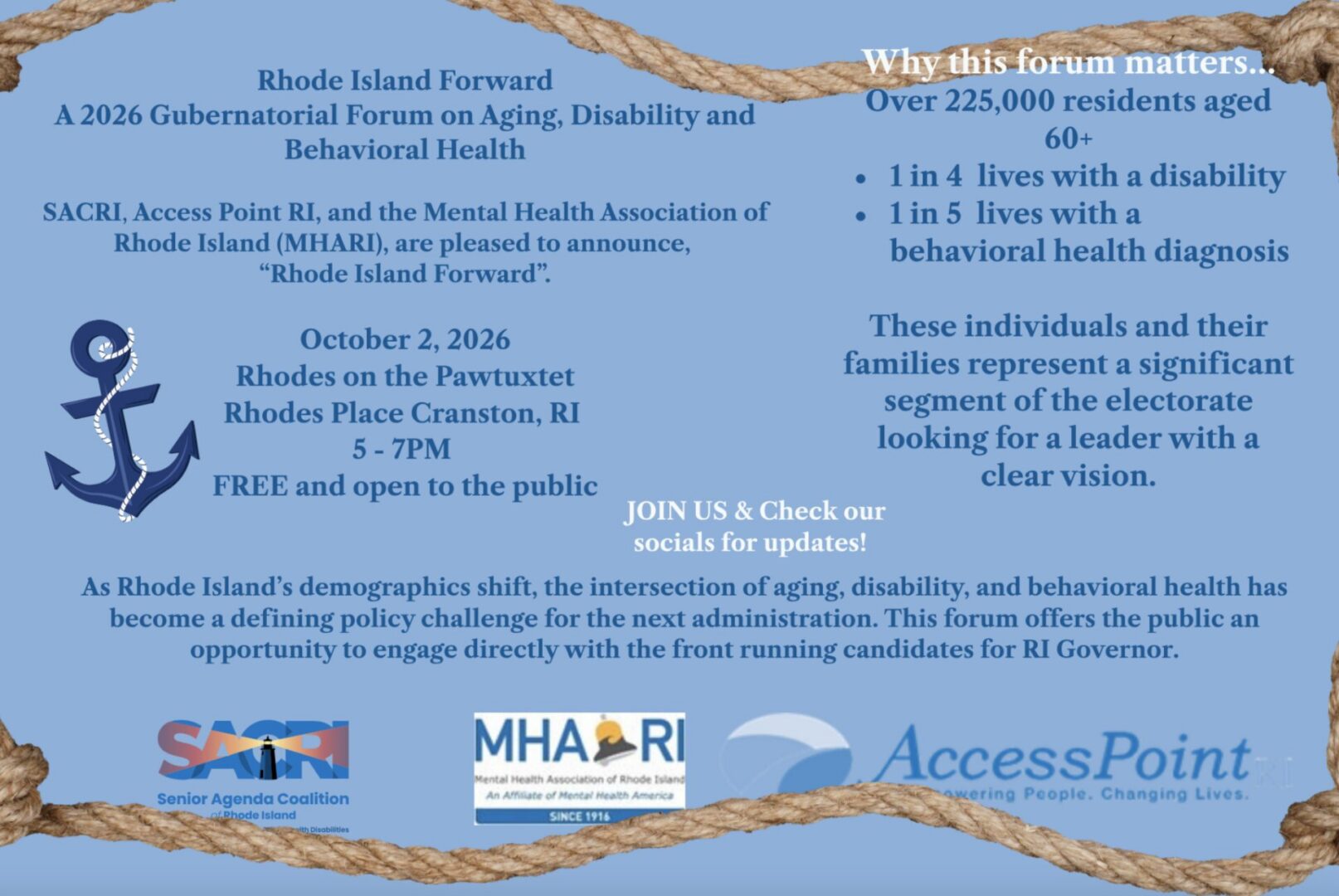
Rhode Island Forward: 2026 Gubernatorial Forum on Aging, Disability and Behavioral Health is that very opportunity to consider the intersectionality within human services and the management of systemic programs and services. It is an important topic, as these are not separate constituencies or siloed policy questions. Rather they are overlapping realities for hundreds of thousands of Rhode Islanders and the people who love, support, and care for them.
Rhode Island is aging rapidly. More than 225,000 residents are age 60 or older, nearly one-quarter of the state’s population. That means roughly one in four Rhode Islanders will be 65 or older. At the same time, disability touches the lives of people across every age, income, race, and community. Behavioral-health needs are also deeply intertwined with physical health, disability, caregiving, housing, and social isolation. These issues deserve intense executive level scrutiny but not merely because of their scale, but because they determine whether Rhode Islanders can exercise independence, participate in community life, and experience security and hope.
Too often, government treats aging, disability, and behavioral health as separate “lanes.” A person may be referred from one office to another, required to complete different applications, or forced to navigate different eligibility rules, service systems, transportation arrangements, and provider networks. But people do not experience their lives within the layered and complicated state bureaucracy.
An older adult with mobility challenges may also be coping with grief, depression, financial stresses, dementia, or loss. An adult with an intellectual or developmental disability may be aging alongside a parent who has been their principal caregiver for decades. A family may be trying to support a loved one whose mental health needs, medical needs, and housing instability cannot be solved by any one agency alone. In each case, the central question is not which bureaucracy “owns” the issue. The question is whether Rhode Island has built a system that sees and hears the whole person and their advocates. That is why this forum is necessary.
It’s Personal
Public policy becomes real at the kitchen table, in the emergency room, in a caregiver’s pleas, and in the moment, someone realizes they may no longer be able to stay in the home and community they love.
Consider this story: An 82-year-old woman lives alone. She has limited mobility, takes several medications, and relies on a daughter who works full time, has a family, and lives 30 minutes away. After a fall, the woman becomes fearful and hesitant. She becomes more homebound. Her world gets smaller. She misses appointments, loses contact with friends, and begins experiencing depression and anxiety. Her daughter is now trying to coordinate primary care, home supports, meals, transportation, medication management, and behavioral-health care while also stressing over her mother’s safety. It’s a lot to carry.
This is not just an “aging” issue. It is an accessibility issue, a behavioral health issue, a caregiver issue, a housing issue, a transportation issue, and a healthcare coordination issue.
If timely services and/or referrals are unavailable or if the family cannot figure out how to access them, the result may create a preventable crisis, an emergency-room visit, hospitalization, institutional placement, caregiver burnout, or a loss of independence that could have been delayed or avoided. The quality of government leadership is felt precisely in the gap between a person’s needs and the system’s capacity to respond.
The stakes are similarly high for adults with developmental disabilities and their families. Many caregivers are themselves older adults. They are asking a question that should concern every candidate for governor: What happens to my son, daughter, sibling, or loved one when I can no longer provide the support I provide today? A serious answer requires more than good intentions. It requires a reliable community-based system, a stable direct-support workforce, accessible housing, meaningful employment and day opportunities, coordinated health care, and a transition plan that respects both the person’s independence and the family’s legitimate concerns.
Government Must Work Across Systems
Rhode Island already recognizes, structurally, that these issues are connected. The Executive Office of Health and Human Services (EOHHS) is the state’s principal executive-branch agency for coordinating several departments, including the Office of Healthy Aging, the Department of Human Services, the Department of Health, and the Department of Behavioral Healthcare, Developmental Disabilities and Hospitals. The challenge for the next governor is to ensure that this structure functions as an integrated system in the lives of RIers, not simply as an organizational chart.
This forum will press candidates beyond broad commitments to “support seniors,” “improve mental health,” or “stand with people with disabilities.” Rhode Islanders deserve to hear how each candidate would lead. RIers and advocates are all set with platitudes.
The questions asked will examine their vision for transformation and moving the needle on long time stalled programs and initiatives. It requires innovative and deeply moral leadership, and includes budgets, appointments, agency coordination, Medicaid policy, workforce strategy, housing investment, and accountability. Most importantly, they involve whether people are treated as whole human beings rather than as cases moving through fragmented systems.
An Intentional Format
Rather than a conventional debate built around quick exchanges and political sound bites, this forum gives each candidate the time and space to explain their views on important policy issues without the gratuitous back and forth. On stage with a moderator, candidates will be asked substantive questions, pressed for specifics, and required to demonstrate whether they understand the lived realities behind the policy language.
The format matters because aging, disability, and behavioral health cannot be reduced to slogans. These are complex systems, but the values at stake are clear: independence, inclusion, access, safety, choice, dignity, and accountability.
Rhode Islanders who rely on services, and the families, professional caregivers, advocates, and providers who stand beside them are not a narrow interest group. They are a powerful and engaged part of the electorate. They are voters, taxpayers, parents, adult children, workers, neighbors, and community leaders. They understand that a governor’s decisions can mean the difference between waiting and receiving care; between isolation and connection; between a family holding on and a family reaching a breaking point.
We have a Choice to Make – It must be Informed
This forum is ultimately about asking the people seeking to lead Rhode Island whether they are prepared to lead for all Rhode Islanders.
The next governor will inherit systems that are under real strain, but also a rare opportunity to create a more coordinated, responsive, and humane vision of public service. The work begins by recognizing the intersectionality of aging, disability, and behavioral health. It continues by listening directly to the people who live with these challenges every day. And it succeeds only when state policy produces tangible improvements in ordinary life: a ride to an appointment, a trusted aide at the door, a caregiver who can get respite, a mental-health provider when one is needed, a safe and accessible home, and the confidence that no Rhode Islander will be left to navigate a crisis alone.
Rhode Island Forward: 2026 Gubernatorial Forum on Aging, Disability and Behavioral Health offers candidates an opportunity to show not only what they promise, but how they will govern. For the people, whose lives depend on the answer, that distinction could not be more important.
The three candidates seeking to be Rhode Island’s next Governor have committed to this forum.
Ken Block – I
Helena Buonanno Foulkes – D
Aaron Guckian – R
Join us! – October 2, 2026, Rhodes on the Pawtuxet 5-7 PM – It’s FREE, and doors open at 4:30 PM.
___
Submitted by:
Rory Carmody, Access Point RI
Dr. Chris Gabois, DNP, RN, PMH-BC, PHNA-BC
Laurie Piscotta, MHARI
Carol Anne Costa, SACRI
Thank you AccessPoint, SACRI, & MHARI for bringing attention to the intersection of aging, disability, behavioral health and long-term care. This is exactly the conversation Rhode Island needs to be having!
Through RI Elder Info’s work on guardianship reform and our recommendations for strengthening Rhode Island’s planning for an aging population, I keep coming back to one principle: our systems should help people maintain their independence, autonomy and right to make decisions about their own lives for as long as possible.
The need is growing. Thousands of Rhode Islanders are living with dementia, traumatic brain injury, intellectual and developmental disabilities, and other conditions that can require increasing levels of support. We also need to recognize how much our current system depends on families. Rhode Island data estimate that 18,400 people with intellectual and developmental disabilities live with family caregivers, including approximately 4,900 whose caregivers are age 60 or older.
At the same time, we cannot build public policy on the assumption that everyone has a daughter, spouse, sibling, friend or neighbor available to provide care, advocate for them or coordinate increasingly complex services. Some people simply do not have family or community supports.
We see the consequences when people with dementia, TBI, cognitive impairment, behavioral health needs or complex medical conditions become stuck in hospitals because they are medically ready for discharge, but there is no appropriate place for them to go. Guardianship sometimes becomes part of that conversation, but a guardian cannot create housing, home care, dementia care, an appropriate long-term care setting or a workforce where those resources do not exist.
We also need to recognize that supporting independence does not mean assuming everyone can remain in the community forever. There may come a point when advanced dementia, TBI, IDD, serious chronic illness or a combination of conditions means someone can no longer safely be supported in their current community setting, even with services. Rhode Island needs sufficient and appropriate long-term care options for people with complex needs while continuing to protect their dignity, preferences, autonomy and rights.
And we have to plan for all of this while recognizing the significant federal policy and funding changes ahead. Medicaid is the backbone of much of our long-term care, home- and community-based services, behavioral health and disability service system. Rhode Island will be making difficult decisions in an increasingly challenging fiscal and regulatory environment. That makes thoughtful, coordinated planning now even more important.
Aging, disability, behavioral health, housing, caregiving, guardianship and long-term care cannot continue to be addressed in separate silos. Our goal should not simply be finding somewhere to send someone when a crisis occurs. We need a true continuum of care—one that helps people maintain their independence, autonomy and connection to their communities for as long as possible, while ensuring appropriate, dignified long-term care is available when advanced illness or disability makes community living no longer safe or possible.