
Subscribe!
Brown Shooting Review Finds Campus Security Gaps; Providence Crime Center Link Planned
After-action reviews found that police saved lives but were slowed by disconnected cameras, incompatible communications and delayed access to campus video.
Two reports released Friday about the Dec. 13, 2025, mass shooting at Brown University arrive at one unmistakable public-safety conclusion: Providence’s first responders moved with extraordinary speed, but the systems that could help police identify and follow a fleeing gunman were not connected when they were needed most.
Brown is now moving to close that gap.
In its newly released Safety and Security Overview and Action Plan, the University says it has decided to participate in the Providence Police Department’s Real Time Crime Center, provided the two sides complete a memorandum of understanding containing specific privacy and control provisions.
The proposed arrangement would not simply provide Providence Police with an unrestricted, continuous feed from every Brown camera. Brown calls for an activation-based system under which the University would decide when video is shared, retain the recordings on its own servers and determine which feeds and technologies are made available. Every instance of police access would be time-stamped so it could be audited and included in public reporting.
That is a reasonable model: connect the technology when a serious crime occurs, establish the rules in writing and leave an electronic record showing when and how the system was used.
Minutes saved lives
The City of Providence released the full 76-page independent assessment by the Police Executive Research Forum. Brown released its own 24-page action plan, which includes the executive summary of a separate review by Teneo Risk. Brown did not publish the complete Teneo and physical-security reports, citing sensitive security and personnel information and attorney-client and work-product privilege.
The City review gives high marks to the men and women who responded. The first calls reporting gunfire came at approximately 4:05 p.m. Providence police and fire personnel were dispatched at 4:07, and the first officers arrived around 4:10. Providence and Brown officers entered Barus and Holley within minutes, without knowing whether the shooter was still inside.
By 4:23 p.m., all nine wounded students had been removed and were being transported for hospital care. Some went in police vehicles rather than ambulances because officers determined that waiting would cost precious time. PERF found that Providence met or exceeded national time targets for reaching, treating and transporting victims during an active-shooter event.
The attack killed Brown students MukhammadAziz Umurzokov, 18, and Ella Cook, 19, and wounded nine others.
The camera system was not ready for the investigation
The gunman, later identified as Claudio Manuel Neves Valente, had already left the building and blended into the surrounding neighborhood. That shifted the emergency almost immediately from a search inside Barus and Holley to a far more difficult effort to identify and locate an unknown person moving away from campus.
Brown had approximately 1,200 security cameras across its properties at the time, but only three working exterior cameras near the shooting location and one interior camera in Barus and Holley. More importantly, investigators could not quickly reach and search all the footage that did exist.
Teneo found that Brown personnel had difficulty locating people authorized to access the video system and identifying the relevant recordings for Providence detectives. The City’s review adds a striking detail: Brown personnel initially told investigators that University shuttle buses did not record video. Detectives continued asking and ultimately learned that a shuttle did have a working camera. Its recording showed the suspected gunman’s direction of travel after he crossed Hope Street and continued along Waterman Street.
The review found that the early delay did not change the investigation’s eventual outcome. But PERF concluded that if Providence’s Real Time Crime Center had been able to view Brown’s north-exit and shuttle-camera footage immediately, the attacker might have been identified and followed as he left campus.
That is precisely why Brown and Providence should complete this connection before another emergency occurs.
Flock did not solve the case alone — but it broke it wide open
The investigation also provides a clear demonstration of how surveillance technology works best: not as a substitute for witnesses and police work, but as a way to turn a credible clue into a manageable set of leads within minutes.
After investigators released clearer images of the gunman, an anonymous Reddit post directed attention to a gray Nissan with Florida plates. A second, independently supplied tip also described a small gray vehicle with Florida plates moving slowly near Brown before the shooting. Police later interviewed the Reddit poster, a Brown alumnus who had encountered and followed the suspicious man near Barus and Holley before the attack.
Once detectives had the vehicle description, Providence’s Flock license-plate-reader system reduced thousands of possible vehicles to two candidates. Police eliminated one after comparing its movements with video and the established timeline. The remaining vehicle led to an Alamo rental office in Boston and the identity of Neves Valente.
Federal investigators then used financial information to locate a storage facility in Salem, New Hampshire. Neves Valente was found dead there on Dec. 18. Investigators determined that he had also killed Massachusetts Institute of Technology professor Nuno Loureiro in Brookline while the manhunt was underway.
No report can establish that immediate access to Brown’s cameras would have led police to Neves Valente before the Brookline killing. But a five-day search for an armed killer is a powerful argument for giving trained investigators faster access to relevant information under clearly written rules.
Brown adds more than 700 cameras since the shooting
Brown has installed more than 700 cameras since the shooting, bringing the campus total to 1,942, with approximately 2,000 expected to be operating by the beginning of the fall semester. The expansion includes cameras at entrances and exits to undergraduate residence halls and in other locations identified through a building-by-building security review.
Brown’s 1,942 cameras are distributed among 231 Providence buildings totaling approximately 7.2 million square feet—about one camera for every 3,700 square feet of building space.
Providence Police operate approximately three specialized Flock license-plate readers around Brown’s central campus. Brown operates 1,942 conventional video-surveillance cameras across its properties.
- Flock: Automatically identifies and indexes vehicles and license plates for searching.
- Brown cameras: Record fuller visual scenes, including people and their movements.
Once Brown activates the proposed connection, Providence Police could obtain selected campus video showing people, movements and vehicles—far broader visual information than a Flock camera’s searchable vehicle record.
Brown has not released a manufacturer-by-manufacturer inventory of its 1,942 security cameras. However, a Brown technology job posting identified Axis Communications cameras operating through Genetec Security Center software, while also referencing American Dynamics and Pelco equipment—indicating that Brown likely operates a mixed camera network.
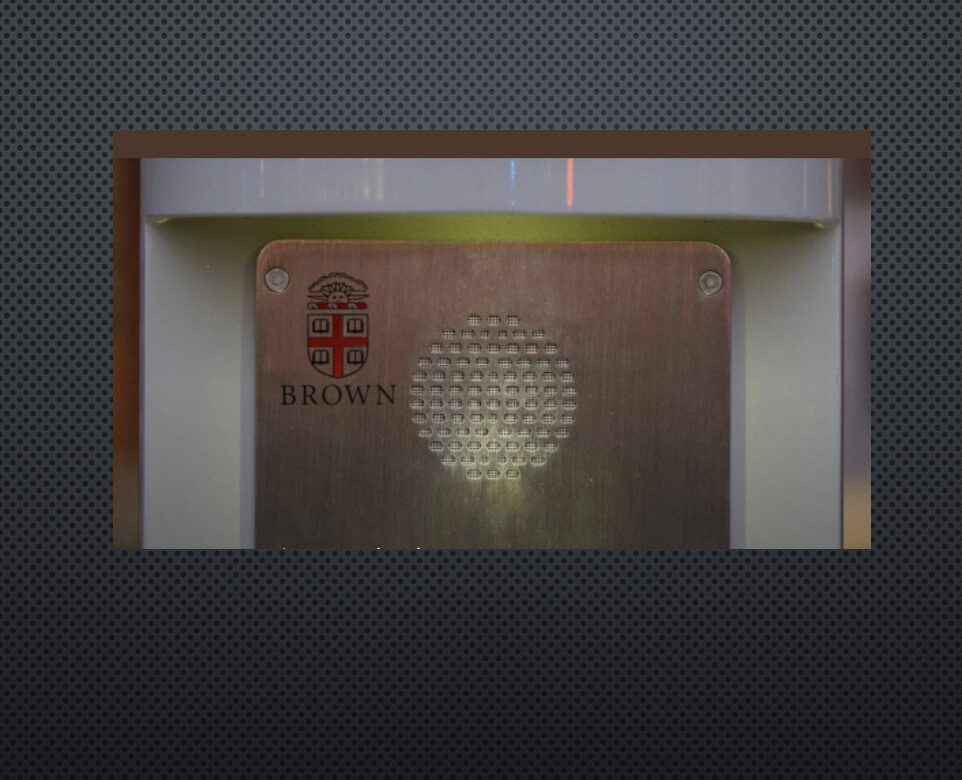
The University has also upgraded blue-light phones with cameras, increased the number of panic buttons in major classrooms and lecture halls, improved direct radio communications with Providence Police and added card access at buildings that still relied on keys.
In Brown’s spring survey, 53% of participating students, faculty and staff said additional exterior cameras would make them feel safer—the most frequently selected physical-safety improvement.
The reports also identified problems that technology alone cannot correct. Brown’s siren was not activated after the shooting. Two on-duty dispatchers were overwhelmed by calls and could not promptly issue a Rave emergency alert; they also needed supervisory authorization to send one. Some Brown officers did not know how to reach Providence officers directly on their portable radios.
PERF found that Providence and Brown officers initially entered the building on different radio channels without knowing that armed officers from the other department were also inside. They established communications only after meeting face to face—an avoidable risk in an active-shooter response.
The agencies had participated in one tabletop exercise in June 2025, but it was limited and did not establish the detailed, joint procedures needed for a campus shooting. The City report recommends regular exercises involving Brown and Providence at the tactical, operational and command levels.
Teneo was also sharply critical of former senior Brown public-safety leaders, finding that they failed to provide necessary help to the unified command and had not adequately prepared the department for an active-assailant event. Brown has since placed former Providence Police Chief Hugh Clements in charge of its Department of Public Safety and Emergency Management and is working to fill vacancies and reassess staffing.
Brown President Christina Paxson, who recently announced that she will step down after the 2026-27 academic year, and Chancellor Brian Moynihan said they remain “resolute and steadfast in maintaining safety and security at the center of everything we do.”
Privacy rules and public safety can coexist
The ACLU of Rhode Island immediately objected to PERF’s recommendations that Providence retain its 60 automated license plate readers and connect Brown to the Real Time Crime Center. It argues that Rhode Island has no statewide law governing these systems and that internal police policies can be altered without legislation or a public vote.
Those concerns merit enforceable safeguards, but they do not require leaving two adjoining public-safety systems disconnected.
PERF expressly acknowledges the absence of a Rhode Island statute. It recommends continued compliance with the Providence Police Department’s ALPR policy, including validation, audits and penalties for misuse. Brown’s proposed agreement would add another layer by allowing Brown to control activation and selected feeds while producing a time-stamped record of every access.
The choice is not between unchecked, around-the-clock surveillance and no police access at all. A limited, activation-based, auditable connection can provide police with essential information during an emergency while protecting against casual or unauthorized use.
The ACLU has urged Brown to reject the connection, outlining its concerns in a January letter to University President Christina Paxson. Brown’s answer is not to dismiss those concerns; it is to build protections into the agreement.
That is the better course. Cameras already operating on a campus should not become inaccessible islands when a gunman walks from university property into city neighborhoods.
A public-safety issue—and now a political one
This report comes out less than two weeks before the Democratic mayoral primary. Mayor Brett Smiley supports the Flock system, while his opponent Rep. David Morales has said he would terminate the contract over surveillance and misuse concerns.
The timing does not erase the evidence assembled in the report. PERF found that Flock data was indispensable once investigators received a sufficiently specific vehicle description. It also found that the technology was used as a lead—not as automatic grounds to stop or detain someone—and that detectives independently tested both candidate vehicles before identifying the correct one.
The Brown shooting did not demonstrate that a camera can prevent every unpredictable act of violence. Teneo concluded that the attack was highly unlikely to have been prevented. What the shooting did demonstrate is that once violence occurs, speed, access and coordination matter enormously.
Providence’s first responders supplied the speed. Connecting Brown to the Real Time Crime Center—with activation controls, audits and public accountability—can supply the access and coordination the next emergency may demand.