
Subscribe!
Bringing Back the Starter Home: Big Thinking for Modest Homes and the NY and MA Move-In Program
by Nancy Thomas, commentary
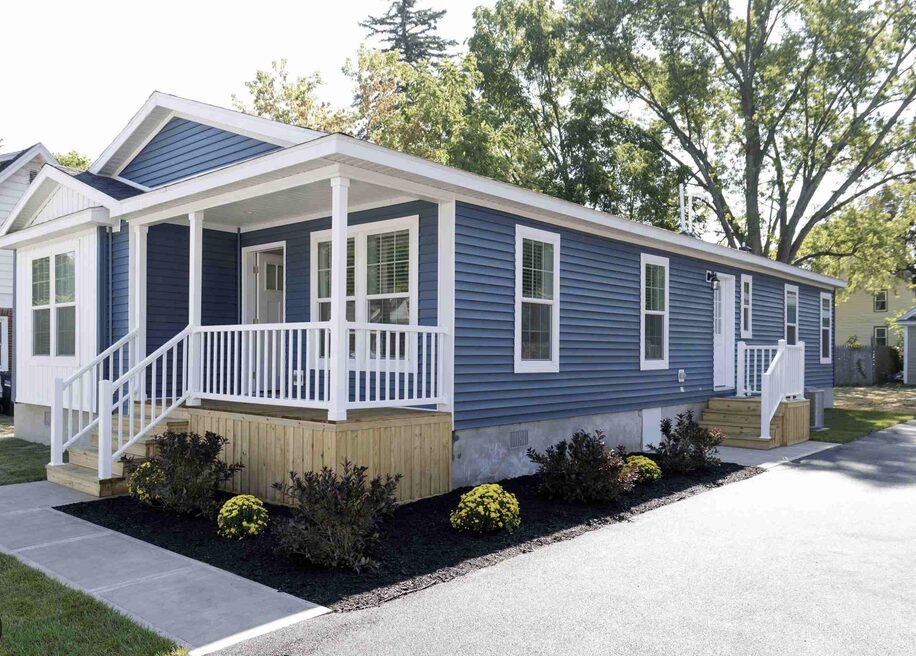
A blue house with white trim, a covered front porch and room for family life offers a concrete example of what the next generation of starter homes could look like.
The Syracuse home pictured in Buffalo Rising’s coverage of New York’s MOVE-IN NY program was built in a factory. It is part of an effort to make homeownership more attainable by changing how houses are produced and financed.
Massachusetts is now pursuing a similar approach. Together, the programs offer Rhode Island something worth examining: ways to build modest homes more efficiently while preserving the qualities that make a house a place to stay.
New York: From a pilot to more homes
New York housing officials say their three-home pilot, completed in 2025 in Syracuse, Schenectady and Newcomb, demonstrated that factory-built homes could be manufactured and installed in less than six months, at roughly half the cost of comparable site-built houses.
The CrossMod designs combine manufactured construction with features such as porches, garages and three-bedroom layouts.
In June 2026, Buffalo was awarded $12 million for 40 homes, while Niagara Falls Neighborhood Housing Services was awarded nearly $8.5 million for 28, according to Buffalo Rising. Those awards support planned homes; they are not a count of completed houses.
The Syracuse example illustrates the difference between building cost and affordability. Buffalo Rising reported total development costs of approximately $300,000 per house, with sale prices of $175,000 to $250,000, depending on buyer income. State assistance covered the gap.
Lower construction costs help. Public subsidy can still be necessary to bring the purchase price within reach. And therein lies a larger philosophical discussion.
Massachusetts: A new starter-home initiative
Massachusetts launched Move-In Mass on October 22, with $10 million in financing and an initial round expected to support at least 20 homes.
The program accepts proposals for detached single-family houses, townhouses and duplexes using manufactured, modular or other cost-effective construction methods.
At least 20 percent of homes in each project must be affordable to qualifying first-time buyers earning no more than 80 percent of area median income. Affordability restrictions would last 15 years. Eligibility therefore depends on both location and household size; the income limit is not one statewide dollar figure.
Proposals are due February 25, 2027, with awards expected in April.
Massachusetts expects to recover much of its financing through sales and reinvest it. The program also allows subsidies of up to $150,000 per eligible affordable home when necessary to meet specified affordability or development-gap needs.
Those are different tools. A repaid construction loan can finance another project. A subsidy does not automatically return to the fund. A credible program needs to explain how much money will come back, when, and how much must remain invested in affordability.
Garden City: A Rhode Island lesson
 Rhode Island already has an example of starter homes becoming lasting family homes.
Cranston’s Garden City developed after World War II around houses, yards, nearby shops and schools. Over the decades, homes have been renovated and expanded as families’ needs changed.
The neighborhood’s history is receiving renewed attention through its nomination to the National Register of Historic Places. A November 12 neighborhood meeting was scheduled as part of that process.
The homes remain, but the original opportunity is harder to reproduce. Today’s buyers face a very different market. Re-creating the promise of an attainable first home would require new approaches to land, construction and financing.
It would not necessarily require Garden City-sized lots. Smaller parcels could still provide space for children to play, a garden or a table outdoors. Good design could preserve privacy and useful living space. Where future additions are envisioned, the lot and zoning would have to allow them.
The lesson is worth considering: a starter home need not be a home people quickly outgrow and leave.
A modest house, a family of five
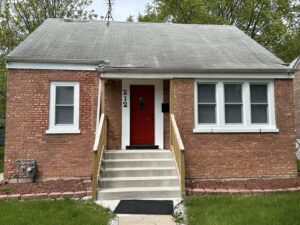
Pope Leo’s childhood home where he lived with his parents and two brothers
Another familiar example stands in Dolton, Illinois. Pope Leo XIV, born Robert Prevost, grew up in a modest brick house with his parents and two older brothers, Louis and John. The house is described as having three bedrooms, with 1,050 square feet for the four people.
It is a historical illustration, not a blueprint for every household. But it gives a human scale to the discussion: modest housing can accommodate family life without requiring a large house.
What should a starter home provide?
The New York and Massachusetts efforts should be judged by what buyers actually receive.
That means looking beyond an advertised price to the full cost of land, site preparation, foundations and utility connections—and establishing whether buyers own the land or face continuing land charges. It means considering taxes, insurance, energy bills and maintenance alongside the mortgage.
Quality needs equally concrete measures: durable materials, adequate storage, workable bedrooms, efficient heating and cooling, and designs that can accommodate changing needs.
Tiny homes can suit some people. They cannot answer every household’s needs. They can be a good emergency fix.
Certainly an option for the homeless as seen at the Pallet Village in Providence, where shelter “homes” offer little more than a 1 or 2 person temporary shelter. And usually for one, occasionally two, people. An anticipated stay of less than a year or less than 6 mos is now extending to multiple years, with success stories at finding housing, usually a subsidized apartment, don’t happen often enough. The Pallet Village was to be open for a year. We see no time ahead when it will close, which also strains the upkeep of the area. Today, on the grassy hill overlooking the tiny homes is a growing tent village. Looking like they are waiting for an opening. The plan for winter this year will meet square on with a change of administration both for Rhode Island’s governor and Providence’s mayor.
Housing policy must offer choices for people living alone, couples, families with children and older residents.
We cannot put people into tiny homes and call the job done.
We cannot put people into large apartment buildings without parking and call the job done.
We cannot look at ADUs as anything but a unique and somewhat rare solution for a particular subset – not a populace.
We need big thinking about modest homes: smaller lots where appropriate, efficient construction, thoughtful layouts and financing that is clear about both repayments and subsidies.
The goal should be a home people can afford to buy, afford to maintain—and want to stay in.