
Subscribe!
Ask Chef Walter: Summer Arrives at the Table – Walter Potenza
by Master Chef Walter Potenza, contributing writer
What to cook, what to eat, and why June is when the kitchen finally exhales
Friends:
June is the month the kitchen stops apologizing. All spring, you have been working with what the earth could spare — the early, tentative gifts of asparagus and new peas, the strawberries that lasted three weeks and then vanished. You were grateful, and rightly so. But June is different. June is when summer stops being a rumor and starts being a fact. The zucchini appear overnight. The tomatoes are still hard and green on the vine, but they are there, swelling steadily, making their quiet promises. The cherries are ripe and need no help. The fava beans are bulging in their pods. The basil, left in a jar on the windowsill, roots itself in the water and begins to smell like an Italian hillside in the afternoon heat.
There is a particular quality to June produce that you will not find in any other month: it is the quality of things not yet overabundant. July and August will drown you in tomatoes and corn and peaches, and that will be wonderful, but it will also be easy — abundance makes a cook lazy. June requires a little more attention. The zucchini are still slender, and their blossoms are still attached; the tomatoes are the small, sweet, early varieties rather than the heavy-slicing beasts of August; the garlic is still fresh and sticky with juice rather than dried and papery. Everything is young. Cook accordingly.
Vegetables to Consider
Zucchini & Blossoms. Slender ones only. Stuff the blossoms or fry them in batter.
Fava Beans. Double-pod them. Eat raw with Pecorino and good oil.
Fresh Garlic. Wet, milky, mild. Use it everywhere you’d use dried.
Cucumber. Early crop — thin-skinned, barely bitter, barely anything.
Eggplant. First of the season. Smaller and less bitter than later fruit.
Green Beans. Haricots verts are at their thinnest and most snappable.
Fresh herbs
Basil, tarragon, and mint — all at peak before summer heat turns them.
Early tomatoes. Cherry and grape varieties only. The big ones aren’t ready.
Fava beans are the great June ritual, and they demand participation. You have to shell them twice — first from their thick, velvet-lined pod, then from the pale green skin around each bean — and this is not a task you delegate. You do it at the table, slowly, possibly with a glass of something cold nearby. The reward is a creamy, sweet bean, entirely unlike the canned version most people know, which is why many think they don’t like fava beans. They like fava beans. They just haven’t met the right ones.
Zucchini blossoms are the month’s most theatrical ingredient. They are the kind of thing that makes guests believe you are a more accomplished cook than you are, when in fact all you have done is fry them. Stuff them loosely with ricotta, a little lemon zest, and a torn anchovy; twist the ends closed, drag them through a very thin batter of flour and sparkling water, and lower them into hot oil for two minutes. They collapse slightly, go translucent, and blister at the edges. Serve them immediately with nothing but flaky salt. There is no second course that can follow this without disappointment.
Fresh garlic in June is a different ingredient entirely from the dried heads you’ve been cooking with all winter. Use it with the same generosity, but expect half the sharpness and twice the sweetness.
Fruits
Cherries. Peak month—Bing, Rainier, and sour varieties all in.
Peaches & nectarines. Early, firm. Better grilled than raw.
Apricots. Short season, full flavor. Eat them before they’re gone.
Blueberries. Domestic crop is in full swing—tart and small.
Plums. First Italian prune plums: tart skins, sweet flesh.
Watermelon. Early small melons — cooler and less sweet than July’s.
Cherries in June are the fruit equivalent of the best week of the year — urgent, perfect, and over before you’ve properly appreciated them. The Bing cherry, black-red and heavy with juice, needs nothing. The Rainier, gold and blush, is sweeter and more delicate and bruises if you handle it carelessly, which is why you never see it in supermarkets and why it tastes like a reward for going to the farmers market. If you can find sour cherries — Montmorency, Morello — buy as many as you can carry. Cook them down into a sauce for duck or pork. Bake them into a tart. Pit them, freeze them in bags, and pull them out in January when everything tastes of nothing.
Apricots have the shortest season of any stone fruit and the highest ratio of disappointment when purchased from a chain grocery store, where they are invariably mealy and flavorless and make you wonder why anyone bothers. A tree-ripened apricot from a farm stand, slightly soft, deeply orange, smelling faintly of flowers and honey — this is a different object entirely. Halve them, grill them cut-side down until they caramelize, and lay them alongside grilled pork with fresh herbs. Or eat them standing at the counter, juice running down your wrist, over the sink. Both preparations are equally valid.
Dishes of the month
Fried zucchini blossoms with ricotta & anchovy – Lightly stuffed, battered in sparkling water and flour, and fried for two minutes. The definitive June appetizer.
Fava bean & pecorino bruschetta – Raw favas, good oil, lemon, and cracked pepper. Shaved young Pecorino. Charred bread. That’s the whole recipe.
Grilled peaches with prosciutto & burrata – Cut-side down on a hot grill until caramelized. Tear over burrata, drizzle with prosciutto, and finish with honey and thyme.
Cherry & duck leg braise – Sour cherries cooked down with red wine, thyme, and a little vinegar. Braised duck legs nestled in for an hour—Sunday dinner.
Zucchini, mint & lemon pasta – Thin-sliced zucchini cooked slowly in olive oil until almost jammy. Tossed with pasta, torn mint, and lemon. No cream needed.
Watermelon, cucumber & feta salad – Cubed watermelon, sliced cucumber, crumbled feta, torn mint, red onion, olive oil. Salty, cold, essential for a hot afternoon.
Try this Recipe
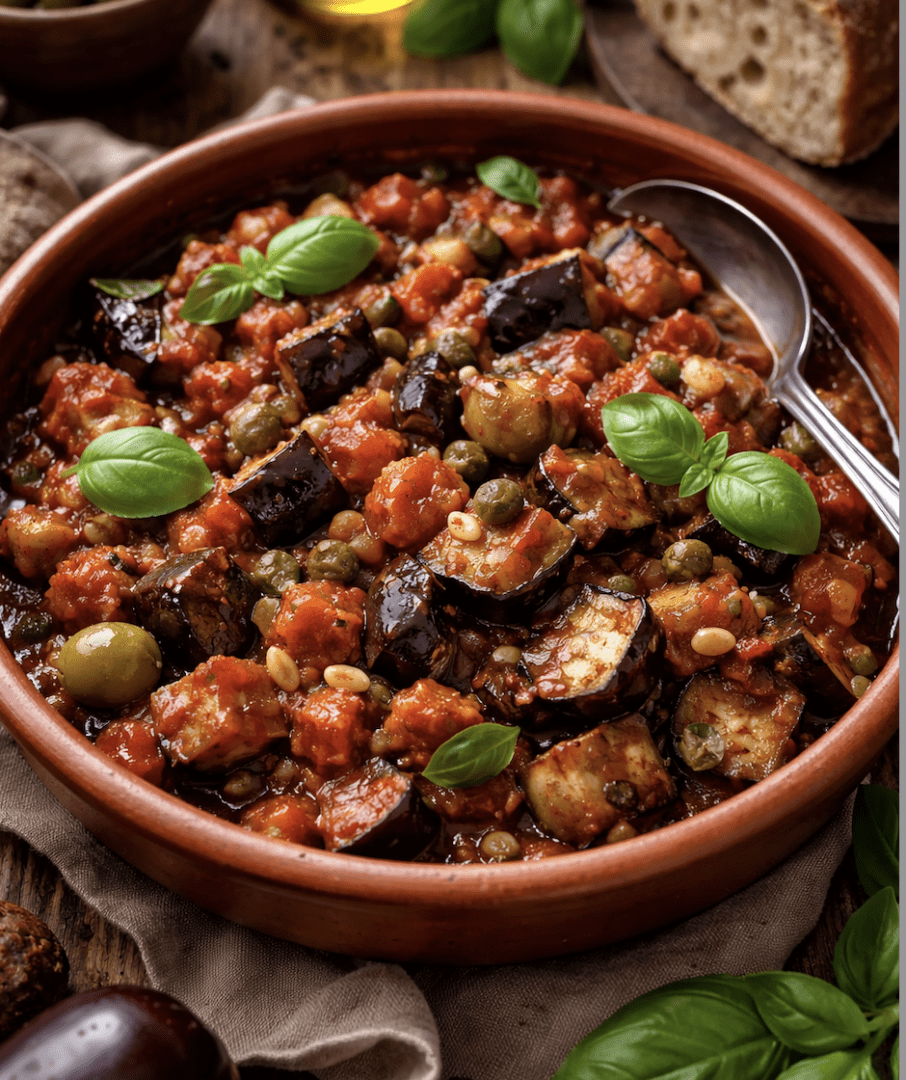
Sicilian Caponata – The great Mediterranean sweet-and-sour eggplant relish — better the next day, and the day after that
Ingredients — serves 4
2 medium eggplants, firm, cubed
Coarse salt, for drawing
5 tbsp olive oil, divided
1 large onion, diced
3 celery stalks, sliced
2 garlic cloves, sliced
400g canned tomatoes, crushed
3 tbsp red wine vinegar
1 tbsp sugar
60g green olives, pitted
2 tbsp capers, rinsed
Salt + black pepper to taste
Fresh basil to finish
Procedure
Salt the eggplant cubes generously and leave them in a colander for 30 minutes. This is not optional. It draws out bitterness and, more importantly, moisture — a dry eggplant fries rather than steams, and that changes everything. Rinse and pat thoroughly dry.
Fry the eggplant in batches in three tablespoons of olive oil over high heat, turning until golden on most sides. Do not crowd the pan, or it will steam. Remove and set aside on paper towels. Season while still hot.
In the same pan, add the remaining oil and cook the onion and celery over medium heat for 8 minutes until softened. Add the garlic and cook for one more minute. The kitchen should smell like a Palermo market by now.
Add the crushed tomatoes and cook for 10 minutes, stirring occasionally, until the sauce has thickened and deepened in color. Add the vinegar and sugar, stir well, and let the agrodolce — the sweet-sour balance that defines caponata — come into focus. Taste and adjust.
Return the eggplant to the pan. Add the olives and capers and fold everything together gently. Cook 5 more minutes on low heat. Remove from heat and let it cool completely at room temperature. Pile torn basil on top and serve at room temperature with crusty bread — or refrigerate overnight and serve the next day, when it will be even better.
___
READ “Ask Chef Walter” every Sunday in RINewsToday

Master Chef Walter Potenza
There is a constant, recognizable thread in the career of Walter Potenza to elevate the level of Italian culinary culture in the United States. Besides his unquestionable culinary talent and winning business perspective, Chef Walter has been a relentless educator with passion and knowledge who defeats stereotypes. His life, career, and values are a model, an example to follow by any chef of Italian gastronomy working outside Italy.
Chef Walter appears regularly on National and International Networks such as Food Network, ABC, CBS, NBC, RAI, FOX, and Publications such as NY. Times, Washington Post, Wall Street Journal, Food & Wine, Saveur, Gourmet, and several Italian media outlets.