
Subscribe!
Ask Chef Walter: Eating in October! – Chef Walter Potenza
by Executive Chef Walter Potenza, contributing writer
On chestnuts and wild mushrooms, the return of the braise, and why October is the month that finally gives the cook permission to slow down
The time when the kitchen becomes the warmest room.
A particular moment in October—it falls on a different day every year and cannot be predicted; you only know it’s here when it happens—at which point you close the kitchen window for the first time since spring. It isn’t cold yet, not really, but the evening air has a certain quality about it which is no longer just cool; it has a sharpness, a sense of determination, as if it means business. So, you close the window, then go to the stove and, for the first time in four months, the heat from the burners doesn’t seem like a nuisance anymore but rather something pleasant.
The kitchen is warm, even though it is not outside. This is the moment that October has been leading up to since the first amber leaf appeared in the third week of September, and when it finally comes, the cook who has been patiently waiting all summer finally lifts the lid off the Dutch oven and starts cooking. October returns the time, heat, and patience that summer took away.
In October, the cook gets back from summer those things summer took away. First of all, time—the long, leisurely afternoon needed for a braise, the two hours required for a ragù to become what it is, and the patience needed when making a bean soup turried and ought not to be. The oven, an enemy since June, or an ally once again, can switch on without guilt or overthinking and let it do its work while the kitchen fills with the scent of something slow and sure.
The ingredients also change in character; they are denser, more serious, and less inclined to be eaten raw. The butternut squash has to be roasted. The celeriac needs peeling and time. The chestnut, the food most typical of October, cannot be eaten straight from the tree without some effort— it must be scored and then roasted or simmered in milk and sugar, and this is entirely appropriate because October is a month that rewards effort in a manner that July, with all its easy abundance, does not. (Chestnut – Raw Materials, n.d.) That is why October matters to the cook: it reinstates the conditions necessary for real cooking.
The month of October is the one which divides the cook who enjoys summer produce from the cook who enjoys cooking; the ingredients now call on you in some way, asking for time and heat and attention, and as a reward they give you a depth which no July tomato, no matter how perfect, can achieve. That is the season’s lesson: the work is just as important as the produce.
Vegetables
Butternut squash. It is sweet when roasted, whether whole, halved, or cut into cubes, and it tolerates being overlooked.
Celeriac. Ugly, bumpy, and magnificent. Roast, purée, or slice raw and make a rémoulade.
Parsnips. First sweetness appears after frost. Roast until the edges turn dark and caramelized.
Brussels sprouts. The peak month: halve and roast hard; never boil gently.
Cavolo nero. Black kale from Tuscany should be braised in olive oil and garlic for a long time.
Cardoons. Rare and magnificent, the Italian cook’s October ritual.
Beets. Roast the whole thing wrapped in aluminum foil for one hour, and the skin will come off as easily as a glove.
Wild mushrooms. The hen-of-the-woods mushroom, the maitake, still appears in late summer along with the porcini.
The ink-black Tuscan kale—a variety of kale with dark green leaves and a stronger flavor than any other member of the brassica family—is October’s most important vegetable and the one that warrants the cook’s most attention. (Toolbox, n.d.) It is not a delicate plant, and it does not collapse easily when heated in a hot pan as spinach does, giving itself up right away to heat and butter; instead, it demands persuasion. The stalks must be removed and thrown away, the leaves should be torn roughly, and then the entire quantity has to be braised — not sautéed, not steamed, but actually braised — in olive oil and garlic together with a ladleful of water or stock, covered and cooked over a low heat for fifteen to twenty minutes until that which was previously tough and resistant becomes smooth and tender and deeply, almost bitterly, savory.
The Tuscans eat this green with their ribollita, their white beans, and their bread soups. It is the green that marks the arrival of winter, and in October, with the window now shut, this is not a sad fact but rather an anticipation. (Ribollita | Traditional Vegetable Soup From Tuscany, Italy, n.d.)
Abroad, apart from France and northern Italy, celeriac is underrated because people lack imagination, not taste. (Ephanov, 2023) Beneath its unpleasant, root-filled outer appearance — as if it grew up in hard conditions and has scars to show for it — the flesh is ivory-colored, sweet, and has a clean celery flavor that is, in some way, more refined than celery itself. Peel it vigorously, getting rid of all the brown outer layer, and either roast it in large pieces until it is golden and tender, or cook it down to a purée with butter and a small amount of cream so that it can be served with a piece of braised meat or a seared scallop without hesitation. When eaten raw, grated, and combined with mustard and crème fraîche to make a rémoulade, it is one of the best autumn salads and takes only ten minutes to prepare. (Celeriac and Rémoulade, n.d.)
Fruits
Chestnuts. Score them, roast them over the fire, and eat them at once with wine. That is the ritual of October.
Apples. The full range includes Cortland, Mutsu, and Winesap; you can eat them and use them for cooking.
Pears. The Bosc and Comice varieties have arrived; they’re better for cooking than Bartlett.
Quince. The month in question. Sear in butter and wine until deep amber—a must-try.
Cranberries. The first of the season, quite tart and so requiring some sugar, is worth having.
Pomegranate. The seeds are as bright as jewels all season and work well as a garnish and in dressings.
Persimmons. The Fuyu is firm and sweet now, while the Hachiya needs to be fully soft and calls for patience.
Late grapes. Last harvest was very sweet and rich because of the cold nights.
The chestnut is not just a food item in October; it is an event, a ceremony, a kind of punctuation in the year that makes it clearer than any calendar that autumn has come and that the cook’s relationship with the outdoors will change fundamentally. You make a cut across the flat side of them using a sharp knife — it takes more pressure than you anticipate and yet you apply less care than you should — and then you roast them over a wood fire or over a gas flame in a pan that has holes drilled in its base, eating them standing up, burning your fingers, blowing on them and smelling the sweet, starchy smoke.
Inside, they are mealy, only slightly sweet, and satisfying in a manner that has nothing to do with elegance. From then on, they appear in Italian cooking: pasta fillings, soups made with rosemary and pancetta, and Piedmontese and Tuscan desserts that pair them with cream, dark chocolate, and the particular quality of a cold October evening. However, the best way to prepare them is also the simplest: roast them until they are scorched and slightly underdone in the center, then eat them outside with a glass of young red wine as the last leaves fall.
In October, the quince comes along looking like a distorted yellow pear and, when you bring it close to your nose, smells of flowers and honey and something almost tropical—an unlikely fragrance for a fruit that will not break under the pressure of your teeth. You cannot eat a quince raw since it is astringent, dry, and impossible to deal with. However, if you cook it — for example, roast it in butter with a bit of wine and sugar in a low oven for two hours or poach it in a syrup made with cardamom and a strip of lemon peel — it changes completely. The flesh shifts from white to a deep, rosy amber; the flavor becomes something between apple, rose, and caramel; and the texture softens so you can eat it with a spoon. From there, it goes very well with pork, aged cheese, a simple tart crust, and the patience October gives above all other months.
My suggestions for dishes of the month
Roasted chestnuts with young red wine
Score it, then roast it on a perforated pan over a fire or flame until it splits and becomes fragrant. Eat it straight away while standing, burning your fingers, with a glass of Barbera or Beaujolais. That is the recipe.
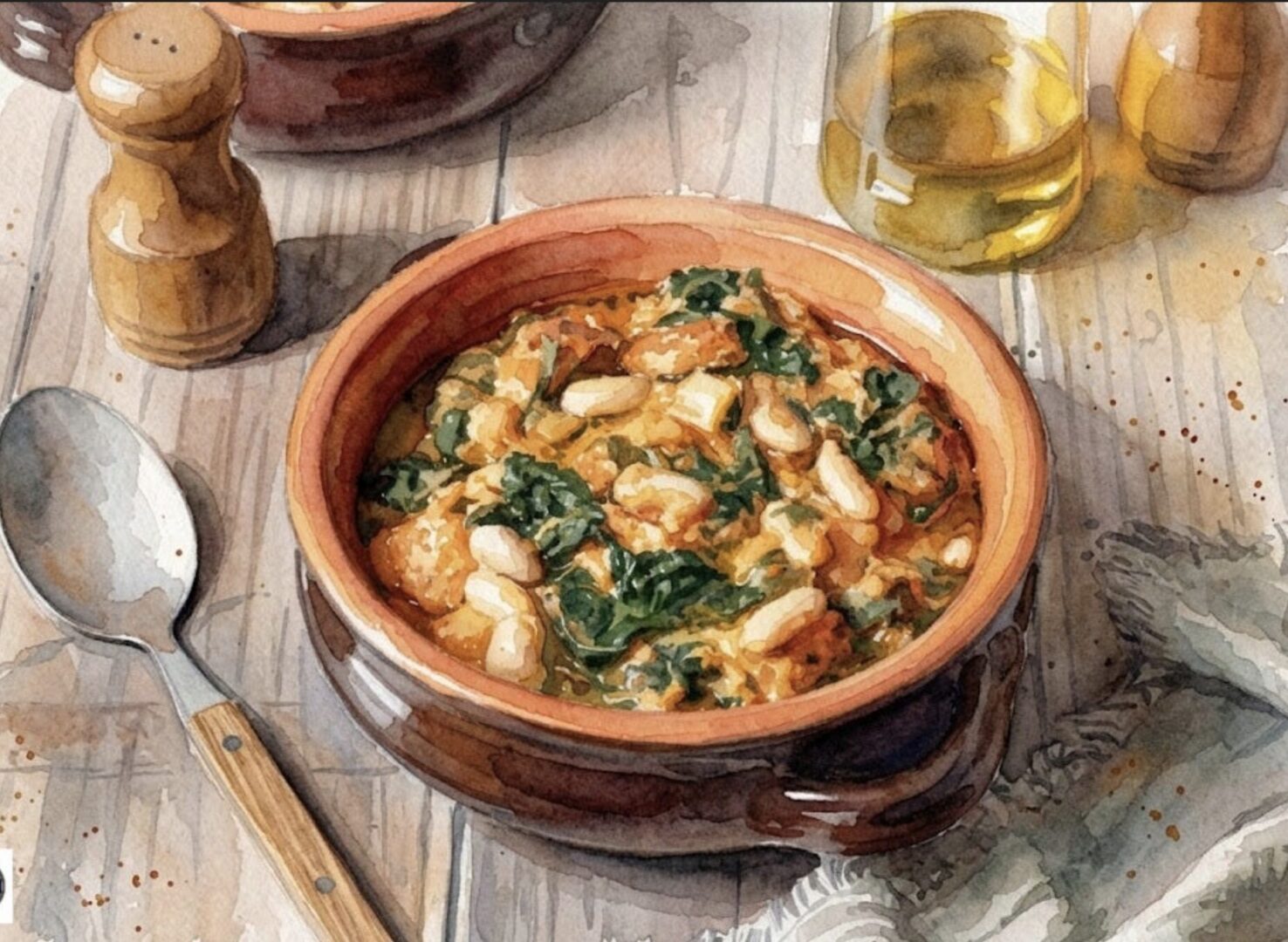
Tuscan Ribollita in Watercolor
Ribollita
The excellent Tuscan dish of bread and beans—cavolo nero, cannellini beans, stale bread, and olive oil—is made one day, then reboreboiled the next, and it gets better with each reheating.
Roasted butternut squash with sage brown butter
Halve the squash and roast it cut-side down until caramelized. Then turn it over and fill it with brown butter infused with sage and toasted pine nuts. This was the centerpiece of the October table.
Cerémoulademoulade
Grated raw coarsely is mixed with Dijon mustard, lemon, crème fraîche, and capers. It is cold, sharp, and essential with braised meat or on a charcuterie board.
Slow-roasted quince with aged pecorino
Roast the quince quarters in butter and white wine for two hours, until they reach a deep amber color, then serve with a sharp aged cheese and a small amount of honey. The cheese course required very little effort.
Wild mushroom and cavolo nero pasta
Sauté the maitake (hen of the woods) in butter, then add the braised cavolo nero, the pasta, and a little pasta water. Top with Parmigiano and a generous drizzle of oil. That’s October in a bowl.
The Tuscan Country Jewel.

Ribollita
The Tuscan bread and bean soup that improves with every re-breboiling- a great October dish for the cook who believes that patience is itself a technique
Ingredients — serves 6
400g dried cannellini beans, soaked overnight
6 tbsp olive oil, plus more to finish
1 large onion, finely diced
3 celery stalks, diced
2 medium carrots, diced
4 garlic cloves, sliced
400g canned whole tomatoes, crushed by hand
1 bunch cavolo nero, ribs removed, leaves roughly torn
2 sprigs fresh rosemary
4 sage leaves
300g stale Tuscan or sourdough bread, torn
1.5 liters water or light vegetable stock
Flaky salt and black pepper
Best olive oil and Parmigiano, to serve
Method
Drain the beans and put them in a large pot, covering with fresh cold water. Bring the water to a boil, skim off any foam, then lower the heat and simmer gently. Add a sprig of rosemary and cook uncovered for 1 to 1.5 hours, until the beans are fully tender but not falling apart. Add salt only during the last ten minutes, because salting earlier will toughen the skins, and no further cooking can fix it. Keep all the cooking liquid, as it adds flavor and starch and is needed for the soup’s consistency, since you’ll use it to take the beans into the next stage.
Take about one-third of the cooked beans and process them with a food mill or mash them well with a fork until smooth. This purée blends into the soup and gives ribollita its distinct, thick, almost porridge-like texture, setting it apart from a regular minestrone. Keep both the whole beans and the purée separate.
In the largest, most heavy-duty pot you have — a Dutch oven is best for this — warm the olive oil over medium heat. Then add the onion, celery, and carrot with a good pinch of salt and cook, stirring occasionally, for exactly fifteen minutes. This mixture, known as the soffritto, forms the base of the dish, so don’t rush it. Once the vegetables have softened and become silky, add the garlic, the remaining rosemary, and the sage leaves, and cook for two more minutes, until the kitchen fills with the scent of something old and appropriate.
Crush the tomatoes and stir them well. Cook them for ten minutes until they have thickened and darkened a little. Next, add the cavolo nero, stir it through the soffritto, and let it wilt fully in the mixture — this should take five minutes over medium-low heat with the lid on. It will reduce considerably. This is normal and exactly what you want.
Add the whole beans, the bean purée, and as much of the reserved bean cooking liquid as needed—adding more stock or water if necessary—until the soup is very thick, almost like a stew. Heat to a gentle simmer, then cook uncovered for twenty minutes, stirring occasionally, until the ingredients begin to blend, and the flavors deepen. Taste it and season it copiously. The ribollita should have flavor; if it tastes flat, it needs more salt, more time, or both.
Put the crumbly, old bread into the pot and stir it thoroughly. Cover the pot and leave it off the heat for ten minutes so the bread can absorb the liquid, swell the soup, and thicken until it holds its shape when you stir it with a spoon. This is what ribollita looks like when served for the first time — it is already quite good. Transfer the soup to deep bowls, top it with a thick strand of your finest olive oil, add a bit of Parmigiano if you wish, and add some black pepper. However, set aside at least half of the pot for tomorrow, when you will reheat it — that is, re-breboil since that is the literal sense of the word — and find that it has become even better: denser, more cohesive, the flavors having been brought together by the time it spent in the refrigerator overnight into a single, sustained flavor that no soup made from fresh ingredients can equal.
Ribollita is the only suitable recipe for October; it contains all the qualities this month demands of a cook — patience, self-restraint, and the readiness to let something improve as it sits rather than serving it the moment it is technically complete. The name gives the instruction: re-boil it, prepare it on Sunday, and enjoy it on Monday. Moreover, it is one of the great peasant dishes of Italian tradition — a soup made from the ingredients cucina povera always had available in October: dried beans, stale bread, and the dark, bitter greens that survive the first frost. Nothing is wasted, and everything is transformed.
___
https://flavorsandknowledge.substack.com/
EAD “Ask Chef Walter” every Sunday in RINewsToday

Master Chef Walter Potenza
There is a constant, recognizable thread in the career of Walter Potenza to elevate the level of Italian culinary culture in the United States. Besides his unquestionable culinary talent and winning business perspective, Chef Walter has been a relentless educator with passion and knowledge who defeats stereotypes. His life, career, and values are a model, an example to follow by any chef of Italian gastronomy working outside Italy.
Chef Walter appears regularly on National and International Networks such as Food Network, ABC, CBS, NBC, RAI, FOX, and Publications such as NY. Times, Washington Post, Wall Street Journal, Food & Wine, Saveur, Gourmet, and several Italian media outlets.