
Subscribe!
Ask Chef Walter: Earth Wakes Up. A comprehensive guide in what to eat in May – Walter Potenza
by Executive Chef Walter Potenza, contributing writer
Friends:
There is a particular kind of morning that belongs only to May — when the air is still cool, but the light means business, and the ground has finally warmed past its winter suspicion and starts giving things away. That is when you should go to the market. Not on a Saturday afternoon when the stalls are picked over, and the crowd moves slowly. Early, when the asparagus bundles are still wet, and the strawberry punnet at the corner stall smells like something you dreamed about in February.
May is the hinge month. Winter produce — the heavy root vegetables, stored apples, and cabbages that have outlasted their welcome — is finally gone, or should be if your cook has any self-respect. Summer’s real abundance, the tomatoes, peaches, and corn that make July effortless, hasn’t arrived yet. Instead, you have a brief, almost anxious generosity from the earth: asparagus shooting up faster than it can be cut, peas so sweet you eat half on the walk back from the garden, strawberries that bruise if you look at them too long.
The asparagus window is at most six weeks. Treat it accordingly, not as a side dish, but as the whole point of the meal. Give it a starring role in a creamy asparagus risotto, pale green with each bite echoing spring. Or pile roasted spears onto a puff pastry tart, scattered with goat cheese and herbs, and call it dinner. Let the thick stalks support a poached egg, or cover them with parmesan and grill until the edges are bubbling. Asparagus holds the center easily; make the most of it while you can.
Asparagus is the month’s undisputed headliner and rewards the cook who takes it seriously. To pan-char thick spears, heat a heavy, dry skillet over medium-high heat until it begins to smoke. Add the asparagus in a single layer without crowding. Let them cook undisturbed for 2 to 3 minutes, until the undersides are deeply seared and the tips begin to blacken. Flip each spear and continue for another 2 minutes, or until the stalks have just started to collapse and feel tender when pressed with a fork. The outside should show char marks, but the inside remains juicy. Lay these alongside a poached egg whose yolk is barely set, finish with brown butter and a snow of Pecorino. This is not a starter. This is dinner. Thinner stalks, shaved raw with a vegetable peeler and tossed with lemon and good olive oil, go into a salad over a bed of arugula still peppery from the cool ground. Both preparations are correct. Both are urgent.
Peas arrive a few weeks after asparagus, and their season is even shorter, with a window even less forgiving. Buy them in their pods and shell them at the table—the act alone is meditative enough to justify the effort, and the peas, eaten straight, taste like the color green sounds. They want almost nothing done to them. A bruschetta with ricotta, lemon zest, and torn mint is barely a recipe; it is more of an arrangement, and that is exactly right for this time of year. But if you have a handful left, toss them into a buttery pasta or stir them into a simple risotto at the very last moment, to warm them and keep their bite. The result is an instant tribute to the season, simple and green and precisely what May intended.
Fruits
Fruit in May is a study through patience and early reward. The strawberries come first and are nothing like the hard, pale, flavorless objects that occupy supermarkets from December onwards. When choosing strawberries at the market, look for ones that are deep red all the way through, never white-tipped or green at the stem. The skin should be glossy and unblemished, and the berries should give off a strong fragrance that lingers in your hands and perfumes the car on the drive home. Size is less important than scent and color—a small, intensely aromatic berry often tastes best. A proper May strawberry requires almost nothing. It does not need a shortcake, whipped cream, or chocolate. It needs salt, a single flake, and perhaps a spoonful of crème fraiche if you are feeling generous. Macerate them briefly with a pinch of sugar and a few drops of aged balsamic, and their juice runs garnet into the bowl. You will wonder why you ever complicated a strawberry.
Rhubarb, technically a vegetable but always eaten as a fruit, connects the gap between late spring and early summer with its blunt, honest tartness. It makes a compote that goes over Greek yogurt with toasted pistachios at breakfast, or it can anchor a crumble that is far more interesting than any apple version. Blueberries arrive from the south with more acid and less sugar than their midsummer versions — which means they are better for cooking, better in a sauce, better alongside meat than the softly sweet July crop. Cherries and apricots appear at the very end of the month, if the climate obliges, taut-skinned and firm, signaling that summer is no longer a rumor.
At the table
The dishes that make sense in May are not the dishes you planned. You do not consult a recipe, go shopping, and then cook. You go to the market first, return with what was actually good, and then figure it out. The green garlic pasta happens because there was green garlic, beautiful and strange. You sliced it thin and cooked it in butter until it softened and turned golden at the edges. Then you added pasta water and lemon, and it became something better than its parts. The cherry clafoutis happens because there were cherries and because clafoutis requires almost no skill and produces almost unreasonable results — whole pitted cherries suspended in barely-sweet custard, the whole thing warm from the oven and dusty with icing sugar.
What May teaches a cook, if paying attention, is that restraint is not deprivation. Less is not an acceptable word for not enough. It is a recognition that a raw sugar snap pea, eaten standing at the kitchen counter, is better than any dish you could make with it. That a bowl of strawberries needs no improvement. The best thing you can do with asparagus this week is cook it and eat it while it is still warm.
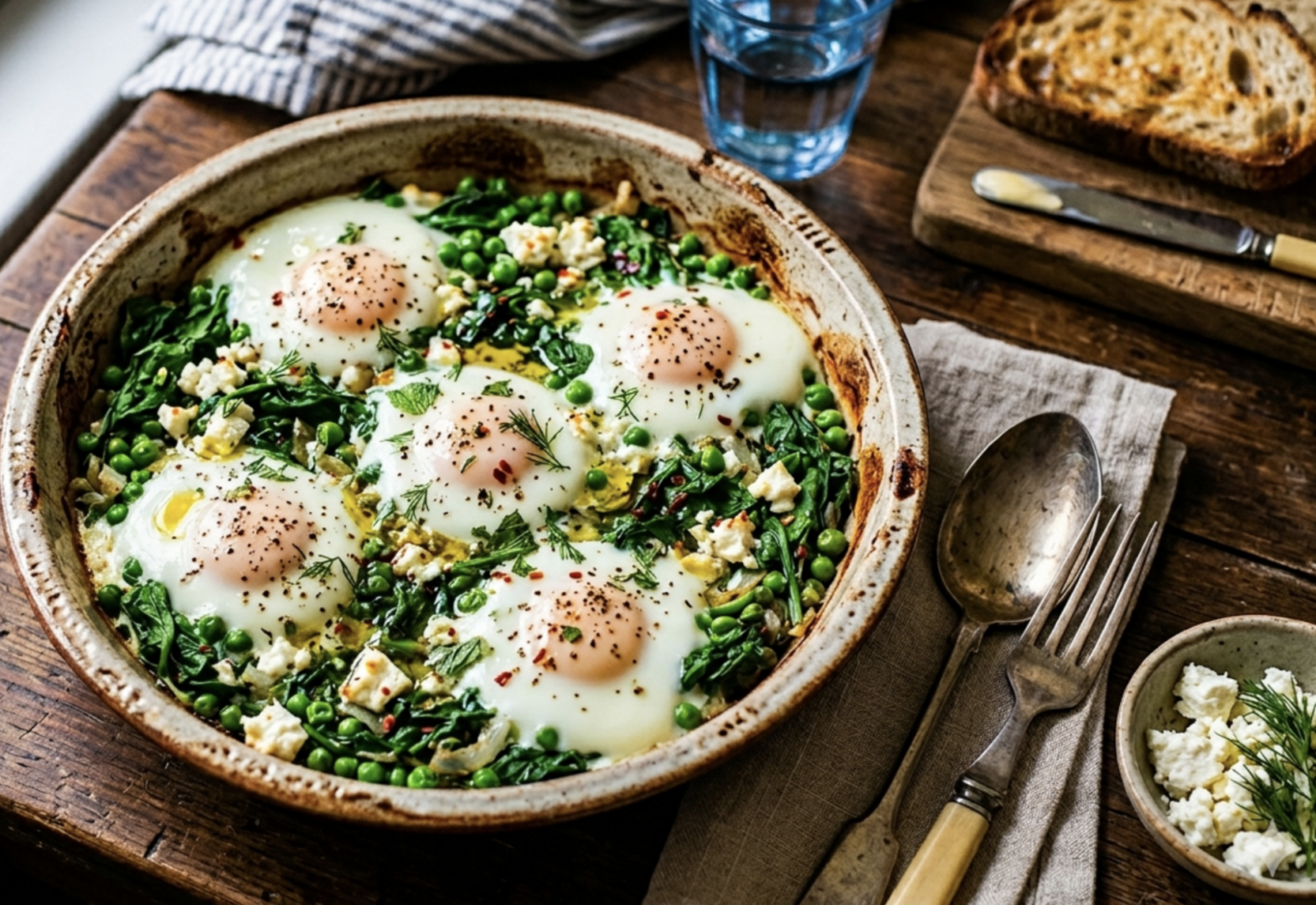
Baked eggs with spinach, peas & feta
A Greek-inflected one-pan supper — what the Mediterranean calls a weeknight, and what you should call it too
Ingredients — serves 2
3 tbsp olive oil
4 spring onions, sliced
2 garlic cloves, minced
7 oz. 200g fresh spinach
1/2 cup of fresh or frozen peas
If using fresh peas, make sure they are sweet and tender—young peas are best. Frozen peas are a perfectly good substitute and save time on shelling; they tend to be a bit softer and slightly sweeter once cooked. No adjustments are needed to the recipe, but if using frozen, add them straight from the freezer and cook just until warmed through to preserve their bright flavor.
1 tsp dried oregano
Pinch of nutmeg
1/2 cup of feta, crumbled
4 large eggs
Flaky salt & black pepper
Crusty bread to serve
Method
- Warm the olive oil in a wide oven-safe skillet over medium heat. Add the spring onions and let them soften and color at the edges for about 4 minutes. The kitchen will already smell like something good is happening.
- Add the spinach and salt, then stir-fry for 1 minute. Once the spinach has wilted, add the garlic and continue stir-frying for another 2 to 3 minutes, according to the recipe by Curtis Aikens on Food Network. Fold in the peas and the nutmeg.
- Season generously — feta is salty, but the greens need their own seasoning too. Scatter the crumbled feta across the surface so it sits in small, uneven islands.
- Make four small wells in the mixture with a spoon and crack one egg into each. Slide the pan into a 190°C oven.
- Bake for eight to ten minutes. You want the whites set and the yolks still quivering. The whites should look fully opaque and be slightly puffed around the eggs, not slimy or translucent, while the yolks should gently wobble if you nudge the pan, their surfaces still glossy. Pull the pan from the oven at this point to avoid overcooking. Finish with more olive oil and bring the pan directly to the table. Eat from it with torn bread. Do not plate it. The pan is the point.
___
Sign up HERE for RINewsToday daily newsletter – and look for my column this SUNDAY!

Meet Chef Walter!
There is a constant, recognizable thread in the career of Walter Potenza to elevate the level of Italian culinary culture in the United States. Besides his unquestionable culinary talent and winning business perspective, Chef Walter has been a relentless educator with passion and knowledge who defeats stereotypes. His life, career, and values are a model, an example to follow by any chef of Italian gastronomy working outside Italy.
Chef Walter appears regularly on National and International Networks such as Food Network, ABC, CBS, NBC, RAI, FOX, and Publications such as NY. Times, Washington Post, Wall Street Journal, Food & Wine, Saveur, Gourmet, and several Italian media outlets. And now – RINewsToday!