
Subscribe!
Ask Chef Walter: Bread of the Poor, Blessed by the King – Walter Potenza
by Chef Walter Potenza, contributing writer
Bread-sticks’ enduring popularity and evolution underscore their enduring significance in culinary culture, transcending geographical boundaries and historical epochs.
The Genesis of Grissini: Noble Origins or Humble Beginnings?
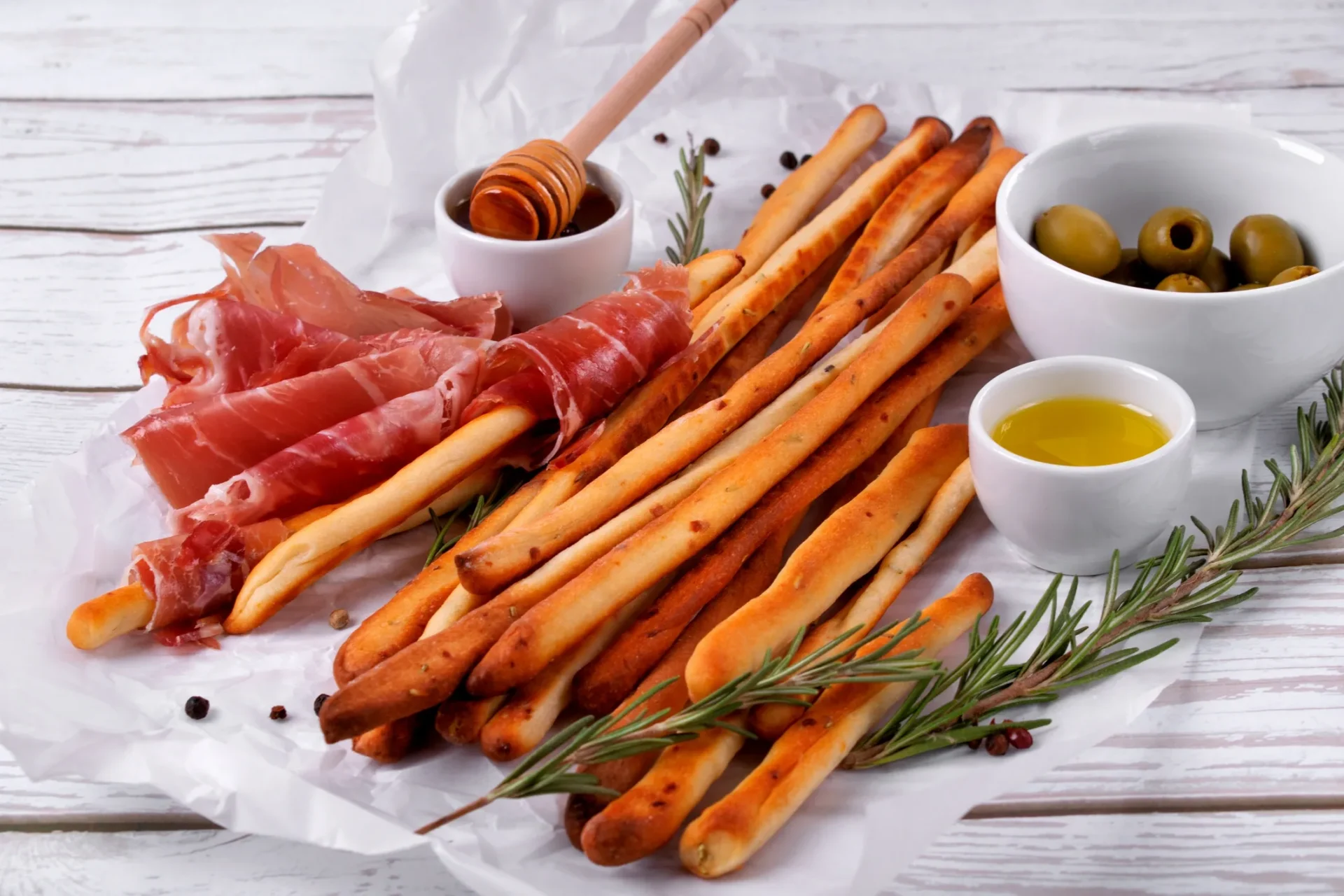
Grissini, the elongated breadsticks, have earned widespread admiration in Italy for their delightful crunch, making them a beloved snack. Available in numerous delectable variations, their popularity has transcended national borders, capturing the palates of enthusiasts worldwide. Historical lore traces the inception of breadsticks to 1679, crediting the ingenuity of Antonio Brunero, a baker from Lanzo Torinese. Tasked by Teobaldo Pecchio, physician to the House of Savoy, Brunero was charged with devising palatable, easily digestible sustenance to ease the dietary ailments of the young monarch, Vittorio Amedeo II.
Accounts from the era suggest that the thirteen-year-old sovereign struggled to eat traditional breadcrumbs. At the same time, other accounts suggest a broader reluctance to eat. Regardless, Brunero ingeniously modified the recipe of ghërsa, a bread characterized by its elongated form, thereby birthing the delicacy known today as grissino. This aromatic delicacy, simple yet immensely appealing, purportedly captivated the royal court and won favor with the Savoy dynasty. Indeed, historical records indicate that Carlo Felice, a descendant of Vittorio Amedeo II, derived pleasure from indulging in grissini during intermissions at the illustrious Teatro Regio; despite assertions that position grissini as the quintessential snack of nobility, some scholars posit an antecedent origin predating the 17th century, suggesting an association with the necessity for durable sustenance to withstand periods of plague, serving as a means to nourish the populace during times of adversity.
Turin, the former capital of Italy under the Savoy dynasty from 1861 to 1865, is irrevocably associated with breadsticks, establishing itself as the epicenter of this culinary specialty. This enduring connection is exemplified by a historical event in 1852, when an obelisk was erected in Piazza Savoia, one of the city’s principal squares. Buried at the base of this monument, amidst a collection of artifacts symbolizing good fortune, were notable items such as coins, two editions of the ‘Gazzetta del Popolo’ newspaper, a sack of rice, a bottle of Barbera wine, and notably, a handful of breadsticks.
Moreover, the historical affinity between breadsticks and significant figures extends beyond local bounds, including notable figures such as Napoleon Bonaparte. Renowned for his fondness for these delicacies, Napoleon established a dedicated transport service to regularly convey the cherished ‘petits bâtons de Turin’ to Paris. Scholarly discourse suggests that Napoleon’s affection for breadsticks stemmed not only from their gustatory allure but also from a purported necessity. It is believed that he suffered from gastritis and thus adhered to a careful dietary regimen.
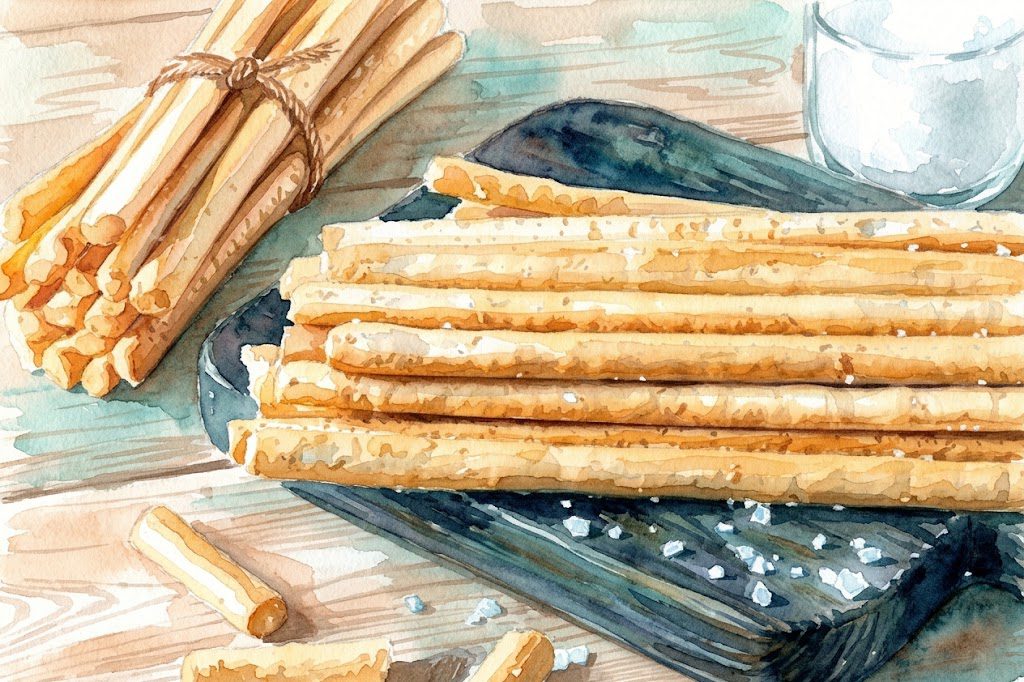 Despite their seemingly straightforward composition, preparing traditional Turin breadsticks entails inherent complexities. While modern machinery has streamlined the baking process, historical records indicate that breadstick production once required a team of four, each with a specific role. The Stiror rolled the dough, the Tajor cut it, the Coureur transferred it onto a long spatula for insertion into the oven, and the Gavor removed the baked breadsticks and broke them into uniform pieces.
Turin breadsticks, characterized by their simple ingredients—00 flour, yeast, salt, and water—are classified into two classic types: the robatà, made from rolled dough, and the ironed variant, a more recent innovation suited to industrial-scale production. The latter, distinguished by its uniform appearance, involves stretching raw dough by hand or using specialized equipment. Additionally, this culinary tradition has spawned numerous variations, from spiced varieties with chili pepper or sesame to those coated in chocolate.
Furthermore, the international acclaimed breadsticks have garnered attests to their versatility and convenience. Notably, in the United States, breadsticks are celebrated annually on Breadstick Day, observed on October 27. Thus, breadsticks’ enduring popularity and evolution underscore their significance in culinary culture, transcending geographical boundaries, and historical epochs.
Let’s go in the kitchen and follow this recipe. Pair with antipasti or dip in extra virgin olive oil.
Ingredients (makes ~24 thin breadsticks)
2 ¼ tsp (1 packet / 7 g) active dry yeast
1 tsp sugar
1 cup (240 ml) warm water (about 110°F / 43°C)
2 ½ cups (315 g) bread flour (or all-purpose flour)
1 ½ tsp salt
2 tbsp olive oil
Optional toppings: sesame seeds, poppy seeds, coarse salt, rosemary, grated Parmesan
Method
Proof the yeast: In a small bowl, combine warm water, sugar, and yeast. Let sit 5–10 minutes until foamy. Make the dough: In a large bowl, whisk flour and salt. Add the yeast mixture and olive oil. Mix until a shaggy dough forms. Knead: Turn onto a lightly floured surface and knead for 8–10 minutes until smooth and elastic. (Or use a stand mixer with a dough hook for ~6 minutes.
First rise: Place dough in a lightly oiled bowl, cover, and let rise in a warm spot until doubled, about 1 hour.
Shape: Punch down the dough and divide into 24 equal pieces. Roll each piece into a thin rope, about 10–12 inches (25–30 cm) long. For extra-thin, crisp grissini, roll thinner—they puff a little in the oven.
Second rise (optional): Place ropes on parchment-lined baking sheets, cover, and let rest 15–20 minutes for a slightly airier texture. Skip this for denser, crunchier sticks.
Finish: Brush lightly with olive oil and sprinkle with coarse salt and/or seeds.
Bake: Preheat oven to 400°F (200°C). Bake 12–18 minutes, until golden and crisp, rotating sheets halfway. Thinner sticks will need less time.
Cool: Let cool completely on a wire rack—they crisp up as they cool. Store in an airtight container for up to a week.
Suggestions
For extra crunch: Bake a few minutes longer at a slightly lower temperature (375°F / 190°C) to dry them out.
Flavor variations: Add 1 tsp dried rosemary or ¼ cup grated Parmesan to the dough or use a bit of semolina flour for a rustic texture.
Even thickness: Roll with your palms on the counter for uniform sticks, so they bake evenly.
https://flavorsandknowledge.substack.com/
___
READ “Ask Chef Walter” every Sunday in RINewsToday

Master Chef Walter Potenza
There is a constant, recognizable thread in the career of Walter Potenza to elevate the level of Italian culinary culture in the United States. Besides his unquestionable culinary talent and winning business perspective, Chef Walter has been a relentless educator with passion and knowledge who defeats stereotypes. His life, career, and values are a model, an example to follow by any chef of Italian gastronomy working outside Italy.
Chef Walter appears regularly on National and International Networks such as Food Network, ABC, CBS, NBC, RAI, FOX, and Publications such as NY. Times, Washington Post, Wall Street Journal, Food & Wine, Saveur, Gourmet, and several Italian media outlets.