
Subscribe!
RIPEC Report: RI Medicaid Spending Continues to Grow Rapidly Despite Declining Enrollment
 Recommends controlling spending, enhancing data transparency and improving access
The Rhode Island Public Expenditure Council (RIPEC) has released a comprehensive report examining Rhode Island’s Medical Assistance Program, commonly known as Medicaid. The report finds that state spending on the program is projected to increase nearly three times faster than state revenues.
“Medicaid is the single largest expenditure in state government, representing over one-third of the state budget and serving as a critical safety net for hundreds of thousands of Rhode Islanders,” said RIPEC President and CEO Michael DiBiase. “However, even with new federal eligibility rules expected to disenroll over 30,000 residents, costs are projected to increase well above revenues. Policymakers must alter the trajectory of Medicaid spending before it overwhelms state finances and crowds out other essential public services.”
The report notes that while Rhode Island maintains relatively moderate costs per individual enrollee, state-funded spending relative to the state’s wealth is among the highest in the country—driven by expansive income eligibility ceilings and a broad range of optional adult benefits.
“Rhode Island’s relatively generous eligibility criteria and covered benefits place us near the top of the nation in state tax dollars committed to Medicaid,” added DiBiase. “Yet, despite this massive public investment, state policymakers lack comprehensive visibility into how over 80 percent of these funds are spent because they flow through private managed care organizations. At the same time, enrollees still face severe barriers to booking medical appointments.”
Key Findings Highlighted in the Report
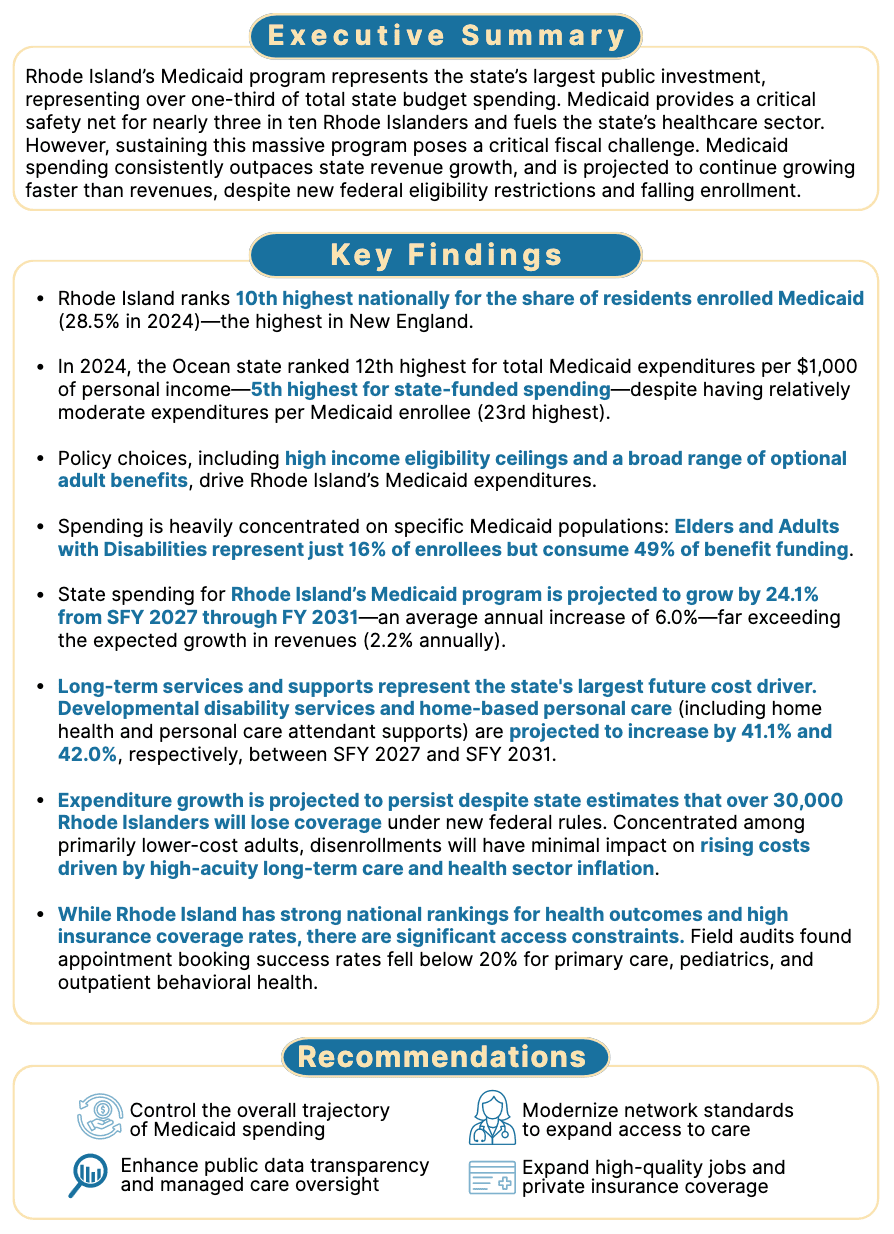
- Medicaid represents more than one-third of total state budget spending and serves nearly three in ten Rhode Islanders—28.5 percent of residents in 2024, the 10th-highest share nationally and the highest in New England.
- In 2024, the Ocean State ranked fifth-highest nationally for state-funded Medicaid spending per $1,000 of personal income, despite maintaining relatively moderate total expenditures per individual enrollee, ranking 23rd-highest.
- High income eligibility ceilings and a wide range of optional adult benefits drive Medicaid spending.
- Spending is heavily concentrated among high-need populations. Elders and adults with disabilities represent just 16 percent of enrollees but account for 49 percent of benefit spending.
- State general revenue spending on Medicaid is projected to grow at an average annual rate of 6.0 percent from state fiscal year 2027 through state fiscal year 2031, far outpacing expected annual state revenue growth of 2.2 percent.
- Long-term services and supports represent the state’s primary future cost driver. Between state fiscal years 2027 and 2031, spending on developmental disability services and home-based personal care is projected to increase by 41.1 percent and 42.0 percent, respectively.
- Expenditure growth is projected to persist despite state estimates that more than 30,000 Rhode Islanders will lose coverage under new federal rules. Because the disenrollments will be concentrated primarily among lower-cost adults, they will have minimal impact on rising costs driven by high-acuity long-term care and health-sector inflation.
- Rhode Island performs well in national health rankings, but access to medical care remains constrained. Simulated appointment testing found booking success rates below 20 percent for primary care, pediatrics and outpatient behavioral health.
Policy Recommendations
Based on its findings, RIPEC recommends that state leaders:
- Control the overall trajectory of Medicaid spending.
- Strengthen existing program-integrity efforts.
- Enhance public data transparency and managed-care oversight.
- Modernize network standards to expand real-world access.
- Expand high-quality private-sector jobs.
“Sustaining a strong Medicaid safety net requires fiscal discipline,” DiBiase said. “By controlling spending growth, improving transparency, and expanding economic opportunity, state leaders can ensure that Medicaid remains financially sound and capable of delivering accessible care for the Rhode Islanders who need it most.”
Find the full policy report here.