Categories

Subscribe!

Screen Shot 2026-06-15 at 7.59.38 AM

RIPEC Report: RI Cities, Towns Continue to Shift Burden to Increasing Property Taxes

Rhode Island Property Tax Increases Jump in Fiscal Year 2026 – New analysis finds cities and towns continue to shift burden to landlords, renters, and businesses

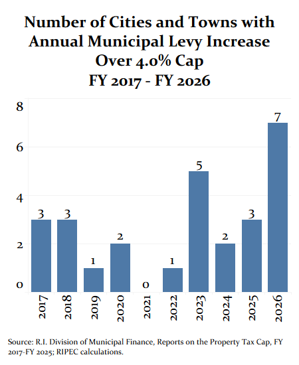
Rhode Island property taxpayers saw a return to higher tax increases in FY 2026, alongside rapid growth in property values and widening disparities among classes of taxpayers, according to a new analysis from the Rhode Island Public Expenditure Council (RIPEC).FY 2026 marked a significant acceleration in property tax increases following several years of comparatively modest growth. The statewide municipal tax levy increased by 3.7%, or $98.3 million, in FY 2026, the largest increase in ten years and above projected inflation (2.8%). Nearly one in five cities and towns (seven) exceeded the state’s mandated 4.0% levy cap—the highest number in the last decade and well above the prior nine-year average of 2.2 communities. Rhode Island taxpayers overall already face the 10th highest property tax levels in the nation at $2,505 per capita in FY 2023 and 22% above the U.S. total.
Property tax growth is likely to further accelerate next year with the new statewide tax on high-value, non-owner-occupied residential property, projected to generate about $25 million annually.“With Rhode Island property taxpayers already facing some of the highest property tax levels in the country, it’s concerning that several communities are raising taxes beyond the 4.0% cap,” said Michael DiBiase, President and CEO of RIPEC. “When we looked at local tax trends and who is impacted the most, it became clear that cities and towns are increasingly shifting a greater share of the burden onto landlords, renters, and businesses. These patterns are most pronounced in the communities where most renters live and where most of the state’s business activity is concentrated.”

RIPEC also finds rapid growth in assessed property values across the state. Total values surged by $61.47 billion (42%) between FY 2023 and FY 2026; 2.5 times the growth rate of the preceding three-year period. Residential real estate drove overall growth, increasing by $55.16 billion (47%) over three years and more than doubling in value over nine years. Commercial real estate also experienced strong growth over the last three years, though at a lower rate than residential property (26%).

Businesses are bearing a growing share of Rhode Island’s property tax burden. In FY 2026, the statewide effective commercial property tax rate was 54% higher than the residential rate, up from 41% in FY 2022. In Providence, commercial property owners face the largest disparities in Rhode Island and among the highest in large U.S. cities, with commercial real estate taxed at 3.5 times the single-family owner-occupied residential rate, resulting in an annual tax bill of $29,200 on a $1 million commercial property—$20,800 greater than the tax on an owner-occupied single-family home of equal value.

RIPEC also finds that renters and landlords are increasingly affected by local tax policies that favor owner-occupied housing. Larger apartment buildings are typically classified as commercial property and taxed at higher rates in 21 municipalities. Additionally, 12 municipalities now use homestead exemptions that shift tax burdens onto non-owner-occupied properties. In some communities, this translates into an annual tax bill gap of nearly $3,000 between owner-occupied and non-owner-occupied single-family homes of equal value at the median sale price. This additional cost is often passed on to renters, who are already more likely than homeowners to be housing cost burdened.

“These policies are not only about fairness but also have real consequences for two of Rhode Island’s most pressing challenges: housing affordability and economic prosperity,” said DiBiase. “Property taxes account for nearly 20 percent of housing costs and about 40 percent of state and local business taxes in Rhode Island. As a result, they play a meaningful role in decisions about business formation, location, and expansion, as well as rental prices and the feasibility of building new housing—particularly the type of higher-density developments we need to meaningfully increase our housing stock.”

Based on its findings, RIPEC makes the following recommendations:

  • Maintain the state’s 4.0 percent levy cap
  • Establish constitutional limits on tax rate differentials among property classes
  • Move toward annual property revaluations
  • Expand targeted property tax relief for vulnerable taxpayers

“These issues have been building for years without meaningful reform,” said DiBiase. “The General Assembly has provided cities and towns with very few guardrails. Given the recent jump in property taxes, which are already high, the urgency for action is even greater. The state can either pursue meaningful reforms or continue to allow tax inequities to grow, eroding affordability and economic growth.”

RIPEC’s full analysis is available here – or click on the report, 


2026_Property_Taxes

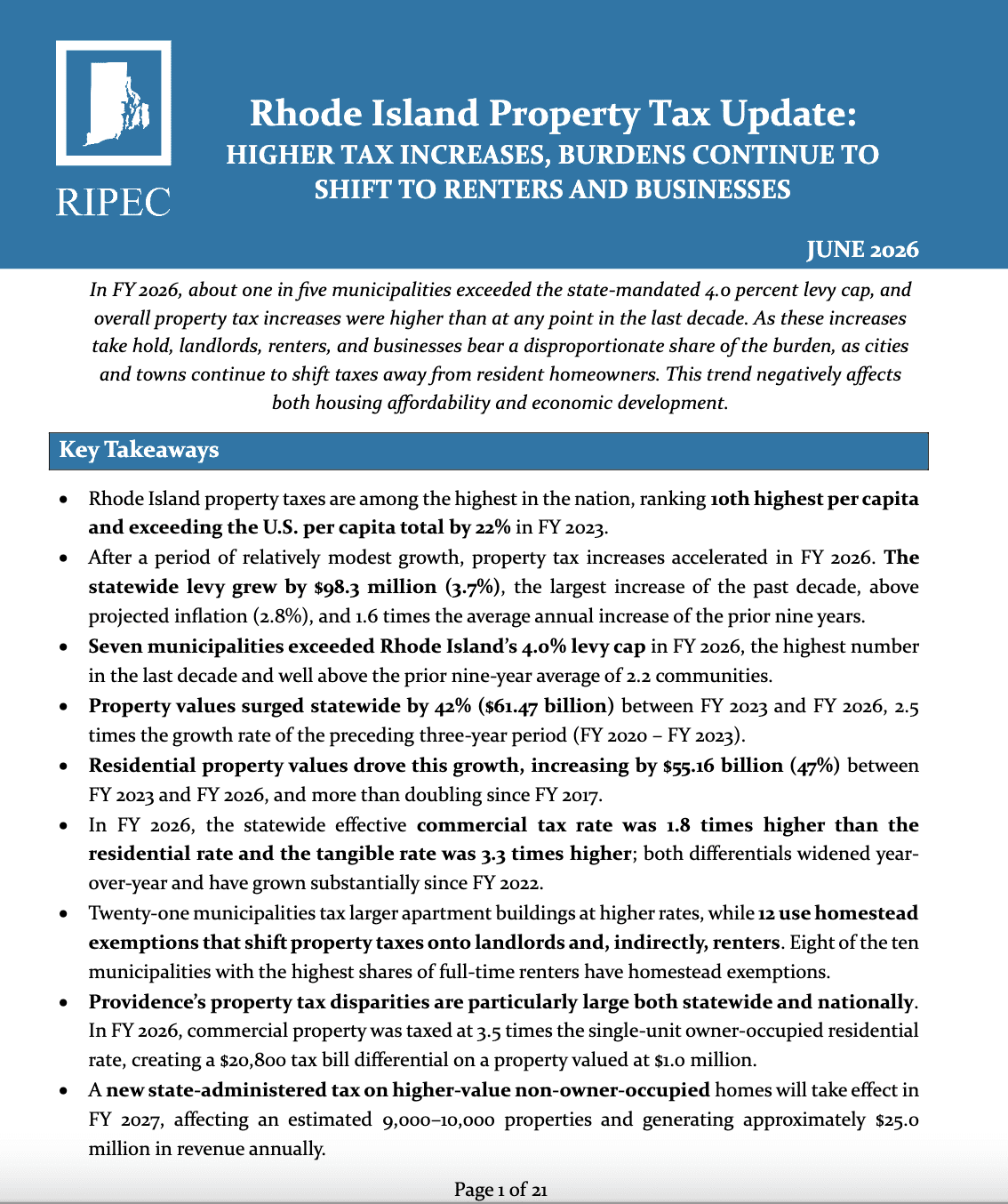
RIPEC report page 1

2026_Property_Taxes Report

___


Given these findings, RIPEC makes the following recommendations to state and local policymakers:

The state should maintain the 4.0 percent levy cap. The cap is one of the few components of Rhode Island’s property tax system that places relatively uniform limits on cities and towns, and shields taxpayers from sharp year-over-year increases in their property tax bills. State policymakers should maintain this important protection.

The state should adopt a constitutional amendment that sets guardrails limiting effective tax rate differentials across property classes. Rhode Island has a state classification plan that sets limits to tax differentials, but most cities and towns have an exemption, or an individual statute, allowing deviation from state requirements. Ultimately, state statutes have proven ineffective at reducing, or even maintaining, current tax rate differentials, exacerbating unfairness among taxpayers and worsening housing affordability and economic opportunity in Rhode Island.

State policymakers should consider implementing an annual property revaluation schedule. The more frequently property is assessed, the more accurate are assessments relative to market value. Rhode Island is currently experiencing large swings in valuation that render three-year-old assessments highly inaccurate. This creates another layer of unfairness among taxpayers and may result in policy decisions being influenced by price shock. This unfairness among taxpayers will soon be compounded by the new state tax on higher-value non-owner-occupied residential property, as assessed values will diverge from market values by varying degrees across communities based on revaluation cycles.

Local policymakers should consider adopting or expanding targeted methods of property tax relief. When broad relief is provided to all homeowners without regard for ability to pay, property tax systems become distortive and unfair relative to other taxpayers. However, given that property is a non-liquid asset, property tax increases based solely on property value can be particularly burdensome to some taxpayers. Targeted tax relief can serve as a better tool to assist overly burdened taxpayers. Most municipalities already make use of means-tested tax relief programs—such as freezes, deferrals, and credits—and expanded use of these tools would better equip local governments to target tax relief.

Posted in

Leave a Comment