
Subscribe!
RI AG Report on Child Sexual Abuse in the Diocese of Providence, and the Diocese Response
Attorney General Peter F. Neronha has published the Office’s Report on Child Sexual Abuse in the Diocese of Providence. The report, which describes the Diocese’s handling of decades of clergy abuse, is the result of a yearslong investigation by the Office of the Attorney General, with assistance from the Rhode Island State Police. The investigation began in 2019 when, as a result of a Memorandum of Understanding between the Attorney General and former Bishop Thomas J. Tobin, the Diocese agreed to voluntarily produce internal records relating to clergy abuse dating back to 1950.
“First and foremost, I want to offer my sincerest gratitude to the many survivors of child sexual abuse who came forward to share their stories for purposes of this investigation,” said Attorney General Neronha. “Each survivor we spoke with recounted unthinkable trauma at the hands of trusted religious leaders, and yet what stood out most was their bravery, resiliency, and commitment to accountability. I also want to honor those who could not come forward, whether due to trauma or because they are no longer with us. We recognize and remember you, as well… as our report describes, for decades the Diocese of Providence engaged in a well-worn pattern of protecting the reputation of the Church and its priests over the welfare of children. They failed to report the abuse to civil authorities; they failed to properly investigate those complaints internally; and they failed to remove accused priests from positions where they had access to even more children, who tragically paid the price for those failures.
“Instead, the Diocese kept the abuse secret; they hid and they obfuscated. And while the situation has improved in recent years, there remains work to be done. When my Office asked Diocesan representatives to engage in the investigatory process in person, they repeatedly refused. When my Office requested supplemental documents, they frequently dragged their feet. Their tendency to reflexively turn inward is part of what perpetuated this crisis, and I’m not sure if all of the lessons have been learned.

Access full report HERE
As part of the investigation, Office investigators reviewed over 250,000 pages of records produced by the Diocese which included personnel files of accused priests, records of internal investigations of abuse complaints, correspondence involving bishops and other senior Diocesan leaders, “treatment” reports for accused priests, Diocesan policies, and other materials. Detectives and investigators also attempted to reach more than 300 victims, and contacted nearly 150 of them, to discuss reported instances of abuse by Diocesan clergy.
Additionally, the Office and the Rhode Island State Police set up a hotline at the outset of the investigation to provide a channel for anyone to confidentially report information on sexual abuse by clergy members.
Importantly, though the Diocese cooperated in producing a large volume of records, which laid bare the deep institutional and personal failures at the heart of this crisis, the investigatory process was also not without roadblocks of the Diocese’s own making. As already mentioned, the Diocese denied the Office’s requests for in-person interviews. Likewise, the Diocese sometimes delayed in responding to requests for documents or information, and in some instances simply did not answer those requests. Such obstacles unnecessarily delayed the completion of the investigation and, ultimately, limited certain aspects of this report. Nevertheless, the report’s findings regarding the Diocese’s historical responses are clear, tragic, and damning.
As a result of the investigation, the Attorney General identified 75 credibly accused clergy, including 61 Diocesan priests and deacons, 13 religious order members, and one extern priest, who reportedly abused over 300 victims from 1950 to 2011. The Office brought criminal charges against four current and former priests for child sexual abuse they allegedly committed while serving in the Diocese. Three are currently awaiting trial and are presumed innocent unless and until proven guilty.
- John Petrocelli (P1-2020-3184A) – The indictment alleges that the defendant committed multiple acts of child molestation against three male victims who were all under the age of 14 at the time of the alleged assaults. The charges against the defendant stem from his alleged actions while he served as an assistant pastor at Holy Family Parish in Woonsocket sometime between November 6, 1981, and October 3, 1990.
- James Silva (P1-2021-3378A) – The indictment alleges that the defendant committed multiple acts of child molestation against a male victim under the age of 14 between 1989 and 1990 during his time as Interim Director and Assistant Director at the Office of Ministerial Formation within the Diocese of Providence.
- Kevin Fisette (P1-2022-1857A) – The indictment alleges that the defendant committed first degree child molestation against a juvenile male victim in the town of Burrillville between January 1, 1981, and December 31, 1982. At the time of the alleged assault, the defendant was appointed to serve as a Deacon in Our Lady of Victory Parish, in Hopkinton, and as a Chaplain at Rhode Island Hospital.
- Edward Kelley – On May 5, 2021, a Statewide Grand Jury returned an indictment charging former Smithfield priest Edward Kelley with multiple counts of sexual assault. In February 2022, the defendant was found by the Court to be incompetent to stand trial. Kelley died at Eleanor Slater Hospital in 2022, and as a result the case against him was dismissed.
The investigation found that the Diocese’s historical failures to properly respond to and report complaints of child sexual abuse by clergy led to the abuse of additional children. Rather than report complaints of child sexual abuse to civil authorities, bishops and other senior officials withheld those complaints and instead sent accused priests to different parishes, or to “treatment,” before ultimately returning them to active service. These failures persisted from the earliest part of the “review period” in the 1950s until near the end of the 20th century when external pressures, such as civil lawsuits against the Church, criminal prosecutions of individual priests, and a heightened public awareness of clergy abuse, forced the Diocese to begin reforming its responses.
Recommendations to the Diocese
In response to those concerns, the report offers recommendations to the Diocese to improve its prospective handling of child sex abuse allegations and investigations, survivor supports, and transparency and accountability. Specifically, the Office recommends the Diocese, among other things:
- Establish a monitoring program for credibly accused clergy;
- Strengthen preventive measures, such as requiring regular nationwide background checks for all clergy, and investigating and disciplining grooming behaviors;
- Improve and expand Diocesan policies and procedures for internal investigations of sexual misconduct complaints, including clear deadlines, meaningful oversight, and the use of trauma-informed investigative practices;
- Establish and fund an independent survivor compensation program;
- Update and formalize the policies of the Review Board, which should include at least one victim representative;
- Adopt a survivors-rights policy;
- Improve transparency by (1) expanding the currently published Credibly Accused List and (2) creating an on-line document repository for key records relating to the Diocese’s past and present response to the abuse crisis; and
- Enter into a revised Letter of Understanding with this Office to include a wider range of sexual misconduct offenses involving minors, and clarify that reports to the Office and the State Police must be made within 24-48 hours of receipt by the Diocese.
4 Legislative Reform Suggestions
Finally, the Office proposes four important legislative reforms intended to ensure greater accountability for child sexual abusers and their enablers.
First, amend Rhode Island’s civil statute of limitations for child sexual abuse to permit plaintiffs whose claims previously expired to sue the institutions and supervisors responsible for enabling or covering up their abuse.
Second, increase the criminal statute of limitations for second-degree sexual assault.
Third, clarify the state mandatory reporting law to explicitly require the reporting of known or suspected child sexual abuse or neglect committed by clergy and other religious leaders, or any person employed by a church or religious body with supervisory responsibilities over children.
And finally, adopt a grand jury reporting statute that authorizes grand juries to issue public reports on their findings, even when they do not return an indictment, subject to court oversight and procedural safeguards.
Attorney General Neronha recognizes the tireless work and contributions of members of his Office, the Rhode Island State Police, and the many victims and survivors, without whom this report would not be possible. For more information, and to read the report, please visit our dedicated website. To report child sexual abuse by a clergy member, you may call the Rhode Island State Police Special Victims Unit’s dedicated clergy abuse hotline at 401-764-0142.
___
Response from the Diocese of Providence
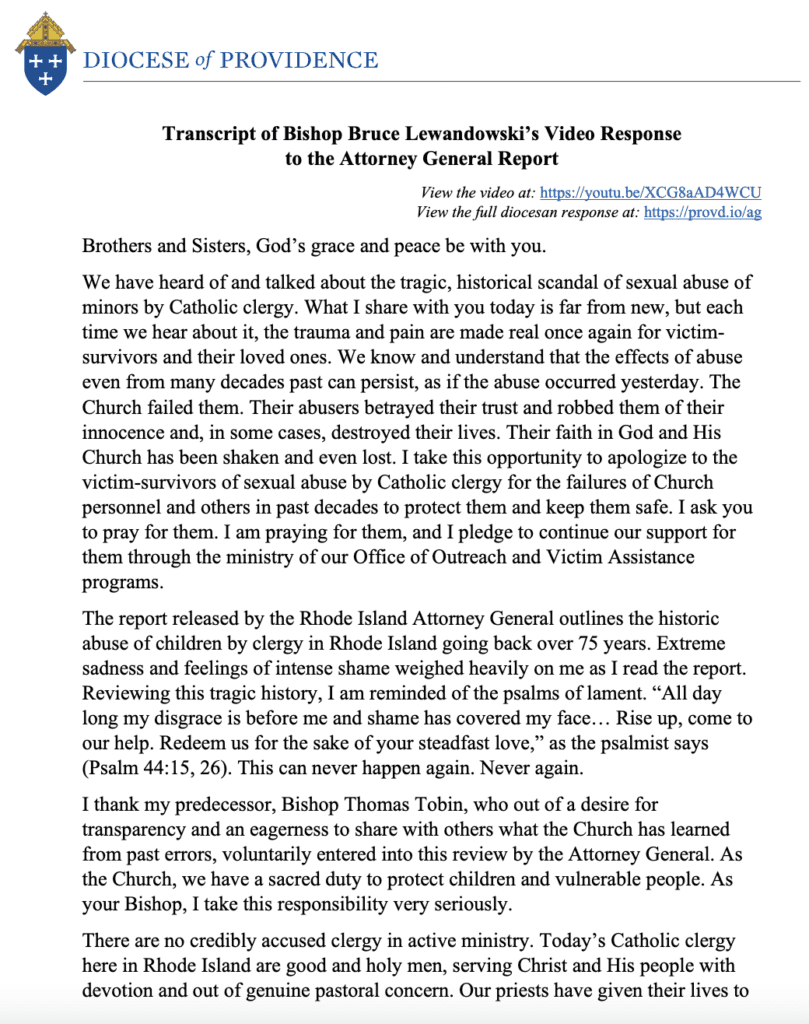
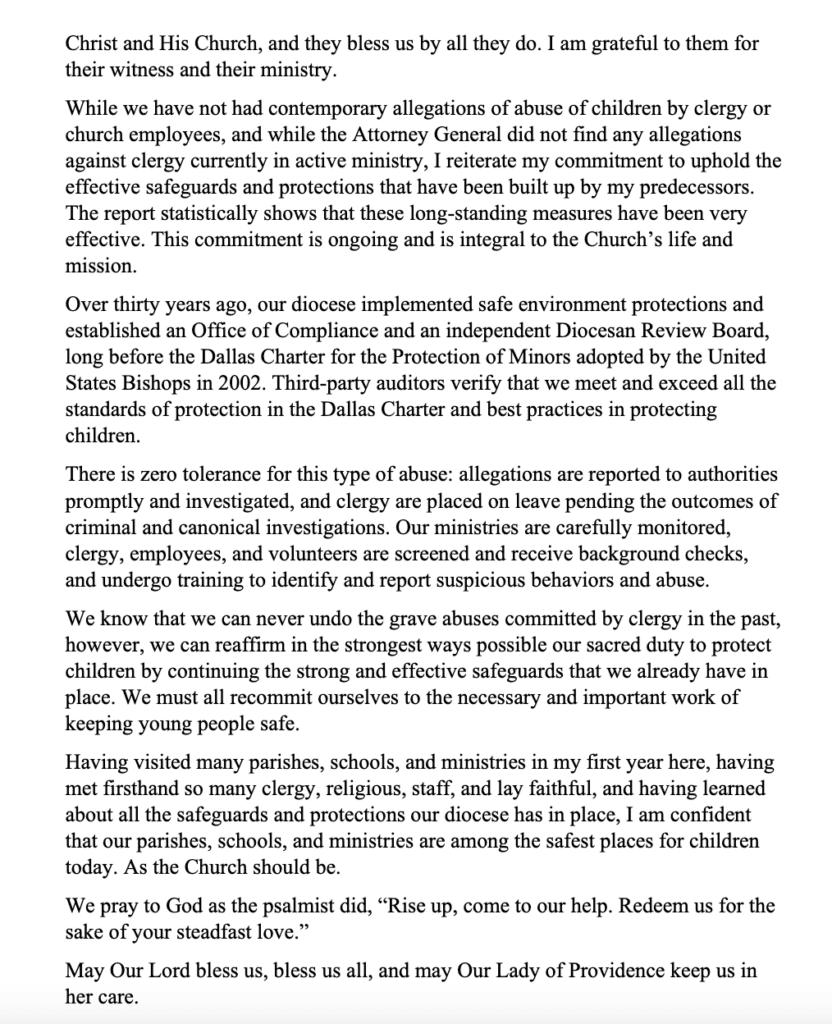
The Diocese responded to the release of the report – below is a transcript and a video message from Bishop Lewandowski follows:
Today’s Standards Cannot Adequately Judge Responses from Forty Years Ago
The Report repeatedly criticizes the diocese’s very early response to the crisis. In doing so, it often applies contemporary standards, practices, and awareness to conduct that occurred nearly a half century ago when the world was very different.
For example, the Report criticizes the diocese’s turning to medical centers for counseling and evaluation of abusive priests, adding ominous quotation marks around terms like “treatment centers” and “cure” and implying that these were disingenuous responses. However, at the time it was not just church leaders who believed that the abusers were afflicted with a serious psychological pathology that could be medically addressed. During that same time period, Rhode Island’s own judges and prosecutors approved and ordered treatment for those subject to criminal prosecution (as in the cases of O’Connell, Silva and Abbruzzese).
One case that highlights this is William O’Connell. In 1986, O’Connell pled no contest to 26 charges of sexually assaulting boys and was sentenced to a year in prison and ordered to undergo two years of psychiatric treatment at St. Luke’s Institution in Maryland — one of the very same institutions the Report denounces. By today’s standards, the sentence seems preposterous, but it was met by the following response from the then Attorney General: “We feel it’s a good sentence because on the one hand he is getting punished, but, on the other hand, he is getting some treatment.” (The Providence Journal, “Fr. O’Connell gets year on sex counts” June 23, 1986).
Times have changed. As the medical community and wider society’s understanding of these issues has grown and matured, so did the diocese’s own responses and understanding. Today’s standards cannot adequately be applied to yesterday’s conduct – yet the Report does so repeatedly to judge the diocese’s response.
More information on the Diocese’s response, program and other information can be reviewed, HERE.