
Subscribe!

Outdoors in RI: Green Bond funds Open Spaces; Forecasting Hurricanes by Studying Waves
$1.23M in Grant Awards to Protect 174 Acres of Open Space

Hicks property, Tiverton. Photo Credit: B. Buckless, DEM
The Rhode Island Department of Environmental Management (DEM) announces $1.23 million in grant awards to help communities and local conservation organizations protect valuable green space throughout the state. Four projects will receive matching grants through DEM’s competitive Local Open Space Grant Program to protect 174 acres across Rhode Island. The funding is made possible by the 2022 Green Bond, which was passed by Rhode Island voters, and invests in preserving open space, improving recreational facilities, and cleaning up lands and waters.
“These grant awards will help preserve natural spaces that are so important for protecting both our environment and local communicates,†said Governor Dan McKee. “Through DEM’s Local Open Space Grant Program, preserving green spaces, ensuring that they continue to provide resiliency and recreational benefits for generations of Rhode Islanders to come.â€
“DEM is proud to invest in communities and conservation organizations leading the charge to make Rhode Island greener, healthier, and more sustainable,†said DEM Director Terry Gray. “These grant awards will open more doors to the outdoors, protect and restore our vital water resources, preserve valuable farmland, and strengthen our ability to withstand the impacts of climate change, helping to ensure a more resilient future for Rhode Island’s communities, economy, and environment.â€
Municipalities, land trusts, and nonprofit land conservation organizations were eligible to apply to the FY 2026 Local Open Space Grant Program in May 2025. Applications were reviewed and ranked by Governor Dan McKee’s Natural Heritage Preservation Advisory Committee, with final awards made by the State Natural Heritage Preservation Commission. Grants of up to $500,000 covering up to 50 percent of project costs support projects that preserve or connect lands with significant natural, ecological or agricultural value.
The four open space grants being awarded include:
Glocester Land Trust – Payton Woodlands: $142,500 grant to acquire 24 acres of forestland abutting the Land Trust’s Steere Hill Conservation Area. The land contains areas of important wetland habitat and high-quality streams together with road frontage that will allow for auxiliary parking to the popular Steere Hill.
Town of Tiverton – Hicks: $500,000 grant to acquire a Conservation Easement over 49 acres of land overlooking Mount Hope Bay in densely developed northern Tiverton. The project will secure the land for public access and will protect a diverse woodland and shoreline.
Audubon Society of Rhode Island – Hunt River South: $200,000 grant to acquire 23 acres of a key riverine habitat corridor and shrub swamp along the Hunt River, linking existing conservation land. Protection of this parcel supports diverse wildlife and provides flood storage and erosion control.
West Greenwich Land Trust – Searle: $391,000 grant to acquire 78-acres of farm and forestland – home to an alfalfa operation on prime farmland soils and upland forest located between Big River and Arcadia Management Areas. The property is located in an important groundwater protection area, and its conservation will help to protect drinking water quality for local residents.
Since 1985, over 13,000 acres of land have been protected through the Local Open Space Grant Program. These natural assets play a big role in the state’s tourism economy by providing opportunities for the public to camp, fish, hunt, hike, and enjoy the great outdoors.
___
Computer simulations show strong ocean currents reduce size of surface waves
URI researchers determine how much hurricane-driven ocean currents modify surface waves and why it happens
Using advanced computer simulations, researchers from the University of Rhode Island’s Graduate School of Oceanography (GSO) have concluded how and why strong ocean currents modify surface waves.
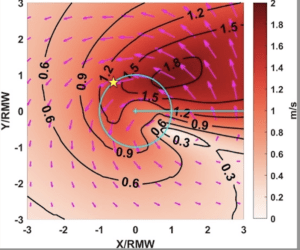
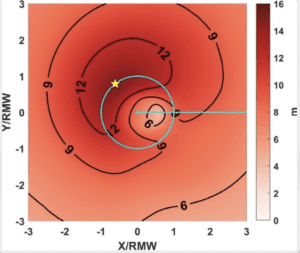
Waves – Using a high-performance computer, the research team generated models to show how storm-driven currents affect wave height and dominant wave period. (URI images courtesy of Isaac Ginis)
Currents – Researchers produced models to show how currents of varying strengths, moving in different directions impact surface waves.
“Our primary finding is that hurricane-generated ocean currents can substantially reduce both the height and the dominant period of hurricane waves,†said Isaac Ginis, URI professor of oceanography. “The magnitude of wave reduction depends strongly on how accurately ocean currents are predicted. This highlights the importance of using fully coupled wave-ocean models when forecasting hurricane waves.â€
Ginis conducted the research with URI Professor Tetsu Hara and Angelos Papandreou, who earned his Ph.D. in oceanography from URI in December 2025. Their results were published in a peer-reviewed article in the Journal of Physical Oceanography in January 2026.
According to Ginis, waves are most strongly reduced by currents on the front right of the storm, where winds, waves and currents are typically strongest.
“On the front-right side of a hurricane, storm-driven currents move in the same direction as the waves,†said Ginis. “This causes the waves to travel more quickly through the high-wind region. Because the waves spend less time being energized by the wind, they do not grow as large as they otherwise would.â€
The team’s computer simulations included hurricanes of different sizes, strengths, and forward speeds. Depending on the hurricane characteristics, the simulations revealed that the maximum significant wave height—the average height of the highest one-third of waves—can be reduced by 0.4-2.2 meters, or roughly 1-7 feet, and the dominant wave period can be shortened by about 0.3-1.5 seconds.
“While wave height often gets the most attention, wave period is also a key factor in determining how waves affect offshore or nearshore structures, such as oil platforms,†said Ginis.
The simulations required a powerful computer, so the researchers remotely accessed URI’s high-performance computing nodes installed at the Massachusetts Green High Performance Computing Center in Holyoke, Massachusetts. URI formed a partnership with the computing center in 2021.
Ginis is hopeful that the team’s research, which was funded by the National Oceanographic Partnership Program/Office of Naval Research, will be adopted by weather services to more accurately predict waves during hurricanes.
The professor will have an opportunity to discuss potential operational implementation of the team’s findings with NOAA scientists and hurricane forecasters at the American Meteorological Society Conference on Hurricanes and Tropical Meteorology in San Diego on March 30.
“This work has strong potential for operational use because we use the same wave and ocean models—WAVEWATCH III and MOM6—that are already part of the National Weather Service’s HAFS hurricane forecast system,†said Ginis. “Our findings could be incorporated without major changes to existing forecasting tools. Our group has a long history of working with NOAA scientists, and results from our previous studies have already been implemented in operational hurricane models.â€
___