
Subscribe!
House Lawmakers Must Not View Aging as a Partisan Issue – Herb Weiss
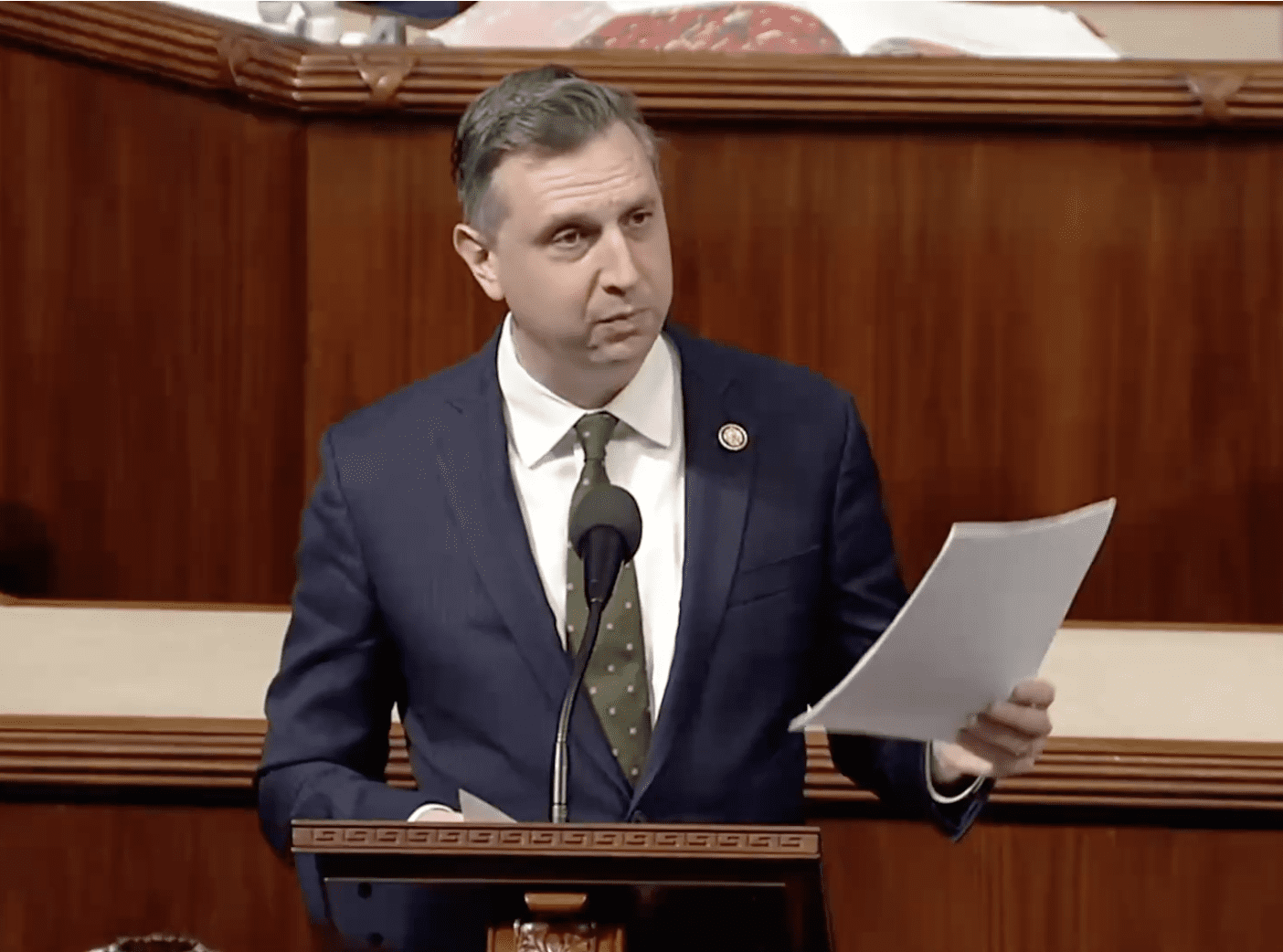
Photo, top: Rep. Seth Magaziner holding up RINewsToday article by Herb Weiss on reestablishing the House Select Committee on Aging – and entering it into the US Congressional Record
By Herb Weiss, contributing writer on aging issues
The Leadership Council of Aging Organizations (LCAO), representing 69 national groups dedicated to the well-being of seniors, is urging Congress to support H. Res. 1013, a bipartisan resolution introduced by Reps. Seth Magaziner (D-RI) and Maria Elvira Salazar (R-FL), which would reestablish the Permanent House Select Committee on Aging (HSCoA). Reestablishing this committee strengthens House congressional oversight, crucial for meeting the needs of a growing older population.
The original HSCoA served as the House’s investigative panel to spotlight aging issues until 1993, when it was dismantled at the end of the 102nd Congress as part of a budget reduction that cut $1.5 million in funding. From 1974 to 1993, the committee fostered bipartisan collaboration to address a myriad of issues affecting older Americans, expanding its membership from 35 to 65 as its political influence grew. While the House allowed its committee to expire over 30 years ago, the U.S. Senate continues to operate a Special Committee on Aging.
Today’s aging policy challenges now demand bipartisan solutions and comprehensive, coordinated action. The reestablishment of the HSCoA is a necessary, nonpartisan step to addressing these urgent policy needs.
Working Closely with Standing Committees
“Jurisdiction over many programs affecting seniors is spread across multiple standing committees, making it difficult to fully address problems that do not fit neatly into one category,” said Max Richtman, president of the National Committee to Preserve Social Security and Medicare and chair of LCAO. “The nation faces intergenerational challenges, including increasing strain on family caregivers and a persistent retirement security crisis, which demand forward-looking solutions. A select committee with broad jurisdiction is uniquely positioned to address these issues.”
In a March 16 LCAO endorsement letter, Richtman emphasized that a reestablished committee would be active and engaged—holding field hearings, convening teleconferences, and incorporating community perspectives directly into policymaking.
Support from LCAO’s member organizations underscores that the passage of H. Res. 1013 is a national priority, not a narrow concern. As Richtman noted, the nation’s largest aging coalition is calling for the immediate reinstatement of the House Aging Committee.
Reestablishing the committee would also restore balance to Congress’s approach to aging policy, notes LCAO’s endorsement letter. In recent years, the Senate’s Special Committee on Aging has played a vital bipartisan role in highlighting issues such as elder abuse, scams and fraud, high prescription drug costs, the impact of COVID-19, financial pressures on retirees, and the growing crisis of social isolation. The House lacks a comparable legislative panel—an absence that becomes more significant as the population continues to age.
Without a dedicated body to examine the full scope of aging policy, critical issues risk fragmentation, oversight gaps, and delays. In the past, HSCoA hearings provided a forum for bipartisan debate and dialogue, helping bridge philosophical political divides and enabling standing committees to advance informed legislative solutions.
On January 21, 2026, lawmakers introduced H. Res. 1013 and referred it to the House Rules Committee. As of this writing, the resolution remains in committee, awaiting hearings, markup, or a floor vote.
“It is too hard to be a senior in the United States, and Congress has a responsibility to do more for today’s growing population of older Americans and future generations,” said Rep. Magaziner, the bill’s primary sponsor. “Reestablishing the Select Committee on Aging would create a dedicated forum to address these challenges and help ensure Americans can retire with dignity.”
“America’s seniors built this country, and they deserve more than gratitude—they deserve action,” added Rep. Salazar, an original cosponsor. “From rising health care costs to housing and long-term care, their challenges are too important to be buried in bureaucracy. This committee would provide focus, coordination, and accountability, and deliver meaningful solutions so seniors can live with security and purpose.”
As a cosponsor, Rep. Gabe Amo (D-RI) supports bringing back the HSCoA. “With rising costs, threats to Medicare, Medicaid, and Social Security, and scams targeting older Rhode Islanders, it is essential that we deliver real solutions for America’s seniors,” says Amo.
As Co-Chair of the Stop Scams Caucus, Rep. Amo introduced the STOP Scams Against Seniors Act to ensure investigators have the resources needed to protect seniors from losing their life savings and to help them retire with dignity. “I supported reestablishing this committee in the 118th Congress, and I remain committed to elevating the voices of seniors in the legislative process,” he says.
Can a Bipartisan Proposal Pass in a Divided House?
“AARP supports exploring the restoration of a House Aging Committee to help encourage bipartisan dialogue and elevate issues important to older adults,” said Debra Whitman, AARP’s chief public policy officer.
AARP Board Member Bob Blancato, former staff director of the House Subcommittee on Human Services, highlighted the strategic importance of AARP’s backing. “AARP’s support gives bipartisan weight to the resolution and can motivate lawmakers across the aisle to consider it,” he said.
Blancato called restoring the committee a “sound policy decision,” noting that the growth of the older population makes action urgent. “The sheer increase in the number of older adults since 1993 is reason enough,” he said, pointing out that the oldest baby boomers are now turning 80. “President Donald Trump, the oldest sitting president in U.S. history, turns 80 on June 14, 2026,” he added.
He also noted that a single vote in 1993 eliminated HSCoA and several other committees as part of an effort led by House Democratic leadership to reduce government spending. Blancato suggested the resolution could pass in today’s Republican-controlled House if lawmakers see it as politically advantageous, adding that Rep. Salazar, a Republican, could play a key role in building support.
Still, Blancato acknowledged uncertainty about how effective a modern version of the committee might be. “It’s a dicey question—it depends on the issues they take on,” he said. However, he emphasized that a reestablished committee could play a crucial role by holding hearings on Social Security reform proposals from both parties.
Rep. Magaziner’s effort to secure a Republican cosponsor reflects the kind of thoughtful, collaborative leadership our country needs—especially as America’s older adult population continues to grow at an unprecedented rate, says aging advocate Vincent Marzullo, a former federal civil rights and social justice administrator. “By working across party lines, he is helping to refocus national attention on a myriad of pressing challenges facing older Americans,” he says.
“Rep. Magaziner’s bipartisan initiative also underscores a shared commitment to dignity, respect, and opportunity for seniors, adds Marzullo, who serves on the Congressman’s senior advisory council, calling a bipartisan approach a constructive path to addressing the needs of aging communities nationwide.
Robert Weiner, former chief of staff of the HSCoA under the late Chairman Claude Pepper (D-FL), now director of an ongoing op-ed writing group recruiting young journalists, which won the National Press Club President’s Award, noted that similar resolutions have been introduced in six previous congressional sessions. He said bipartisan support—including from Rep. Salazar, a member of the House Problem Solvers Caucus—could improve the resolution’s chances for passage.
However, Weiner argued that attracting Republican cosponsors should not be difficult. “Historically, Republicans have received strong support from older voters,” he said. “Bipartisan sponsorship should help overcome partisan resistance,” he believes.
Given that Rep. Salazar is a Republican member of the bipartisan Problem Solvers Caucus, Weiner agrees that it is now time to urge the Problem Solvers Caucus to endorse and become cosponsors of H. Res. 1013. “The Aging Committee has always been bipartisan, with House leaders including not only Pepper and Ed Roybal (D-CA) as chairs, but supportive ranking minority members, including then House members — later Senators — Charles Grassley (R-IA), William Cohen (R-ME), and John Heinz (R-PA),” notes Weiner. He added that the passage could depend on political timing. “It can and should be a shared victory,” Weiner said. “If not this year, then next year.”
A Call for Support
It is time for the Tallahassee, Florida–based Claude Pepper Foundation to step forward and formally endorse H. Res. 1013. The Foundation’s mission—to advance the ideas, values, and public policy legacy of the late Sen. Pepper, ensuring they remain part of contemporary American discourse—aligns directly with the purpose of this bipartisan resolution.
At its core, the Foundation educates federal and state policymakers and advocates for initiatives that enhance the quality of life for all Americans. H. Res. 1013 embodies that commitment. Endorsing this measure would not only honor Sen. Pepper’s legacy but also reinforce the Foundation’s leadership in shaping policies that address the needs of a growing aging population.
The bipartisan Problem Solvers Caucus, established in January 2017 as an outgrowth of the No Labels organization, was created to foster cooperation across party lines on key policy issues. Nearly evenly divided between Democrats and Republicans, the caucus has demonstrated that consensus-driven policymaking is both possible and necessary.
During the 119th Congress, the Problem Solvers Caucus endorsed 12 legislative proposals. Notably, however, none directly addressed aging programs or services. As an original cosponsor of H. Res. 1013, Rep. Salazar is well-positioned to urge the caucus’s co-chairs—Representatives Brian K. Fitzpatrick (R-PA) and Tom Suozzi (D-NY)—along with their colleagues, to make this resolution their 13th endorsed proposal.
Addressing the needs of older Americans should never be viewed as a partisan issue. Reestablishing the House Select Committee on Aging is a practical, bipartisan step that lawmakers from both parties can and should strongly support.
Restoring the committee is essential—not only to revive a once-vital congressional institution, but also to ensure that today’s Congress is now equipped to meet the evolving needs of the nation’s rapidly aging population.
LCAO member organizations endorsing H. Res. 1013 include AARP, AARP, Justice in Aging, CWI Works, Inc., Alzheimer’s Association, Village to Village Network, Gerontological Society of America, Network of Jewish Human Service Agencies, Meals on Wheels America, International Association for Indigenous Aging, APWU, Retirees Department, Service Employees International Union (SEIU), PHI, LeadingAge, Aging Life Care Association, National Adult Day Services Association (NADSA), Post Acute and Long Term Care Medical Association, National Academy of Elder Law Attorneys (NAELA), National Committee to Preserve Social Security and Medicare (NCPSSM), National Council on Aging, USAging, Mairead Painter, CT State Long Term Care Ombudsman, National Adult Protective Services; and National Association of Nutrition and Aging Services Programs (NANASP), among others.
_
Read the full resolution here https://www.congress.gov/bill/119th-congress/house-resolution/1013/text
Rep. Magaziner’s one-minute floor statement calling for the passage of H. Res. 1013 – see it here: https://youtube.com/watch?v=IygZGcwnFPg&si=MLAAdY6QctiXd1TF
To read LCAO’s endorsement of H. Res. 1013, go to https://www.lcao.org/wp-content/uploads/2026/03/LCAO-Chairs-Letter-Endorsing-H.-Res.-1013.pdf.
___
To read more articles by Herb Weiss, go to: https://2×8.ea2.myftpupload.com/herb-weiss/

Herb Weiss, LRI, 12, is a Pawtucket-based writer who has covered aging, healthcare, and medical issues for more than 45 years. To purchase his books, Taking Charge: Collected Stories on Aging Boldly and its two sequels, visit herbweiss.com.
