Subscribe!
Homeless in RI: Woonsocket Task Force Releases Update on Housing and Homelessness – Steve Ahlquist
This article is reprinted with approval as joint members of the RI News Collaborative (RINC.news)
by Steve Ahlquist, SteveAhlquist.news, SubStack
“Two years ago, we laid out a plan,” said Margaux Morisseau, “Today, we can show that progress is possible when a community decides to work together, and why we cannot stop now.”

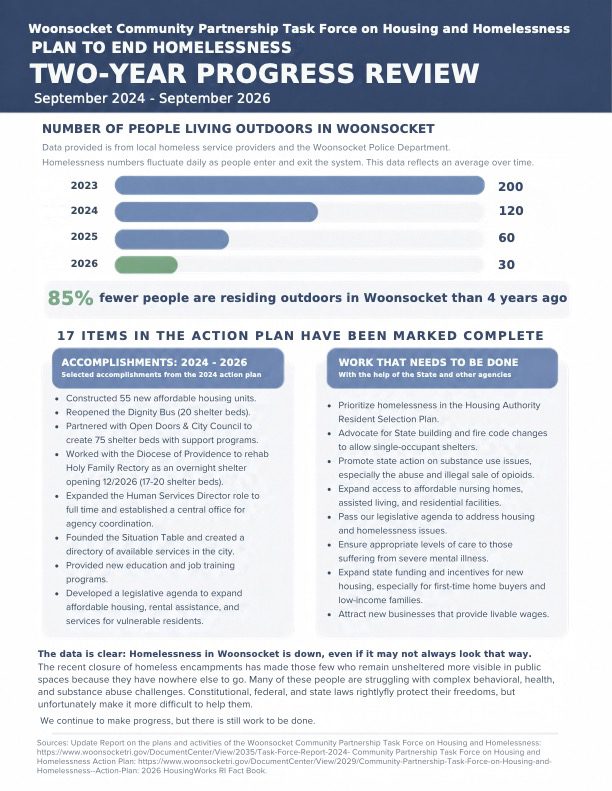
The Woonsocket Community Task Force on Housing and Homelessness released its update on the state of homelessness in the city at a Tuesday press conference. When the plan was unveiled two years ago, I called it “terrific.” Two years later, the results show the Task Force’s policies are working, with an 85% decrease in the number of unsheltered people in the city.
Here’s the video:
“Two years ago, the Community Partnership Task Force on Housing and Homelessness released a report that took an honest look at housing and homelessness in our city,” said Margaux Morisseau, Director of Woonsocket’s Department of Human Services and Task Force co-chair. “We didn’t just document the problem. We developed an action plan and committed to act.
“Today we are here to answer three simple questions. What have we done? Has it made a difference? And what do we still need to do? I am proud to say that the work has made a difference. Over the past two years, Woonsocket has built a much stronger and more coordinated response to homelessness. City government, police, housing and shelter providers, behavioral health organizations, outreach workers, and community partners are communicating and working together in ways that simply were not happening before. And the numbers reflect that work. But I want to be very clear: Progress does not mean the problem is solved.
“There are people still sleeping outside in our city; there are families struggling to afford their rent; there are homeowners barely keeping up with their mortgages; and there are people facing mental health challenges, substance use, domestic violence, and other crises that make the path to stable housing incredibly difficult. We also know that homelessness can sometimes look more visible even while the numbers are going down. With the closure of encampments, people who remain unsheltered are no longer concentrated in faraway locations. They are more visible throughout our community. That visibility matters, but so do the facts, and today is an opportunity to talk about both.
“This is not a victory lap; it’s a progress report. This work is about people and helping someone move from street to shelter, from shelter to stability, and from stability to a permanent place to call home. Two years ago, we laid out a plan. Today, we can show that progress is possible when a community decides to work together, and why we cannot stop now.”
The report estimated that with a median income of about $49,000 – far less for renters – the lack of housing stock and the spiking costs of rent and homeownership left more than half the city’s population struggling to make ends meet. Many of these people, unable to pay their rent, were evicted, while others suffered from various mental disorders and/or substance use issues and a shortage of treatment options.
“Two years ago, we gathered together to present our task force report on housing and homelessness in our city. My role this afternoon is to provide you with an updated snapshot of what that situation looks like today,” said Task Force co-chair Bruce Daigle.
“Let’s start with the good news. 85% fewer people are unsheltered in Woonsocket than four years ago. According to the Woonsocket Police Department and the logs of local service providers who have long worked directly with people experiencing homelessness, the city has reduced the number of unsheltered homeless by about 85% since 2023. (These numbers are averages over time, rounded up to the nearest 10, as the homeless population is not static and these numbers are always changing.)
“This reduction of homelessness in the city hasn’t happened by accident. City leaders and others have worked with the task force and each other to accomplish a host of initiatives that together have made a real difference. For those unfamiliar with the Situation Table, it is a weekly meeting of social service, public safety, and housing professionals who strategize solutions for those in our community facing the most serious circumstances.
“Note that NeighborWorks Blackstone River Valley added another 55 affordable units this year in its Millrace District apartments by Market Square. This adds to the already high concentration of affordable and subsidized housing in our city.
“Woonsocket already ranks third of only eight cities and towns in Rhode Island that meet the state’s mandate that each community makes 10% of its housing stock affordable. Our city’s current rate of 17% is 70% above that mandate. Only one other northern Rhode Island community has met this target. [Burrillville] We’ve made meaningful progress in helping those without shelter in our community, and we’re focused on those who remain unsheltered. But we’re also painfully aware that too many people are tenuously housed and face one or more circumstances that can instantly land them on the street.
“There’s a national consensus that a lack of affordable housing is at the top of that list. This is best viewed as two separate but related issues: renting and ownership. The median income for Woonsocket residents who rent is much lower than what’s needed to rent an average-priced two-bedroom apartment. About half of all renters in the city are cost-burdened, meaning they pay more than 30% of their gross annual income in rent. Only one in four can afford rent without cutting other essential needs.
“A lack of affordable housing for purchase is the other side of this coin. Less than one in five city residents earns enough to purchase an average-priced home in Woonsocket, but that’s only part of the problem. There’s a widespread misperception that someone who owns their own home is secure from the prospect of homelessness. This isn’t true. More than one quarter of city residents who live in their own home are cost-burdened by mortgages they can’t afford, which can lead to foreclosure.
“There are other factors at work that contribute to homelessness in our community and elsewhere, because I want to remind everyone that this is a nationwide problem. We’re not just dealing with this in Woonsocket. This is happening throughout Rhode Island and across the country. Mental health and substance use issues are major contributing factors to this problem. And there’s overlap. Some struggle with both conditions, but it’s very important to note that these problems are as much a result of being homeless as they are a cause.
“Of the other contributing factors, Woonsocket has among the highest rates of domestic violence, opioid addiction, and child abuse in the state. More of our residents have been directly impacted by federal cuts in relief and assistance programs than almost anywhere else in Rhode Island. Because of these pressures on our city residents, we have much work to do if we are to resolve this issue in our time. We look forward to new opportunities to partner with state leaders, many of whom will be new to the scene.”
Since the release of the initial report, city officials have taken several steps to help improve the situation, including the establishment of a Situation Table and a ‘Housing Helpers’ program, the addition of job training and support programs, the opening of a new 75-bed shelter with support services, the re-opening of several overnight shelters, and the creation of a resource directory for residents. At the Task Force’s invitation, the Diocese of Providence plans to open an additional 20-bed overnight shelter beginning in December. The City Council passed an ordinance in May 2025 making the city’s homeless encampments illegal but giving the mayor some latitude as to when and how to close the camps, which he eventually did.

“You know the adage, ‘There’s no ‘I’ in team.’ That’s truly apt for this situation because Woonsocket can’t do it by itself, and you can’t do it yourselves,” said Woonsocket Mayor Christopher Beauchamp. “Through cooperation and coordination, we can solve things. I can’t say how thankful and appreciative we are that the community task force put together by Councilwoman Valerie Gonzalez, Margaux Morisseau, and all the community partners here came together. I’d like to recognize Council President Daniel Gendron and the city council for being instrumental in making sure this continues.
“Our next governor, Helena Foulkes, is here because we have to work together as a city and a state at the state house. We have to work together to solve, or to at least attempt to solve these problems, because again, we are not going to solve homelessness overnight. We’ve seen a dramatic decrease in people living outside. I’ve gone to many encampments; I’ve helped; I’ve cleaned; I’ve talked to people, and that’s what it’s about for me: talking to people, understanding their situation, and directing them to where they need help. And the Situation Table that Margaux mentioned was a great asset in solving some of these problems.”
“We’ve done a lot of good things; we still have a lot to do, but we’ll keep working hard. We’re going to keep working hard in Woonsocket because we need to make this a place people want to come to. We have the highest poverty level and domestic violence. We have a lot of things that still bog us down. But by working together, we can get people where they need to be. That’s my goal, and I the state will be there to help us.”

“I’m really impressed, and I know this is not a celebration because there are too many challenges to solve, but you should feel very proud of the progress,” said Helena Foulkes, Democratic nominee for Governor of Rhode Island. “The idea that you have an 85% reduction in folks living outside is something I would hope for the whole state. I’ve been a member of the Crossroads board for the last four years, trying to get their perspective on how we serve people who are without housing.
“There are so many big issues connected to it, like housing costs. But to Bruce’s point, even for someone who has a home [there is no certainty.] By the way, there’s not a single city or town where a family making $100,000 could afford to buy a home. I’ve learned at Crossroads that one of the best ways we keep people out of homelessness is making sure sometimes it’s as simple as a month or two of rent relief that can really make a big difference. So how do we learn from all of you? I’m eager to learn from all of you: how can I learn from you to bring some of these best practices across the state? I really love the collaboration that you’ve got going. I’ve also been serving breakfast for a while at Mathewson Street Church in Providence, and I’ve been so impressed with the people who show up every week and every day.
“And I can tell all of you in this room have that spirit very much. So thank you. For what you’ve done, and what I would just commit to is that I think what’s beautiful about this too is that I bring today a sense of feeling inspired by all of you, a sense that I want to bring some of what you’ve done to other cities and towns that care, but also maybe bring some of you together to learn from each other. The situation table is a spectacular example, and I think it’s exciting for me that Woonsocket could be a leader in this space.
“I know you all care very deeply. So I’m truly just honored to be with all of you today. And I do hope to be the future governor. I hope to be a real partner with you on all this work.”
“Conservatively, 20% or greater of the unhoused population struggle with major health concerns, serious mental illness, and substance use addiction,” added Ben Lessing, Community Care Alliance President and CEO. “Rhode Island needs a broader array of resources, including accessible assisted living, nursing homes, specialized behavioral health shelters, respite programs, and group care. Rhode Island does not have a functioning State Hospital with rehabilitative services, nor the ability to develop the necessary supported housing. Until State government removes the obstacles and silos between its own state agencies and community providers to create viable solutions, we will not fully address the needs of the unhoused population.”