| The Rhode Island Public Expenditure Council (RIPEC) released a report finding that while the state spends heavily on the construction of major public surface transportation infrastructure, a heavy focus on bridges has left Rhode Island with high debt burdens, underfunded routine maintenance, and non-interstate secondary roads that rank worst in the nation.
Rhode Island’s transportation priorities over the past decade were largely shaped by the RhodeWorks initiative, which committed substantial capital resources to bridge reconstruction and address conditions that were the worst in the country and subject to federal penalties.
“The RhodeWorks program was successful in reducing the number of bridges rated in poor condition by nearly half,” said RIPEC President & CEO Michael DiBiase. “However, this focus came with significant trade-offs—more debt, less funding for roads and maintenance, and arterial state roads ranked worst in the country.”
The report notes that Rhode Island’s financing model has become increasingly strained due in part to high borrowing costs and the 2022 court ruling invalidating commercial truck tolls. Replacement of the Washington Bridge—now estimated to cost $572.1 million—places further pressure on transportation financing. While the state utilized one-time general revenue and capital transfers to meet federal matching requirements in recent years, there is a $279 million projected shortfall in state revenues required to access future federal funding.
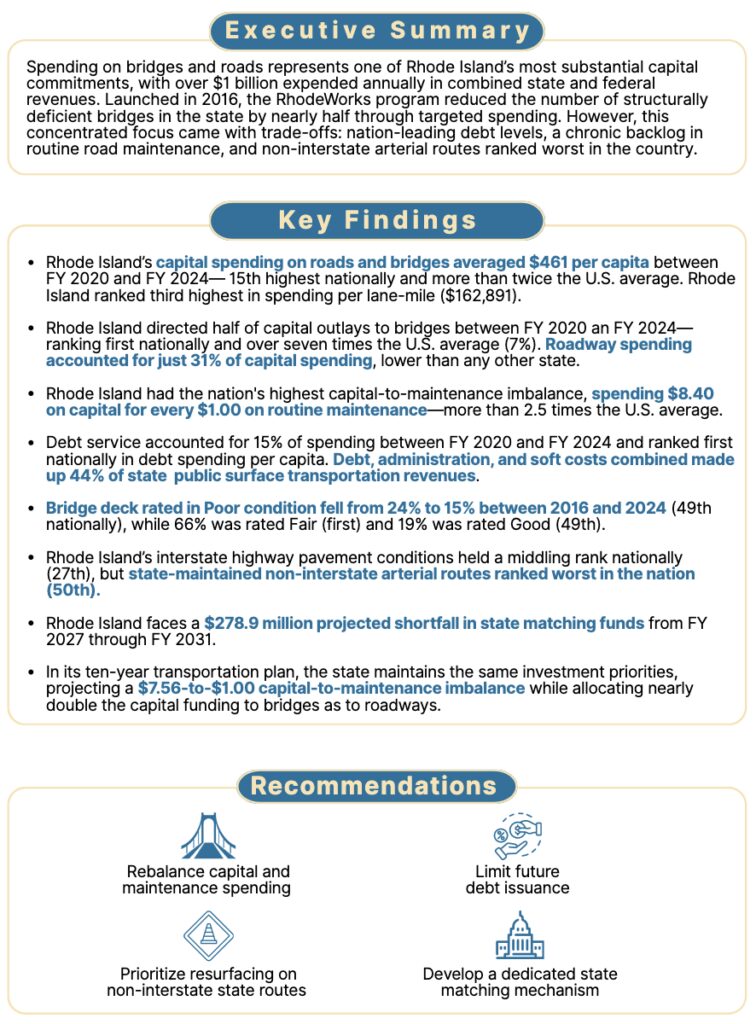
“Rhode Island should pursue a more balanced approach to its transportation investments going forward: less reliance on debt, more dedicated state revenues, and more investments in roads,” said DiBiase. “Currently, debt service, administration, and soft costs make up 44 percent of state-generated transportation revenues, leaving fewer resources for on-the-ground road and bridge work.”
RIPEC’s report found that state spending has been dominated by large-scale replacement projects rather than routine maintenance like pavement resurfacing, crack sealing, and drainage clearing—a pattern that Rhode Island’s ten-year transportation plan is set to continue.
“Routine maintenance has to become a much higher priority,” DiBiase added. “While the state has focused heavily on major capital construction, it needs to do a far better job of preserving and maintaining these assets once built.” |