
Subscribe!
Ask Chef Walter: The Golden Legacy of Quince – Walter Potenza
by Chef Walter Potenza, contributing writer
Every autumn, when I smell quince being gently cooked, I am once more that young man in an Italian kitchen, observing how patience and tradition turn gold into something that feeds the soul.
Friends:
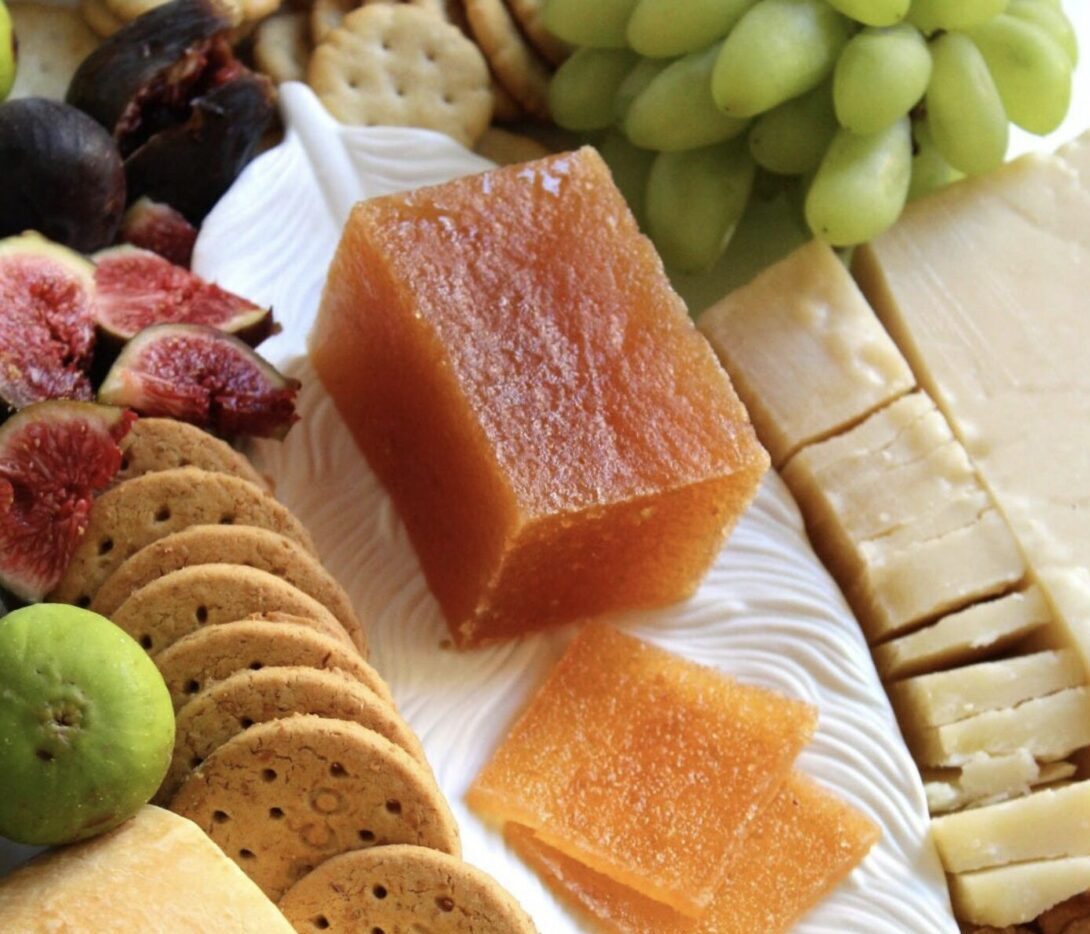
When I was a young man in Italy, I often stood in our kitchen and watched my mother turn hard, fragrant quinces into a deep amber paste. My grandparents grew quinces on several sections of the family land, mostly to feed the pigs and for their nourishment. Mamma would peel and remove the cores from the golden fruits, then simmer them before cooking the puree with sugar until it thickened into cotognata—firm enough to cut and ideal for serving alone, with sharp cheeses, or spread thickly on warm bread at breakfast. The whole house was filled with that fragrance, a mixture of apple, pear, and something flowery and musky that still brings me back to those autumn days. This simple routine linked our family meals to centuries of Mediterranean tradition.
Quince, known as Cydonia oblonga, is the only species in its genus within the Rosaceae family, which also includes apples and pears. It is a small deciduous tree or large shrub, generally growing to 12 to 15 feet, with crooked branches, ovate leaves usually grey hairy on the underside, and single white to pink flowers that appear at the end of spring. The fruit is a pome—firm and either pear- or apple-shaped —initially covered with a soft grey down that rubs off as it matures to a bright golden yellow. In most cases, the fruit stays hard, astringent, and too sour to eat raw, but when cooked, the flesh softens, gives off a strong aroma, and the pale interior often turns a beautiful pink or rosyr ed due to natural pigments. Due to its high natural pectin content, quince is well-suited for making jams, jellies, and firm pastes.
Quince was native to the area extending from the Caucasus through Iran and into Central Asia, where it was among the first fruits to be cultivated. About 5,000 to 3,000 years ago, Neolithic farmers propagated it from its place of origin. It made its way to the eastern Mediterranean early on and became an important part of both Greek and Roman culture. The name comes from the ancient city of Cydonia (now known as Chania) on Crete, where a particularly good variety was grown; the Romans called it the Cydonian apple. In Greek mythology, the fruit was associated with Aphrodite, the goddess of love, and served as a symbol of fertility and happiness—often given to brides. Some scholars believe references to “golden apples” in classical literature and certain biblical passages originally referred to quince rather than the apple we know today.
Charlemagne had quince trees planted in the royal orchards, and by the end of the 13th century, Edward I was growing them at the Tower of London. European colonists later brought the tree to the Americas, where it once flourished in almost every homestead garden because of its fruit and the valuable pectin it contained.
Quince is still highly valued in the Mediterranean region, the Middle East, Latin America, and certain areas of Central Asia, even though it is less common in many markets in Northern Europe and North America. In cooking, it is almost always prepared by cooking the fruit: poaching it in syrup, roasting it with meat, baking it into tarts, or making it into preserves. The classic Spanish dulce de membrillo, the Portuguese marmelada (the authentic “marmalade”), the French pâte de coing, and the Italian cotognata are all examples of the firm quince paste my mother made. This paste pairs well with aged cheeses—Manchego being the traditional choice in Spain—while thinner jams and jellies brighten breakfast tables. Its fruit also appears in savory meals, stewed with lamb or goat, and its seeds and leaves have long been used in traditional herbal medicine for their tranquilizing qualities.
In America, quince is like a quiet outsider. It used to be a common sight in colonial orchards and in the gardens of nineteenth-century homesteads—planted for the fragrance it gave off —and has since mostly disappeared from everyday life. Today the vast majority of Americans have never even held a quince, let alone cooked one. The fruit is only available for a short time in the autumn in specialty shops or at farmers’ markets, if at all, and commercial production has now been reduced to almost nothing. The trees that remain are generally grown not to produce fruit, but as dwarfing rootstock for pears. Imports come in only in small amounts, mostly from Chile, sufficient to meet the needs of a small group of enthusiasts but by no means enough to appear on ordinary dining tables.
However, it has not completely disappeared. People from Mediterranean, Latin American, and Middle Eastern communities still look for it, passing on the same traditions I remember—such as the slow process of turning it into membrillo or cotognata, serving it with cheese, and spreading it on warm bread. Sometimes food writers and small-scale producers talk about a possible revival of quince, drawn by its incredibly pleasant smell and the way its hard, astringent flesh becomes rosy and fragrant when heated. Specialty farms in places such as Oregon send fruit and paste throughout the country, prompting curious cooks to try a flavor most of their neighbors have never experienced.
Around this time of the year, I often make cotognata as soon as a quince appears in the markets. I place the finished product in small glass jars and give them to friends and a chef colleague. I still experience the same feeling of belonging that spans time and continents. Although the fruit no longer has the everyday role it once did, those who know it still get the same reward: patience is rewarded with fragrance, color, and a deep, long-lasting sweetness that seems older than any one kitchen or country.
If you have never had a quince, don’t be intimidated—try the recipe below. It is simple to make and bring that new memory directly to the table, yielding a firm, sliceable block that keeps in the refrigerator for many months.
Quince Paste (Cotognata / Membrillo in Spain)
Serves as an accompaniment for many and yields about 2- 3 pounds.
Ingredients
3½ pounds ripe quinces
Water (enough to cover)
3–4 cups granulated sugar (or an equal amount to the cooked puree)
Juice of 1–2 lemons
Method
Clean the quinces well and rub off any remaining fuzz. Cut them into quarters (you don’t need to peel them; the skins add color and pectin). Put the fruit in a large, heavy pot, cover with water, and bring to a simmer. Cook until very soft, which takes 45 minutes to 1½ hours depending on size and ripeness. Drain the fruit and, if you wish, keep some of the liquid. Pass the soft fruit through a food mill or puree it in a food processor until smooth, removing the cores and any tough bits.
Weigh the puree and return it to the clean pot. Add sugar equal in weight to the puree (or start with 3 to 4 cups and adjust as needed), along with the lemon juice. Cook the mixture over medium-low heat, stirring frequently at first and then almost continuously afterward, until it thickens considerably, turns a deep rose-orange or amber, and a wooden spoon leaves a clear mark on the bottom of the pot—this usually takes 1 to 2 hours. Pour the mixture into a shallow pan or mold lined with parchment paper, smooth the surface, and allow it to cool completely. For a firmer set, dry it further in a very low oven (about 150°F / 65°C) for an hour or so, or leave it uncovered in a cool place for a day or two. Then slice it and serve with cheese or spread it on toast.
The change is nearly magical: a tough, unimpressive fruit becomes rich, fragrant, and long-lasting. Every autumn, when I smell quince being gently cooked, I am once more that young man in an Italian kitchen, observing how patience and tradition turn gold into something that feeds both the body and the memory. Although quince can never return to the everyday place it once held, it still offers those who seek it a direct, delicious connection to the orchards of ancient times and the quiet kitchens where families still hold its secrets.
https://flavorsandknowledge.substack.com/
___
EAD “Ask Chef Walter” every Sunday in RINewsToday

Master Chef Walter Potenza
There is a constant, recognizable thread in the career of Walter Potenza to elevate the level of Italian culinary culture in the United States. Besides his unquestionable culinary talent and winning business perspective, Chef Walter has been a relentless educator with passion and knowledge who defeats stereotypes. His life, career, and values are a model, an example to follow by any chef of Italian gastronomy working outside Italy.
Chef Walter appears regularly on National and International Networks such as Food Network, ABC, CBS, NBC, RAI, FOX, and Publications such as NY. Times, Washington Post, Wall Street Journal, Food & Wine, Saveur, Gourmet, and several Italian media outlets.