
Subscribe!

Give $500. Get $500 Federal Tax Credit. Why Hasn’t Rhode Island Joined?
A new federal program will allow people to donate toward children’s education and receive a matching reduction in their federal income taxes.
It could help pay for school supplies, tutoring, transportation, school-provided after-school programs or private-school tuition. Children attending public, private and religious schools can benefit.
The Federal Scholarship Tax Credit begins January 1, 2027.
But states must choose to participate—and Rhode Island is not on the IRS’s latest posted participation list. Neither is Massachusetts.
_
First, a simple example
You donate $500 to an approved scholarship organization. You could receive a $500 credit against your federal income taxes.
If your federal income tax for the year would otherwise be $3,000, the credit reduces it to $2,500.
This is a tax credit, which reduces taxes dollar for dollar. A deduction only reduces the income you are taxed on.
The maximum annual credit is $1,700. You must have sufficient federal income tax liability to use it; unused credit can carry forward for up to five years.
Who gets your donation?
Your donation goes to an approved nonprofit called a scholarship granting organization. It pools donations, reviews families’ applications and awards scholarships.
The organization must spend at least 90% of its income on scholarships. You cannot direct your donation to your own child, grandchild or another particular student. An ordinary donation directly to a school does not automatically qualify.
What could a scholarship pay for?
The law includes:
- School tuition and fees.
- Books, supplies and equipment.
- Academic tutoring.
- Special-needs services.
- School-required or school-provided uniforms and transportation.
- School-required or school-provided extended-day programs.
- Computers and internet access, subject to specific requirements.
These expenses must meet the law’s conditions. For example, a school’s own after-school program can fall within the extended-day category; that does not mean every outside childcare arrangement qualifies.
So a public-school child could receive help?
Yes. A scholarship could help an eligible public-school student with qualifying supplies or tutoring expenses.
Likewise, a child attending a religious elementary school could receive help with a qualifying school-provided after-school program.
The scholarship benefits the student, but that does not necessarily mean the family receives a check. Payment arrangements would depend on the program’s rules and the scholarship organization.
Who qualifies?
Students must come from households earning no more than three times their area’s median income. This reaches beyond low-income households to include many middle-income families.
Families apply for scholarships. They do not have to donate to receive assistance. The $1,700 limit applies to the donor’s annual tax credit, not the amount each child can receive.
Why hasn’t Rhode Island joined?
Governor Dan McKee has expressed concern about the program’s support for private-school tuition.
In June, he signed legislation requiring both the General Assembly and governor to approve Rhode Island’s participation. He indicated he would consider participation under limited circumstances supporting services such as tutoring, transportation and educational technology without supporting private-school tuition or voucher-style programs.
That is the central disagreement: the federal program permits help for public-school students, but it also permits private-school tuition.
Opponents, including NEARI, argue that the program would subsidize private schools with fewer public accountability requirements. Supporters argue that states should accept an opportunity to help families with education expenses, including those whose children remain in public school.
And – Massachusetts?
On August 21, Gov. Healey said she was awaiting further federal guidance before reviewing participation. However, the Massachusetts Budget and Policy Center has urged rejection, arguing that the program would disproportionately benefit private schools and higher-income families and divert administrative resources from public education.
Where does participation stand?
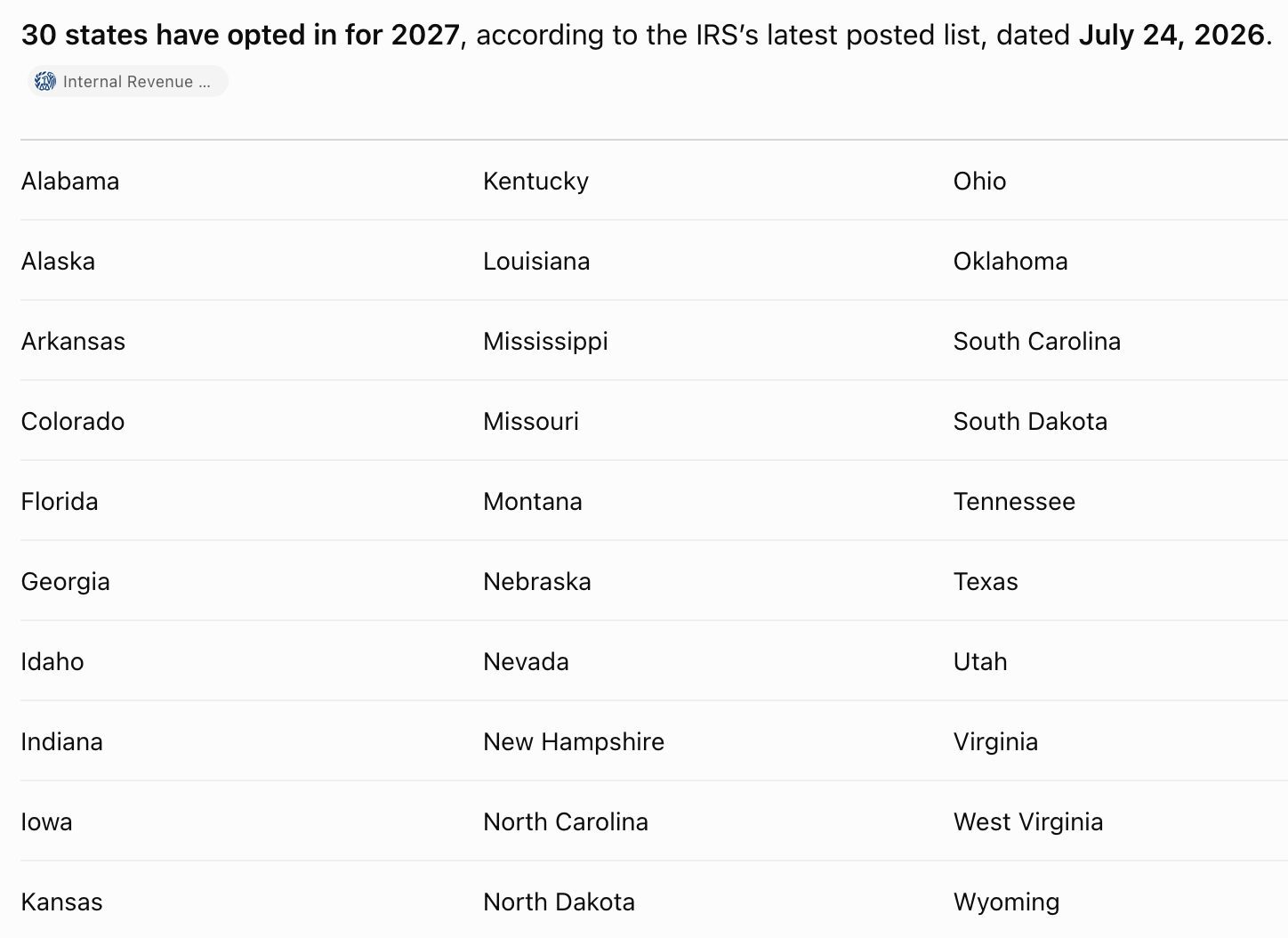
The IRS’s latest posted list, dated July 24, 2026, identifies 30 states that have elected to participate for 2027. New Hampshire is the only New England state listed. Later decisions may not yet appear on that list.
Why New Hampshire joined
New Hampshire announced its participation on January 29, 2026. Governor Kelly Ayotte framed the decision as part of the state’s effort to invest in educational opportunities and expand options for families. The state already has a separate Education Tax Credit scholarship program, which helps eligible students access schooling that better meets their needs. Its decision to join the federal program builds on that existing approach.
If Rhode Island does not participate when the program begins in January 2027, Rhode Island taxpayers could still claim the federal credit for qualifying donations to approved scholarship organizations in participating states. Rhode Island students, however, would not have access to scholarships funded through this program.