
Subscribe!
On Labor Day: Remembering Rhode Island’s Child Mill Workers
Today is Labor Day—a national holiday honoring the contributions and achievements of American workers.
For many, it is also the unofficial end of summer, marked by cookouts, beach trips and Labor Day sales. But few states have a deeper or more complicated connection to the history behind the holiday than Rhode Island.
Here, the American Industrial Revolution began not only with moving water, spinning frames and the vision of Samuel Slater. It began with children going to work.
The first workers were children
In 1790, Slater successfully put a water-powered cotton-spinning system into operation in Pawtucket. Three years later, the firm of Almy, Brown and Slater constructed the building now known as Old Slater Mill—the first successful water-powered textile mill in America.
Slater introduced what became known as the Rhode Island System of Manufacture. Rather than depending entirely upon individual adult workers, mill owners recruited families from surrounding farming communities. Parents and children worked for wages, often living in villages owned and controlled by the mill company.
According to the National Park Service, children between the ages of seven and 12 were the first employees in Slater’s mill. As the system expanded, entire families became part of mill life.
Children were not hired simply because they had “small fingers,” an explanation frequently repeated in accounts of the period. They were inexpensive to employ, easier for owners and overseers to control, and able to perform repetitive machine-tending jobs that did not require the physical strength of an adult man.
They tended spinning frames, replaced full bobbins, pieced together broken threads, swept floors and worked around machinery that was rarely stopped for cleaning or repairs.
The system spread rapidly along Rhode Island’s rivers. By 1830, children reportedly made up approximately 55 percent of Rhode Island’s mill workforce.
When the mill owned the workplace—and the neighborhood
The row houses still standing near many Rhode Island mills were part of the labor system itself.
Mill owners constructed housing close to their factories, often in rows of similar wooden houses occupied by two or more families. A mill village might also include a company store, church and school. This allowed owners to recruit entire families from rural communities and keep a dependable workforce within the sound of the factory bell.
The arrangement offered families regular wages and a place to live, but it also gave the mill owner influence over nearly every part of family life. The company might provide the job, own the house and operate the store where workers purchased food and other necessities—sometimes on credit.
If a parent lost a job, left the mill or challenged its working conditions, the family could also lose its home. Children therefore were not simply extra workers hired from the surrounding community. They lived inside an economic system in which the family’s wages and housing could depend upon their continued labor.
The mill village made employment, home and family inseparable. Children could leave a company-owned row house in the morning, walk only a short distance to the factory and spend most of the day working beside relatives and neighbors.
Work governed by the mill bell
The mill bell determined when families awakened, reported for work, ate and returned home.
A typical workday lasted from 10 to 14 hours, depending upon the mill and the season. Some accounts describe children working 12 hours a day during the winter and as many as 16 hours during the longer days of summer—six days a week.
Their earnings were important to families that had little cash income, but the children generally did not control the money they earned. Their wages were paid directly to their parents.
That does not mean parents were necessarily indifferent to what their children endured. For rural families facing debt, uncertain harvests or poverty, mill wages could provide regular income and housing. The Rhode Island System was constructed so that the economic survival of the family depended upon the labor of nearly everyone in it.
The mills were noisy, poorly ventilated and filled with cotton lint and dust. Temperatures could be stifling during the summer and bitterly cold in winter. Workers stood for long periods while tending fast-moving belts, gears and rollers without the safety guards expected today.
Repetitive work caused exhaustion and injury. A moment’s distraction around the machinery could be devastating.
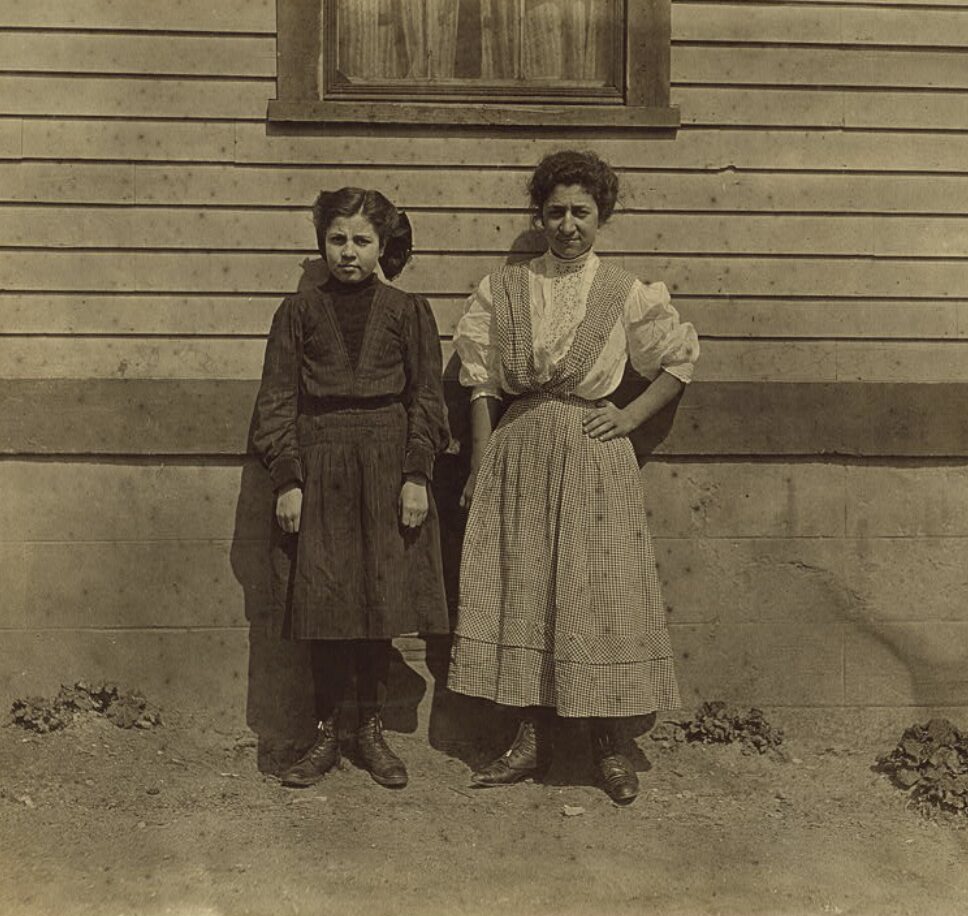
Photo, top: Two Portuguese girls working in Royal Mill, River Point, R.I. Younger girl, Mary Fartado “Works on lace.” Been in mill 3 years. Other girl 3 years too. they do not speak English. Location: River Point, Rhode Island. – Library of Congress (River Point is in West Warwick area of RI – 2 mills, Royal Mill (now apartments) and Valley Queen Mill, surrounding mill houses and former Cotton Shed make up River Point)
Rhode Island’s children, photographed
More than a century after Slater began employing children, young boys and girls could still be found inside Rhode Island mills.
In 1909, investigative photographer Lewis Wickes Hine traveled through Rhode Island for the National Child Labor Committee. His photographs put faces to a practice that factory owners and public officials could otherwise describe only in numbers.
At 6 o’clock on the morning of June 10, Hine photographed boys reporting for work at the Warren Manufacturing Company. His notation was brief: “Plenty of youngsters here.”
At the Jackson Mill in Fiskeville, Hine encountered John Dempsey, a boy who appeared to be only 11 or 12. The boy said he worked only on Saturdays, but Hine found him working in the mule-spinning room, which he described as a dangerous place for boys.
In River Point, Hine photographed young sweepers and mule-room boys at the Valley Queen Mill. Several of the smallest children told him they had already worked there for three years. Hine noted that they spoke no English.
Other photographs documented young workers at mills in Pawtucket, Natick, Olneyville, Lonsdale and elsewhere across the state. One Pawtucket image showed lint accumulated across a mill floor. Hine wrote that the air was full of it, although the photograph could not capture what the workers were breathing.
The photographs were taken after Rhode Island had begun establishing age and school-attendance requirements. Laws existed, but enforcement was inconsistent. Ages could be misstated, documents were not always demanded and desperately poor families still needed every available wage.
A 1908 study of Rhode Island factory legislation cited workers who said that children who appeared to be “almost babies” remained in the mills. One Lonsdale spinner reported seeing nine-year-old boys who never attended school. Another worker said children between seven and 15 were sometimes kept at work until 10 at night.
Rhode Island workers begin to resist
Rhode Island was not only the birthplace of America’s factory system. It was also the site of one of the country’s earliest and most important labor protests.
In May 1824, Pawtucket mill owners announced that they would extend the workday by one hour, reduce mealtime and cut the pay of power-loom weavers by 25 percent.
More than 100 women weavers walked out.
Other workers joined them, mills were shut down and the protest continued for more than a week. The Pawtucket walkout is recognized by the National Park Service as the first industrial labor strike in United States history—and the first American strike led by women.
Some of those women were only in their teens.
The walkout did not immediately transform factory life, but it introduced an idea that would shape the labor movement: workers did not have to accept every condition imposed upon them individually. Together, they could stop production and demand to be heard.
Rhode Island establishes Labor Day
Rhode Island workers spent years marching, petitioning and pressing the General Assembly to recognize a holiday honoring labor.
In 1893, Governor D. Russell Brown signed legislation making the first Monday in September a state holiday. On September 4 of that year, thousands of union members marched through Providence while an estimated 10,000 spectators watched. Afterward, workers and their families traveled to Rocky Point for speeches, a clam dinner, amusement rides and games.
The federal government followed in 1894, when Congress made Labor Day a national legal holiday.
Still, the struggle over child labor continued. Early federal laws were struck down by the courts, and state protections varied widely. Meaningful nationwide restrictions finally arrived with the Fair Labor Standards Act of 1938, which established federal wage-and-hour protections and prohibited oppressive child labor.
Today, Rhode Island law prohibits children under 16 from working in factories, mechanical operations or manufacturing establishments. Younger teenagers may work in certain other jobs, but permits, limits on hours and restrictions on hazardous work apply.
Looking beyond the brick walls
Rhode Island’s old mills have become apartments, offices, restaurants, studios and museums. Their brick walls, tall windows and riverfront settings are now viewed as historic and sometimes beautiful.
Labor Day asks us to look beyond the buildings.
The machinery that launched America’s Industrial Revolution was tended by children. The mills that created fortunes also consumed childhoods. The protections now considered ordinary—time for school, limits on working hours, workplace safety rules and restrictions on dangerous employment—did not come automatically with progress.
They came because workers, reformers, parents, photographers and eventually lawmakers challenged the belief that economic production should take precedence over human life.
That may be Rhode Island’s most important connection to Labor Day: our state helped launch America’s factory system—but Rhode Island workers also helped lead the long fight to make it safer, fairer and more humane.
Nancy, thank you for reminding us how those in power have no oversight over their actions until the masses organize.
How many of those children actually lost fingers or became maimed, or died while working for Mr. Slater. A man who was touted as a visionary for being able to draw up plans from memory. A man who treated his workers as slaves.
This part of our history must never repeat it self.
A fascinating and well-written article. Well done, Nancy Thomas!