
Subscribe!
The Long and Short of Basketball: When Reach May Matter More Than Height
by Nancy Thomas, commentary
I do not pretend to know basketball – well, not enough to write about it.
But! I was at Providence College during the marvelous Ernie DiGregorio-Marvin Barnes years, when the Friars reached the Final Four. As far as I was concerned, “Li’l Ernie D.” was the best—and that represents approximately the beginning and end of my basketball expertise.
Then Enes Kanter Freedom stretched out his arms at a WNBA game, Riley Gaines remarked on his wingspan on X, and suddenly I was researching human geometry.
Freedom, the former NBA center, was removed from Sunday night’s Indiana Fever-Chicago Sky game following a confrontation with Chicago guard Natasha Cloud. He was seated near the baseline wearing a black shirt that read: “WOMAN. noun. adult human female.”
Late in the third quarter, Cloud walked in his direction while shouting and pointing. Freedom stood, extended his arms and stepped close toward the court before security intervened and escorted him from the arena.
Freedom later said he had been removed for “supporting women.” News reports, however, also show that the episode involved a verbal exchange, his movements so close to the edge of the court and quite a scene as he was escorted away. Whether it was the shirt, the confrontation, the step toward the court—or the entire package—security decided it was time for him to go. CBS/AP coverage
But look at that photograph.
Freedom is standing with both arms extended so widely that he appears capable of directing traffic on two different streets.
That was when Gaines’s wingspan remark on social media sent me down a completely different road: How long are his arms? How does his reach compare with the women playing in the WNBA? And is height—or reach—the more important measurement in basketball?
Bringing in the measuring tape
A person’s wingspan is measured from the tip of one middle finger to the other while both arms are extended horizontally.
For most people, wingspan is reasonably close to height. Basketball players have a habit of upsetting reasonable expectations.
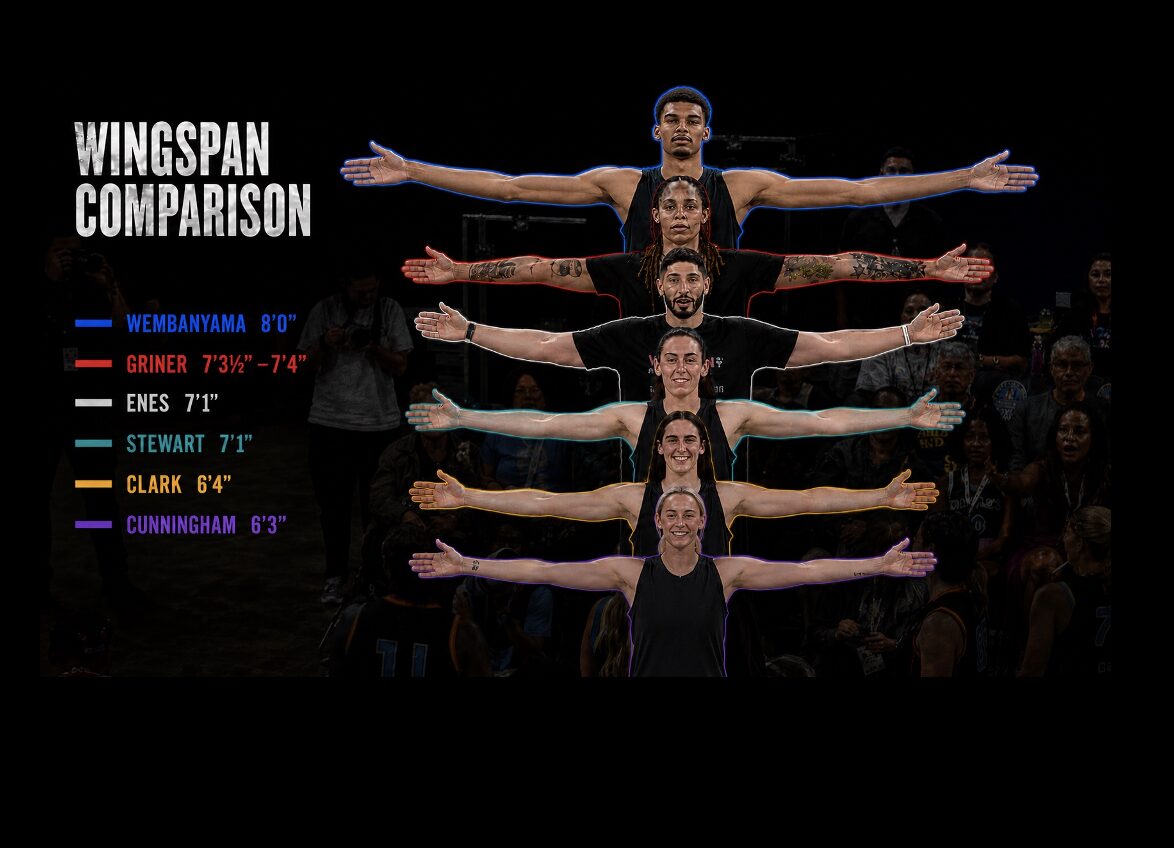
Here is our admittedly unconventional lineup, arranged by wingspan (see photo, above)
- Victor Wembanyama — 8 feet
- Brittney Griner — 7 feet, 3½ inches to 7 feet, 4 inches
- Enes Kanter Freedom — 7 feet, 1 inch
- Breanna Stewart — 7 feet, 1 inch
- Caitlin Clark — 6 feet, 4 inches
- Sophie Cunningham — 6 feet, 3 inches
Wingspan figures are reported or estimated measurements and can vary slightly among sources. Years ago teams didn’t record it, but today they do.
At the top is San Antonio Spurs phenomenon Victor Wembanyama, officially listed at 7-foot-4, with a reported wingspan of approximately 8 feet. At that point, we are no longer discussing arms. We are discussing residential square footage. NBA profile
Second we added is Brittney Griner, the 6-foot-9 Connecticut Sun center, with a reported reach approaching 7-foot-4.
Griner is included here strictly for basketball reasons—and few players offer better evidence of what extraordinary reach can accomplish. In June, she became the WNBA’s career leader in blocked shots, recording her 878th block. If we want to know whether wingspan matters defensively, that is fairly persuasive evidence. WNBA
Enes (Kanter) Freedom, listed at 6-foot-10 during his NBA career, follows with an approximately 7-foot-1 wingspan.
Then comes one of the more interesting comparisons. Breanna Stewart stands 6-foot-4 but reportedly has roughly the same 7-foot-1 wingspan as Freedom. Stewart is six inches shorter, yet when both extend their arms, they occupy nearly the same amount of horizontal territory.
Caitlin Clark, listed at 6 feet, has a reported 6-foot-4 wingspan.
Her Indiana Fever teammate Sophie Cunningham is 6-foot-1, with a wingspan estimated at approximately 6-foot-3.
One clarification for my fellow basketball novices: These people are not all teammates. I assembled them solely to determine how many basketball players it takes to fill an arena horizontally.
Height, wingspan—and something called standing reach
The obvious assumption is that basketball is primarily a game of height.
Height certainly helps. It places a player closer to the basket, generally produces a higher release point and can provide a natural advantage in rebounding and shooting over shorter opponents.
But height tells us only where the top of a player’s head is.
Wingspan tells us how much horizontal territory the player can affect. Long arms can disrupt passes, reach around opponents for rebounds, protect the ball and challenge shots without requiring the player to stand directly beneath the basket.
Then there is “standing reach”—how high a player can touch without jumping. That measurement combines height, shoulder position and arm length. For blocking shots, rebounding and releasing the ball above a defender, standing reach may be more useful than height alone.
In plain English:
- Height determines where your head is.
- Wingspan determines how much territory your fingertips cover.
- Standing reach determines how high you can interfere without leaving the floor.
But measurements are only the equipment. The player still has to know how to operate it.
Timing matters. Positioning matters. Footwork, anticipation, speed, balance, shooting touch, passing, judgment and the ability to read other players all matter.
Wembanyama’s dimensions make him an extraordinary defensive obstacle, but his ability to handle, pass and shoot makes him far more than a very tall roadblock.
Griner’s reach helped her become the WNBA’s career leader in blocked shots—but a long arm does not automatically know when to leave the floor.
Stewart’s combination of length, movement and skill has helped make her a multiple-time WNBA MVP and champion.
Clark demonstrates the other side of the lesson. She is the shortest person in this particular comparison, yet her shooting range, court vision and passing allow her to influence areas far beyond the space covered by her fingertips.
Cunningham, also with Indiana, contributes toughness and outside shooting. In one June game this season, she scored 24 points and made six three-pointers. Her effectiveness was not measured by how far her arms extended, but by what happened after the ball left her hands. Indiana Fever
Freedom’s NBA career was built more around rebounding and interior scoring than elite shot-blocking. He and Stewart may have similar reported wingspans, but they used that physical tool in different ways.
“Li’l Ernie” wasn’t actually little – at all!
All this measuring brought me back to Providence College and Ernie DiGregorio.
Ernie D. always seemed, well, short, to us—but he was not. He stood 6 feet tall and weighed 180 pounds. In ordinary life, that is not particularly small. It simply looks small when your coworkers approach seven feet and your office contains two elevated baskets.
He was also exactly the same listed height as Caitlin Clark.
Ernie’s Providence teammate Marvin Barnes stood 6-foot-9—nine inches taller. Barnes was selected second overall in the 1974 NBA Draft, one year after Ernie was selected third overall. Ernie DiGregorio, Marvin Barnes
At 6 feet, “Li’l Ernie D.” wasn’t little anywhere except on a basketball court. Put him next to Barnes and the nickname suddenly required no explanation.
Yet Ernie led the nation in assists at Providence, became an All-American and helped take the Friars to the Final Four. He then won NBA Rookie of the Year and led the league in assists during his first professional season.
Height gave Barnes advantages Ernie could never possess. Ernie compensated with passing, vision, ball handling and an ability to see plays developing before other players did.
Once again, the measuring tape did not tell the entire story.
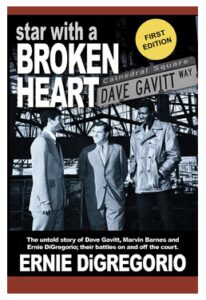
(Personal note, the last time I met Ernie outside of PC, I was waiting for an average sized person, and in stroke a “tall” Ernie, with the swag walk reserved for pro-athletes!)
You can buy Ernie’s so-memorable book at PC basketball days, HERE – Personalized, too!
Enter the Celtics’ Big Three
Years later, New England basketball fans watched another rather imposing group: Larry Bird, Kevin McHale and Robert Parish—the Celtics’ celebrated Big Three.
Their listed heights:
- Larry Bird — 6-foot-9
- Kevin McHale — 6-foot-10
- Robert Parish — 7-foot-1
Their average height was nearly 6-foot-11. Place 6-foot Ernie DiGregorio among them and he would be almost eleven inches shorter than the average member of the trio.
That alone explains why basketball can make a perfectly normal six-foot person appear petite.
Reliable wingspan measurements were not routinely published during that era. We have no dependable figures for DiGregorio, Barnes or Parish. Bird’s reach has been estimated at around 7 feet, but no definitive official measurement appears to survive.
McHale, however, is a story unto himself.
Kevin McHale: “Only” 6-foot-10
Basketball may be the only place where anyone says a man was “only” 6-foot-10.
McHale’s wingspan was widely estimated at 8 feet—the same reported reach as 7-foot-4 Wembanyama, despite McHale standing six inches shorter.
The exact measurement was never officially verified. Nevertheless, photographs show McHale’s fingertips hanging considerably lower than Bird’s and even lower than those of 7-foot-1 Parish. A Celtics Sentinel examination of the claim concluded that no one could confirm the precise 8-foot measurement, but there was little doubt that McHale was extraordinarily long. Celtics Sentinel
Contemporary observers noticed it, too.
During the 1985 NBA Finals, Lakers coach Pat Riley reportedly said McHale was 6-foot-10 but his arms were so long that “he plays like he’s 7-4.” The Washington Post
An NBA historical profile describes McHale’s exceptionally long arms and explains how they gave him shooting angles over taller or more explosive defenders. He could keep the ball high and away from opponents, collect rebounds, block shots and release the ball from positions that made him nearly impossible to defend near the basket. NBA Legends profile
McHale may be the strongest proof that height is only the beginning of the basketball story.
He did not play like a 6-foot-10 man. His reach allowed him to occupy the territory of someone much taller.
My highly unlicensed conclusion
Basketball is certainly a game of height—but perhaps it is even more a game of functional reach.
Height gets a player closer to the basket.
Wingspan allows a player to interfere from another ZIP code.
Standing reach determines how high that interference can begin.
Skill determines whether any of it matters.
All of this began with an argument over a shirt, a confrontation beside a basketball court and a former NBA player standing with his arms fully extended.
Others saw politics.
And allow a personal comment on that as well..
Riley Gaines saw a wingspan and a solid argument for why men should not be playing in women’s sports.
Wingspan is only one part of the physical equation. Enes Freedom was listed at 250 pounds, while Caitlin Clark is listed at 157—a 93-pound difference that affects strength, contact, balance and how each player uses that reach. Clark compensates with speed, shooting and court vision; Freedom used his larger frame primarily for rebounding and scoring near the basket.
For the record, my own view is straightforward: girls’ and women’s sports should be for girls and women, and boys’ and men’s sports for boys and men—a matter of fair competition and play and safety, not partisan politics.
Back to the “Long & Short of Basketball” – I saw a man who looked as though he might accidentally clothesline an entire row of spectators—and wondered how he measured up against the people who actually play the game.
That curiosity eventually led from Enes Freedom to Wembanyama, Griner, Stewart, Clark and Cunningham—and then all the way back to Ernie D., Marvin Barnes and the Celtics’ Big Three.
That may not qualify me as a sports analyst.
But Ernie D. would probably appreciate the assist.
I love the game of basketball. I just came across my scrapbook, loaded with PC clippings. My Dad was a grad of PC so when the basketball team became nationally noticed, it was a very big deal.
If a game was on TV, we watched it. PC had a reunion or family day one time and I managed to get Joe Mullaney’s autograph. When they won the NIT (a huge deal – it was the one every college team wanted to win), Dad drove us down to see the team bus roll into Providence.
I’ve followed the WNBA on & off. Foxwoods used to give away tickets. I hit some games but if there were 100 people there, it was a good night.
My oldest son is a basketball nut. If there’s a game on, he’s watching it. He can rattle off stats, names, positions; a walking encyclopedia of the game. He played in youth games but still keeps a basketball in his car in case he sees a pickup game.
Now I’m back to the WNBA. Organized female sports didn’t exist when I grew up. I am fascinated by their skills. A neighbor had a hoop and I “attempted” to play. I’m too short and blind as a bat.
I never make a long story short, do I?
Wingspan – it’s an official measurement from fingertip to fingertip. It determines the “reach” of a player.
Lexie Hull of the Fever is 6′ 1” – she has a wingspan of 6′ 5 inches. It’s to her advantage. when she spreads her arms, the opposing player is going to have to go over her since there’s no way they’re getting by her.
Love the game. Now I’ll pull out my scrapbook and remember the excitement of the home team.