
Subscribe!
Outdoors in RI: Quahog Week, Surf Therapy, Be a Lifeguard, Marine Life & Wind Turbines
10th Annual Quahog Week in RI
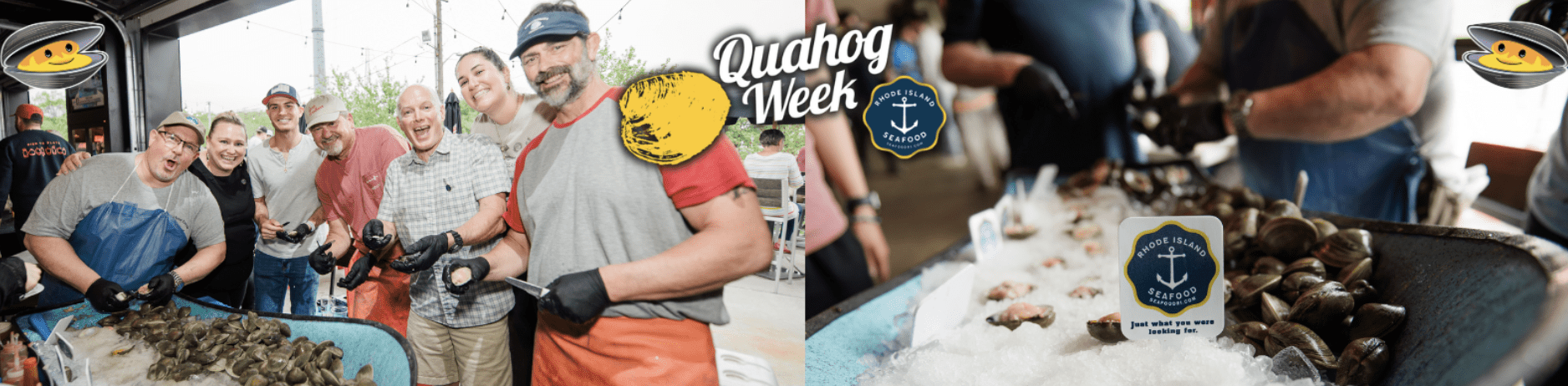
Quahog Week highlights the many restaurants, markets, harvesters, and food-based businesses committed to growing Rhode Island’s local food economy, with special emphasis on wild harvest clams. Restaurants and markets across Rhode Island will celebrate this sustainable resource and its year-round availability by featuring a quahog dish or special on their menu during the week.
Quahog Week shines a light on our state’s favorite local clam, the hard-working men and women who harvest them, and the vibrant local food industry that makes them available to consumers. Quahogging has a rich local history, supporting the livelihoods of hundreds of Rhode Islanders year-round and serving as a treasured pastime for Rhode Island families who enjoy digging their own. Demand for these delicious local clams swells in the summer months due largely to the popularity of fresh-shucked littlenecks, clam cakes, and stuffies. But they also make the perfect fare for chowders, pasta, and other dishes year-round.
Quahog Week at Tiverton Farmers Market
Keep Clam! Quahog Week is here! Join RI Seafood in “shell-ebrating” the 10th Annual Quahog Week at the Tiverton Farmers Market!
This is a FREE event and is open to the public. RI Seafood will be there with Brightside Market and Salty Winebar with fun goodie bags for kids.
Quahog Week (May 17-23) shines a light on our state’s favorite local clam, the hard-working men and women who harvest them, and the vibrant local food industry that makes them available to consumers.
As part of the week-long observance, venues will feature quahog-inspired specials on their menus, and participating markets will offer deals for those who enjoy cooking their own clam dishes at home. View the list at seafood.ri.gov/quahog-week
__
Quahog Week at Narragansett Brewery
Join RI Seafood in “shell-ebrating” the 10th Annual Quahog Week!
Harvesters from the RI Shellfishermen’s Association will be shucking and serving complimentary little necks. Small bites will be provided by various RI Seafood partners.
This event is FREE and open to the public. Quahog Week (May 17-23), shines a light on our state’s favorite local clam, the hard-working men and women who harvest them, and the vibrant local food industry that makes them available to consumers.
Quahogging has a rich history locally, supporting the livelihoods of more than 500 Rhode Island fishermen and women year-round with more than 13 million clams being harvested in 2025.
As part of the week-long celebration, restaurants will feature quahog-inspired specials on their menus, and participating markets will offer deals for those who enjoy cooking their own clam dishes at home. View the list at https://seafood.ri.gov/quahog-week
___
Quahog Week at Newport Craft and Distillery
Keep Clam! Quahog Week is here! Join RI Seafood in “shell-ebrating” the 10th Annual Quahog Week at Newport Craft and Distillery (293 JT Connell Hwy, Newport)
This is a FREE event and is open to the public. Harvesters from the RI Shellfishermen’s Association will be shucking and serving complimentary little necks. Small bites will be provided by various RI Seafood partners.
Quahog Week (May 17-23) shines a light on our state’s favorite local clam, the hard-working men and women who harvest them, and the vibrant local food industry that makes them available to consumers.
As part of the week-long observance, venues will feature quahog-inspired specials on their menus, and participating markets will offer deals for those who enjoy cooking their own clam dishes at home. View the list at seafood.ri.gov/quahog-week
___
Want to be a Lifeguard?
The Rhode Island Department of Environmental Management (DEM) announces that state lifeguard certification testing begins this weekend. Anyone seeking to work at any open water facility in the state, including all municipal and private open water facilities, must be certified by DEM’s Division of Parks and Recreation as either a Surf or Non-Surf lifeguard. DEM will hold the first surf test on Saturday, May 16, from 9 AM – 3 PM at Scarborough North State Beach. The first non-surf test will take place on Wednesday, May 27, from 12 – 5 PM at Lincoln Woods State Park beach.
Lifeguard candidates should register for a timeslot and are required to hold current certifications in lifeguard training, first aid, and CPR, including infant, child, and adult. For a full list of lifeguard certification testing dates and times, and information about becoming a lifeguard for DEM, please visit: riparks.ri.gov/lifeguard.
“Our state beaches and parks provide some of the best outdoor swimming spots around,” said DEM Director Terry Gray. “One of our top goals is making outdoor recreation accessible and enjoyable for everyone. To do that, we need a great team – and recruiting qualified, enthusiastic workers is how we deliver on this promise. Working outside, building lifelong friendships, and serving our communities are big benefits of spending the summer working with us.”
Full-time positions are available at DEM swimming locations across the state. Lifeguard pay ranges from $19.75 to $21.00 per hour based on experience and position level. Lifeguards hired by May 22, 2026, can receive a one-time $500 sign-on bonus, and those who remain employed until September 7, 2026, can earn a $500 retention bonus if specific requirements are met.
___
Plant Sale – Mapleville Farm
May 16-17, 2026 Plant Sale Kickoff! What a fun weekend at Mapleville Farm! Stop by with the family, get a coffee and enjoy everything they’ve got going on!
First, pick up some gorgeous plants to fill your gardens! Mapleville Farm grows a great selection of vegetables, cut flowers and annual and perennial herbs!
There will be a gardening station for little ones so they can plant their own seed, take it home and watch it grow. That’s ALL weekend.
There will also be vendors.
On Sunday, Uncle Sam (aka Roger Bourbonniere, Granpa Rock) will be coming to paint rocks with kids from 11-12:30.
John McNiff (Roger Williams for the day) will start artound 1:00 p.m. doing presentations and gardening.
Contact info: Mapleville Farm 544 Victory Highway Mapleville, RI 02839 – [email protected] – 401-568-0544
___
Sweet outcome: Surf therapy program receives Fogarty Foundation grant; expands to serve those with visual impairments
Professor Emily Clapham and student Wendy Flanagan are teaming up to expand the URI Surf Therapy Program to children with visual impairments
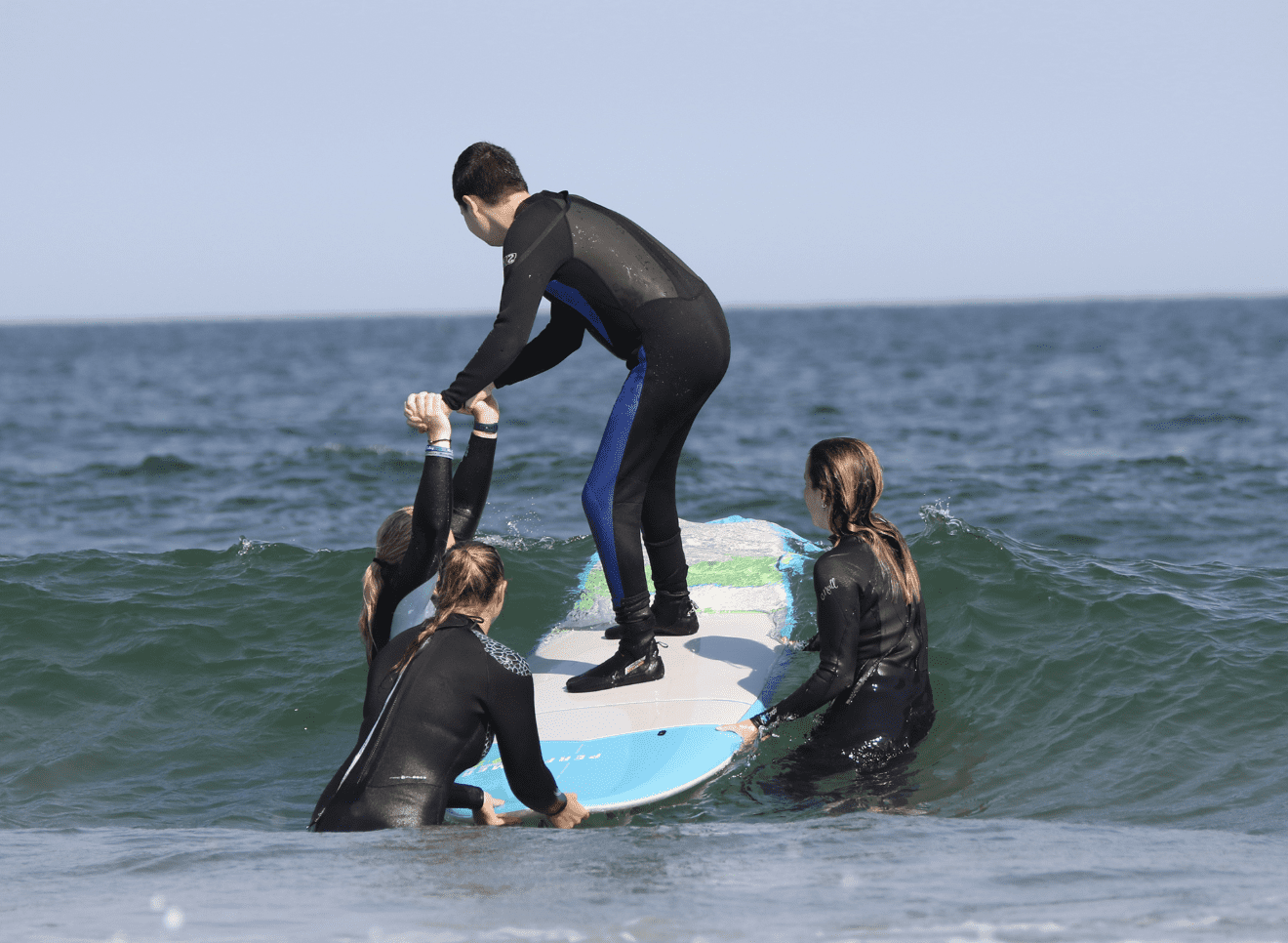
Imagine having a 12-year-old child you’ve never been able to take out for ice cream. That’s been the case for at least one family who has participated in the University of Rhode Island Surf Therapy Program that Professor Emily Clapham runs each year at Narragansett Town Beach. Clapham, associate professor of health and physical education, started the program for kids with a range of disabilities in 2010 and has seen tremendous positive outcomes over the past 15 years.
Clapham, who is the coordinator of the Adapted Physical Education program in the URI Feinstein College of Education, was recently awarded a $5,000 grant from the John E. Fogarty Foundation. A portion of that funding will go to purchase approximately 20 surfboards in order to cut down on the annual costs of running the Surf Therapy Program. The Fogarty Foundation had been a long-time supporter, but this is the first grant Clapham has received in recent years. She noted that the foundation encouraged her to purchase surfboards for the program to make it more sustainable.
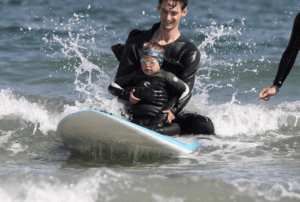
Another change this year is the addition of a surf therapy program for children with visual impairments, which is slated to launch this fall as part of Wendy Flanagan’s master’s program project. Flanagan, a senior who will graduate this May with a degree in health and physical education and adapted physical education, will continue at URI this summer pursuing her M.A. in education. She has been working with Clapham in the Surf Therapy Program for three years.
The pair is teaming up with Lauren Lieberman of SUNY Brockport, who is well known in the adapted physical education world as a scholar and the founder of Camp Abilities, a sports camp that serves children who are blind, deafblind, or have low vision.
“It’s a good collaboration with her because she is such a leader in the world of adapted PE. She is the main person who does this kind of work with children with visual impairments,” Clapham said. “It’s such a unique disability. It’s important for them to have their own program. It’s going to be great for us to learn how to make modifications for children with visual impairments.”
Flanagan noted the need for additional funding for the new program as it will involve both taking the participants surfing and doing research. “We’ll test gross motor development and develop some questionnaires,” she said.
“This will be a pilot program,” Clapham said of the new program. “We’re not sure what will come from the data collection; we’re going to measure a few different variables. We’re going to learn a lot.”
The pair anticipate that people will come from a distance to have their children participate. “There are so few programs just for children with visual impairments, people will travel long distances so their child can participate,” Clapham said.
The URI Surf Therapy Program continues to grow, last year serving approximately 50 children, ages 3 to 21. Even more people, including some repeat participants, are expected to apply this year. The first session is scheduled to take place on May 20.
“We may have to turn people away,” Flanagan said. The program relies on many volunteers to operate, but ultimately needs to hire surf instructors to fill the gap. “That’s why getting grant funding is so important,” Clapham adds.
The veteran educator and surf instructor has seen many positive effects of the program over the years but notes that she often sees the biggest gains with students who have autism or are on the spectrum. Many of them like swings or wearing body socks for compression, she says. And being in the natural rhythmic motion of the waves and wearing a tight-fitting wetsuit mimic both of these calming techniques, which are important for people with autism who often experience a lot of stress and anxiety and are frequently overwhelmed by sounds, bright lights, and unexpected changes.
“We’ve had physical gains, like core strength, upper body strength, and stability” in the participants, said Clapham. Being in the water also helps to regulate them, “which often carries over to school the next day. They are very calm, relaxed and focused. The ocean and being in the water gives them that rhythmic experience.”
Parents have been pleased with the outcomes and find that having their children participate is extremely therapeutic. And so each year, Clapham finds a way to keep it going.
“When I first started the program, I thought this would be a one-time thing, but everyone just loved it so much and I tied my research to it, so I said let’s try to do it again next year,” she said. “It’s been like that every year, and it’s just worked out that we secure funding and support every year. We’ve been lucky.”
And so have the participants and their families. “They get good quality time with their kids after surf sessions,” Clapham says. “One family had never been able to take their 12-year-old out for ice cream, and they were able to do that after this program.” That’s a pretty sweet outcome.
Those interested in having their child attend the URI Surf Therapy Program can fill out the application form. Anyone interested in volunteering to assist with the program can reach out to Emily Clapham at [email protected].
This story was written by Jo Fisher in the Feinstein College of Education.
Photos provided E. Clapham
___
Marine life finds new home at base of wind turbines
URI graduate student studies how wind farm structures affect Jonah crabs
As lobsters migrate to colder waters due to climate change, Jonah crabs are becoming one of the most important species for fisheries in Southern New England.
“As the biomass of the American lobster declines due to climate-related changes and shifting ocean conditions, many fishermen have adapted by targeting other valuable species, and the Jonah crab has become a major alternative,” said Emmanuel Oyewole, a first-year Ph.D. student in the University of Rhode Island’s Graduate School of Oceanography. “The Jonah crab used to be considered a bycatch species and thrown back because lobster was so lucrative. As lobsters became less abundant, people started to realize that the Jonah crab is a viable and delicious alternative.”
Oyewole is conducting a study that is partly funded by a grant from The Nature Conservancy into how offshore wind farm structures are impacting the growth and habitats of Jonah crabs.
“Ecologically, Jonah crabs also play an important role in the marine food web,” said Oyewole, who is from Ilé-Ifẹ̀, Nigeria, a town in the southwestern part of the country. “They are both predators and prey, helping to maintain balance within benthic ecosystems. Because they are closely connected to seafloor habitats, they can help us understand how offshore wind farm structures may influence local biodiversity, habitat use, and the productivity of fisheries.”
When turbine foundations are installed on the seafloor, their hard surfaces become desirable habitats for marine organisms to attach, grow, and live, just as they do on natural rock or reefs. As algae, barnacles, mussels, and other small marine life, settle on these structures, these smaller organisms attract larger species such as crabs and fish that come to feed, hide, or seek shelter.
“The turbines can create a kind of ‘mini ecosystem.’ They provide food and habitat, which can draw marine life into the area and potentially change how species use the surrounding environment,” said Oyewole. “The question is whether they are increasing the overall amount of marine life in the ocean by creating new production or simply concentrating animals that were already living in the surrounding areas.”
The data Oyewole collects and analyzes will benefit the Commercial Fisheries Research Foundation, a nonprofit organization founded by local commercial fishermen.
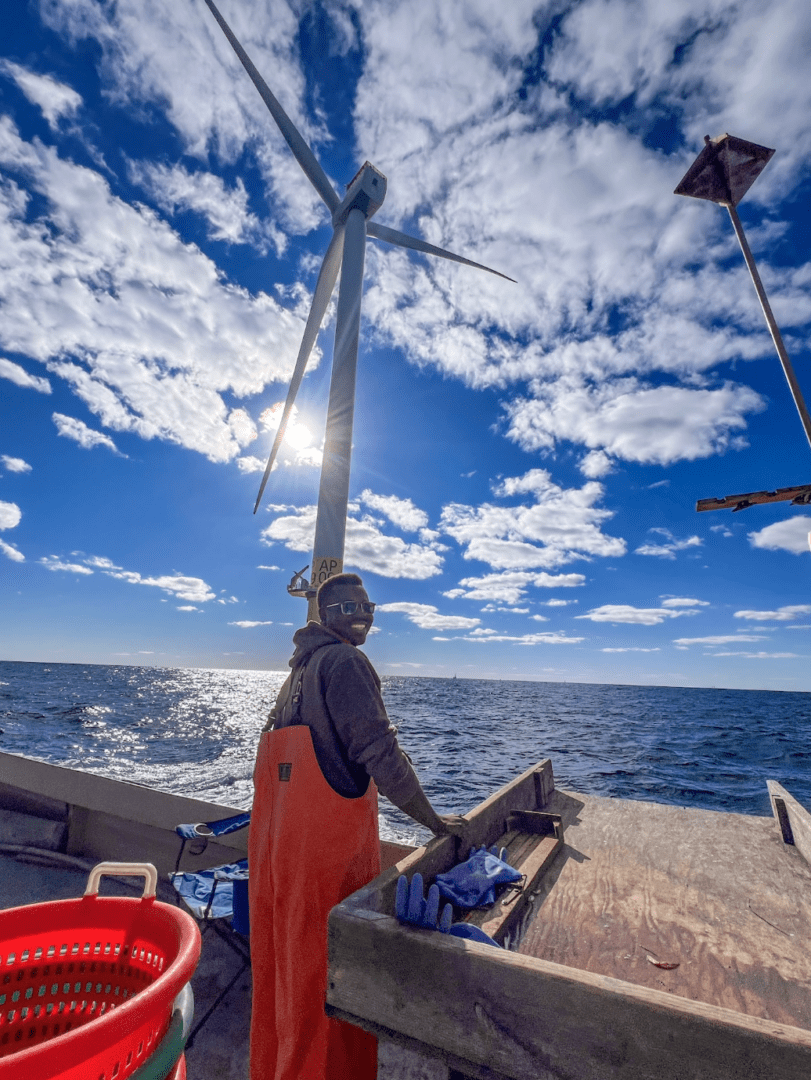
For the last year, Oyewole has conducted field work twice a month, long before sunrise. Boarding lobster vessels at Point Judith, Rhode Island, he has accompanied fishermen as they haul ventless traps from 10 stations near the Revolution Wind and South Fork Wind sites.
“One of the most important things I have learned from commercial fishermen is that the end product of research is just as important as the research process itself,” said Oyewole. “Research should not only answer scientific questions, but it should also be useful to the people and communities most affected by it.”
Oyewole’s conversations with the fishermen have helped inform his research.
“This project has been shaped by listening to their experiences, concerns, and needs. Their knowledge of the water, species behavior, and changing fishing patterns provides insight that scientific sampling alone can’t capture,” he said. “Even as data collection continues, their support remains a critical part of the work.”
Rather than completing his fieldwork first and starting lab work later, Oyewole’s project is designed to accomplish both phases concurrently.
“While we are collecting samples, we will begin processing them in the lab for tissue-specific stable isotope analysis,” said Oyewole. “Field sampling, lab analysis, and data interpretation will build on each other over time.”
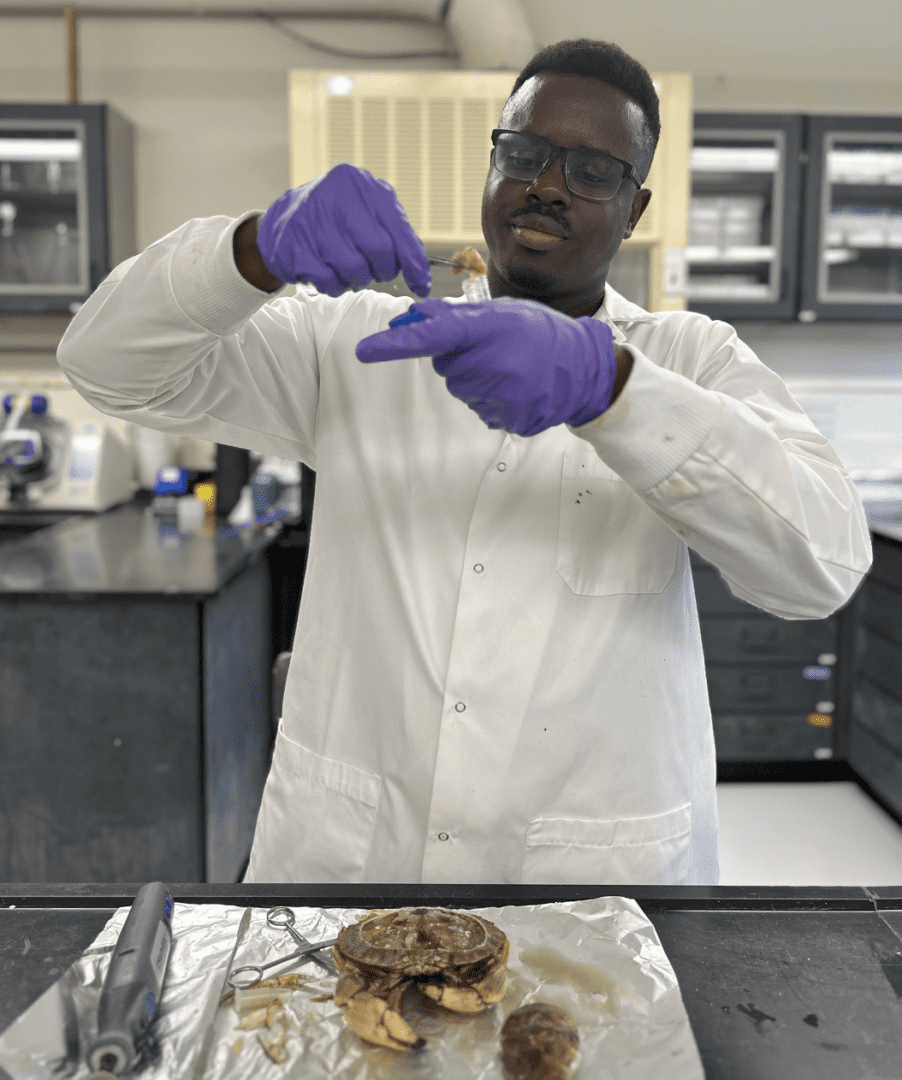
With the guidance of Associate Professor Kelton McMahon, Oyewole performs tissue-specific stable isotope analysis on the crabs in the Ocean Ecogeochemistry Laboratory on URI’s Narragansett Bay Campus.
“The isotope analysis helps us understand where these crabs have been living and feeding at different times of their lives,” said Oyewole. “Different parts of the ocean can leave slightly different chemical ‘signatures’ in an animal’s tissues, almost like a natural geographic fingerprint. This will enable us to trace whether the crabs are living and feeding around the wind farm long enough to benefit from the habitat or whether they are simply moving in temporarily from surrounding areas.”
McMahon has been impressed with Oyewole dedication and research prowess.
“Emmanuel is intellectually independent, technically skilled, and deeply committed to producing science that informs real conservation and management decisions by fisheries,” said McMahon. “His work addresses a timely question about offshore wind development and marine resource dynamics.”
Having grown up in a region where fisheries are both economically important and environmentally vulnerable, Oyewole saw firsthand the challenges communities face in balancing resource use with long-term sustainability.
“My research at URI has shaped my desire to develop practical, science-based management strategies that protect aquatic resources while also supporting local livelihoods,” said Oyewole. “My goal is to build a career at the intersection of marine ecosystem science and the sustainability of fisheries, with a particular focus on African waters, especially in my home country of Nigeria.”
Photos:
URI Ph.D. student Emmanuel Oyewole conducting field work at the South Fork Wind farm turbines. (Photos courtesy Emmanuel Oyewole)
Oyewole prepares Jonah crab muscle samples for analysis in URI’s Ocean Ecogeochemistry Laboratory.
___