
Subscribe!
Fragile Ceasefire: U.S., Iran Reach 2-Week Deal; Strait of Hormuz Reopens, War Issues Remain
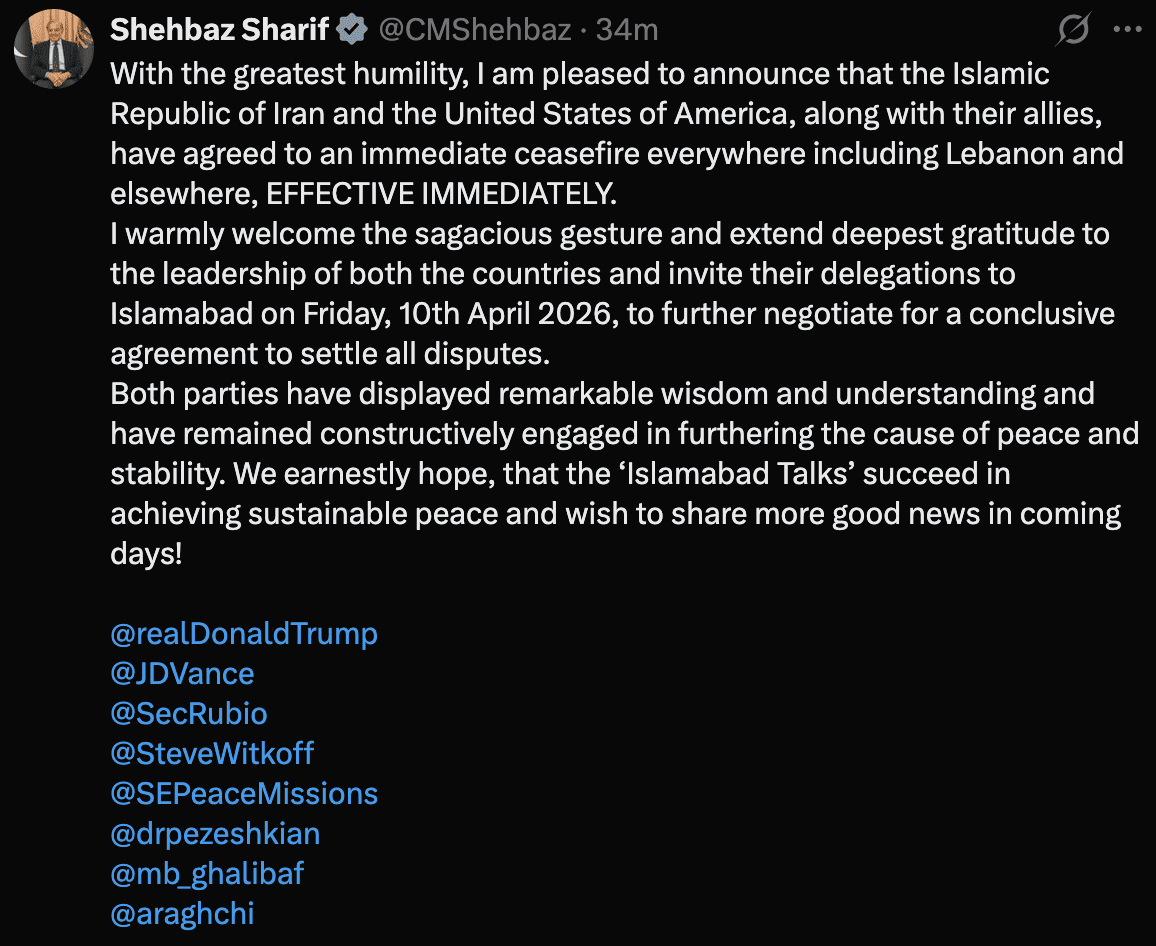
Pakistan to host talks between parties (delegation level unclear) on Friday in Islamabad as lists of demands back and forth begin to emerge.
With less than an hour to go before 8 p.m. on April 7, President Donald J. Trump announced he had accepted a two-week ceasefire—conditional on the immediate opening of the Strait of Hormuz. Pakistan, led by Shehbaz Sharif and Asim Munir, served as intermediary.
As the agreement was issued—and a companion statement from Iran released—explosions and incoming missiles were still being reported over Tel Aviv. The next 24 hours will be critical.
Iran has historically used pauses in conflict to recalibrate strategy, raising concerns that this ceasefire window could be leveraged for repositioning or escalation. Notably, uranium or nuclear development is not referenced in either statement.
As this article goes to press, Iran says it will coordinate the opening of the Strait—this even as active strikes continue. Oil prices have reacted immediately, dropping sharply, now around or below $90.
What this ceasefire does—and does not do: Despite growing discussion of nuclear issues and long-term peace, the current agreement hinges on a single immediate condition: reopening the Strait of Hormuz—not a broader resolution of the conflict. Ali Khamenei’s successor and son Mojataba declared in his statement: “This is not the end of the war, but all military branches should follow the Supreme Leader’s order and cease fire.”
Israel supports the ceasefire but notes this does not involve Lebanon – and was said not to have been at the table. France’s Macron says the ceasefire must include Lebanon and clarifications need to be made at once.
Pakistan will host “peace talks” at Islamabad this Friday.
___
Full statement released by President Trump on Truth Social at approximately 6:34pm April 7th:
Based on conversations with Prime Minister Shehbaz Sharif and Field Marshal Asim Munir, of Pakistan, and wherein they requested that I hold off the destructive force being sent tonight to Iran, and subject to the Islamic Republic of Iran agreeing to the COMPLETE, IMMEDIATE, and SAFE OPENING of the Strait of Hormuz, I agree to suspend the bombing and attack of Iran for a period of two weeks.
This will be a double sided CEASEFIRE!
The reason for doing so is that we have already met and exceeded all Military objectives, and are very far along with a definitive Agreement concerning Longterm PEACE with Iran, and PEACE in the Middle East. We received a 10 point proposal from Iran, and believe it is a workable basis on which to negotiate. Almost all of the various points of past contention have been agreed to between the United States and Iran, but a two week period will allow the Agreement to be finalized and consummated.
On behalf of the United States of America, as President, and also representing the Countries of the Middle East, it is an Honor to have this Longterm problem close to resolution.
Thank you for your attention to this matter! President DONALD J. TRUMP
____
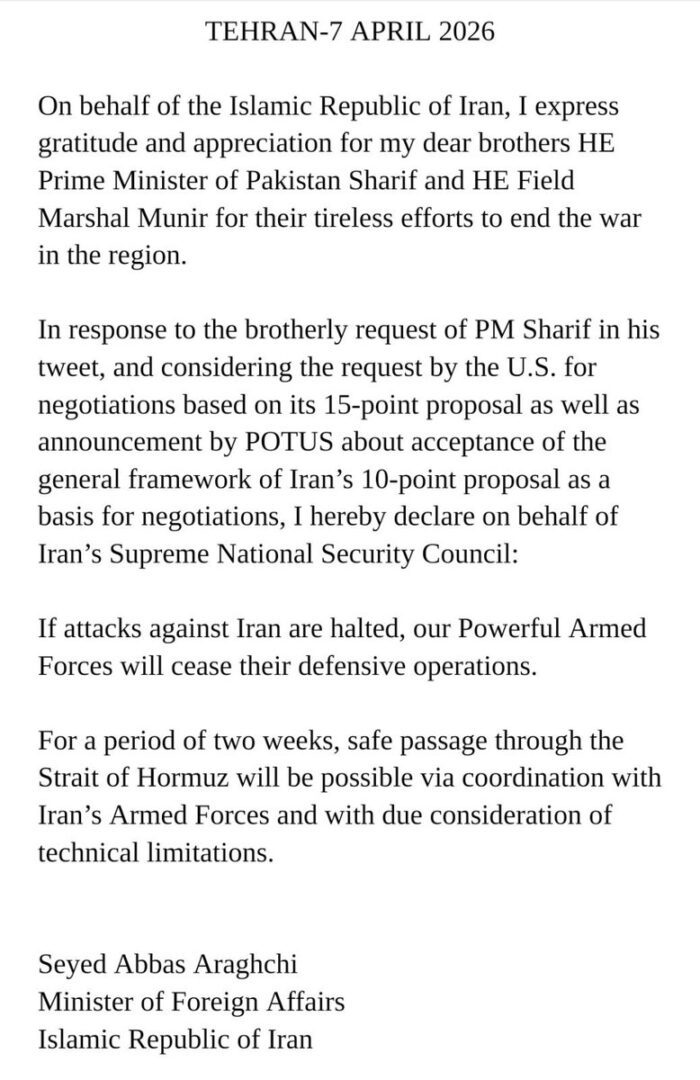
Statement returned by Iran:
Statement of negotiator, Prime Minister of Islamic Republic of Pakistan:
The statement acknowledges Pakistani involvement in advancing negotiations and signals tentative alignment with a broader diplomatic framework. While some reports point to Chinese pressure behind the scenes, the ceasefire itself was largely driven by Pakistan’s mediation—and centers narrowly on reopening the Strait of Hormuz, not a broader agreement on Iran’s nuclear program or long-term conflict.
Iran further indicated that, for a period of two weeks, safe passage through the Strait of Hormuz would be permitted—coordinated through its armed forces and subject to “technical limitations.”
For now, the ceasefire is about access through the Strait—not a broader peace agreement.
In a moment like this, the same decision is being called both strength and weakness—depending on who’s watching.
___
Voices of Reaction: A Divide at Home
“He’s crazy,” one younger observer said, reacting to the rapidly unfolding ceasefire announcement.
But others see it differently: “The people he’s dealing with are far beyond crazy. The strength in this moment may be for them to think he is, too.”
The exchange reflects a broader divide—where some Americans view the moment through the lens of tone and temperament, while others see calculated signaling aimed not at the public, but at foreign leadership.
It’s a divide playing out across the country—between those focused on tone and those focused on strategy.
Even as questions swirl at home, the reality is far more sobering. This isn’t about us.
The Pentagon has announced a press briefing TODAY at 8am with US Defense Secretary Pete Hegseth and Joint Chiefs of Staff Chairman Dan Caine.
This is a developing story.