
Subscribe!

Outdoors in RI: Aquatic Weeds – Invasive Pests – Whip-poor-wills – Dogapalooza – Twilight on the Blackstone
Novel discoveries about Eastern Whip-poor-will nesting and chick growth – from URI
Known for their haunting, distinctive singing—a repetitive “whip-poor-will” call that echoes through summer nights—Eastern Whip-poor-wills have long inspired folklore, often seen as omens or symbols of mystery. Their elusive, nocturnal nature and expert camouflage make them far easier to hear than to see. Liam Corcoran ’18 M.S. ’25, a recent graduate of the University of Rhode Island’s interdisciplinary Biological and Environmental Sciences (BES) master’s program from Warwick, Rhode Island, is working to demystify this bird through science.
Wild populations have declined precipitously since 1970. Because of their nocturnal activity and cryptic nature, very few researchers have focused on whip-poor-wills’ nesting habits. New research from Corcoran published in The Wilson Journal of Ornithology offers the first published growth data for whip-poor-wills, contributing critical baseline information for future ecological and conservation research.
Extensive video documentation captured and analyzed by Corcoran shows how males and females interact at the nest, regularly conducting a coordinated courtship-like display, and how adult birds engage in active nest defense from potential predators. While there have been past anecdotal reports of female whip-poor-wills potentially singing, Corcoran’s research provides the first video confirmation that females do indeed sing.
-
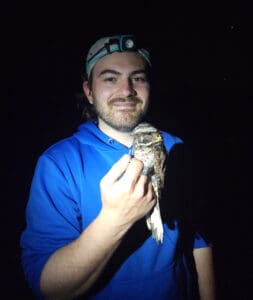
- Liam Corcoran ’18 ’25 is contributing crucial new insights into the breeding biology of the Eastern Whip-poor-will. Corcoran has designed the first tool for estimating chick age, hoping to demystify the elusive, and vulnerable, bird. (Photos courtesy Liam Corcoran)
-
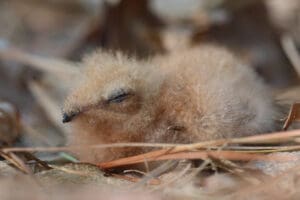
- Because of their nocturnal activity and cryptic nature, few researchers have focused on whip-poor-wills’ nesting habits. (L. Corcoran)
-
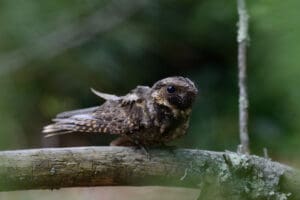
- Known for their distinctive singing, Eastern Whip-poor-wills’ nocturnal nature and expert camouflage make them easier to hear than to see. (Megan Gray)
Prior to Corcoran’s work, no one had focused on chick growth. Thanks to his efforts, scientists now have a way to estimate chick age based on both measurements and plumage which can help identify the whole history of a nest, from nest initiation to hatching to fledging (when young birds first take flight).
“I hope this research serves as a starting point and that chick growth may be further studied throughout the whip-poor-will breeding range,” Corcoran says. “I also hope the predictive tools that came out of this research prove useful to researchers looking to estimate the age of chicks.”
For this research, Corcoran placed trail cameras at whip-poor-will nests found at three state management areas in Rhode Island–Arcadia, Great Swamp, and Tillinghast–as well as at the Nature Conservancy’s Francis Carter Preserve and the Audubon Society of Rhode Island’s Marion Eppley Wildlife Refuge. He documented unique behaviors of paired males and females, interactions with predators, and chick growth.
“Capturing not one but four female whip-poor-wills singing the male song while on nest surprised me,” Corcoran says. “I was also very surprised to see how much whip-poor-wills perceived slugs and millipedes as potential threats. By far the most fulfilling part of this research was getting to know these birds on such a personal level.”
“I’m happy I was able to capture so many interesting and unique behaviors on the trail cameras,” he adds, “like a courtship-like display that males and females regularly engage in at the nest and females singing while on nest.”
After earning an undergraduate degree in wildlife and conservation biology, Corcoran continued to work in Professor Scott McWilliams’s lab and assist in conducting fieldwork.
“While working as a field technician with the Rhode Island state herpetologist at the Division of Fish and Wildlife, an opportunity to apply for a graduate position in Professor McWilliams’ lab came about and I decided to give it a shot,” Corcoran says. In August of this year, he completed his M.S. in the Ecology and Ecosystems Science concentration of the BES program.
For this research, Corcoran worked with McWilliams and Megan Gray, also a master’s student in BES.
“I have dreamed of working with this species since I saw my first whip-poor-will,” Corcoran says, “and it was an absolute privilege to be able to see the inner workings of how whip-poor-wills behave around the nest and rear chicks.”
This story was written by Anna Gray in the College of the Environment and Life Sciences.
___
Dogapalooza Family Festival

Don’t miss the 2025 Dogapalooza Family Festival at Slater Park in Pawtuckcet on Sunday, August 3, 10 am-5 pm
Shop the amazing vendors and stay for the fabulous food trucks for the two-day event. There will be entertainment to enjoy, too. If you haven’t been, Slater Memorial Park is at 845 Armistice Blvd. in Pawtucket.
Lots of fun events being planned!
___
Aquatic Weed Treatment Scheduled for Meadowbrook Pond

The Rhode Island Department of Environmental Management (DEM) announces that Meadowbrook Pond, Richmond will receive treatment to control infestations of invasive aquatic plants on Wednesday, July 30. Anglers and boaters should avoid using the lake during the treatment. Signs will be posted with information about temporary water use restrictions. Neighbors and other users of the pond should keep pets from drinking the water for at least three days. This treatment will target invasive plants in particular, variable water milfoil, and it will not harm fish or other aquatic life. Meadowbrook Pond is popular with anglers and boaters and is stocked with trout several times per year.
To prevent the spread of invasive aquatic plants, felt-soled waders and other porous gear that absorb water is prohibited in all RI freshwater, including any waters shared with adjacent states where RI fishing regulations apply. Transporting plants on boats, vehicles, trailers, and gear is also prohibited. Boaters must clean all equipment and vehicles before and after use. For more on stopping the spread of aquatic invasives, click here.
___
Twilight on the Blackstone

The Downtown Woonsocket Collaborative is very excited to announce that our signature event, “Twilight on the Blackstone” will be back once again in 2025! Break out those dancing shoes and get ready to dine under the stars for another unforgettable experience. This event is the yearly fundraiser for DWC, a non-profit board of Main Street enthusiasts dedicated to the revitalization and promotion of the downtown area. This year’s dinner will take place Saturday August 23rd, from 6pm to 10pm with a rain date of August 24th.
This year, our menu will be from Chef Michael Heroux along with his daughter who will bring you a five course meal sure to make any foodie really happy. The appetizer course will feature a charcuterie board consisting of an artful selection of preserved meats, fine cheeses, fresh fruit, and crisp crackers. The soup course will be a Sopa de Pescado Blanco made up of hearty white fish soup with potatoes, carrots, leeks, and peppers simmered in a tomato-infused broth and seasoned with dill and lemon. The salad course will be an Aegean Quinoa Salad with crisp greens dressed with Greek vinaigrette, paired with herb-packed quinoa tabbouleh, creamy whipped feta, and tangy pickled red onions. The entree course will be Chicken Saltimbocca alla Romano with tender chicken cutlets layered with prosciutto and sage, pan seared to perfection, and finished with a savory Marsala mushroom sauce. Served with creamy Parmesan risotto, broccoli spears, and jardiniere carrots. The dessert course will be Crema Catalina which is a traditional Spanish dessert with a silky custard base, subtly flavored with citrus and cinnamon, topped with a brittle layer of caramelized sugar. A meal you simply do not want to miss out on.
“The night we wait for all year for is almost here,” notes DWC Event Chair Margaux Morisseau. “This one of a kind experience only comes around once a year to gather up your family and friends to buy a table or come meet some new friends and dine al fresco for the ultimate view of our Blackstone River and City downtown area. This is the event that you simply don’t want to miss out on” she goes on to say.
Entertainment this year will feature Kelley Lennon and her band. Kelley’s soulful voice and team of talented musicians with her will be the highlight of your summer. Ciros’ Tavern also will be on hand with a cash bar. You also do not want to miss the Bombshell Betties dressed to impress with some classic cars for great photos with your family and friends.
DWC Board Chair Garrett Mancieri says, “What I love most about this event is how it truly brings the community out to enjoy the wonderful things about our City.” Mancieri continues, “Our downtown is growing every year with adding new businesses and multi-million dollar redevelopment projects that are adding hundreds more residential units every year. The momentum is clearly in our favor as we helped to lobby the state General Assembly to create the first ever Rhode Island Main Street program this year! Come join us for a fun night downtown with dinner and dancing on a bridge that you can only find here in Woonsocket.”
Tickets are now available on our website (www.dwc02895.org). Individual tickets are $75 per person, couples $150, or a table of eight for $560. Event sponsorships are also available on the donation page of our website. DWC is a 501c3 organization and tax advantages may apply for the purchase of tickets and sponsorships. More information can also be found on the Downtown Woonsocket Collaborative Facebook page, www.facebook.com/downtown02895.
So – make your plans to attend!
___
Terry Gray, DEM Director and Chair of the Executive Climate Change Coordinating Council (EC4) Responds to EPA’s Proposed Repeal of the 2009 Foundational Climate Decision
“Since the Act on Climate became law in 2021, the EC4 has worked hard to reduce greenhouse gas emissions in Rhode Island and chart a clear path forward to meet the state’s ambitious climate targets,” said DEM Director Terry Gray. “We’ve engaged communities across the state and universally there is broad understanding that climate change is real and driven by greenhouse gases. Tuesday’s action by EPA to ignore well-established climate science and unilaterally declare that greenhouse gas emissions do not pose a danger is deeply concerning. It threatens to undermine the significant progress we’ve made but it won’t alter our goals. Our Climate Action Strategy is in development, and this fall we’ll continue statewide public engagement to solicit feedback. We will continue to collaborate with local partners and other like-minded states to fill the leadership gap at the federal level to advance climate action and strengthen Rhode Island’s resilience to the impacts of climate change. The Ocean State is already experiencing the effects of climate change in both our coastal communities and inland areas. Tuesday’s action by EPA highlights the importance of continuing our work with partners to strengthen our resilience.”
For more information on climate change in Rhode Island or the EC4 visit: https://climatechange.ri.gov/ and https://climatechange.ri.gov/ri-executive-climate-change-coordinating-council-ec4-overview
___
Invasive Species Spreading North
Invasive species are spreading fast across the U.S., presenting new threats for health, property and the environment. With no natural predators to keep them in check, these species can quickly become more than just a nuisance. Experts at the National Pest Management Association (NPMA) are tracking their spread and sharing helpful information about the species that are raising red flags this summer.
“Homeowners are usually familiar with the more common household pests such as rodents and bed bugs, but invasive species are often newer and unfamiliar,” said Dr. Jim Fredericks, Senior Vice President of Public Affairs at NPMA. “Unfortunately, a new invasive species’ threat may not be immediately apparent until they become established. Because they can spread quickly, it’s important to be aware of known risks and to take steps to manage these pests.”
These are the top invasive pests NPMA is warning the public about:
- Spotted Lanternflies were first found in the U.S. in 2014 and pose a significant concern to the agriculture industry. Typically found in Northeastern states, the best way to prevent their spread is to scrape away egg masses off property and squish any adults.
- Asian Longhorned ticks are found in the Southeast and Northeast states. Known for their unique ability to reproduce without a mate, this tick feeds on livestock as well as humans, and is a vector of several diseases. Keep grass cut low, use repellent with at least 20 percent DEET, and wear long sleeves and pants when spending time outdoors to prevent any bites.
- Red imported fire ants (RIFAs) and Asian needle ants are two invasive ant species known for their painful stings. Both species were first detected in the 1930’s and have a wide population spread, stretching across several states and regions in the U.S. If these ants are discovered on your property, don’t attempt to control them on your own.
For more information on invasive species or to contact a licensed pest control professional, visit www.PestWorld.org.
The NPMA, a non-profit organization with more than 4,000 members, was established in 1933 to support the pest management industry’s commitment to the protection of public health, food and property from the diseases and dangers of pests. For more information, visit PestWorld.org or follow @PestWorld on Facebook, X, TikTok and YouTube and@PestWorldOfficial on Instagram.